Split equity based on real contributions.
Equity Matrix tracks every hour and dollar your team puts in, then calculates each person's ownership automatically. The split updates as contributions change — so it's always fair, always current, and ready when investors ask.

 Rated 5/5 on G2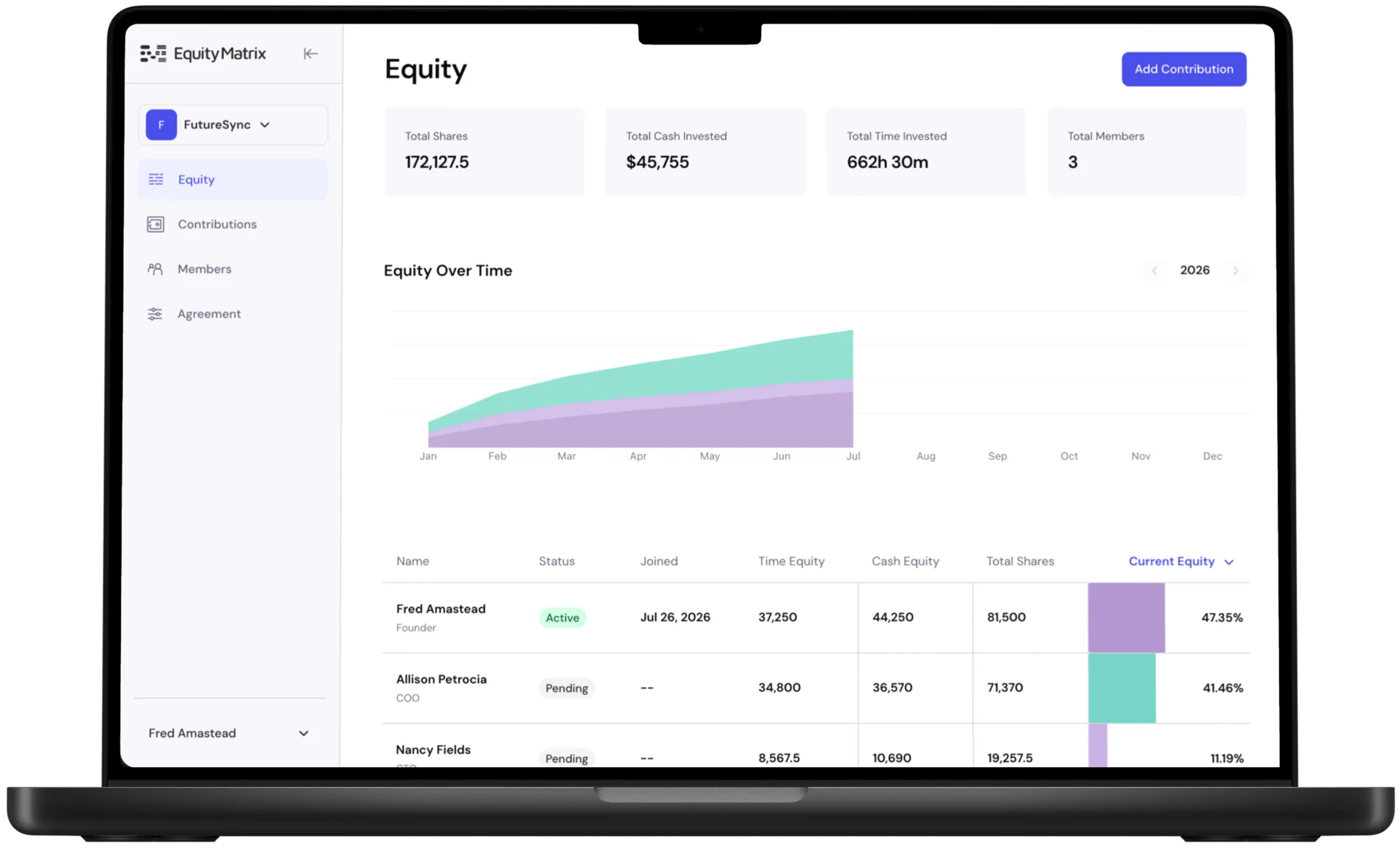

50/50 is the most common equity split, and it rarely stays fair. People contribute differently over time. Circumstances change. Equity should reflect that.
About 65% of high-potential startup failures trace to people problems, with co-founder conflict the largest category.
The #1 cause? Equity splits that feel fair on day one but fall apart as contributions diverge. Without a system to track who's actually contributing what, startups end up with:
- × Dead equity — departed founders holding ownership they didn't earn
- × Resentment — one person doing 80% of the work with 50% of the equity
- × Investor red flags — messy cap tables that kill deals or force expensive cleanup
Equity Matrix fixes this by tracking contributions in real time and letting the math determine fair ownership.


A startup team with unequal equity splits is three times more likely to experience serious conflict."Noam Wasserman, Harvard Business Review

Build together. Own together.
Equity Matrix replaces guesswork with a simple three-step process. Each co-founder logs what they put in, the system calculates what they've earned, and ownership stays aligned as the company evolves.
Track contributions.
Each co-founder logs hours worked and cash invested as they happen. Set market rates for each person's time so the system knows how to value different types of contributions.
Log directly in the app or through Slack. Everything is timestamped and transparent to the whole team.
120 hours
@ $75/hr
9,000 shares
$15,000
@ 2x multiplier
30,000 shares
Convert to shares.
Hours are multiplied by each person's market rate. Cash contributions are weighted with configurable multipliers. The system converts everything into shares automatically, so equity percentages always reflect real input.
Try the Equity Calculator →Stay aligned.
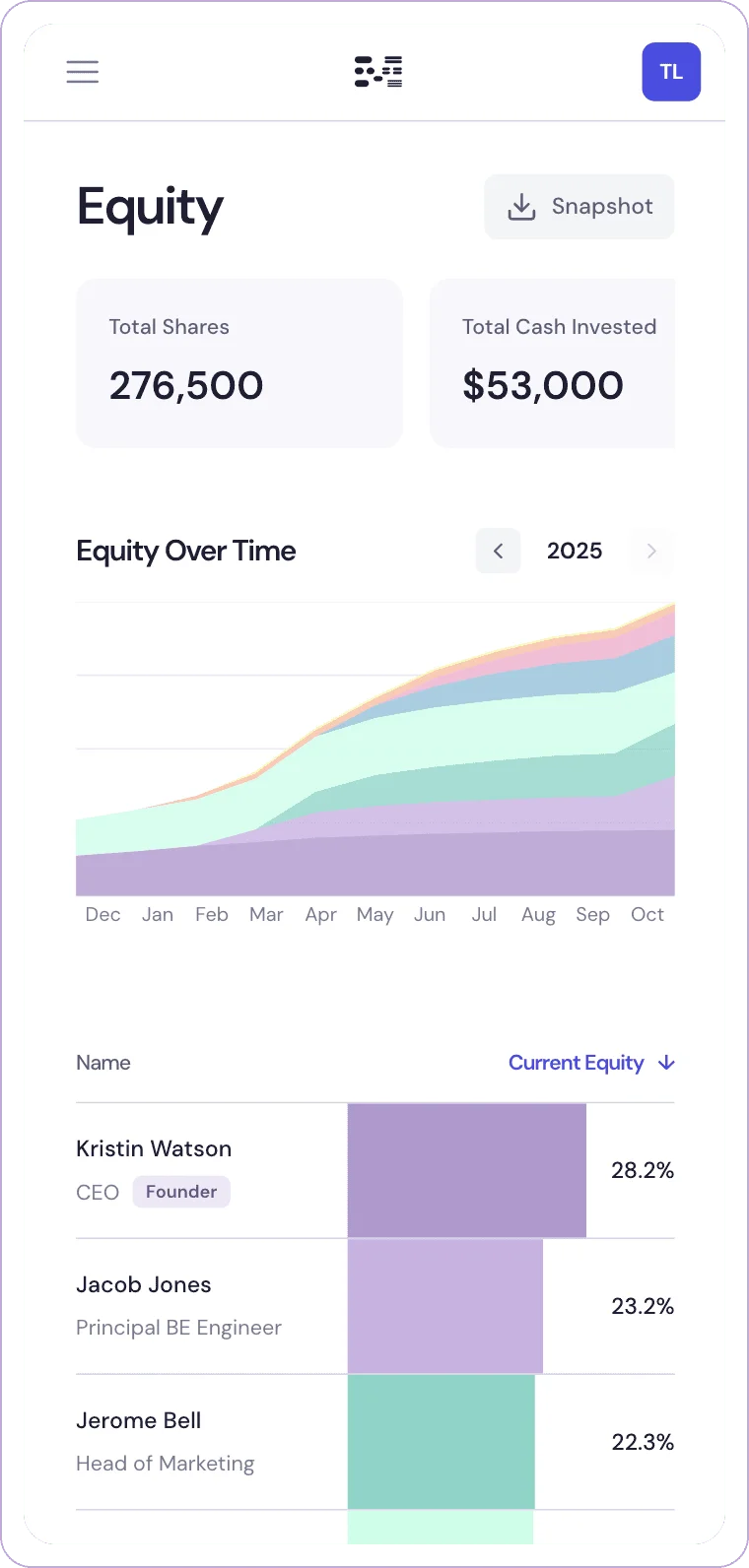
As contributions accumulate, the equity table updates in real time. Everyone can see exactly where they stand. When roles shift, someone ramps up, or a co-founder steps back, ownership adjusts naturally.
When you're ready to raise or formalize, your contribution history is the basis for a traditional cap table.
Start Your Free TrialKristin Watson
CEO
Jacob Jones
Engineer
Jerome Bell
Marketing
Samantha Maxwell
CTO
What founders are saying.
"We almost didn't start the company because we couldn't agree on the split. Equity Matrix gave us a framework we both trusted."
Marcus R.
San Francisco, CA
"Three founders, three different life situations. Now when someone puts in a 60-hour week, everyone can see it reflected."
Jamie L.
Seattle, WA
"Brought on a technical co-founder 8 months in. She could see exactly what her contributions would mean over time."
Sarah K.
Boston, MA
"Finally, a way to handle equity that doesn't require a lawyer every time something changes. Game changer for early stage."
David M.
Denver, CO
"My co-founder and I were stuck on the equity conversation for months. This tool got us unstuck in one afternoon."
Rachel T.
Los Angeles, CA
"We use this with every new team member. It sets expectations from day one and removes the awkwardness of equity talks."
Alex P.
Austin, TX
"The transparency is everything. No more wondering if the split is fair. The numbers speak for themselves."
Nina S.
Portland, OR
"Investors loved that we had a clear, documented equity structure. Made due diligence so much smoother."
Chris W.
Chicago, IL
"As a bootstrapped founder, I needed something simple. This is exactly that. No complexity, just fair splits."
Emma J.
Miami, FL
"Wish we had this two years ago. Would have saved us a lot of difficult conversations and one lost friendship."
Michael B.
New York, NY
Co-founder conflict is often a bigger threat than product failure."Paul Graham, Co-founder of Y Combinator

Equal is not always fair.
Start your dynamic equity matrix now.
Start for Free14-day free trial. No credit card required.