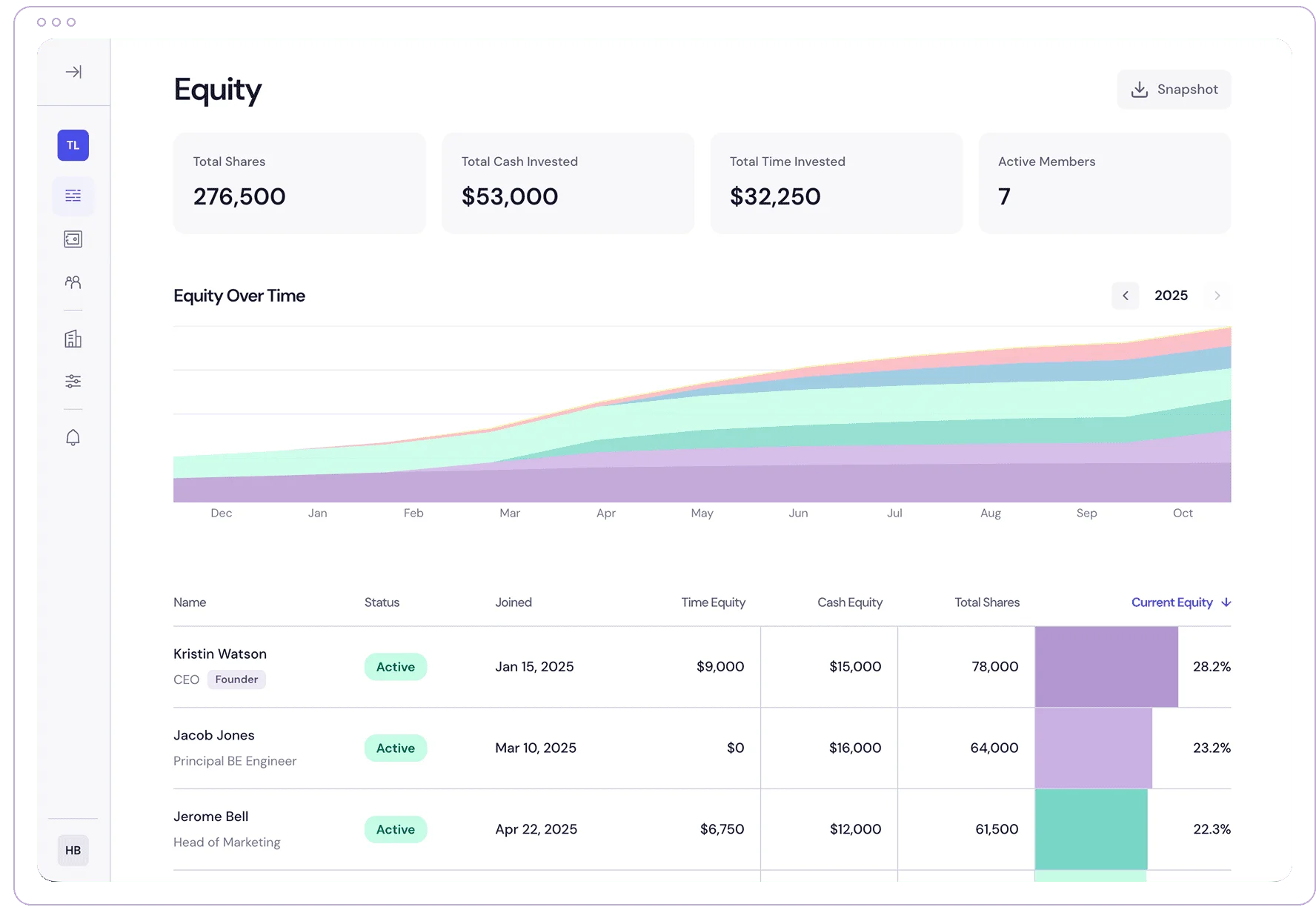
We spend a lot of time talking about co-founder equity splits that failed. But what about the ones that worked?
Google, Microsoft, Oracle, Apple, LinkedIn, Instagram — these companies had wildly different equity structures among their founding teams. Some were equal. Most weren’t. All of them survived the co-founder phase and built massive companies.
The question isn’t which split is “correct.” It’s what made these particular splits survivable. Because the patterns are surprisingly consistent, even when the numbers aren’t.
Google: the rare equal split that worked
Larry Page and Sergey Brin split Google’s equity 50/50. They’re the example every founder with an equal split points to as proof it can work.
And it did work. But the circumstances were unusual.
What made it survive:
Page and Brin met as PhD students at Stanford. They collaborated as academic equals for years before starting a company. Their skills were genuinely complementary and genuinely balanced — both were deeply technical, both contributed core intellectual property to PageRank, and neither could claim the idea was “theirs” alone.
More importantly, they built governance mechanisms from the start. When Google went public in 2004, Page and Brin created a dual-class share structure inspired by Warren Buffett’s Berkshire Hathaway. Class B shares carried 10 votes each versus 1 vote for Class A shares. This gave them joint voting control even as their economic ownership diluted below 12%.
They also brought in Eric Schmidt as CEO in 2001, creating a three-person leadership structure that gave them a tiebreaker for strategic decisions.
Google's Equity Structure
| Element | Detail |
|---|---|
| Initial split | 50/50 |
| Structure | Dual-class shares (10:1 voting ratio) |
| Governance | External CEO as tiebreaker (Schmidt) |
| Pre-existing relationship | Years of collaboration at Stanford |
| Outcome | Both stayed, company succeeded |
The Google example proves that equal splits can work. But it also shows the extraordinary conditions required: perfectly matched co-founders, shared intellectual property, and governance structures that most startups never build.
The lesson: Google’s equal split worked not because it was equal, but because Page and Brin had genuinely equal contributions, a pre-existing relationship, and the foresight to build governance that prevented deadlock.
What would your equity split look like?
Model your team's contributions and see how ownership adjusts based on who puts in what.
Try the calculator →Microsoft: unequal from the start
Bill Gates and Paul Allen didn’t start at 50/50. They started at 60/40, with Gates taking the larger share because he’d done more of the coding work on their first product (a BASIC interpreter for the Altair 8800).
Shortly after their first major sale, Gates proposed adjusting to 64/36. Allen accepted, later reflecting that “Bill knew that I would balk at a two-to-one split, and that 64 percent was as far as he could go.”
What made it survive (for a while):
The split reflected a real conversation about contributions. Gates was working more hours and had written more of the early code. Allen brought strategic vision and technical depth, but his involvement was different. The split acknowledged that difference rather than papering over it.
What eventually went wrong:
The partnership didn’t fully survive. Allen left Microsoft in 1983 after a health scare and growing tension with Gates. In his memoir, Allen claimed that Gates tried to dilute his stake and went behind his back to offer Steve Ballmer a larger equity package than they’d agreed on.
Allen retained his shares and became one of the wealthiest people in the world. But the co-founder relationship fractured, in part because the equity structure reflected early contributions without accounting for how the relationship would evolve.
The lesson: An unequal split based on honest assessment of contributions is a strong starting point. But equity alone doesn’t prevent co-founder conflict. The structure needs to include ongoing governance, not just an initial division.
Oracle: the 60/20/20 split
Larry Ellison, Bob Miner, and Ed Oates founded Oracle with a 60/20/20 split. Ellison took the dominant share as the company’s CEO and originator of the business strategy. Miner and Oates, who built the core database technology, each took 20%.
What’s interesting: the co-founders agreed that Miner and Oates could earn a larger share if they hit certain milestones. The equity had a dynamic element built in from day one.
What made it survive:
Clear roles. Ellison ran the business. Miner and Oates built the product. There was minimal overlap in decision-making domains. Nobody was competing to be CEO.
The milestone-based adjustment also helped. It acknowledged that contributions might shift over time and created a mechanism for equity to reflect those shifts.
The lesson: Unequal splits with clear role delineation work well when each founder has a distinct domain. The milestone-based adjustment was ahead of its time — it’s essentially a primitive version of dynamic equity.
Apple: unequal, with a buyout
Apple’s original split was 45/45/10 — Steve Jobs and Steve Wozniak each held 45%, with Ron Wayne holding 10%.
Wayne famously sold his 10% stake back to Jobs and Wozniak for $800 just 12 days after the company was founded. That stake would eventually be worth billions. It’s the most expensive exit in tech history.
Between Jobs and Wozniak, equity was technically equal at 45/45. But the power dynamic was never equal. Jobs drove the business vision, marketing, and fundraising. Wozniak built the products. Over time, Jobs accumulated more control through additional shares and board influence.
What made it work:
Complementary skills with zero overlap. Wozniak never wanted to be CEO. Jobs never wanted to build circuit boards. Their domains were so distinct that the equal ownership didn’t create governance conflicts — each person was clearly in charge of their area.
What complicated it:
Jobs was eventually forced out of Apple in 1985, partly due to board-level power dynamics that had shifted over the years. He returned in 1997 and rebuilt the company. The co-founder relationship endured personally, even as the corporate structure evolved dramatically.
What Made These Splits Work
| Company | Split | Key Success Factor |
|---|---|---|
| 50/50 | Dual-class governance, external CEO, genuinely equal contributions | |
| Microsoft | 64/36 | Honest assessment of early contributions |
| Oracle | 60/20/20 | Clear role separation, milestone-based adjustments |
| Apple | 45/45/10 | Zero overlap in domains, natural CEO designation |
| ~55/45 (est.) | Reid Hoffman as clear strategic lead | |
| ~60/40 (est.) | Kevin Systrom as clear product vision holder |
LinkedIn: the strategic lead model
Reid Hoffman co-founded LinkedIn with Allen Blue, Konstantin Guericke, Eric Ly, and Jean-Luc Vaillant. Hoffman held the dominant equity position, reflecting his role as the strategic and financial lead.
Hoffman had an extensive network from his time at PayPal, provided early capital, and drove the company’s business strategy. The other co-founders brought technical and operational skills.
What made it work:
There was never ambiguity about who was leading. Hoffman’s larger stake reflected his larger role, and the other founders accepted this because it was grounded in reality. Hoffman also had a reputation for being generous and fair, which kept the team cohesive.
The lesson: When one founder is clearly the strategic and financial driver, an unequal split that reflects this reality creates less friction than a forced equal split that pretends everyone contributes the same way.
Instagram: dominant founder, clear vision
Kevin Systrom founded what became Instagram and brought on Mike Krieger as a co-founder and technical lead. Systrom held the larger equity stake, reportedly around 40% compared to Krieger’s 10%, with the remainder distributed to early investors and employees.
What made it work:
Systrom was the product visionary. Krieger was the technical executor. Their roles never overlapped. When Facebook acquired Instagram for $1 billion in 2012, both founders were aligned on the decision — there was no deadlock because the governance structure was clear.
The lesson: A significant split can work when the equity difference reflects a genuine difference in risk, investment, and decision-making authority. Krieger’s 10% of Instagram was worth $100 million at acquisition. A smaller slice of a larger pie is often better than a larger slice of nothing.
The patterns across successful splits
Looking at these companies together, the successful equity structures share common traits:
1. Contributions were honestly assessed
Whether the split was 50/50 (Google) or 60/20/20 (Oracle), the founders had real conversations about who was contributing what. Nobody defaulted to equal because they wanted to avoid an awkward discussion.
2. Roles were clearly defined
In every case, each founder owned a distinct domain. Jobs did business, Wozniak did engineering. Ellison ran sales, Miner built the database. Page and Brin were an unusual case of overlapping technical roles, but even they eventually separated into CEO and President with distinct responsibilities.
When co-founders compete for the same role — especially CEO — conflict is inevitable. Elad Gil argues that having a dominant co-founder who serves as the clear decision-maker produces better outcomes than equal power sharing, regardless of equity percentages.
3. Governance existed beyond the split
Google had dual-class shares and an external CEO. Microsoft had clear domain separation. Oracle had milestone-based adjustments. None of these companies relied on the equity split alone to govern decision-making.
An equity split is not a governance structure. It’s a starting point. The companies that survived built actual governance mechanisms on top of the split.
4. Vesting and protections were in place
Every company on this list eventually implemented protections against dead equity: vesting schedules, buyout provisions, or contractual obligations around ongoing commitment. The ones that did this early had smoother co-founder relationships than those that added protections after problems emerged.
What founders can learn from these examples
If contributions are genuinely equal: Google-style 50/50 can work, but only with governance mechanisms that prevent deadlock. At minimum: vesting, a co-founder agreement, and defined decision domains.
If one founder is clearly leading: Microsoft/Oracle/LinkedIn-style unequal splits are often healthier. They acknowledge reality rather than creating a fiction of equality.
If contributions are hard to predict: Oracle’s milestone-based approach or dynamic equity lets the split evolve as contributions become clearer. This is the approach we recommend at Equity Matrix — track contributions, let the data determine the split, and freeze into a cap table when you’re ready.
The famous splits that worked have one thing in common: the founders had the conversation. They didn’t default to equal because it was easy. They assessed contributions, defined roles, built governance, and structured equity to reflect reality.
Use the equity calculator to run the numbers for your founding team. The right split isn’t always obvious, but the conversation is always necessary.
When founders shared equity generously
The examples above are all about co-founder splits — how founding teams divided equity among themselves. But some of the most striking equity stories aren’t about the founding team at all. They’re about founders who chose to share equity with employees, line workers, and even contractors.
These aren’t fairy tales. They’re real companies with real numbers. And they show that equity doesn’t have to stop at the cap table.
Employee equity that created millionaires
| Company | What they did | Outcome |
|---|---|---|
| Chobani | Gave 10% to all 2,000 employees | Some received $1M+ each |
| Broadcast.com | Shared sale proceeds with staff | 300 of 330 employees became millionaires |
| Dave’s Hot Chicken | Structured deal to benefit team | 19+ employees became millionaires |
| Starbucks | Stock options for all, including part-timers | 400x+ returns for early participants |
| WinCo Foods | Employee-owned since 1985 | 400+ front-line workers are millionaires |
| Options for everyone, even contractors | 1,000+ millionaires at IPO |
Chobani: the yogurt company that made everyone rich
Hamdi Ulukaya, a Turkish-Kurdish immigrant, founded Chobani in 2005 after buying a shuttered Kraft yogurt factory in upstate New York. Within five years, the company was doing over $1 billion in annual sales.
On April 26, 2016, Ulukaya made a surprise announcement: he was giving 10% of Chobani’s shares to all 2,000+ full-time employees. The shares came directly from his own stake, not from a dilutive pool. Employees received packets detailing their ownership based on tenure — those who had been with the company longest received the most.
For some long-time employees, stakes were estimated to be worth over $1 million. At the company’s later $20 billion valuation, those stakes became worth even more.
“I’ve built something I never thought would be such a success, but I cannot think of Chobani being built without all these people.” — Hamdi Ulukaya
The lesson: Equity generosity doesn’t require an impending sale. Ulukaya acted proactively, years before any liquidity event, because he believed the people who built the company deserved to own part of it.
Broadcast.com: Mark Cuban’s 91% millionaire rate
In 1995, Mark Cuban invested in and took operational control of AudioNet, an audio streaming platform that became Broadcast.com. When Yahoo acquired it for $5.7 billion in stock in 1999, Cuban made sure his employees benefited.
300 of the company’s 330 employees became millionaires. That’s 91% of the workforce.
This wasn’t a one-time thing. When Cuban sold MicroSolutions for $6 million in 1990, he gave about 20% to his 80 employees. When he later sold the Dallas Mavericks, he paid out more than $35 million in employee bonuses.
“It’s the right thing to do. No company is built alone.” — Mark Cuban
Cuban has been vocal about his philosophy: share equity immediately and meaningfully. “You will get more from your employees, and they will be more committed if you share equity immediately in a meaningful way, so that everybody rises up.”
The lesson: Cuban’s pattern was consistent across multiple companies and decades. Generous equity sharing wasn’t a gesture — it was a system.
Dave’s Hot Chicken: a $900 startup that created 19 millionaires
In 2017, four childhood friends scraped together $900 to set up a small hot chicken shop in a California parking lot. Seven years later, when Roark Capital acquired a majority stake at a $1 billion valuation, CEO Bill Phelps deliberately structured the deal to create wealth for employees — negotiating transaction bonuses and ensuring everyone from brand leaders down to restaurant-level managers participated.
Within weeks of closing, 19+ employees became millionaires. Every support center employee received bonuses averaging $100,000. Store managers received bonuses equivalent to roughly one year’s salary. Some got three to five years’ worth in a single payout.
“I had some investors who were like, ‘you’re giving away too much money, this isn’t right.’ They were absolutely right as investors to stand up for other investors. They have a fiduciary duty, but I have a duty to the people that created this business.” — Bill Phelps
The lesson: Even in industries where equity for employees is uncommon — like fast food — intentional deal structuring can create transformational wealth for the people who built the company.
Starbucks: stock options for baristas
Howard Schultz grew up in public housing in Brooklyn. When Starbucks first turned a profit in 1990, he decided to do something unprecedented.
In 1991, Schultz introduced Bean Stock, making Starbucks the first privately owned U.S. company to offer stock options to all eligible employees — including part-timers working 20+ hours per week. He stopped calling employees “employees” and started calling them “partners.”
Initial grants had a strike price of $6 per share. After multiple stock splits, early participants saw returns of over 400x. One employee who started in 1992 saw a 13,000% return — enough to pay off student loans and buy a home.
“If there is one accomplishment I am proudest of at Starbucks, it’s the relationship of trust and confidence we’ve built with the people who work at the company.” — Howard Schultz
The lesson: Including part-timers and hourly workers isn’t naive generosity — it’s alignment. When every person in the building has a stake in the outcome, the culture shifts.
WinCo Foods: grocery clerks worth millions
WinCo Foods started as a privately owned grocery chain in 1967. In 1985, employees established an Employee Stock Ownership Plan (ESOP) and bought a controlling stake. Today, WinCo contributes 20% of an eligible employee’s compensation in stock annually — entirely company-funded, with no employee contributions required. After six years, the stock is fully vested.
Of 11,000 front-line employees in the ESOP, over 400 have accounts worth more than $1 million. Stock values have averaged 18% compound annual increases since 1986. At one Corvallis store, 130 employees have combined savings of roughly $100 million.
One employee named Cathy accumulated over $1 million working on the shop floor from ages 19 to 42. Despite being able to retire, she planned to keep working for another decade.
The lesson: The ESOP model proves that employee ownership doesn’t require a startup. Any company — including a regional grocery chain — can build an equity-sharing structure into its foundation.
Google: the massage therapist who retired a millionaire
In 1999, Google was a tiny startup with about 40 employees. They needed a massage therapist. Bonnie Brown, a recently divorced massage therapist living with her sister, answered the ad “on a lark.” When negotiating her contract, she made an unusual request for a part-time subcontractor: she asked for stock options.
The recruiter agreed. She worked for $45/hour, 10 hours a week, while receiving equity.
Brown worked at Google for five years and retired a multi-millionaire — estimated at around $5 million. Google’s 2004 IPO turned over 1,000 early employees into millionaires.
“Toward the middle of 2003, it started to look pretty promising. But I’m an optimist and I hoped for the moon right from the start.” — Bonnie Brown
The lesson: Google’s equity generosity extended even to non-traditional workers. That culture of broad ownership is part of why the company attracted and retained exceptional talent in its earliest years.
Jobs create income. Equity creates wealth.
The pattern: what these companies did differently
These stories span yogurt factories, tech startups, fast food chains, and grocery stores. Different industries, different decades, different founders. But they share consistent traits.
Founders from modest backgrounds shared more generously. Schultz grew up in housing projects. Cuban started with nothing. Ulukaya arrived as an immigrant. They remembered what it felt like to have nothing.
Equity was proactive, not reactive. These weren’t last-minute gestures after a sale was announced. They were deliberate philosophies built into company culture before a liquidity event locked anything in.
Part-timers and non-executives were included. Starbucks gave options to baristas. WinCo included grocery clerks. Google gave options to their massage therapist. The wealth wasn’t reserved for the C-suite.
The wealth was transformational. These weren’t token gestures. People paid off student loans. Bought homes. Retired early. The same pattern holds at the very top of the wealth scale — virtually every name on the list of the greatest philanthropists in history built their fortune through equity ownership before giving it away.
Zero-sum thinking was rejected. These founders proved that sharing wealth doesn’t diminish success — it often amplifies it.
True economic equity includes ownership
How to build an equity-sharing culture
You don’t have to wait for a billion-dollar exit to share equity fairly.
Start with dynamic equity. Track contributions from day one. Let ownership reflect what people actually put in. When it’s time to freeze your split, the numbers speak for themselves.
Include more people than feels comfortable. Every founder in these stories was told they were giving away too much. They did it anyway. The loyalty and commitment they got in return was worth far more than the equity they shared. This stands in contrast to companies that created dead equity by giving shares to people who stopped contributing.
Think about the long game. A smaller slice of a much bigger pie is better than hoarding a large slice of something that never grows. The founders who share generously tend to build companies that grow faster — because everyone’s incentives are aligned.
Put it in writing. Fair intentions mean nothing without clear agreements. Document your equity structure. Add vesting. Make sure everyone understands what they own and how it works.
Frequently asked questions
Did any billion-dollar company start with a true 50/50 co-founder split?
Google is the most prominent example. Larry Page and Sergey Brin split equity equally and maintained that balance through IPO and beyond. But their situation was unusual: years of pre-existing collaboration, genuinely shared intellectual property, and governance structures (dual-class shares, external CEO) that most startups don’t implement. Most billion-dollar companies, including Microsoft, Oracle, Facebook, and Amazon, had clearly dominant founders from early on.
Does an unequal split hurt co-founder morale?
Not when it reflects reality. Research from Harvard’s Noam Wasserman shows that resentment builds when equity doesn’t match contributions, not when splits are unequal. A 60/40 split where both founders feel their ownership reflects their input creates less friction than a 50/50 split where one person feels they’re doing more. The key is having the honest conversation, not finding a specific ratio.
What’s the most common equity split among successful startups?
There’s no single answer, but Carta data shows that unequal splits are still the majority among funded startups, even as equal splits are trending upward. Among the most successful tech companies, unequal splits with a dominant co-founder are the norm. Elad Gil’s analysis of the top tech companies over 50 years found that nearly all had a clearly dominant founder for most of the company’s life.
Should I model my equity split after a famous company?
No. Every founding team is different. Google’s 50/50 worked because of Page and Brin’s specific circumstances. Microsoft’s 64/36 worked because of Gates and Allen’s specific contributions. Copying a famous split without understanding why it worked for that team is the same mistake as defaulting to 50/50 without thinking about it. Base your split on your actual contributions and circumstances, not on someone else’s story.
How do employee stock ownership plans (ESOPs) work?
ESOPs are retirement plans where the company contributes stock to employees’ accounts. Unlike stock options, employees don’t have to buy anything. After a vesting period — typically 3-6 years — employees own the shares outright. WinCo Foods is the most prominent example: the company contributes 20% of each eligible employee’s compensation in stock annually, entirely company-funded. It’s a model that has turned hundreds of grocery clerks into millionaires.
Do generous equity programs actually work, or do they hurt the company?
Yes, they work. Companies like Starbucks, WinCo, and Southwest Airlines have consistently outperformed competitors while sharing more equity with employees. The alignment of incentives creates loyalty and commitment that’s hard to replicate with salary alone. Every founder in the examples above was told they were giving away too much — and every one of them built a company worth far more than if they’d kept it all.
Can small startups afford to share equity generously?
Yes. Dynamic equity models let you share ownership based on contributions without spending cash. Early employees who take below-market salaries in exchange for equity are essentially providing sweat equity. Dave’s Hot Chicken started with $900 and created 19 millionaires. The key is structuring it fairly from the beginning and documenting it clearly — not waiting until a deal is on the table.
Ready to split equity fairly?
Equity Matrix tracks contributions and calculates ownership automatically.
Get Started FreeThis article is for informational purposes only and does not constitute legal, tax, or financial advice. Equity Matrix is not a law firm, accounting firm, or financial advisor. Consult a qualified professional for guidance specific to your situation.
Co-founder, Equity Matrix
Sebastian writes about startup equity, founder dynamics, and building fair partnerships.
Keep reading
When a co-founder leaves: outcomes from 150+ cases
We studied 150+ real co-founder departures. 28% ended in litigation, only 35% were clean exits, and vesting was the single biggest predictor of outcome.
Read more →Famous co-founder equity disputes: what went wrong
Eduardo Saverin lost Facebook. Reggie Brown sued Snapchat for $157M. Noah Glass got erased from Twitter. The equity mistakes that cost co-founders billions.
Read more →