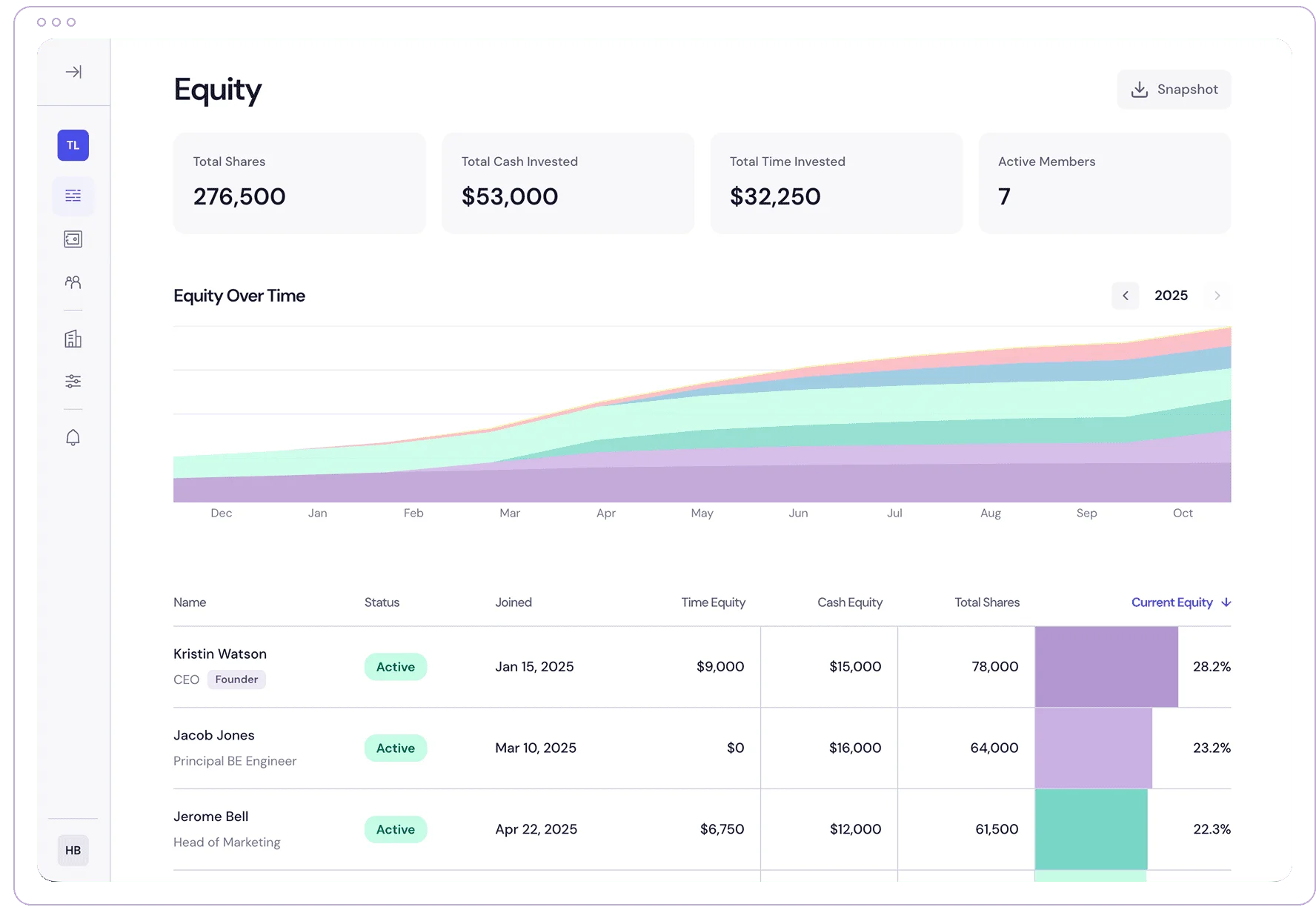
Slicing Pie is a dynamic equity model that divides startup ownership based on actual contributions rather than arbitrary day-one guesses. Created by entrepreneur and professor Mike Moyer, the framework tracks time, money, ideas, relationships, and other inputs to calculate each person’s fair share of a “grunt fund” as the company grows.
The core insight is simple: nobody knows on day one who will contribute what over the next few years. So instead of guessing and locking in percentages, you track what actually happens.
This guide covers everything you need to know about Slicing Pie: how the model works, when to use it, how to calculate slices, and how to avoid the common implementation pitfalls that trip up even the most well-intentioned founding teams.
What Is Slicing Pie?
At its heart, Slicing Pie is a formula. Each person’s equity percentage equals their slices divided by total slices.
Your equity = Your slices / Total slices
Slices represent the fair market value of what you’ve contributed to the company. If you contribute more, you earn more slices. Your ownership percentage adjusts automatically as contributions change.
The model was developed by Mike Moyer, a serial entrepreneur and professor at Northwestern, Booth, and other business schools. He published the framework in his 2012 book “Slicing Pie: Funding Your Company Without Funds” and has refined it through subsequent editions.
Moyer’s insight came from watching too many startups blow up over equity disputes. The root cause was almost always the same: founders made permanent decisions based on temporary information.
Slicing Pie eliminates the guesswork. Instead of negotiating percentages when you know the least about the business, you let reality determine ownership over time.
The “Grunt Fund” Concept
Moyer calls the pool of unpaid contributions the grunt fund. It represents all the value team members have contributed without fair compensation.
When someone works for free or below market rate, the difference between what they should earn and what they actually earn becomes their contribution to the grunt fund. Same for cash investments, equipment, intellectual property, and other inputs.
The grunt fund isn’t actual money sitting somewhere. It’s an accounting of uncompensated value. Each contribution earns slices based on its fair market value.
As the company grows and can afford to pay people properly, the grunt fund naturally stops growing. Contributions shift from unpaid labor to normal employment. At some point, most teams freeze their split and convert to a traditional cap table.
How to Value Sweat Equity Contributions
Model a Slicing Pie split with your own numbers.
Adjust cash, hours, and rates to see how contributions translate to ownership.
Try the calculator →How the Slicing Pie Model Works
Slicing Pie tracks five types of contributions.
Time Contributions
The biggest category for most startups. Time starts with each person’s GHRR (Grunt Hourly Resource Rate): fair-market annual salary divided by 2,000. The GHRR is not pre-multiplied; the standard 2x time multiplier is applied after multiplying GHRR by unpaid hours.
A developer who could earn $150,000 in the job market has a $75 GHRR ($150,000 divided by 2,000). If they work 20 unpaid hours this week, they earn 20 x $75 x 2 = $3,000 worth of slices.
The key word is “fair market.” Not what they were paid at their last job. Not what they think they’re worth. What someone with their skills could reasonably command in the current market.
Cash Contributions
At-risk cash invested in the company earns slices at the standard 4x multiplier.
The multiplier reflects the risk of investing in an early-stage startup. If you put $10,000 into a bank account, you’ll get it back with interest. If you put $10,000 into a startup, you might lose everything. The multiplier compensates for that risk.
Example: A founder invests $25,000. At the standard 4x multiplier, they earn $100,000 worth of slices.
Supplies and Equipment
Items contributed to the company (a laptop, software licenses, lab equipment) earn slices at their fair market value. Used items are valued at what they could reasonably sell for, not what was paid for them originally.
Ideas and Intellectual Property
If someone brings in a patent, a prototype, or foundational intellectual property, it can earn slices. This gets subjective, which is why Moyer recommends valuing ideas based on what they would cost to develop from scratch.
Relationships and Sales
Introductions that lead to customers, investors, or key hires can earn slices. The valuation depends on the outcome. An introduction to a customer who signs a $100,000 contract might earn slices based on a percentage of that value (often 5-10%).
The Slice Calculation Formula
The math is straightforward once you understand the inputs, and you can plug your own figures into the Slicing Pie calculator to see the split without doing it by hand.
Basic Formula
Slices = Fair Market Value of Contribution x Multiplier
For time: Slices = Hours worked x Hourly rate x Multiplier For cash: Slices = Amount invested x Cash multiplier For assets: Slices = Fair market value x Asset multiplier
Multiplier Guidelines
| Contribution Type | Standard Multiplier | Notes |
|---|---|---|
| Time (no salary) | 2x | Work done without any pay |
| Time (below-market salary) | 2x on the unpaid portion | Difference between market rate and actual pay |
| Time (full market salary) | 0x | They’re being compensated fairly |
| Cash (at risk) | 4x | Standard cash multiplier |
| Unreimbursed expenses (non-recoverable) | 2x | Out-of-pocket business costs |
| Equipment/supplies | 1x | Fair market value of items contributed |
| Intellectual property | 1x to 2x | Based on development cost |
| Sales commissions | Varies | Typically 5-10% of deal value |
Worked Example
Let’s say you have three co-founders building a SaaS product.
Founder A (Technical):
- Works 40 hours/week at a market rate of $80/hour
- No cash contribution
- Weekly slices: 40 x $80 x 2 = $6,400
Founder B (Business):
- Works 30 hours/week at a market rate of $60/hour
- Invested $30,000 cash (4x multiplier)
- Weekly slices from time: 30 x $60 x 2 = $3,600
- Slices from cash: $30,000 x 4 = $120,000 (one-time)
Founder C (Part-time Advisor):
- Works 5 hours/week at a market rate of $150/hour
- No cash contribution
- Weekly slices: 5 x $150 x 2 = $1,500
After the first month (4 weeks):
| Founder | Time Slices | Cash Slices | Total Slices | Ownership |
|---|---|---|---|---|
| A | $25,600 | $0 | $25,600 | 15.4% |
| B | $14,400 | $120,000 | $134,400 | 81.0% |
| C | $6,000 | $0 | $6,000 | 3.6% |
| Total | $166,000 | 100.0% |
Each percentage is the contributor’s slices divided by the current total. There is no percentage reserved for future contributions; new slices dilute every existing percentage as they are added.
After six months, if everyone keeps contributing at the same rate but Founder B’s cash contribution stays flat:
How Ownership Shifts Over 6 Months
Month 1
Month 6
Full-time work catches up to cash investment over time.
Notice how the split shifted over time. Founder A’s consistent full-time work gradually caught up to Founder B’s cash investment. This is exactly the point. The model reflects reality as it unfolds.
Use our equity calculator to model scenarios like this for your own team.
When to Use Slicing Pie
Slicing Pie works best in specific situations. It’s not right for every startup.
Pre-Funding Stage
Before you raise outside capital, contributions are inherently uncertain. One founder might be full-time while another is nights-and-weekends. Roles shift. Plans change. Slicing Pie handles this uncertainty gracefully.
Once you raise a priced round, investors will require a fixed cap table. But that doesn’t mean you can’t use dynamic equity to get there fairly.
Uncertain Contributions
If you’re not sure who will do what over the next 6-12 months, a fixed split is a guess. Slicing Pie removes the guessing.
Classic scenario: Two friends start a company. One can go full-time immediately. The other has a job they can’t leave yet but plans to join full-time “soon.” How do you split equity?
With a fixed split, you’re betting on the future. With Slicing Pie, you track what actually happens. If “soon” becomes six months, the split reflects that.
Bootstrapped Companies
If you’re not planning to raise money, you might never need to convert to a fixed cap table. Some bootstrapped companies run Slicing Pie for years, distributing profits based on dynamic ownership percentages.
Capital-Intensive Startups
Slicing Pie handles cash contributions through its multiplier system, which makes it particularly well-suited for AI startups where compute costs can dwarf founder salaries. When one founder is funding GPU clusters and another is writing the model architecture, tracking both inputs on the same framework prevents the equity disputes that are common in AI founding teams.
Sweat Equity Arrangements
When people are contributing work instead of (or in addition to) cash, tracking that work fairly becomes critical. Slicing Pie provides a framework for valuing sweat equity systematically.
When NOT to Use Slicing Pie
The model isn’t ideal when:
-
You’re raising immediately. Investors need fixed caps. If you’re closing a round in 30 days, you don’t have time to track contributions dynamically.
-
Contributions are fixed and predictable. If everyone is full-time, equally committed, with similar market rates, a simple equal split might work fine.
-
Your team isn’t disciplined about tracking. Slicing Pie requires logging contributions regularly. If no one will do it, the system breaks down.
-
You’re running an SMB partnership, not a startup. The Slicing Pie language (co-founders, option pools, grunt fund) doesn’t map well to an LLC where one partner invests cash and the other runs the business. The underlying math applies, but you’ll need a framework designed for that context. See sweat equity in small businesses, or compare the Slicing Pie alternatives built for that use case.
Slicing Pie vs. Fixed Equity Splits
The core difference is when decisions get made.
| Factor | Slicing Pie (Dynamic) | Fixed Equity Split |
|---|---|---|
| When ownership is decided | Ongoing, based on contributions | Day one or soon after founding |
| Based on | Actual work, cash, and resources contributed | Predictions about future contributions |
| Flexibility | Adjusts automatically | Requires renegotiation to change |
| Dead equity risk | Lower (ownership reflects contribution) | Higher (departed founders keep unvested stakes) |
| Investor compatibility | Must convert before raising | Ready for investment immediately |
| Administrative burden | Requires regular tracking | Set once and done |
| Best for | Pre-revenue, uncertain stages | Post-funding, defined roles |
Neither approach is inherently better. The right choice depends on your situation.
If you’re in the early, messy phase where nobody knows what the company will become, Slicing Pie prevents the problems that plague 50/50 splits and other arbitrary allocations.
If you’re post-funding with defined roles and stable commitments, fixed equity with proper vesting is simpler and what investors expect.
Many teams do both: start dynamic, then freeze when the time is right.
Pros and Cons of Slicing Pie
Like any framework, Slicing Pie has tradeoffs. Here’s an honest assessment. For a deeper look at where the model falls short, see the problems the book doesn’t tell you about.
Advantages
Fair by definition. Ownership mathematically reflects contribution. There’s no arguing about whether the split is “fair” because the formula determines it objectively.
Eliminates day-one guesswork. You don’t have to predict the future. Research shows that 42% of founding teams decide on equity within a single day. Slicing Pie lets you delay that decision until you have real data.
Reduces dead equity. If someone stops contributing, their percentage naturally decreases as others keep earning slices. This is different from fixed equity where dead equity can cripple a company.
Handles changing circumstances. Part-time to full-time transitions, cash injections, role changes, all handled automatically by the formula.
Transparent and defensible. When disputes arise, you have data. The spreadsheet shows what everyone contributed. This transparency prevents the festering resentment that kills partnerships. It also keeps an auditable record, but the record alone does not make the arrangement enforceable; consult a startup attorney familiar with dynamic equity to formalize it.
Disadvantages
No cliff protection. This is the big one. In a standard fixed equity arrangement, vesting includes a one-year cliff. If someone leaves before the cliff, they get nothing.
Pure Slicing Pie has no cliff. Someone who works for two months earns slices for those two months, even if they leave immediately after. This can create dead equity in a different way.
EquityMatrix solves this by combining dynamic equity tracking with loyalty protections like cliffs and vesting. You get fair contribution-based allocation without the risk of short-term contributors walking away with meaningful stakes.
Tracking requires discipline. You need to log contributions regularly. Weekly is ideal, monthly at minimum. If people stop tracking, the data becomes unreliable and disputes multiply.
Can create anxiety. Some team members find dynamic ownership stressful. There’s always a question of “who’s contributing more this week?” For teams with trust issues, this can amplify tension rather than reduce it.
Some contributions are hard to value. What’s an introduction worth? How do you value the original idea? Moyer provides guidelines, but some judgment calls remain subjective.
Requires conversion for investment. VCs need fixed cap tables. You’ll have to freeze your split before raising, which can be a difficult transition if founders disagree about the final numbers.
No standard legal structure. Slicing Pie is a framework for tracking, not a legal entity. You still need proper formation documents, operating agreements, and (often) lawyer involvement to make it enforceable. EquityMatrix solves this by generating the legal documents you need automatically.
Step-by-Step Implementation Guide
Ready to implement Slicing Pie? Here’s how to do it right.
Step 1: Establish Fair Market Rates
Before tracking anything, agree on hourly rates for each team member.
Research comparable salaries for each person’s role and experience level. Glassdoor, levels.fyi, and similar resources help establish market rates.
Be honest. The rate should reflect what this person could actually command in the job market, not what they wish they were worth.
Document the rates. Put them in writing. Everyone should sign off.
| Team Member | Role | Market Salary | Hourly Rate |
|---|---|---|---|
| Alice | Full-stack Developer | $160,000 | $80/hr |
| Bob | Product/Business | $120,000 | $60/hr |
| Carol | Designer | $100,000 | $50/hr |
Step 2: Agree on Multipliers
Decide which multipliers you’ll use for different contribution types.
Standard multipliers:
- Unpaid work: 2x
- Below-market pay: 2x on the unpaid portion
- Cash: 4x
- Non-recoverable unreimbursed expenses: 2x
- Equipment/supplies: 1x
- IP: 1x to 2x depending on development cost
Put these in writing too. Everyone should agree before contributions start.
Step 3: Set Up Tracking
You need a system to record contributions. Options range from simple to sophisticated. Before committing to any tracking system, it helps to see the math in action — our Slicing Pie calculator guide walks through how market rates, multipliers, and contribution types affect the final split, with a worked three-person example you can follow along with.
Spreadsheet approach: Create a shared Google Sheet with columns for date, contributor, contribution type, hours/amount, and calculated slices. Everyone updates it weekly.
Dedicated software: Tools like EquityMatrix automate the calculations, provide reporting, and generate legal documents. The tracking becomes part of a complete equity management system.
Whatever you use, establish a rhythm. Weekly updates keep the data accurate and prevent memory-based disputes about “who did what.”
Step 4: Review Regularly
Monthly or quarterly, sit down as a team and review the numbers.
Check accuracy. Does everyone agree the tracking reflects reality?
Surface issues. If someone feels undervalued, now is the time to discuss it.
Adjust rates if needed. As roles evolve, market rates might change. Agree on updates.
These reviews prevent small disagreements from becoming big ones. They also build trust through transparency.
Step 5: Plan the Freeze
At some point, most teams convert dynamic equity to a fixed split. Common triggers include:
- Raising outside investment
- The business becoming self-sustaining with proper salaries
- An agreed event that requires conversion to fixed ownership
Decide in advance what will trigger your freeze. Put it in your operating agreement. Breakeven or self-sufficiency is the normal endpoint; institutional funding or another event that requires a fixed cap table can also trigger conversion. Revenue alone and a contributor’s departure do not automatically freeze the pie. When the trigger happens, you freeze the percentages and add vesting for ongoing commitment.
Why LLCs Work Better for Dynamic Equity
Common Mistakes to Avoid
Mistake 1: Skipping the Cliff
Pure Slicing Pie doesn’t include a cliff, and that’s a problem.
Someone who works for 60 days and then leaves still owns slices representing those 60 days. For most startups, that’s not ideal. A contributor who leaves before you know if they’re truly committed shouldn’t walk away with equity.
The fix: Use a modified system that includes a cliff period (typically 6-12 months). During the cliff, contributions are tracked but don’t vest into permanent ownership until the cliff is reached. EquityMatrix builds this in automatically.
Mistake 2: Not Tracking Consistently
Slicing Pie only works if everyone actually logs their contributions. In practice, this is where most implementations fail.
People get busy. They forget to update the spreadsheet. Weeks go by. Suddenly you’re trying to reconstruct three months of work from memory, and everyone remembers differently.
The fix: Make tracking frictionless. Use software that sends reminders. Build it into your weekly routine. If someone consistently fails to track, address it immediately.
Mistake 3: Valuing Ideas Too Highly
Founders sometimes want to allocate massive slices for the “original idea.” This almost always causes problems.
Ideas are cheap. Execution is expensive. Giving 30% of slices to someone because they “had the idea” undervalues the years of work required to build something real.
The fix: Value ideas based on what they would cost to develop from scratch. A back-of-napkin concept is worth almost nothing. A working prototype with proven technology might be worth significant slices.
Mistake 4: Ignoring Departing Contributors
What happens when someone leaves? They hold slices, not the percentage shown on their departure date. Their percentage keeps diluting as active contributors add slices, and the agreement’s good-reason or bad-reason departure rules determine how many slices are retained or recovered.
The fix: Build recovery mechanisms into your agreement. Options include:
- Buyback rights at fair market value
- Adjustment formulas that reduce departed members’ stakes over time
- Cliff and vesting structures that require minimum commitment
Mistake 5: No Legal Structure
Slicing Pie is a tracking framework, not a legal entity. You still need:
- A properly formed LLC or corporation
- An operating agreement or shareholder agreement
- Clear documentation of ownership rights
- (Often) lawyer review
Running Slicing Pie without proper legal structure is like tracking bank transactions without an actual bank account. The numbers are meaningless if they’re not legally enforceable.
When to Freeze or Bake the Pie
Moyer uses the term “baking” to describe the moment when the pie is done and ownership becomes fixed. Same concept as freezing your split.
Signs It’s Time to Freeze
You’re raising capital. Investors require a fixed cap table. Plan to freeze at least 2-4 weeks before closing to allow for legal documentation.
Everyone is on full salary. If the company is paying market rates, the grunt fund stops growing naturally. Contributions shift from uncompensated risk-taking to normal employment.
The business is self-sufficient. At breakeven, with market salaries replacing at-risk contributions, the dynamic pie has reached its normal endpoint.
An agreed conversion event is approaching. Institutional funding or another event that requires a fixed cap table can trigger the freeze. Revenue alone does not.
How to Freeze
-
Run the final calculation. Everyone reviews and agrees on the numbers.
-
Document the agreement. A simple founder agreement states the final percentages and that dynamic tracking is ending.
-
Add vesting. Even though equity was earned through contributions, future vesting protects everyone. Credit time already served toward the vesting schedule.
-
Set up a proper cap table. Transfer the frozen percentages into formal equity instruments.
Read our full guide on when and how to freeze your dynamic split.
How EquityMatrix Builds on Slicing Pie
Slicing Pie is brilliant in concept. The challenge is implementation.
Mike Moyer created a framework. What most teams need is a system.
The Implementation Gap
Tracking chaos. Spreadsheets work until they don’t. Formulas break. Version control becomes a nightmare. Someone accidentally deletes three months of data.
No cliff protection. Pure Slicing Pie means short-term contributors walk away with equity. That’s fine in theory but painful in practice.
Legal ambiguity. The framework tells you how to calculate slices. It doesn’t give you the operating agreements, equity instruments, and legal documentation to make it enforceable.
Conversion complexity. When it’s time to raise money, converting a spreadsheet into a cap table that lawyers and investors will accept is harder than it sounds.
What EquityMatrix Adds
EquityMatrix is built on the Slicing Pie philosophy of fair, contribution-based equity. But it addresses the implementation challenges.
Automated tracking. Contributions are logged in software that handles the calculations, maintains history, and eliminates spreadsheet errors.
Loyalty protections built in. Cliffs and vesting are part of the system. You get dynamic, contribution-based allocation without the dead equity risk that comes from contributors leaving early.
Legal document generation. Operating agreements, contribution logs, and conversion documents are generated automatically, reviewed by legal experts.
Seamless conversion. When it’s time to freeze your split and become investor-ready, the transition is built into the workflow.
Slicing Pie gives you the theory. EquityMatrix gives you the execution.
We’re grateful for Mike Moyer’s work in popularizing dynamic equity and giving founders a better alternative to arbitrary splits. EquityMatrix is our attempt to make that alternative practical and scalable.
Learn more about how it works or try our equity calculator to model scenarios for your team.
Frequently Asked Questions
What is Slicing Pie in simple terms?
Slicing Pie is a system for dividing startup equity based on actual contributions rather than guesses. Each contribution (time, money, equipment, etc.) earns “slices” based on its fair market value. Your ownership percentage equals your slices divided by total slices. As you contribute more, you own more. The model was created by Mike Moyer and is detailed in his book of the same name.
When should you stop using Slicing Pie?
Most teams freeze their Slicing Pie split when the business becomes self-sustaining with market salaries (the “grunt fund” stops growing), or when institutional funding or another agreed event requires a fixed cap table. Revenue alone does not trigger a freeze. Some bootstrapped companies run dynamic equity indefinitely until self-sufficiency.
Does Slicing Pie work for funded startups?
Not directly. Investors require a fixed cap table before closing a round. However, many startups use Slicing Pie during the pre-funding phase to track contributions fairly, then freeze their split when raising capital. The resulting fixed percentages are data-backed rather than arbitrary, which is actually a stronger story for investors.
What are the main problems with Slicing Pie?
The framework doesn’t include cliff or vesting protections, so short-term contributors can walk away with equity. It requires consistent tracking discipline that many teams struggle to maintain. Some contributions (ideas, relationships) are subjectively valued. And there’s no built-in legal structure. EquityMatrix addresses these gaps by combining Slicing Pie’s contribution-based philosophy with loyalty protections, automated tracking, and legal document generation. If you want to compare tools before committing, see Slicing Pie alternatives for a breakdown of every major option.
Ready to implement contribution-based equity fairly? Run your team’s contributions through the Slicing Pie calculator to see what a contribution-based split looks like today, then follow our step-by-step implementation guide to get started. It’s free and needs no signup.
Before you begin, understand the common problems with Slicing Pie and the 10 mistakes that sink implementations. EquityMatrix addresses these gaps by combining Slicing Pie’s contribution-based philosophy with loyalty protections, automated tracking, and legal document generation.
Ready to split equity fairly?
Equity Matrix tracks contributions and calculates ownership automatically.
Get Started FreeThis article is for informational purposes only and does not constitute legal, tax, or financial advice. Equity Matrix is not a law firm, accounting firm, or financial advisor. Consult a qualified professional for guidance specific to your situation.

Co-founder, Equity Matrix
Sebastian writes about startup equity, founder dynamics, and building fair partnerships.
Keep reading
Rob Walling's TOC framework for splitting equity
Rob Walling's TOC framework splits equity based on Time, Opportunity Cost, and Cash. Here's how it works, how it compares to Slicing Pie, and how to use it with a calculator.
Read more →Co-founders in different countries: how to set a fair rate
When one co-founder is in the US and another is in Lithuania, do you value their time at local rates or the same rate for the same work? How to set GHRR fairly across borders.
Read more →