Calculate your Slicing Pie equity split
Use this free calculator to see how the Slicing Pie model works. Adjust cash contributions, hours worked, and hourly rates to see how ownership shifts dynamically.
Cash multiplier
For cash invested in company.
Time multiplier
For unpaid hourly contributions.
Sales multiplier
For unpaid sales commissions.
Not sure what hourly rate to use?
A person's rate (GHRR) is their fair market annual salary ÷ 2,000 hours. Look up a role to get a starting point.
Grunt fund formula
Cash × The multiplier you set for cash contributions in Pie settings. = shares
Hours × The individual hourly rate you set for each contributor. × The multiplier you set for unpaid time in Pie settings. = shares
Sales × The multiplier you set for unpaid sales commissions in Pie settings. = shares
Want to track your dynamic equity split the easy way?
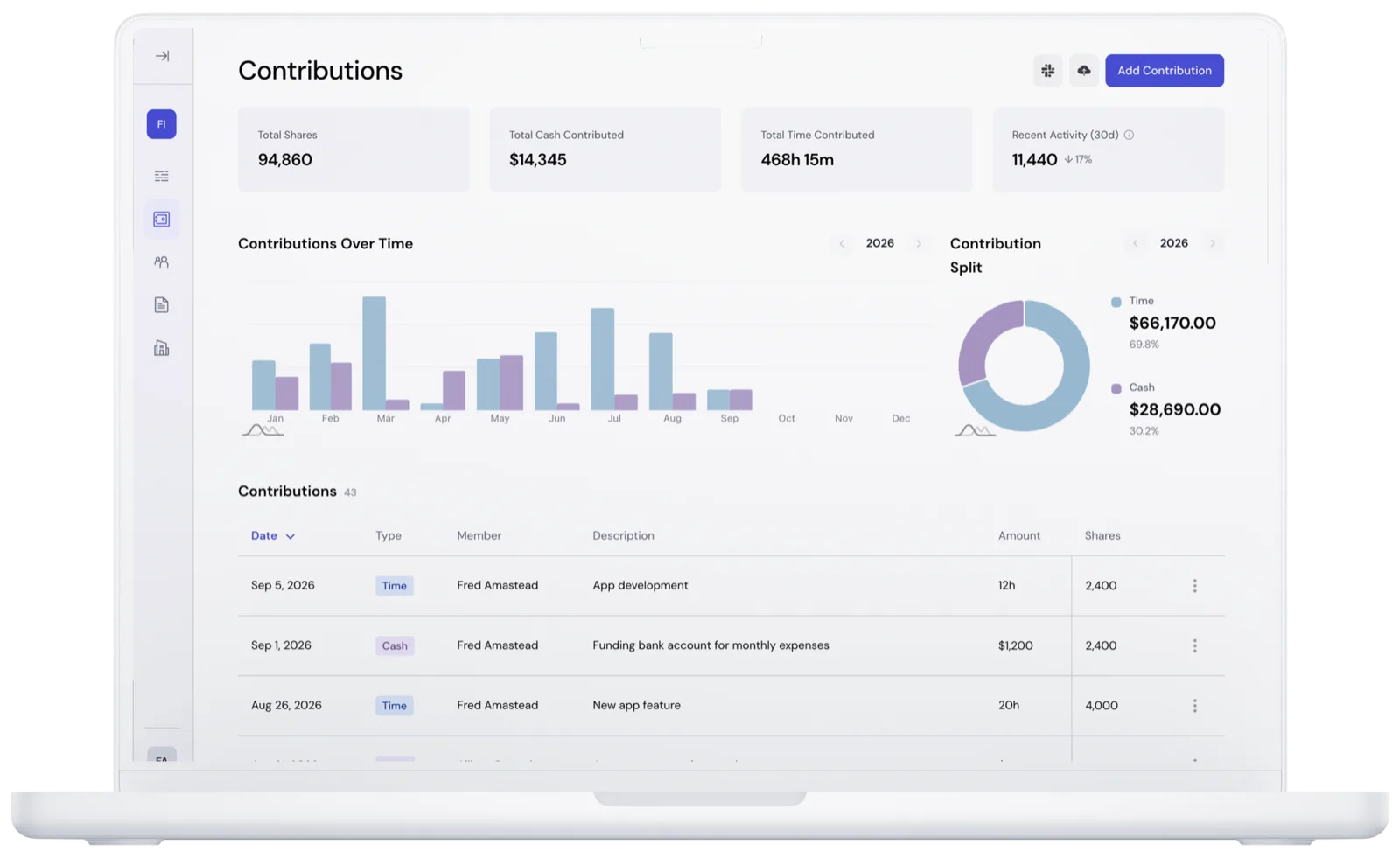
Formalize your agreement and log contributions in the app — it keeps everyone's split live and up to date automatically.

 Rated 5/5 on G2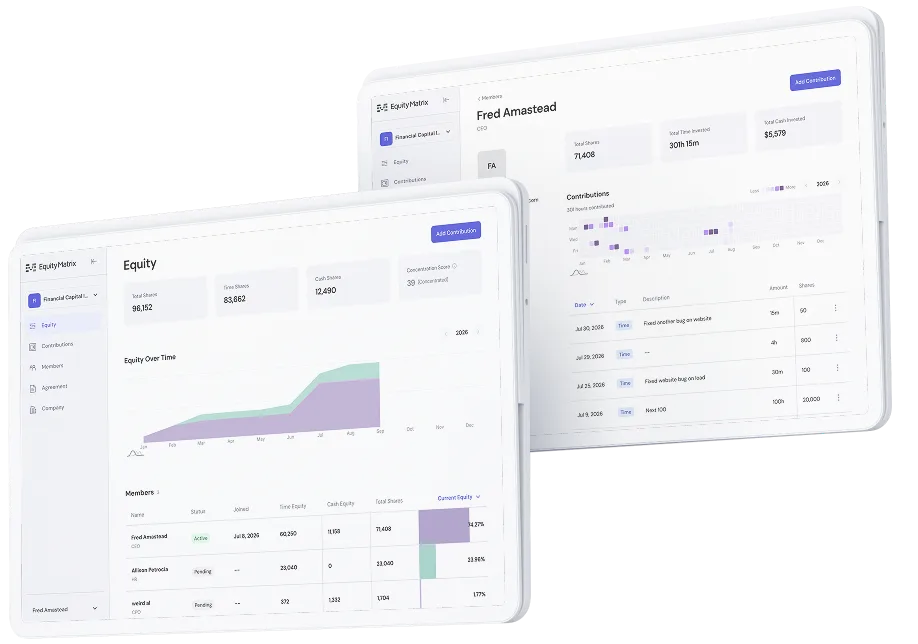
How to use this Slicing Pie calculator
This calculator implements Mike Moyer's Slicing Pie model so you can see how dynamic equity works before committing to it. Here's how to get started.
What is Slicing Pie, and how does it work?
Slicing Pie is a dynamic equityA method for splitting ownership based on real contributions over time, not guesses upfront. framework created by Mike Moyer that replaces guesswork with a formula. Instead of negotiating fixed percentages on day one, founders track their actual contributions (time, money, and sales) and ownership adjusts automatically. It works well for bootstrapped, pre-revenue startups where contribution levels are still uncertain.
The core formula
Every contribution earns "slices." Your ownership percentage equals your slices divided by total slices:
Your % = Your Slices / Total Slices × 100
What counts as a contribution?
- ✓ Time: Hours worked × GHRR (Grunt Hourly Resource Rate) × time multiplier (2× unpaid) = slices
- ✓ Cash: Money invested × cash multiplier (2× recoverable, 4× non-recoverable) = slices
- ✓ Sales commissions: Unpaid commission value × sales multiplier = slices
- ✓ Ideas & IP: Can be valued and converted to slices
- ✓ Equipment & supplies: Fair market value = slices
When to "freeze" the pie
Slicing Pie is designed for pre-revenue startups. Once you raise funding, generate significant revenue, or hit another major milestone, you "freeze" the pie and convert to a traditional cap tableThe record of who owns what in a company, including founders, investors, and employees with options..
The multipliers explained
Different contributions get different multipliers based on their risk level. Here’s how they work.
Cash (non-recoverable)
Money you put in that you won't get back if the startup fails. This is the highest-risk contribution.
Example:
$10,000 × 4 = 40,000 slices
Cash (recoverable)
Loans to the company. When repaid, these slices are removed from your total (you got your money back).
Example:
$10,000 × 2 = 20,000 slices
Time (unpaid work)
Hours worked without cash compensation. You can't recover lost time, hence the 2× multiplier.
Example:
100 hrs × $50 GHRR × 2 = 10,000 slices
Adjust the multiplier sliders in the calculator above to see how different weightings affect ownership.
Complete Guide
The Complete Guide to Slicing Pie for Startups
Learn everything about implementing Mike Moyer's Grunt Fund model: multipliers, recovery rules, freezing the pie, and common pitfalls to avoid.
How to calculate your GHRR (Grunt Hourly Resource Rate)
Your GHRR is the hourly value of your time contributions. Getting it right is critical for fair slice calculations.
The GHRR Formula
For unpaid contributors:
GHRR = Fair Market Salary ÷ 2,000
For partially paid contributors:
(Salary − Cash Paid) ÷ 2,000
2,000 hours = 40 hrs/week × 50 weeks/year
Example Calculation
Scenario: A developer with a $120,000 fair market salary works unpaid.
Fair market salary: $120,000
Divided by 2,000 hours: $60/hour
× 2 (time multiplier): 120 slices/hour
If they work 20 hours this week, they earn 2,400 slices toward their ownership.
Setting your GHRR: key rules
- ✓ Use the salary for the role you're doing, not your previous job
- ✓ Research comparable salaries at funded startups, not big tech
- ✓ Consider a $200/hour cap to prevent skewed splits
- ✗ Don't inflate your rate to grab more slices
- ✗ Don't use your corporate salary if you're wearing multiple hats
- ✗ Don't set different rates for different tasks (blend them)
Slicing Pie vs. traditional equity splits
Most startups divide equity at founding based on guesses. Here's how Slicing Pie compares to the traditional approach.
| Traditional Split | Slicing Pie | |
|---|---|---|
| When decided | Day 1, before anyone works | Ongoing, based on actual work |
| Basis for split | Negotiation, guesswork, relationships | Tracked contributions × multipliers |
| If someone leaves early | Vesting protects, but still messy | They keep slices earned (or forfeit, depending on reason) |
| If workloads change | Equity stays fixed, resentment builds | Equity adjusts automatically |
| Cash vs. time | No formal framework | Cash gets 2-4× multiplier vs. time |
| Best for | Post-funding, established teams | Pre-revenue, bootstrapped startups |
Neither approach is universally "right." Many founders use Slicing Pie early, then freeze into a cap table at funding.
When should you use Slicing Pie?
Slicing Pie works best in specific situations. Here's when it makes sense—and when it doesn't.
Good Fit
- • Bootstrapped startups without outside investment yet
- • Co-founders with different commitment levels (part-time vs. full-time)
- • Teams still figuring out roles and who does what
- • Mixed cash and sweat equity contributions
- • Early-stage uncertainty about whether it will work
Not Ideal
- • Funded startups with a priced round and cap table
- • Solo founders (no one to split with)
- • Equal, full-time co-founders who already agree on 50/50
- • Investors who require traditional equity structures
- • Teams uncomfortable with ongoing tracking
5 common Slicing Pie mistakes
Slicing Pie is elegant in theory. In practice, teams often stumble on these issues.
Not tracking contributions consistently
If you only update the spreadsheet monthly (or worse, quarterly), memories fade and disputes arise. Slicing Pie requires regular logging. This is why most teams eventually move from spreadsheets to dedicated tools.
Using the wrong GHRR (hourly rate)
Your GHRR should be your fair market hourly rate—what you'd earn at a real job. Don't inflate it to grab more slices. Don't deflate it out of false modesty. Learn how to set your GHRR properly.
Forgetting the multipliers
Cash isn't the same as time. Non-recoverable cash (money you'll never get back) earns 4× slices. Recoverable cash earns 2×. Time earns 2× because you can't recover lost time. Getting multipliers wrong throws off the whole model.
No agreement on "good reason" vs. "bad reason" leaving
In the original model, if you leave "for good reason" you keep your slices. "Bad reason" means you forfeit them. But what counts as good vs. bad? Without a written agreement upfront, this becomes a fight. Always define these terms before you need them.
Waiting too long to freeze the pie
Slicing Pie is for bootstrapped, pre-revenue phases. Once you're generating real revenue or raising a priced round, it's time to convert to a traditional cap tableThe record of who owns what in a company, including founders, investors, and employees with options.. Investors expect fixed ownership percentages.
Learn more about Slicing Pie
How to use this calculator
Step-by-step walkthrough with real examples and what the numbers mean.
Complete guide to Slicing Pie
Learn how the model works, from basic concepts to advanced implementation.
Step-by-step implementation
Practical instructions for setting up and running Slicing Pie in your startup.
Common problems to avoid
The gaps in the model and how to address them before they become issues.
Slicing Pie alternatives
Other dynamic equity models and how they compare to Slicing Pie.
Slicing Pie vs. Equity Matrix
How Equity Matrix builds on Slicing Pie's foundation with added protections.