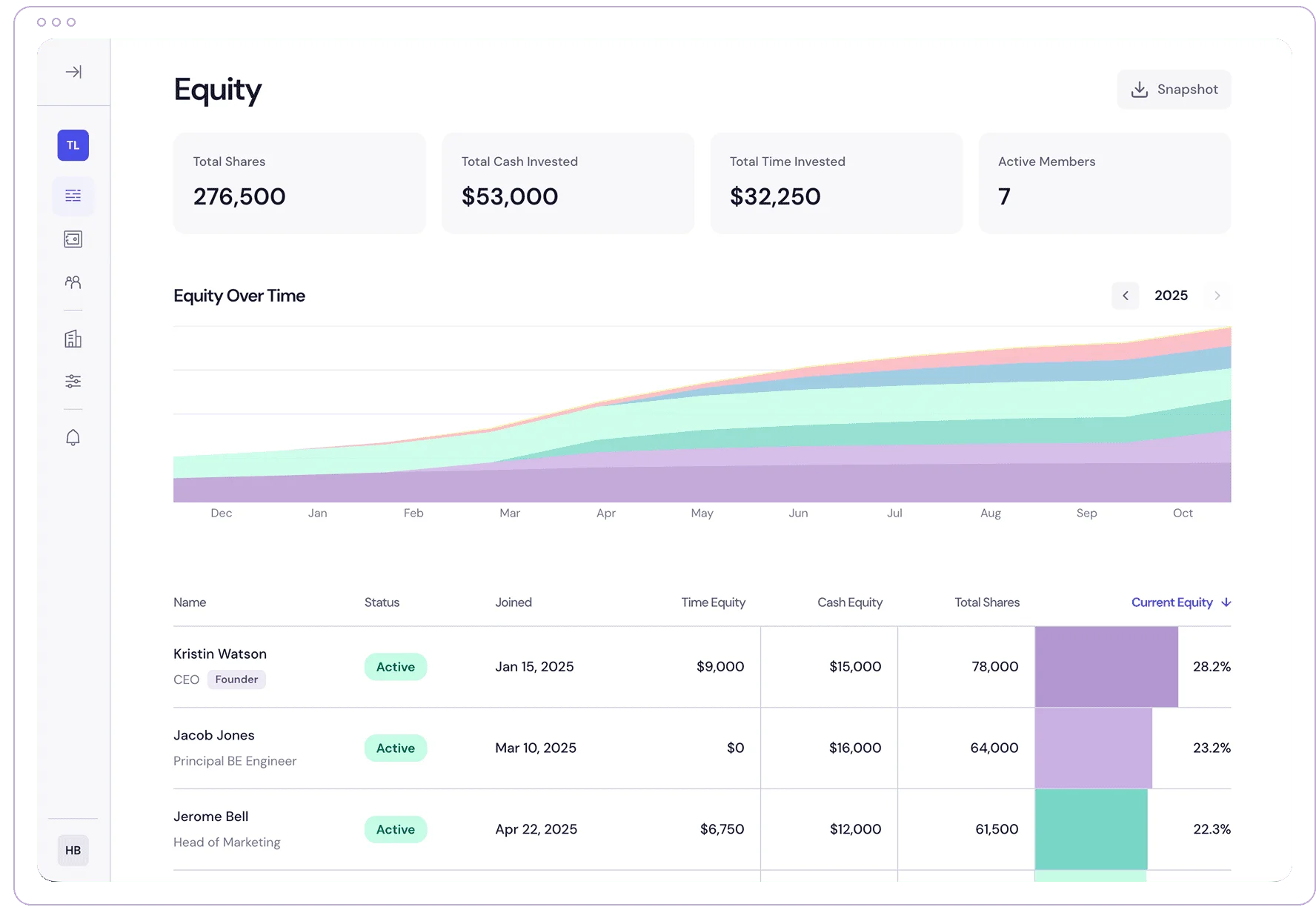
Dead equity is ownership held by someone who no longer contributes to the company — it sits on the cap table, dilutes active contributors, and is one of the most common reasons startups fail or can’t raise funding.
Most founders don’t plan for dead equity. Then it shows up anyway.
Here’s how it usually happens: A co-founder joins early. They get a meaningful stake. Three months later, they leave. Life happened. Maybe the commitment wasn’t real. Either way, they’re gone—but their equity isn’t. When a co-founder departure is happening in real time, you need a structured response — the guide on what to do when a co-founder leaves covers the first 48 hours, 30 days, and 90 days with specific actions that protect both the company and the relationship.
Now you’re building something valuable, and someone who contributed almost nothing owns a piece of it forever.
This is dead equity. And according to research from Harvard Business School professor Noam Wasserman, it’s one of the most common ways startups sabotage themselves.
What Is Dead Equity?
| Term | Definition |
|---|---|
| Dead Equity | Shares held by people who are no longer actively contributing to the company |
| Common Holders | Departed co-founders, inactive advisors, early employees who left |
| Why It’s “Dead” | The equity generates no value for the company but dilutes everyone else |
How Bad Is the Problem?
Worse than most founders realize.
Research by Noam Wasserman analyzing 733 tech startups found that the average value of dead equity tripled between 2008 and 2011—from $480,000 to over $1.5 million. About 75% of that increase came from higher percentages of dead equity, not just higher valuations.
The youngest startups saw the biggest increases. The companies least able to afford dead equity are the ones most likely to have it.
How Vesting Prevents Dead Equity
And this tracks with co-founder departure rates. According to research, a significant portion of co-founder relationships don’t survive to exit—whether due to conflict, life changes, or shifting priorities.
65% of high-potential startups fail due to people problems, including co-founder conflicts. Dead equity is often what remains after those conflicts.
How Dead Equity Happens
The Classic 50/50 Split Gone Wrong
Two first-time founders split equity equally. They put everyone on a 4-year vesting schedule with a cliff. Good so far.
At 2.5 years, one co-founder leaves. Per the vesting terms, they walk away with 22% of the cap table. That equity stays with them indefinitely while you do all the work going forward.
No Vesting Schedule
Without vesting, a co-founder who leaves after six months keeps their entire stake. This happens more often than you’d think. Research shows that 67% of founding teams make equity decisions at the outset, and 42% decide within a day or less.
Quick decisions. No vesting. Recipe for dead equity.
Overly Generous Advisor Grants
Inexperienced founders give advisors 2-5% or more for introductions or vague promises of help. When the advisor relationship fades—and it usually does—they retain significant equity.
VCs view advisor stakes above 1% as a warning sign. Multiple advisors with outsized stakes is worse. Use the advisor equity calculator to benchmark what a fair grant looks like at your stage.
Early Employees with Large Grants
Early hires receive large equity grants when the company can’t afford competitive salaries. This is essentially sweat equity—work in exchange for ownership. Fair enough. But when they leave after a year, they’ve vested into ownership that’s disproportionate to their contribution.
Real Examples
Zipcar: The 50/50 Handshake
Robin Chase and Antje Danielson founded Zipcar in 2000, splitting equity 50/50 on a handshake. No vesting schedule.
When Chase fired Danielson in January 2001, there was no mechanism to recover equity. Danielson remained a shareholder until Avis bought the company in 2013, though her stake was diluted to 1.3% through funding rounds.
The company succeeded despite the dead equity. But Chase’s own stake was diluted from over 50% to around 3% by the exit. The dead equity problem compounded over multiple funding rounds.
Zynga: The Clawback Disaster
In 2011, Zynga CEO Mark Pincus demanded that some early employees return stock options—or be fired.
The company had granted generous equity early on when cash was scarce. As the IPO approached, Pincus worried about employees with outsized stakes relative to their current contribution. His solution: force them to return unvested options or lose their jobs.
The Wall Street Journal story created massive negative publicity. The company still went public, but the reputational damage was significant.
The lesson: trying to fix dead equity after the fact is messy, expensive, and often damaging. Prevention is far easier than cure.
Why Investors Hate Dead Equity
If you’re raising money, dead equity is a major red flag. Understanding what investors look for in cap tables can help you avoid these mistakes.
Here’s what investors see when they look at your cap table:
Someone owns 15% but isn’t involved? You either can’t make hard decisions or don’t understand the value of what you’re giving away. Neither is good.
Multiple advisors with 2%+ stakes? You were desperate or naive. Both are concerns.
Departed co-founder owns 25%? That’s equity that could have been used for the new CTO you desperately need. And they might have blocking rights on major decisions.
According to Techstars, anyone owning more than 5% at the early stage who isn’t actively involved raises immediate questions. Some VCs will simply pass rather than deal with a messy cap table.
The Motivation Problem
Dead equity doesn’t just affect fundraising. It affects your team.
Remaining founders start asking: “Why should I work 80-hour weeks building value when someone who quit owns the same percentage I do?”
Every share of dead equity could have been redeployed as incentive for current or future contributors. Instead, it sits there, generating resentment.
How to Prevent Dead Equity
Use Vesting for Everyone
This is non-negotiable. Every founder, every early employee, every advisor should be on a vesting schedule.
The standard is 4 years with a 1-year cliff. If someone leaves before the cliff, they get nothing. After the cliff, they vest monthly or quarterly.
Some experts argue that 4 years is too short for founders. Consider 6-8 year schedules for founding teams to ensure long-term alignment.
Include Buyback Provisions
Your shareholder agreement should include the right to repurchase shares from departed team members at fair market value (or a discount).
This doesn’t guarantee you can afford to buy them out. But it gives you the option.
Avoid Acceleration Clauses
Acceleration lets founders vest early on acquisition or termination. This sounds founder-friendly, but it creates dead equity risk.
If a co-founder gets fired and their remaining shares accelerate, you’ve just created a large block of dead equity at the worst possible time.
Use Dynamic Equity
With dynamic equity, ownership reflects ongoing contributions. If someone stops contributing, their relative ownership naturally decreases as others continue earning equity. When the time is right, you can freeze your dynamic split into a fixed cap table.
This doesn’t eliminate dead equity entirely—past contributions still count—but it prevents the worst scenarios where someone who worked for 6 months owns as much as someone who worked for 6 years. If you suspect you already have a dead equity problem, the partnership fairness calculator can help you identify it: model what each person has actually contributed and compare that to the current ownership split to see where the gap is.
Choose Co-Founders Carefully
Noam Wasserman’s research shows that teams who choose co-founders based primarily on personal relationships have worse outcomes than those who prioritize complementary skills.
The person you enjoy grabbing drinks with may not be the right person to build a company with. And when that becomes clear 18 months in, you’ll wish you’d been more selective.
Fixing Dead Equity (When It’s Too Late)
If you already have dead equity, your options are limited but not zero.
Negotiate a Buyout
Approach the departed shareholder about selling their stake back. Offer cash, or if you’re raising, see if investors will fund a buyout as part of the round.
This requires cooperation. Some people will negotiate reasonably. Others will demand a premium or refuse entirely.
Investor-Mandated Vesting Reset
When investors encounter dead equity, they often insist on resetting founder vesting. Typically, ~25% of equity remains vested while 75% is subjected to a new 4-year vesting schedule.
This is painful for active founders. But it’s often a condition of getting funded.
Targeted Dilution
If dead equity holders refuse to cooperate, you can authorize and issue additional equity to everyone except them. This dilutes their stake over time.
This requires experienced legal counsel and may create conflicts. It’s a last resort, not a first option.
The Compounding Problem
Here’s what makes dead equity especially dangerous: it gets worse over time.
Dead equity holders don’t just keep their percentage. They keep their percentage while the company becomes more valuable. The 10% you gave someone for 6 months of work might represent $100,000 at seed stage. By Series B, it could be $10 million.
And every dollar that goes to dead equity is a dollar that doesn’t go to the people actually building the company.
The decisions you make about equity in month one will echo for the entire life of the company. Get them right.
Frequently Asked Questions
What is dead equity?
Dead equity refers to shares owned by people who are no longer actively contributing to the company—departed co-founders, inactive advisors, or former employees. The equity is “dead” because it generates no value for the company but dilutes everyone else’s ownership.
How common is dead equity in startups?
Very common. Research shows 45% of co-founder relationships end within 4 years, and about 20% of Y Combinator startups experience founder departures. Without proper vesting and agreements, each departure creates dead equity.
How do investors view dead equity on a cap table?
As a major red flag. It signals poor decision-making, inability to have hard conversations, or both. Some VCs will pass on deals with significant dead equity rather than deal with the complications.
Can dead equity be fixed?
Sometimes. Options include negotiating buybacks, diluting inactive shareholders through new issuances, or accepting investor-mandated vesting resets. But all of these are harder and more expensive than preventing the problem in the first place.
Ready to structure equity that avoids the dead equity trap? Our equity calculator helps you model vesting scenarios and track contributions from day one.
Ready to split equity fairly?
Equity Matrix tracks contributions and calculates ownership automatically.
Get Started FreeThis article is for informational purposes only and does not constitute legal, tax, or financial advice. Equity Matrix is not a law firm, accounting firm, or financial advisor. Consult a qualified professional for guidance specific to your situation.

Co-founder, Equity Matrix
Sebastian writes about startup equity, founder dynamics, and building fair partnerships.
Keep reading
Pausing equity isn't the same as ending it
Freezing your dynamic equity split doesn't have to be permanent. Here's when to pause accrual temporarily, why a fundraise or a full salary is a good trigger, and how it differs from converting to a fixed cap table.
Read more →AI is shrinking the cap table: 2026's smaller teams own more each
Startup teams are smaller than ever in 2026: median seed team of 4, more solo founders. Fewer people are splitting the equity, and the ones who join get bigger grants.
Read more →