Most people spend their careers chasing higher salaries. Bigger titles. Better benefits.
Nothing wrong with that. A good salary pays the mortgage, funds retirement, and creates stability.
But here’s what the wealthiest people figured out early: income is not the same as wealth.
Income is what you earn. Wealth is what you own.
And ownership (equity) is how real financial freedom gets built.
The Math That Changes Everything
Let me be clear upfront: most startups fail. The conventional wisdom about saving consistently, investing in index funds, and building wealth slowly is completely valid. That path works. It’s how most millionaires actually get there.
But that path only works if you’re already making good money.
A software engineer saving $20,000 a year can become a millionaire in 25 years with compound interest. A marketing coordinator making $55,000? A customer support rep making $45,000? After rent, food, and life, they’re saving $3,000 a year if they’re lucky. That math never gets them to a million.
The “just save and invest” path to wealth assumes a salary that most people don’t have. It’s not bad advice. It’s just incomplete.
And even for high earners, that path won’t close the wealth gap.
True Economic Equity Includes Ownership
Here’s why. Say you’re a software engineer making $150,000 a year. After taxes, rent, food, and life, maybe you save $20,000 a year. In ten years, you’ve saved $200,000. Add investment returns, call it $280,000. That’s meaningful. It’s a down payment on a house.
Now imagine you joined a startup in year one. You took $100,000 salary instead of $150,000. But you got 0.5% equity.
Nine out of ten times? The startup fails. Your equity is worth nothing. You gave up $50,000 a year for a lesson in probability.
But that tenth time? The company exits for $200 million. Your 0.5% is worth $1,000,000. Even after dilution cuts that to 0.3%, you’re looking at $600,000.
Saving $20,000 a year builds security. A successful equity outcome can build generational wealth. Both matter, but they’re not the same game.
This isn’t advice to skip your 401(k) or stop saving. You need a salary. You need to save toward retirement. Most startups fail, and you can’t pay rent with equity.
What we’re talking about is something different: the mechanism by which massive wealth gets created. Not comfortable wealth. Not “retire at 65” wealth. The kind of wealth that changes your family’s trajectory.
That kind of wealth almost always comes from ownership.
Why Equity Stays Concentrated
If equity is so powerful, why doesn’t everyone have it?
1. Access is limited
Most jobs don’t offer meaningful equity. Public companies give RSUs, but those are often a small percentage of total comp. The real equity upside is at startups, and most people never work at one.
2. Information is asymmetric
Sophisticated employees negotiate for equity. They understand vesting, strike prices, and dilution. Less experienced employees take whatever is offered. Or don’t ask at all.
3. Risk tolerance is a privilege
Taking equity over cash means accepting risk. If the company fails, the equity is worthless. People with financial safety nets can absorb that risk. People living paycheck to paycheck cannot.
The result is predictable: equity flows to people who already have advantages. The connected. The informed. The financially secure.
The Equity Matrix Problem
Companies have gotten serious about pay equity. They audit salaries, publish pay bands, and track compensation by demographic.
But they don’t audit equity grants.
Nobody’s asking:
- Are stock options distributed fairly across the org?
- Do early employees from underrepresented groups get comparable equity to their peers?
- Is the cap table as diverse as the workforce?
This is the blind spot in the modern equity matrix. We measure who gets hired and what they’re paid. We don’t measure who gets ownership.
And ownership is where the wealth gets built.
The Founder Equity Problem
It’s not just employees. Founders face the same dynamics.
When co-founders split equity, the defaults are often unfair:
- The person with the idea takes 60%, even if they’re not doing 60% of the work
- The technical co-founder gets less because “business guys find the money”
- Early contributors get squeezed out when “real” team members join
These splits get locked in before anyone knows what the company will become. Three years later, the person doing the most work owns the smallest piece.
We’ve seen this story end badly. Famous co-founder disputes at Facebook, Snapchat, and Twitter all involved equity disagreements. The founding team splits, the company suffers, and lawyers get rich.
The equity split you agree to on day one shapes everything that follows.
This is why contribution-based equity models matter. Instead of negotiating a fixed split upfront, you track what everyone actually contributes and let the ownership reflect reality. And ownership, compounded over decades, is what produces the kind of wealth that the greatest philanthropists in history — from Carnegie to MacKenzie Scott — have used to reshape the world.
The Transparency Solution
Equity stays unfair partly because it stays hidden.
At most companies, you have no idea what your coworkers’ equity grants look like. You don’t know if you’re getting a fair deal or getting taken advantage of.
Startups are even worse. There’s no Glassdoor for cap tables. Founders negotiate equity behind closed doors, and employees accept whatever they’re offered.
Transparency changes this.
When equity is visible:
- People can see if the split matches contribution
- Bad actors can’t hide behind opacity
- New hires can evaluate offers fairly
- The whole team is aligned on what fair looks like
This is what an equity matrix should include. Not just salary bands. Equity bands. Not just pay audits. Ownership audits.
Who Gets to Build Wealth?
Here’s the uncomfortable question: who gets access to equity opportunities?
In startups:
- Early employees who can afford below-market salaries
- Founders with enough savings to work without pay
- People with networks that lead to startup jobs
- Those who understand equity well enough to negotiate for it
In corporations:
- Senior executives with equity-heavy packages
- Employees who stay long enough to vest
- Those who joined early enough for meaningful grants
Everyone else trades time for a paycheck and misses the ownership upside.
This isn’t a conspiracy. It’s just how the system works. But it means that the wealth-creation engine (equity) systematically excludes people who are already at a disadvantage.
A Different Model
What if equity was tied to contribution?
Instead of:
- Negotiating a fixed split before anyone knows what the company will need
- Hoping your equity grant was fair compared to your peers
- Trusting that the founders allocated ownership reasonably
You had:
- Transparent tracking of what everyone contributes
- Ownership that adjusts as contribution changes
- A system where working harder actually meant owning more
This is dynamic equity. It’s not perfect, but it’s more fair than the alternatives.
It means the person who builds the product owns a meaningful piece, whether they had savings to work for cheap or negotiated well or not.
The Wealth-Building Opportunity
If you’re early in your career, here’s the blunt advice:
Find ways to own things.
This could mean:
- Joining a startup and negotiating hard for equity
- Starting a side project that becomes a real business
- Investing in assets that appreciate
- Co-founding something with people you trust
Salaries are important. They pay the bills. But they won’t make you wealthy on their own.
The people who build real financial freedom figure out early that ownership is the game.
Jobs create income. Equity creates wealth. Choose accordingly.
Frequently Asked Questions
Why is equity more powerful than salary for building wealth?
Salary is linear. You trade hours for dollars. Equity is exponential. A small ownership stake in a successful company can be worth more than a lifetime of paychecks. Additionally, equity gains are often taxed at lower rates than income. The math simply works differently.
How much equity should I ask for when joining a startup?
It depends on stage, role, and risk. Early employees (first 10) might expect 0.5-2%. Later hires get less as the company de-risks. The key is understanding what percentage of the company you’re getting, not just the number of shares. See employee equity benchmarks for typical ranges by role and company stage, then use our equity calculator to model specific scenarios.
Why don’t more companies share equity with employees?
Complexity, dilution concerns, and tradition. Many founders don’t understand equity well enough to structure it fairly. Others worry about giving away too much. And legacy business models simply never included worker ownership. This is changing as more companies recognize that shared ownership creates alignment.
What is an equity matrix?
An equity matrix is a framework for measuring fairness in the workplace. Traditional versions focus on hiring diversity, pay equity, and promotion rates. A complete equity matrix also includes ownership: tracking whether equity grants and cap table diversity reflect the same fairness standards we apply to salary.
Ready to see how contribution-based equity works? Try our equity split calculator or learn more about dynamic equity models that tie ownership to actual work.
Ready to split equity fairly?
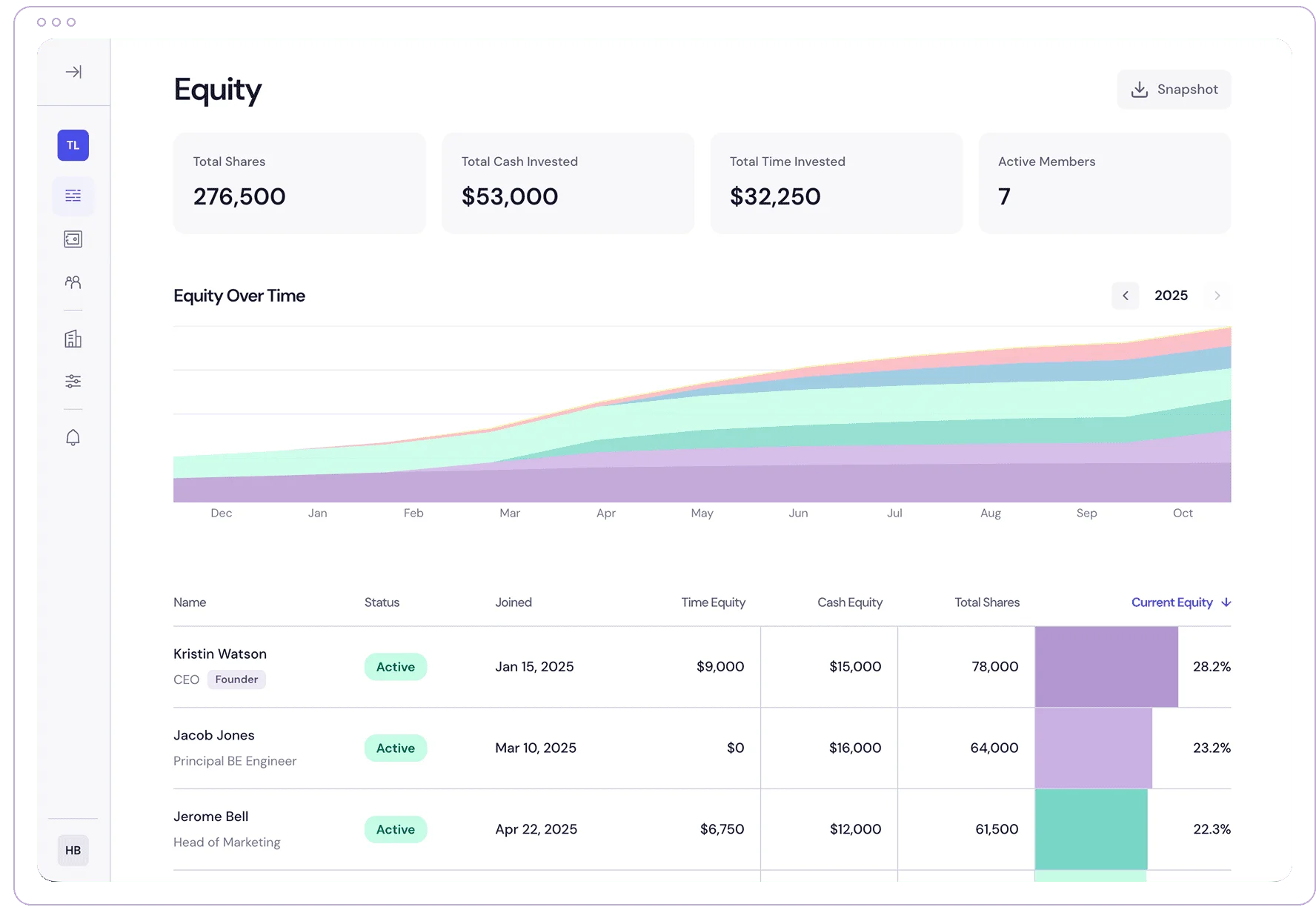
Equity Matrix tracks contributions and calculates ownership automatically.
Get Started FreeThis article is for informational purposes only and does not constitute legal, tax, or financial advice. Equity Matrix is not a law firm, accounting firm, or financial advisor. Consult a qualified professional for guidance specific to your situation.

Co-founder, Equity Matrix
Sebastian writes about startup equity, founder dynamics, and building fair partnerships.
Keep reading
Employee equity shrank by a quarter and it's not coming back
Between 2022 and 2023, startup equity grants dropped 26%. The market has recovered, but equity hasn't. Here's what that means for founders and employees.
Read more →The most valuable company went from $90B to nearly $5T. Who owns the difference?
In 1985 the biggest US company, IBM, was worth about $91 billion. Today the biggest, Nvidia, is worth nearly $5 trillion, and the top 10 make up a record 42% of the S&P 500. The value exploded. The ownership concentrated. Here's what that means for everyone else.
Read more →