Corporate America has spent the last decade building an equity matrix for the workplace. Tracking representation. Auditing pay gaps. Measuring promotion rates by demographic.
It’s important work. And it’s incomplete.
The standard equity matrix measures who gets hired, who gets paid fairly, and who gets promoted. What it doesn’t measure is who gets to own a piece of what they’re building.
That’s a problem. Because jobs create income. Equity creates wealth.
What the Current Equity Matrix Measures
DEI frameworks have gotten sophisticated. According to Harvard Law’s research on executive compensation, over 50% of S&P 500 companies now tie incentive pay to DEI metrics.
Here’s what they typically track:
| Category | What’s Measured |
|---|---|
| Representation | Demographic mix at each level, hiring pipeline diversity |
| Pay Equity | Salary gaps between groups, adjusted for role and tenure |
| Retention | Turnover rates segmented by demographic |
| Advancement | Promotion rates, access to development programs |
| Inclusion | Belonging surveys, psychological safety scores |
This is the modern equity matrix. Organizations use it to identify gaps, set goals, and hold leadership accountable.
But look at what’s missing.
The Wealth Gap Nobody’s Tracking
Nowhere in the standard equity matrix will you find:
- Who receives stock options
- How equity grants are distributed across demographics
- Whether early employees from underrepresented groups get fair ownership stakes
- Cap table diversity at startups
Pay equity audits compare salaries. Nobody’s auditing equity grants.
This matters because salary and equity are fundamentally different wealth-building tools.
A salary pays your bills. It covers rent, groceries, and maybe some savings. When the job ends, the income stops.
Equity compounds. A 1% stake in a company that succeeds can be worth more than a decade of paychecks. It’s how early employees at companies like Google, Facebook, and Shopify built generational wealth.
The history of equity shows that ownership has always been the primary vehicle for wealth creation. Real estate. Businesses. Stock. The wealthy don’t just earn more. They own more.
Jobs Create Income. Equity Creates Wealth.
Why Equity Gets Ignored
Three reasons the equity conversation stays out of DEI frameworks:
1. Opacity
Salaries are increasingly transparent. Many states now require pay ranges in job postings. Glassdoor and Levels.fyi publish compensation data.
Equity? Still a black box.
Most employees don’t know what their equity is worth, what percentage of the company they own, or how their grant compares to their peers. This opacity makes it nearly impossible to audit for fairness.
2. Complexity
Equity comes in many forms: ISOs, NSOs, RSUs, phantom stock, profit interests. Vesting schedules vary. Valuations change. Comparing equity across employees requires expertise most HR teams don’t have.
It’s easier to audit salaries because dollars are simple. Equity requires understanding cap tables, dilution, and exit scenarios.
3. Startup Culture
The biggest equity opportunities are at startups. And startups often operate outside traditional DEI frameworks entirely.
A five-person startup doesn’t have an HR department running pay equity audits. Founders negotiate equity individually, often based on who asks hardest or who they know from previous jobs.
This is where the equity gap compounds. The same networks and privileges that create advantages in hiring also create advantages in equity negotiation.
The Hidden Filter: Who Can Afford to Work for Equity
Here’s an uncomfortable truth about sweat equity:
Working for equity requires the ability to work for less cash.
Early-stage startups can’t pay market salaries. They offer equity instead. This sounds fair until you ask: who can actually afford to take that deal?
- People with savings or family wealth
- People without student debt
- People whose partners have stable income
- People in low cost-of-living situations
In other words: people who already have economic advantages.
Someone supporting a family, paying off loans, or lacking a financial safety net often can’t take the “equity-heavy” compensation package. They need the cash. So they either don’t join early-stage companies, or they negotiate for salary over equity.
The result? The cap table skews toward people who could afford the risk.
This isn’t anyone’s fault. It’s structural. But it means that equity ownership—the real wealth-builder—flows disproportionately to those who already have advantages.
Expanding the Equity Matrix
What would it look like to include ownership in DEI frameworks?
For established companies:
- Audit equity grant distribution by demographic
- Track whether diverse employees receive comparable equity to peers at the same level
- Include equity in total compensation transparency, not just salary
- Measure cap table diversity as a metric alongside workforce diversity
For startups:
- Use dynamic equity models that tie ownership to actual contribution, not negotiation leverage
- Make equity transparent within the team so everyone knows the split is fair
- Build cliff and vesting protections so ownership reflects sustained commitment
- Consider how compensation structure affects who can afford to join
The goal isn’t to mandate specific outcomes. It’s to bring the same rigor and transparency to equity that we now bring to salary.
Employee Equity Is Disappearing
The Bigger Picture
Economic equity isn’t just about getting people in the room. It’s about making sure they get a fair piece of what they build.
We’ve made real progress on hiring. Pay transparency is improving. Promotion paths are getting clearer.
But as long as equity ownership stays opaque and unexamined, the biggest wealth-building opportunity remains unevenly distributed.
True economic equity includes ownership. It’s time to expand the equity matrix.
The companies that figure this out will have an advantage. They’ll attract talent that wants real upside, not just a paycheck. They’ll build cultures where everyone is genuinely invested in success.
And they’ll be on the right side of where the workplace equity conversation is heading next.
Frequently Asked Questions
What is an equity matrix in the workplace?
An equity matrix is a framework organizations use to measure and track fairness across the workforce. Traditional equity matrices focus on representation (demographic diversity), pay equity (salary gaps), retention, and advancement rates. More comprehensive approaches also include ownership and equity compensation as key metrics.
Why isn’t equity ownership included in most DEI frameworks?
Three main reasons: opacity (equity grants aren’t transparent like salaries), complexity (stock options, RSUs, and vesting schedules are hard to compare), and startup culture (early-stage companies where equity is most significant often lack formal DEI processes). This creates a blind spot in how we measure workplace fairness.
How does sweat equity create inequality?
Working for equity requires the ability to accept below-market cash compensation. People with savings, family wealth, or fewer financial obligations can take this trade-off more easily than those with debt, dependents, or no safety net. This means cap tables often skew toward those who already have economic advantages.
What would an ownership-inclusive equity matrix measure?
An expanded equity matrix would track: equity grant distribution by demographic, cap table diversity, whether employees at the same level receive comparable equity regardless of background, and whether compensation structures create barriers to participation for people with fewer financial resources.
Economic equity isn’t complete until it includes ownership. Explore how dynamic equity models create fairer outcomes, or try our equity calculator to see contribution-based splits in action.
Ready to split equity fairly?
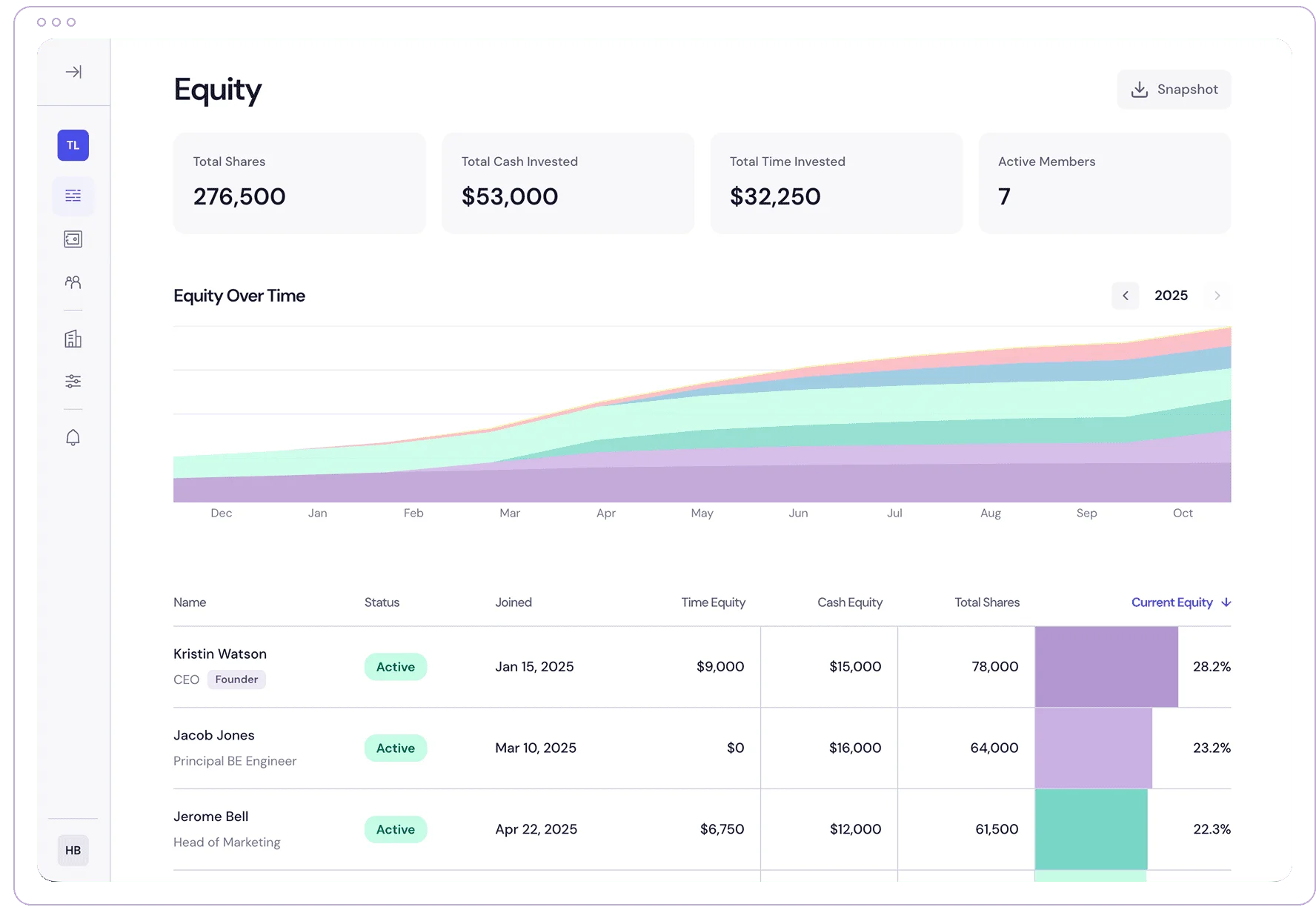
Equity Matrix tracks contributions and calculates ownership automatically.
Get Started FreeThis article is for informational purposes only and does not constitute legal, tax, or financial advice. Equity Matrix is not a law firm, accounting firm, or financial advisor. Consult a qualified professional for guidance specific to your situation.

Co-founder, Equity Matrix
Sebastian writes about startup equity, founder dynamics, and building fair partnerships.
Keep reading
Co-founders in different countries: how to set a fair rate
When one co-founder is in the US and another is in Lithuania, do you value their time at local rates or the same rate for the same work? How to set GHRR fairly across borders.
Read more →How to track co-founder contributions (before it costs you)
A practical system for tracking co-founder contributions: what to log, how often, the fields that matter, and where spreadsheets start to strain.
Read more →