Y Combinator is the most influential startup accelerator in the world. And their official advice on co-founder equity is clear: split it equally.
Michael Seibel, managing director at YC, has said this repeatedly and forcefully. Sam Altman wrote in his Startup Playbook that co-founder splits should be “nearly equal” and that unequal splits are a reason to step back and question the relationship. YC’s Startup School teaches new founders that equal splits keep teams motivated and signal trust.
This advice comes from people who’ve seen thousands of startups up close. It deserves serious engagement, not dismissal.
But the research disagrees with parts of it. And the nuance matters.
What YC actually recommends
YC’s position isn’t “always do 50/50 no matter what.” It’s more specific than that. Here’s the core argument as Seibel lays it out:
1. Most of the work is ahead of you. It takes 7 to 10 years to build a company of great value. Small variations in year one don’t justify massively different equity splits in years two through ten.
2. More equity means more motivation. Almost all startups fail. The more motivated the founders, the higher the chance of success.
3. Don’t penalize people for not having the idea. Ideas are cheap. Execution is what matters. Giving the “idea person” significantly more equity is one of the most common mistakes YC sees.
4. If you don’t value your co-founder, neither will anyone else. An unequal split can signal to investors that one founder doesn’t trust or respect the other.
Seibel explicitly calls out several bad reasons for unequal splits: “I came up with the idea,” “I started working before my co-founder,” “I’m older and more experienced,” and “one founder took salary while the other didn’t.”
Startups are about execution, not about ideas. — Michael Seibel, Y Combinator
This is a thoughtful, internally consistent position. And on several points, YC is completely right.
Where YC is right
Don’t overvalue the idea
This might be YC’s single best piece of equity advice. The founder who had the initial concept often feels entitled to a bigger slice. But ideas change. Most startups pivot at least once. The company you build in year three rarely resembles the idea you had in month one.
If the only justification for an unequal split is “it was my idea,” that’s a weak foundation. YC is correct to push back on this.
Vesting protects everyone
YC strongly advocates for standard four-year vesting with a one-year cliff on all founder shares. This is non-negotiable advice, and it’s perfect.
Vesting means that even if you start with an equal split, a founder who leaves early doesn’t walk away with half the company. It’s the safety net that makes any split more survivable.
Generosity signals confidence
There’s real wisdom in the idea that being generous with equity signals that you believe in the partnership. Founders who try to grab a disproportionate share before anyone has done real work are often the wrong people to build with.
Sam Altman put it well: great people have many options, so you need to be generous with equity, trust, and responsibility to attract them. That applies to co-founders too.
Where YC’s advice breaks down
Here’s where it gets complicated. YC’s argument rests on a key assumption: that co-founder contributions will roughly equalize over time. That the person who starts part-time will eventually go full-time. That the person who contributed less in year one will make up for it in years two through five.
Sometimes that happens. Often it doesn’t.
The research says otherwise
Noam Wasserman’s research at Harvard Business School studied over 6,000 startups and found that 65% of high-potential startups fail because of people problems, not product or market problems. Teams that split equity equally without careful consideration were significantly more likely to experience destructive conflict.
His data shows that 73% of founding teams split equity within the first month, before they have any real information about how contributions will play out. Half of those teams failed to include vesting or buyout provisions.
That was a really stupid handshake, because who knows what skill sets and what milestones and what achievements are going to be valuable. — Robin Chase, Zipcar co-founder, on her 50/50 split
Carta’s 2024 data shows that equal splits among two-founder startups rose from 31.5% in 2015 to 45.9% in 2024. More founders are following YC’s advice. But the co-founder conflict rate hasn’t improved.
”The work is ahead of you” assumes equal commitment
Seibel’s argument that “small variations in year one don’t matter” makes sense if both founders actually stay committed for years two through ten. But what happens when they don’t?
How "Equal" Plays Out in Practice
| Year | Founder A | Founder B | Equity |
|---|---|---|---|
| 1 | Full-time, builds MVP | Full-time, handles sales | 50/50 |
| 2 | Full-time, leads product | Drops to part-time, starts consulting | 50/50 |
| 3 | Full-time, 60-hour weeks | Still part-time, considering leaving | 50/50 |
| 4 | Running the company alone | Gone, but owns 50% | 50/50 |
This isn’t an edge case. It’s one of the most common patterns in early-stage startups. Life changes. Commitment levels shift. One founder gets a job offer they can’t refuse. Another has a baby. A third realizes they’re more interested in a different project.
YC’s advice assumes the best-case scenario. Equity structures need to survive the worst case.
Motivation isn’t just about percentage
YC argues that more equity equals more motivation. This is true in isolation. But it ignores the flip side: the founder doing 80% of the work while holding 50% of the equity becomes less motivated over time, not more.
Resentment is a stronger force than percentage points. When one founder feels they’re subsidizing their co-founder’s ownership, the equal split that was supposed to signal trust becomes a source of bitterness.
The deadlock problem
YC’s advice doesn’t adequately address governance. With a 50/50 split, neither founder can outvote the other. Every major decision requires consensus.
That works until founders disagree about something existential: whether to pivot, whether to take funding, whether to accept an acquisition offer, whether to fire a key employee.
With equal ownership, disagreements become standoffs. And standoffs become lawsuits.
Even Sam Altman acknowledges this partially: “With two founders it may be best to have one person with one extra share to prevent deadlocks.” But this contradicts the equal split recommendation. If deadlock is a real enough risk to warrant a structural tiebreaker, then 50/50 isn’t the right answer.
The missing middle ground
The real problem with the YC vs. unequal split debate is that it presents a false binary. The choice isn’t between “50/50” and “70/30 because I had the idea first.”
There’s a middle ground that addresses all of YC’s concerns while avoiding the pitfalls of rigid equal splits.
Contribution-based equity
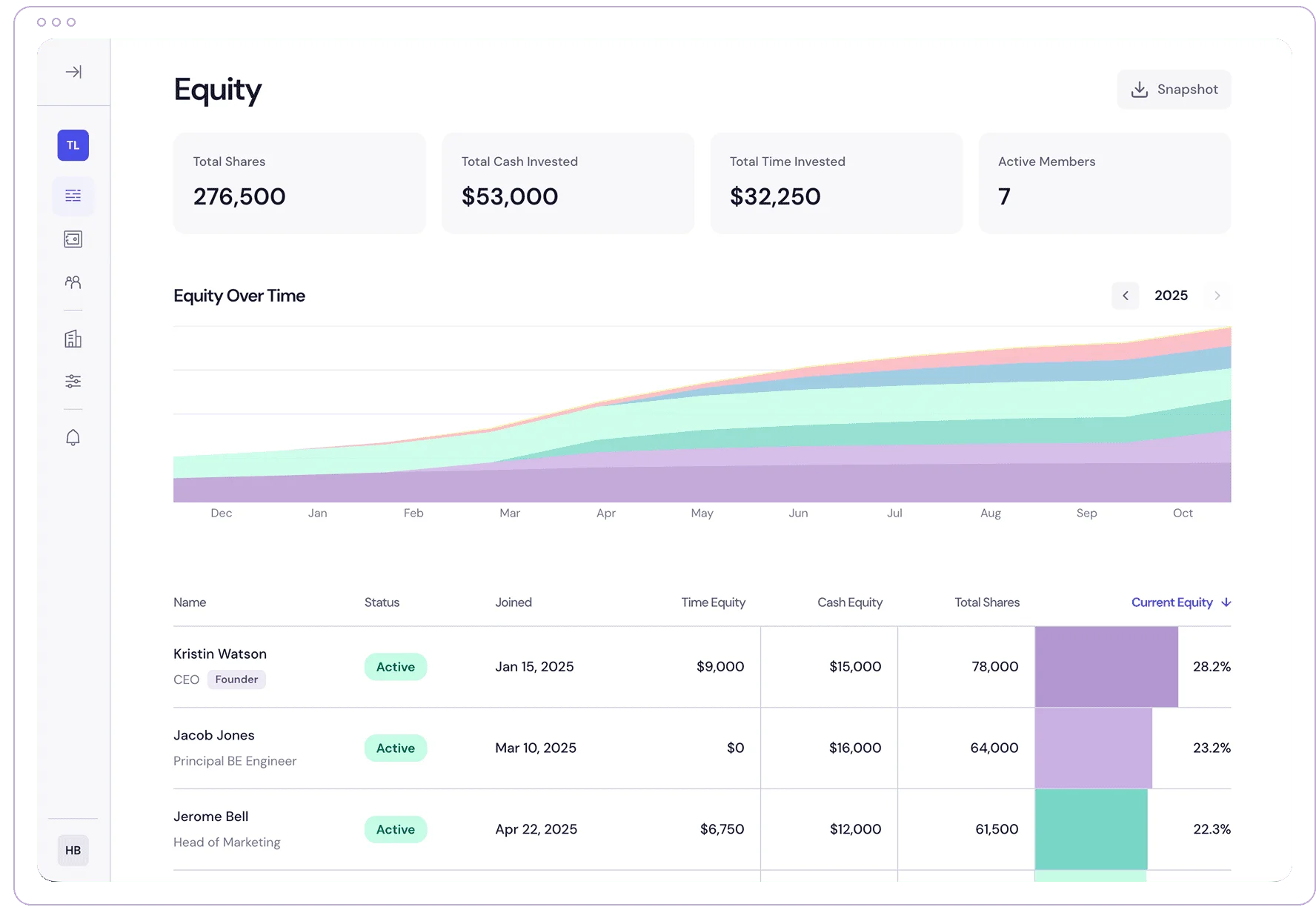
Instead of guessing about future contributions, track them. Dynamic equity adjusts ownership based on what each founder actually puts in: time, money, expertise, assets, relationships.
If contributions turn out to be equal, you get a 50/50 split. But if they diverge, equity adjusts accordingly. Nobody feels cheated. Nobody is subsidizing someone else’s ownership. The math handles the conversation that founders don’t want to have.
This approach agrees with YC’s core principles:
- It doesn’t penalize the idea. Ideas aren’t tracked as contributions.
- It values execution. The person who executes more earns more.
- It keeps everyone motivated. Your ownership reflects your actual input.
- It signals trust. You’re trusting a transparent system, not avoiding a conversation.
The 51/49 compromise
If you believe contributions are genuinely equal but want governance protection, consider a 51/49 split. The economic difference is negligible, but it creates a structural tiebreaker that resolves the deadlock concern entirely.
Even Altman’s note about “one extra share” points in this direction. The step from 50/50 to 51/49 is tiny in ownership terms but significant in governance terms. It says: “We’re nearly equal partners, but we’ve designated a lead decision-maker.”
What YC founders actually experience
Talk to YC alumni and the picture gets more nuanced than the official advice. Many YC companies started with equal splits and made it work. Many others hit exactly the problems Wasserman’s research predicts.
The founders who succeed with equal splits tend to have a few things in common:
- Both founders stayed full-time for the entire journey. Commitment never diverged.
- They had clear domain separation. CEO handles business, CTO handles product. Decisions don’t overlap.
- They built governance mechanisms. Operating agreements with deadlock resolution, decision domains, buyout provisions.
- They got lucky. Things went well enough that the equity question never became contentious.
The last point matters more than most people admit. Equal splits work when everything goes right. The question is what happens when things go wrong.
Our take
YC’s advice is well-intentioned and partly right. Don’t overvalue ideas. Use vesting. Be generous. Think long-term. All of that is solid.
But the recommendation to default to equal splits ignores 20 years of research on founding team dynamics. It assumes contributions will equalize. It doesn’t solve governance. And it treats the equity conversation as something to avoid rather than something to get right. It’s also worth noting that Paul Graham’s equity equation — the most influential essay on startup equity math — deliberately says nothing about co-founder splits. That silence is a signal: the problem doesn’t reduce to a formula, and defaulting to 50/50 doesn’t solve it.
Our position: founders should base equity on actual contributions, not assumptions about what contributions might look like in the future. If those contributions turn out to be equal, the split will be equal. If they diverge, the split will reflect reality.
The best equity structure isn’t one where nobody had to have a hard conversation. It’s one where the conversation happened, the math backed it up, and both founders feel ownership reflects their actual input.
Use the equity calculator to see what a contribution-based split looks like for your founding team. Track contributions from day one, and let the data tell you what’s fair.
Frequently asked questions
Does YC reject startups with unequal equity splits?
No. YC evaluates teams holistically. Sam Altman has said that a non-equal split is “a reason to step back and think about the relationship,” but it’s not an automatic rejection. Many successful YC companies have had unequal splits. What matters more is whether founders can articulate why their split exists and whether governance is clear.
Is Michael Seibel wrong about equal splits?
Not entirely. Seibel’s arguments against penalizing the idea person, overweighting early contributions, and being stingy with co-founder equity are all correct. Where the advice falls short is in assuming that equal commitment will persist across the 7-10 year journey. Research from Wasserman and Carta data show that this assumption frequently fails. The advice is right about generosity and wrong about structure.
What if my YC application has a 50/50 split?
You’re fine. YC explicitly prefers equal splits. If you’re applying to YC, an equal split won’t hurt your application. But make sure you have vesting, a co-founder agreement, and clear governance mechanisms in place regardless of the split. And if you’re not going through YC, don’t default to 50/50 just because YC recommends it. Their advice is tailored to their ecosystem, which has specific support structures that most startups don’t have.
Can I use dynamic equity and still apply to YC?
Yes. Dynamic equity is a pre-cap table framework. By the time you’re incorporating and entering an accelerator, you’d typically freeze your dynamic equity into a fixed split based on tracked contributions. YC doesn’t prescribe how you arrive at your split, only what the split should look like when you formalize it. If dynamic equity produces a near-equal result, that aligns with YC’s recommendation. If it produces an unequal result, you’ll have data to explain why.
YC has helped thousands of startups succeed. Their advice on equity is worth taking seriously. But taking advice seriously means engaging with it critically, not following it blindly. Track your contributions, protect your governance, and let the data guide your split.
Ready to split equity fairly?
Equity Matrix tracks contributions and calculates ownership automatically.
Get Started FreeThis article is for informational purposes only and does not constitute legal, tax, or financial advice. Equity Matrix is not a law firm, accounting firm, or financial advisor. Consult a qualified professional for guidance specific to your situation.

Co-founder, Equity Matrix
Sebastian writes about startup equity, founder dynamics, and building fair partnerships.
Keep reading
Sam Altman's co-founder equity advice, explained
Sam Altman's Startup Playbook recommends nearly equal co-founder splits with one extra share to prevent deadlock. Here's what that advice means in practice and where it falls short.
Read more →Paul Graham's equity equation: what it misses
Paul Graham's equity equation tells you how much to give investors and employees. It says nothing about co-founder splits. Here's why, and what to do instead.
Read more →