Adding a co-founder after you’ve already started building means restructuring equity to fairly account for both the original founder’s prior work and the new partner’s future contributions.
You’ve put in six months of work. Maybe longer. Now someone wants to be called “co-founder.”
How much of what you’ve built should you give away?
This is different from starting together on day one. You’ve already built a prototype, talked to customers, maybe even made a few sales. You’ve taken risk. The company isn’t worth nothing anymore. If you’re still working through whether you should add a co-founder at all — not just how to structure the equity — the solo-to-co-founder transition guide covers when it makes sense and what signals suggest you’re ready.
The question is how to structure equity fairly for someone joining late. (If you’re running a small business or LLC rather than a venture-backed startup, the same principles apply but the language and legal structure are different. See how to add a partner to an existing business for the SMB-specific guide.)
The Core Equity Problem
When two people start a company together, splitting equity is relatively simple. Neither person has contributed anything yet. You’re both betting on the same uncertain future.
But when you bring someone in later, there’s an imbalance. You’ve already done things. You’ve already taken risk. Giving a new co-founder an equal share ignores all of that.
At the same time, if you’re asking someone to join as a co-founder and not just an employee, you need to offer meaningful equity. Nobody’s going to take co-founder risk for a 5% stake.
The challenge is finding the middle ground.
Calculate what a fair split looks like with a new co-founder.
Input your existing contributions and model what happens when someone new joins.
Try the calculator →What You’ve Already Contributed
Before you can figure out what to offer, you need to honestly assess what you’ve put in so far.
Time. How many hours have you worked on this? Be honest. Thinking about your idea in the shower doesn’t count. Actual work does.
Money. Have you spent cash on the business? Development costs, legal fees, marketing experiments, tools and subscriptions. Add it up.
Results. What do you have to show for it? A working product? Paying customers? Letters of intent? Validated learning? A prototype that proves the concept works?
Opportunity cost. Did you quit a job to work on this? Turn down other opportunities? The sacrifice matters. This is essentially sweat equity you’ve invested. If your business is an LLC or partnership where one partner contributes labor and the other contributes capital, the sweat equity guide for small businesses covers how to value time vs. money contributions specifically.
Write all of this down. You’ll need it for the conversation.
What They’re Bringing
Now think about why you want this person as a co-founder specifically.
Skills you don’t have. Maybe you’re technical and need a business person. Maybe you’re the business person and need someone to build the product. A co-founder should fill a critical gap.
Commitment level. Are they going full-time? Quitting a job to join you? Or are they keeping their day job and contributing nights and weekends? This affects how much risk they’re taking.
Network and credibility. Do they bring relationships that could unlock customers, investors, or talent? Sometimes access is as valuable as skills.
Capital. Are they investing money alongside their time?
Be clear about what you actually need. If you just need help with a specific function, maybe you need an employee or contractor, not a co-founder. In an LLC context, the distinction between a “partner” and an “employee” has real tax and legal implications: a partner receives a K-1 and pays self-employment tax, while an employee gets a W-2.
How to Value Sweat Equity Contributions
Having the Equity Conversation
Here’s where it gets uncomfortable.
You need to have an honest conversation about what each person is contributing and what that’s worth. There’s no formula that spits out the perfect number. It’s a negotiation.
Some things to discuss:
Acknowledge your head start. You’ve put in six months of work. That has value. A new co-founder joining now shouldn’t expect the same equity as if they’d been there from day one.
But don’t overvalue it. Six months of solo work on an unvalidated idea isn’t worth that much in the grand scheme of things. If the company succeeds, it’ll be because of what you build together going forward, not just what you did before.
Consider their risk. If they’re quitting a $150K job to join your startup that has no revenue, they’re taking real risk. That deserves meaningful equity.
Think about future contributions. Equity should reflect expected total contribution, not just what’s happened so far. If this person is going to be working alongside you for the next five years, that matters more than your six-month head start.
The best time to have this conversation is before it feels urgent. The worst time is when there’s already tension.
A Framework for Calculating Late Co-Founder Equity
One way to approach this: treat your past contributions as if you’d been an early investor or contractor.
Example Calculation
Your contribution so far:
- 500 hours at $75/hour equivalent = $37,500
- $10,000 cash invested = $10,000
- Total: $47,500
New co-founder’s expected first-year contribution:
- 2,000 hours full-time at $75/hour = $150,000
Implied split after year one:
- You: $47,500 + $150,000 = $197,500 (57%)
- Them: $150,000 (43%)
This math isn’t perfect, but it gives you a framework for discussion. You’re not pulling numbers out of thin air. Our equity calculator can help you run these scenarios before the conversation.
The specific rates and valuations are negotiable. The point is to make the conversation concrete rather than abstract.
Use Dynamic Equity Instead of Guessing
Here’s another approach: don’t try to guess the future at all.
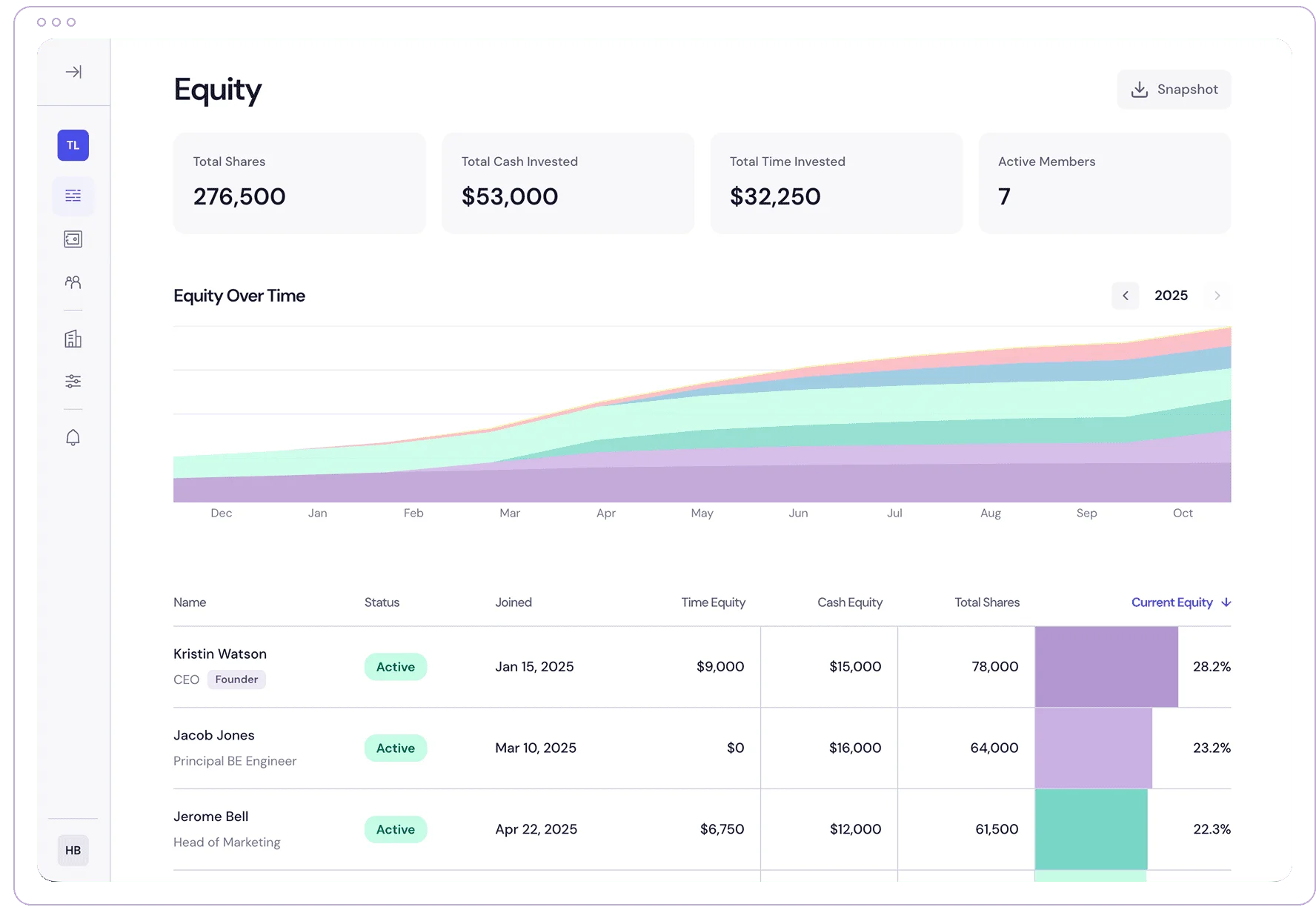
With dynamic equity, you track contributions as they happen. Your past work counts. Their future work counts. Ownership adjusts based on what everyone actually puts in.
Typical Equity Ranges for Late Co-Founders
| Stage When Joining | Typical Range | Notes |
|---|---|---|
| Idea only, no product | 40-49% | Almost like starting together |
| Prototype built | 25-40% | Depends on prototype value |
| Product launched, no revenue | 15-30% | Real traction changes things |
| Revenue, pre-product-market fit | 10-25% | Higher risk is past |
| Product-market fit achieved | 5-15% | More like an early employee |
These are rough ranges based on typical scenarios. Your specific situation may vary based on what each person brings.
This removes a lot of the pressure from the initial negotiation. You don’t have to predict who will contribute what over the next five years. You just agree on how to track contributions and let the numbers work themselves out.
If the new co-founder ends up contributing as much as you over time, they’ll earn equity to match. If they don’t, the split will reflect that.
It’s a way to be fair without pretending you can see the future. And when you’re eventually ready to freeze your equity split, the numbers speak for themselves.
Vesting Still Matters
Whatever split you agree on, vesting protects everyone.
The standard founder vesting schedule is four years with a one-year cliff. If your new co-founder leaves after three months, they shouldn’t walk away with 30% of the company.
For you, since you’ve already been working on this, you might start partially vested. If you’ve put in a year of work, maybe you start 25% vested on your shares. The details are negotiable. Make sure you understand how vesting works before finalizing any agreement.
The point is that equity should be earned over time, not granted all at once. This protects both of you if things don’t work out.
Get It in Writing
Once you’ve agreed on terms, document everything.
This means a formal co-founder agreement (or operating agreement if you’re an LLC) that covers:
- Equity split and vesting schedule
- Roles and responsibilities
- Decision-making process (who has final say on what)
- What happens if someone leaves (including buyout provisions)
- What happens if you disagree on major decisions
- IP assignment (making sure the company owns what you build)
- Profit distribution terms (for LLCs, this can differ from ownership percentages)
Don’t skip this because you trust each other. Written agreements aren’t about distrust. They’re about clarity. You want to make sure you both have the same understanding of what you agreed to. Our research found that 38% of equity disputes go entirely unresolved, and nearly every one lacked a written agreement.
A lawyer can help draft this, or you can start with a template and have a lawyer review it. For LLCs, expect $1,500-$10,000 depending on complexity.
Common Equity Mistakes with Late Co-Founders
Giving away too much too fast. In your excitement to bring someone on, you offer 50% to a person who hasn’t proven anything yet. If they don’t work out, you’ve given away half your company for nothing.
Being too stingy. You’re so protective of your equity that you offer an insultingly small amount. The person either declines or accepts but resents it. Neither is good.
Skipping the hard conversation. You’re so eager to start working together that you say “we’ll figure out equity later.” Later never comes, or it comes at the worst possible time.
No vesting. You agree on a split but don’t add vesting. When they leave after four months, you’re stuck with a co-founder who owns a big chunk but contributes nothing. This is how dead equity is created.
No written agreement. You shake hands and get to work. A year later, you remember the conversation differently. Now it’s your word against theirs. (This is exactly how co-founder disputes happen.) For small business partnerships, the stakes are even higher because state default rules may give your new partner equal management rights regardless of ownership percentage.
The Right Mindset for Co-Founder Equity
Bringing on a co-founder after you’ve started requires balancing two things:
Respecting what you’ve already built. Your past work has value. You took risk when the outcome was even more uncertain than it is now. That deserves recognition.
Being generous enough to attract great people. If you want someone to commit to your vision as a true co-founder, you need to make it worth their while. A great co-founder will multiply the value of the company far beyond whatever equity you give them.
Err on the side of generosity with the right person. A smaller slice of a much bigger pie is better than a bigger slice of nothing.
But also protect yourself with vesting and clear agreements. Hope for the best, structure for the worst.
Equity Is Not Just About the Number
The equity percentage matters, but it’s not the only thing.
How you handle this conversation tells your potential co-founder a lot about what it’ll be like to work with you. Are you fair? Do you communicate openly? Can you have hard conversations without it getting personal?
If you approach equity as a zero-sum negotiation where you’re trying to give away as little as possible, that sets a tone. If you approach it as a collaborative problem-solving exercise where you’re trying to find something that works for both of you, that sets a different tone.
The best co-founder relationships are built on trust and open communication. The equity conversation is your first real test of whether you can do that together.
Frequently Asked Questions
How much equity should I give a late co-founder?
It depends on how much you’ve already built and what they’re bringing. A co-founder joining when you only have an idea might get 40-49%. One joining after you have revenue might get 10-25%. Use the ranges table above as a starting point, then adjust based on their specific contributions.
Should a late co-founder get the same equity as if they’d started with me?
Generally no. You’ve already taken risk and done work. But don’t overvalue your head start either. Six months of solo work on an unvalidated idea isn’t worth as much as you might think. Focus on expected total contribution over the life of the company.
What if they want more equity than I’m willing to give?
This is a negotiation. If you can’t find middle ground, maybe they’re not the right co-founder, or maybe you should consider dynamic equity where ownership adjusts based on actual contributions over time.
Do late co-founders need vesting?
Yes, absolutely. Standard is four years with a one-year cliff. If they leave after three months, they shouldn’t walk away with significant equity. You might start partially vested since you’ve already been working, but they should vest from zero.
Ready to figure out fair equity for a late co-founder? Our equity calculator helps you model different scenarios based on contributions, risk, and expected future work.
Ready to split equity fairly?
Equity Matrix tracks contributions and calculates ownership automatically.
Get Started FreeThis article is for informational purposes only and does not constitute legal, tax, or financial advice. Equity Matrix is not a law firm, accounting firm, or financial advisor. Consult a qualified professional for guidance specific to your situation.

Co-founder, Equity Matrix
Sebastian writes about startup equity, founder dynamics, and building fair partnerships.
Keep reading
50/50 partnership deadlock: how to break a tie before it breaks the business
Equal partners with no tie-breaker can stall a business for months. The deadlock clauses that work, how a shotgun clause plays out, and what to do if you're stuck.
Read more →Co-founders in different countries: how to set a fair rate
When one co-founder is in the US and another is in Lithuania, do you value their time at local rates or the same rate for the same work? How to set GHRR fairly across borders.
Read more →