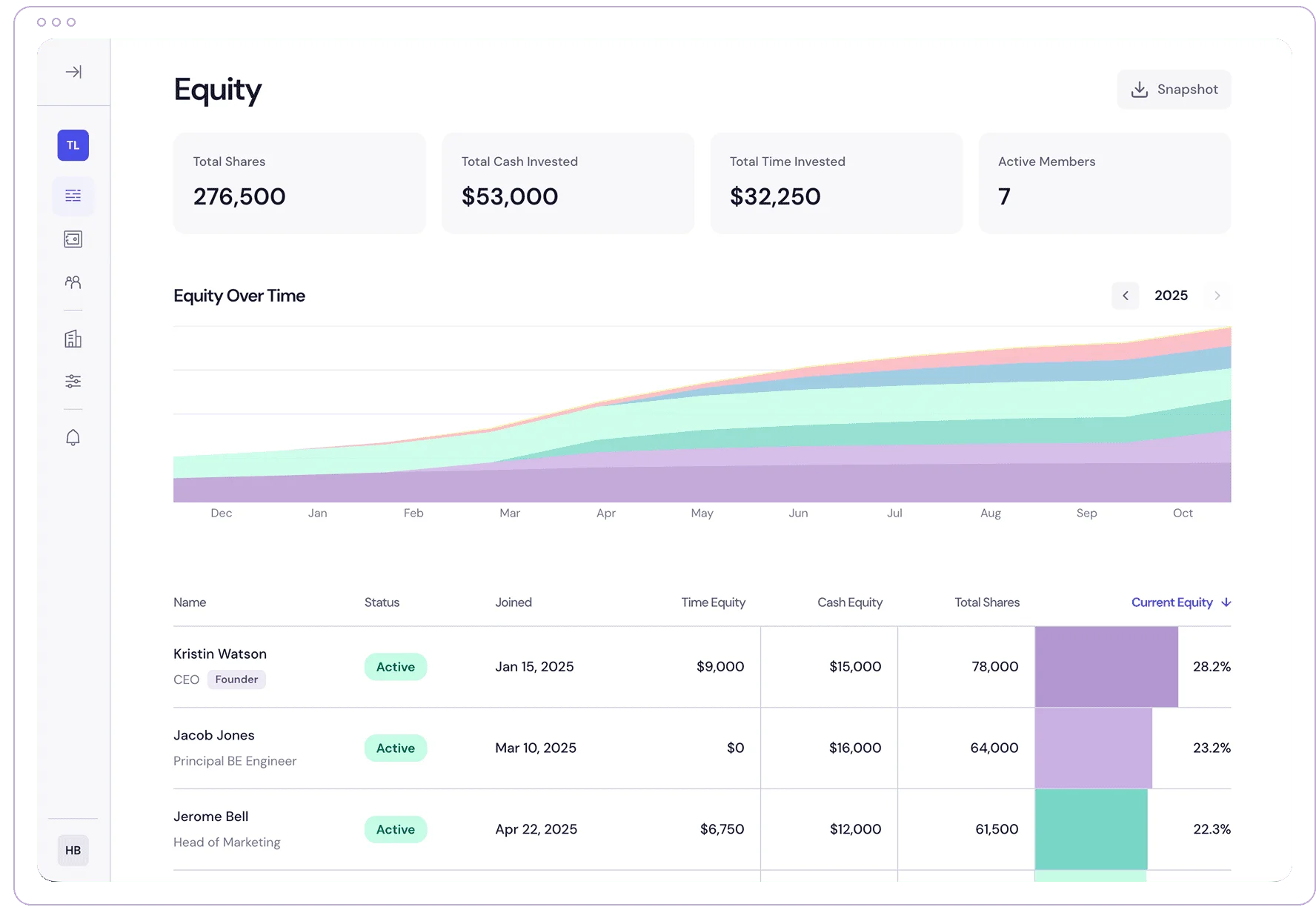
Building a company is one thing. Deciding what to do with the wealth it creates is another.
The greatest philanthropists in history didn’t just write checks. They built fortunes through ownership stakes in companies, then spent decades figuring out how to give that money away effectively.
Their stories matter for anyone thinking about equity. Ownership creates wealth. What you do with that wealth defines your legacy.
The All-Time Leaders
Measuring philanthropy across centuries is tricky. A million dollars in 1900 bought a lot more than it does today. The EdelGive Hurun Philanthropists of the Century report attempted to solve this by adjusting for inflation.
| Philanthropist | Era | Lifetime Giving (Adjusted) | Source of Wealth |
|---|---|---|---|
| Jamsetji Tata | 1839-1904 | ~$102 billion | Textiles, steel, hotels (India) |
| Andrew Carnegie | 1835-1919 | ~$75-90 billion | Steel |
| Bill Gates | 1955-present | $60+ billion | Microsoft equity |
| Warren Buffett | 1930-present | $56+ billion | Berkshire Hathaway equity |
| Henry Wellcome | 1853-1936 | ~$57 billion | Pharmaceuticals |
| John D. Rockefeller | 1839-1937 | ~$30-40 billion | Standard Oil |
| MacKenzie Scott | 1970-present | $26+ billion | Amazon equity |
| Chuck Feeney | 1931-2023 | $8 billion | Duty Free Shoppers |
Every name on this list built their fortune through company ownership. They held equity, watched it grow, then gave it away.
Jamsetji Tata: The Philanthropist Most Americans Have Never Heard Of
The world’s greatest philanthropist, adjusted for inflation, wasn’t American. He was Indian.
Jamsetji Tata founded what became the Tata Group in the 1870s, starting with a textile mill and expanding into steel, hotels, and eventually everything from cars to software. Today, Tata Group is India’s largest conglomerate.
What made him different: Tata started giving while he was still building. In 1892, he established the J.N. Tata Endowment to send Indian students abroad for higher education. Unlike earlier philanthropists who gave mainly to their own communities, Tata made his scholarships available “to all capable natives of this country,” regardless of caste or creed.
By 1924, two out of every five Indians entering the elite Indian Civil Service were Tata scholars.
In 1898, he pledged nearly half his personal wealth to establish what became the Indian Institute of Science in Bangalore. He died before it opened, but his sons finished the work.
Tata’s philanthropic ideals were based on the belief that India’s brightest minds needed to be tapped to raise the country from poverty.
The lesson: Tata didn’t wait until he was done building to start giving. He saw philanthropy as part of the mission, not something that came after.
Jobs Create Income. Equity Creates Wealth.
Andrew Carnegie: The Gospel of Wealth
Andrew Carnegie arrived in America from Scotland as a poor immigrant. He died one of the richest men in history.
His fortune came from steel. Carnegie Steel Company dominated American industry, and when he sold it to J.P. Morgan in 1901 for $480 million (roughly $15 billion today), Carnegie became fantastically wealthy.
Then he spent the next 18 years giving almost all of it away.
The numbers: Carnegie donated approximately $350 million before his death, equivalent to roughly $75-90 billion today. He gave away about 90% of his wealth.
What he built:
- 2,509 public libraries worldwide (1,689 in the United States alone)
- Carnegie Mellon University
- Carnegie Hall
- The Carnegie Corporation, endowed with $125 million in 1911
His philosophy: Carnegie wrote an essay called “The Gospel of Wealth” arguing that the rich had a moral obligation to distribute their fortunes during their lifetimes. Hoarding wealth or passing it to heirs was, in his view, a failure.
“The man who dies rich, dies disgraced.” — Andrew Carnegie
Carnegie and Rockefeller competed publicly in their giving. The newspapers kept score.
John D. Rockefeller: The Original Oil Baron Turned Philanthropist
John D. Rockefeller built Standard Oil into a monopoly that controlled 90% of American oil refining. At his peak, his net worth was roughly 2% of the entire U.S. economy.
Then he gave away $530 million over his lifetime.
What he funded:
- The University of Chicago (essentially created it from a struggling Baptist college in 1892)
- Rockefeller University (medical research)
- The Rockefeller Foundation, established 1913 with $182 million
- The Rockefeller Sanitary Commission, which eradicated hookworm in the American South
His approach: Rockefeller pioneered “scientific philanthropy,” the idea that giving should be strategic and data-driven rather than emotional. He hired advisors, studied problems systematically, and funded root causes rather than symptoms.
The Rockefeller Foundation still exists today, with assets over $5 billion.
Chuck Feeney: The Billionaire Who Wanted His Last Check to Bounce
Chuck Feeney co-founded Duty Free Shoppers, the airport retail empire. At his peak, he was worth an estimated $8 billion.
When he died in 2023 at age 92, he had given away virtually all of it.
The philosophy: Feeney called it “giving while living.” In his words: “I see little reason to delay giving when so much good can be achieved through supporting worthwhile causes today.”
He famously told The New York Times: “I want the last check I write to bounce.”
What made him unusual:
- He gave anonymously for years. Forbes called him “the James Bond of philanthropy.”
- He transferred his entire stake in Duty Free Shoppers to his foundation in 1982, while he was still building the company.
- He set a deadline. The Atlantic Philanthropies made its final grants in 2016 and closed in 2020.
- He lived modestly. When Forbes met him in 2012, he estimated he’d set aside about $2 million for retirement. He gave away 375,000% more than his remaining net worth.
His influence: Feeney directly inspired Bill Gates and Warren Buffett to create the Giving Pledge. Gates said: “Chuck’s longstanding commitment to Giving While Living has been a guidepost for Melinda and me.”
Bill Gates and Warren Buffett: The Giving Pledge
In 2010, Bill Gates, Melinda French Gates, and Warren Buffett launched The Giving Pledge, asking billionaires to commit at least half their wealth to philanthropy.
The scale: As of late 2025, over 250 signatories from 30 countries have pledged a combined $600+ billion.
Bill Gates: His lifetime giving to the Gates Foundation exceeds $60 billion. The foundation holds $77 billion in assets and focuses on global health, poverty, and U.S. education. In 2025, Gates announced the foundation would spend down its entire endowment by 2045.
Warren Buffett: His lifetime giving exceeds $56 billion, mostly to the Gates Foundation. Buffett has pledged to give away 99% of his wealth.
Both built their fortunes through equity. Gates owned Microsoft stock. Buffett owns Berkshire Hathaway. Their philanthropy is funded by selling shares of companies they helped build.
MacKenzie Scott: A New Model for Giving
MacKenzie Scott’s philanthropy looks different from everyone else on this list.
After her divorce from Jeff Bezos in 2019, Scott received 4% of Amazon’s shares, worth roughly $36 billion at the time. She immediately signed the Giving Pledge and started distributing money at unprecedented speed.
The numbers: As of December 2025, Scott has given away $26.3 billion to over 2,000 organizations. In 2025 alone, she donated $7.17 billion.
What makes her different:
-
Speed. Most foundations give slowly. Scott has distributed more in six years than most philanthropists give in a lifetime.
-
No strings attached. Her donations are unrestricted. Organizations can use the money however they see fit.
-
Trust-based. Rather than requiring detailed proposals and reporting, Scott’s team identifies organizations doing good work and sends them money. Many recipients learn about the gift with little warning.
-
Focus areas. She prioritizes economic, racial, and gender equity. Major recipients include HBCUs, community colleges, and grassroots organizations.
Scott credits her dentist and college roommate as inspirations for her approach to giving.
Her giving puts her behind only Buffett and Gates in lifetime philanthropy, despite starting just six years ago.
The Equity Connection
Every philanthropist on this list built their fortune the same way: through ownership stakes in companies.
- Carnegie owned Carnegie Steel
- Rockefeller owned Standard Oil
- Gates owned Microsoft
- Buffett owns Berkshire Hathaway
- Scott owned Amazon
- Feeney owned Duty Free Shoppers
- Tata owned the Tata Group
They didn’t earn salaries that made them billionaires. They held equity that appreciated over decades. For more on how these ownership structures work, see our guide on types of startup equity.
For founders thinking about the long game: Your equity stake isn’t just about getting rich. It’s about having resources to do something meaningful later. The ownership you build today becomes the capital you deploy tomorrow, whether that’s funding your next venture or funding causes you care about. Companies that structure equity fairly from day one create more lasting wealth for everyone involved.
What the Greatest Philanthropists Have in Common
They gave while living. Carnegie, Feeney, Gates, Scott, and Buffett all chose to distribute their wealth during their lifetimes rather than leaving it to foundations that would exist forever.
They thought systematically. Rockefeller pioneered “scientific philanthropy.” Gates applies business metrics to global health. These aren’t people who wrote checks randomly.
They started before they were done. Tata established his education endowment while still building his company. Feeney transferred his equity to his foundation while Duty Free Shoppers was still growing.
They gave away the equity itself. Buffett doesn’t sell Berkshire shares and donate cash. He donates the shares directly. This is more tax-efficient and lets the appreciation continue compounding inside the foundation.
A Brief History of Equity: From Ancient Trade to Silicon Valley
Frequently Asked Questions
Who is the biggest philanthropist of all time?
Adjusted for inflation, Jamsetji Tata of India tops most lists with an estimated $102 billion in lifetime giving. Andrew Carnegie is often cited as well, with giving equivalent to $75-90 billion in today’s dollars. Among living philanthropists, Bill Gates leads with over $60 billion donated.
What is the Giving Pledge?
The Giving Pledge is a commitment by billionaires to give away at least half their wealth during their lifetimes or in their wills. It was founded in 2010 by Bill Gates, Melinda French Gates, and Warren Buffett. As of 2025, over 250 individuals from 30 countries have signed, representing over $600 billion in committed giving.
How do billionaires give away stock instead of cash?
Donating appreciated stock directly to a foundation or charity is more tax-efficient than selling the stock and donating cash. The donor avoids capital gains taxes on the appreciation, and the charity receives the full value of the shares. Warren Buffett has donated billions in Berkshire Hathaway shares this way.
What is “giving while living”?
“Giving while living” is a philosophy popularized by Chuck Feeney, who gave away his entire $8 billion fortune before his death. The idea is that philanthropists should distribute their wealth during their lifetimes, when they can see the impact, rather than leaving it to foundations that may exist indefinitely.
Building something with co-founders? Equity Matrix helps you track contributions and split ownership fairly from day one. The fortune you build today could fund whatever matters to you tomorrow. Try the calculator.
Ready to split equity fairly?
Equity Matrix tracks contributions and calculates ownership automatically.
Get Started FreeThis article is for informational purposes only and does not constitute legal, tax, or financial advice. Equity Matrix is not a law firm, accounting firm, or financial advisor. Consult a qualified professional for guidance specific to your situation.
Co-founder, Equity Matrix
Sebastian writes about startup equity, founder dynamics, and building fair partnerships.
Keep reading
When a co-founder leaves: outcomes from 150+ cases
We studied 150+ real co-founder departures. 28% ended in litigation, only 35% were clean exits, and vesting was the single biggest predictor of outcome.
Read more →Famous co-founder equity splits that worked
Google (50/50), Microsoft (64/36), Oracle (60/20/20), Instagram (60/40). How these co-founder splits survived — plus 6 companies where generous equity created employee millionaires.
Read more →