You’re using dynamic equity to split ownership fairly. Great choice.
But if you set up as a C-Corp, you’ve just created a tax nightmare.
Every time ownership changes in a corporation—every share issued, every adjustment—that’s a potential taxable event. With dynamic equity, where ownership might shift daily based on contributions, you’d be drowning in 83(b) elections, board approvals, and 409A valuations.
An LLC taxed as a partnership can offer more flexibility, but it does not make changing ownership automatically tax-free or informal.
Important: This article is general educational information, not legal or tax advice. Dynamic or floating LLC interests can create compensation income, phantom income, capital-account issues, securities obligations, and state-law formalities. Have a CPA and an attorney design and document the arrangement before anyone earns or receives an interest.
Quick comparison: LLC vs. C-corp for dynamic equity
| Factor | LLC | C-Corp |
|---|---|---|
| Ownership changes | Tax result depends on what is issued and why | Tax result depends on the instrument and transaction |
| Contribution tracking | Can be formula-based, but legal interests must be properly documented | Must be implemented through corporate approvals and issuances |
| Service-based equity | Genuine profits interest may be tax-free at grant; capital interest is compensation | Restricted stock, options, and other awards have different tax rules |
| Tax reporting | K-1 under varying-interest rules | Instrument-dependent reporting and valuation |
| VC-fundable | Convert when ready | Yes, but premature for bootstrapping |
The C-Corp Problem
Here’s what happens when you issue stock in a corporation.
Under Section 83 of the Internal Revenue Code, when someone receives stock for services (like the work they contribute to your startup), the IRS treats it as taxable compensation.
If the stock has vesting restrictions, tax kicks in when shares vest—at whatever the fair market value is at that moment. If your company has grown, that’s a big tax bill on shares you can’t even sell yet.
The workaround is the 83(b) election. You file within 30 days of receiving restricted stock and pay taxes on the current value (usually near zero for early startups). But you have to file for every stock grant. Miss the deadline? Too late. No exceptions.
Now imagine running dynamic equity in a C-Corp:
- Ownership shifts based on weekly contributions
- Each shift requires issuing new shares
- Each issuance needs board approval
- Restricted-stock recipients must consider an 83(b) election within 30 days of transfer; options and RSUs follow different rules
- Option pricing needs defensible fair-market-value support; an independent 409A valuation is one safe harbor, not a requirement for every award
This is administratively impossible for a bootstrapped team. And it defeats the purpose of dynamic equity—tracking contributions in real-time without bureaucratic overhead.
Dynamic equity and C-Corps don’t mix. The legal and tax framework for corporations assumes ownership is fixed, not fluid.
83(b) Election Explained: The 30-Day Decision Worth Thousands
Why LLCs Work for Dynamic Equity
LLCs taxed as partnerships have fundamentally different rules.
Property contributions and service interests are different
Under IRC Section 721, contributing property to a partnership in exchange for an interest generally receives nonrecognition treatment. Services are not property for this rule. A person who receives a capital interest for services generally has ordinary compensation income under Sections 61 and 83.
The IRS does provide a safe harbor for a qualifying profits interest. Under Revenue Procedures 93-27 and 2001-43, a genuine profits interest for services can be tax-free at grant if it is properly structured. That rule does not cover a capital interest or make every later formula adjustment tax-free.
Once admitted, a profits-interest holder is a partner and is taxed on their distributive share of partnership income whether or not the LLC distributes cash. That phantom-income risk makes tax-distribution provisions and cash-flow planning essential. Whether a later change is merely an allocation under existing rights or a new compensatory transfer requires advice from the LLC’s CPA and counsel.
Flexibility in the Operating Agreement
A contribution-tracking formula can be an economic and accounting layer in an LLC’s operating agreement, but the tracker itself is not the legal ownership record.
The arrangement must be implemented through appropriate admissions or issuances, consents, amendments or ledgers, capital-account maintenance, and any applicable securities and state-law formalities. An operating agreement can authorize a formula and reduce repeated drafting, but it does not eliminate those requirements or automatically turn every change into a nontaxable event.
This is exactly what Slicing Pie recommends: “Most Slicing Pie companies choose LLCs” because of this flexibility.
Simpler Record-Keeping
Instead of stock certificates and formal board resolutions, LLCs maintain:
- Operating Agreement: Your foundational document, amended as needed
- Membership Interest Ledger: A running record of who owns what percentage
- Contribution logs: Whatever system you use to track inputs (like Equity Matrix)
The required steps depend on the interests and transactions involved. A protective 83(b) election is often recommended for an unvested profits interest, and each election is transaction-specific; it does not cover future grants or percentage changes. Counsel should also assess valuation and securities-law requirements.
How Tax Reporting Works for LLCs
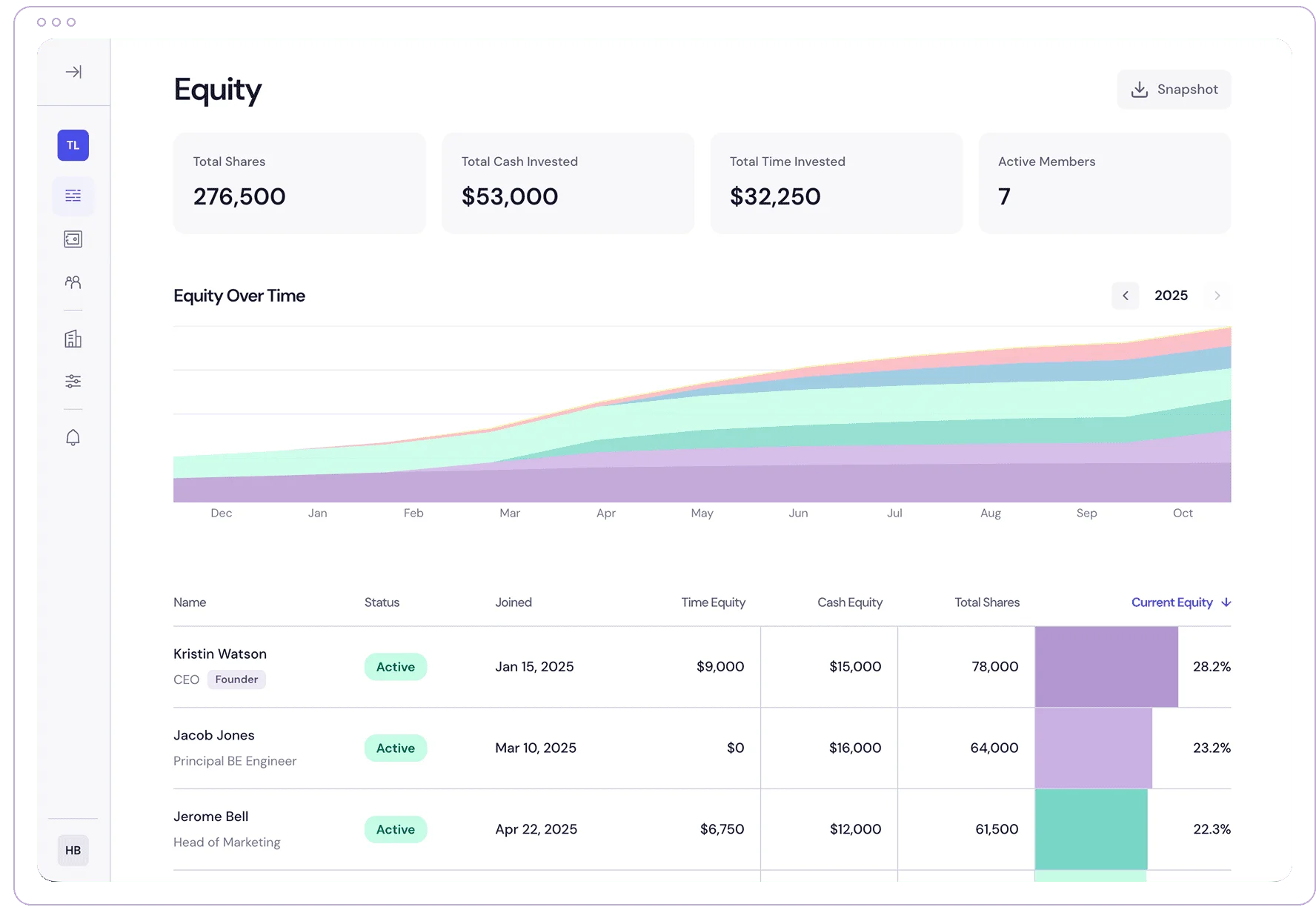
Here’s where the snapshot feature comes in.
Your contribution data may change daily, but tax allocations must follow the varying-interest rules rather than a single year-end ownership average.
Under IRC Section 706 and its regulations, LLCs have two methods for handling varying ownership interests:
Interim Closing Method: Close the books on each date ownership changes, calculating income for each segment separately.
Proration Method: Calculate total income for the year and prorate across all days based on ownership on each day.
The partnership must use the interim-closing method (the default) or a permitted proration convention. Extraordinary items must be allocated when they occur. A single averaged percentage is not sufficient by itself; the CPA must apply the chosen convention to the books and the relevant periods.
The Practical Workflow
- Track contributions daily in your dynamic equity system
- Determine and document legal changes under the operating agreement and applicable approval rules
- Preserve dated records that show when interests or allocation rights changed
- Your accountant applies the Section 706 method, including time-of-occurrence treatment for extraordinary items, for K-1 preparation
The tax snapshot feature can organize dated contribution and percentage data for your accountant. It does not itself determine legal ownership or complete the Section 706 allocation required for IRS filings.
Contribution tracking is an economic record, not a substitute for issued interests, required consents, capital accounts, or tax allocations. Ask counsel which formula changes require formal action and ask the partnership’s CPA how each change must be reflected for tax purposes.
What About the Operating Agreement?
Your operating agreement should specify:
- How contributions are valued (hourly rates, cash multipliers, etc.)
- How ownership percentages are calculated (your dynamic equity formula)
- When snapshots are taken for tax and governance purposes
- What happens when someone leaves (forfeiture, buyback rights, etc.)
An operating agreement may define a formula without requiring a full amendment for every calculation, but the company still must follow its admission, issuance, consent, ledger, capital-account, securities, and state-law requirements. Counsel should specify when a calculation changes economic allocations only and when it changes a legally issued interest.
Some lawyers recommend periodic membership interest ledger updates—quarterly or annually—to create a paper trail. But these are internal documents, not formal filings.
When to Convert to a C-Corp
LLCs are perfect for bootstrapping and early-stage development. But there’s a reason most funded startups are Delaware C-Corps.
VCs Require Corporations
Venture capital funds have tax-exempt investors (pension funds, endowments) who can’t receive pass-through income from LLCs without tax complications. VCs also want specific things when looking at your cap table:
- Preferred stock classes with specific rights
- Delaware Court of Chancery for disputes
- Standard term sheet structures
When to Make the Switch
Convert to a C-Corp when:
- Raising a priced round (seed or Series A)
- Joining an accelerator that requires it (most do)
- Your dynamic equity phase is ending and ownership is stabilizing
If you want to time the conversion to maximize QSBS benefits — potentially excluding up to $15M in capital gains at exit — see the full LLC-to-C-corp QSBS strategy for how the LLC phase, conversion timing, and holding period interact.
The conversion is straightforward if done properly. Under Section 351, if original members retain at least 80% ownership post-conversion, no gain or loss is recognized.
What Happens to Your Equity Split?
At conversion, you freeze your dynamic equity and issue fixed stock in the new corporation based on your current percentages.
This is the natural endpoint of dynamic equity anyway. Once you’re raising institutional money, you need a fixed cap table. The LLC-to-C-Corp conversion is when that happens.
Important: If the conversion transfers restricted C-corp stock subject to vesting, founders should ask their tax advisors whether to file new 83(b) elections. When an election applies, its 30-day clock is transaction-specific and non-extendable. Options and RSUs are not eligible merely because they are equity awards.
The Recommended Path
Based on how dynamic equity actually works and how the tax code treats different entities:
Phase 1: LLC (Bootstrapping)
- Form as an LLC taxed as a partnership
- Operating agreement defines your dynamic equity formula
- Track contributions in real-time
- Generate tax snapshots for annual K-1 filings
- Have counsel and a CPA classify, document, and report each grant or change
Phase 2: Stabilization
- Contributions normalize as roles solidify
- Consider freezing the split when ownership stops changing significantly
- Prepare for conversion if raising institutional capital
Phase 3: C-Corp (Fundraising)
- Convert to Delaware C-Corp before term sheet
- Issue stock based on frozen percentages
- Obtain instrument-specific tax advice and file any applicable 83(b) elections within 30 days
- Proceed with standard VC financing
This path gives you the flexibility of dynamic equity during the uncertain early phase, without the tax headaches of running it in a corporation.
The Complete Guide to Slicing Pie
Common Questions
Can I use dynamic equity in an S-Corp?
Technically, but it’s awkward. S-Corps have restrictions on share classes and can only have one class of stock. The single-class rule limits the flexibility that makes dynamic equity work well. LLCs are simpler.
What if I already incorporated as a C-Corp?
You have options, but none are ideal:
- Dissolve and reform as an LLC (complicated if you have assets or obligations)
- Use restricted stock with vesting (traditional approach, but every adjustment is a taxable event)
- Use phantom equity or profit-sharing (not true equity, but avoids the tax issues) — phantom equity in particular is worth understanding if you need to incentivize key employees without triggering the tax complexity of actual ownership changes
If you’re early enough and haven’t issued stock to many people, reforming as an LLC might be worth the hassle. Consult a startup lawyer.
Do I need a lawyer to set this up?
For the operating agreement, yes. You want a lawyer experienced with dynamic equity or contribution-based models to draft the LLC operating agreement. The good news: it’s a one-time cost. You’re not paying for ongoing stock issuances and 83(b) filings.
How does Equity Matrix handle this?
Equity Matrix tracks contributions and models percentages over time. Its snapshots can supply dated data to your CPA, who must apply Section 706 and the partnership’s governing documents when preparing K-1s. When you’re ready to freeze and convert, you can export the modeled split for legal implementation.
Frequently Asked Questions
Why is an LLC better than a C-Corp for dynamic equity?
LLCs taxed as partnerships can support flexible economic arrangements, but changes are not automatically tax-free. Property contributions may qualify under Section 721; a capital interest for services is ordinary compensation income; and only a genuine, properly structured profits interest may be tax-free at grant under Revenue Procedures 93-27 and 2001-43. Counsel and a CPA should implement any floating-interest arrangement.
How do I report changing LLC ownership on taxes?
LLCs taxed as partnerships report on Schedule K-1. When interests vary, Section 706 requires an interim closing or a permitted proration convention, and extraordinary items are allocated when they occur. Dated snapshots can support the calculation, but one annual average does not satisfy the rule by itself.
When should I convert my LLC to a C-Corp?
Convert before raising institutional venture capital, as most VCs require C-Corp structure. This is also when you’d freeze your dynamic equity split anyway. The conversion is generally tax-free under Section 351 if done properly.
Can VCs invest in an LLC?
Some can, but most won’t. VC funds have tax-exempt limited partners who face complications with pass-through LLC income. Standard VC term sheets and preferred stock structures also assume corporate entities. Plan to convert before fundraising.
Ready to track equity the tax-smart way? Equity Matrix is built for LLCs using dynamic equity, with tax snapshots that make K-1 prep painless.
Ready to split equity fairly?
Equity Matrix tracks contributions and calculates ownership automatically.
Get Started FreeThis article is for informational purposes only and does not constitute legal, tax, or financial advice. Equity Matrix is not a law firm, accounting firm, or financial advisor. Consult a qualified professional for guidance specific to your situation.

Co-founder, Equity Matrix
Sebastian writes about startup equity, founder dynamics, and building fair partnerships.
Keep reading
The dynamic equity playbook: LLC to C-corp to exit
You don't have to choose between dynamic equity flexibility and potential C-corp tax benefits. Start with an LLC, convert when ready, and plan for QSBS.
Read more →Year-end equity housekeeping: a checklist for founders
A Q4 checklist for founders: close out contribution logs, check your 409A, plan ISO exercises, clean up the cap table, and prep for early-2027 filing deadlines.
Read more →