Most founders set their equity split once and never touch it again. Six months later, one person is working 60-hour weeks while the other has quietly drifted to part-time. The split still says 50/50. The reality says something very different.
If you’ve never revisited your equity split, you’re not alone. Most founders treat equity like a constitutional amendment: set in stone, too painful to reopen. But static equity can strain co-founder relationships. Wasserman’s research suggests about 65% of high-potential startup failures trace to people problems, with co-founder conflict the largest category.
This post introduces a simple framework for reviewing your equity split: the equity review matrix. It’s a structured way to figure out whether your current split still makes sense, and what to do if it doesn’t.
Why “set it and forget it” equity breaks startups
When you split equity on day one, you’re making a prediction. You’re guessing how much each person will contribute over the next several years. Even with the best intentions, those predictions are almost always wrong.
Things that change after the split:
- One co-founder goes full-time while another keeps a day job
- Someone brings in a major client, investor, or technical breakthrough
- Life happens: a co-founder has a kid, gets sick, or loses motivation
- The company pivots and one person’s skills become more critical
- A new co-founder or key hire joins after founding
None of these are failures. They’re just reality. The failure is pretending the original split still reflects that reality.
A fair split on day one can become an unfair split by month six. Not because anyone did anything wrong, but because startups change faster than the agreements that govern them.
The result is predictable. The person doing more starts to resent the person doing less. The person doing less either doesn’t notice or feels defensive. Nobody brings it up because equity conversations are uncomfortable. Eventually, the resentment poisons everything. If you’re not sure whether your situation has crossed that line, there are concrete signs your equity split is unfair — from unequal workloads to missing vesting protection — that can help you assess before you reach a crisis.
This is dead equity in slow motion.
What is an equity review matrix?
An equity review matrix is a structured way to evaluate each co-founder’s equity position using two dimensions:
- Contribution-ownership gap (X-axis): Is someone’s current equity percentage higher, lower, or roughly aligned with their actual contribution?
- Performance trajectory (Y-axis): Is their contribution level increasing, holding steady, or declining compared to six months ago?
Plot each co-founder on the grid, and the intersection tells you what to do.
The concept borrows from merit matrices used in salary reviews at larger companies. In a merit matrix, the two axes are salary band position and performance rating. The intersection determines how much of a raise someone gets. We’re applying the same logic to equity, but for founders instead of employees, and for ownership stakes instead of salary bumps.
The two axes explained
Contribution-ownership gap
This is the core question: does someone’s equity match their contribution?
To figure this out, you need to estimate what a fair, contribution-based split would look like today. Not what you agreed to at the beginning. What the data says now.
Factors that matter:
- Time commitment: Hours worked per week, consistently, over the review period
- Cash invested: Money put into the business (not loans, actual risk capital)
- Skills and execution: What they’ve built, sold, shipped, or unblocked
- Relationships and access: Clients, investors, or partnerships they brought in
- Opportunity cost: What they gave up to be here (a $200K job is a real contribution)
Run these through the equity calculator or a Slicing Pie-style contribution model. Compare the result to their actual ownership percentage.
Contribution-ownership gap categories
| Category | What it means | Example |
|---|---|---|
| Under-equitized | Contributing more than their equity reflects | Doing 60% of the work, holding 40% equity |
| Aligned | Equity roughly matches contribution | Doing 50% of the work, holding 45-55% equity |
| Over-equitized | Holding more equity than their contribution justifies | Doing 25% of the work, holding 50% equity |
A 5-10% gap in either direction is normal and not worth acting on. Founding teams fluctuate. Someone picks up slack one month, the other person picks it up the next. You’re looking for sustained, structural gaps of 15% or more.
Performance trajectory
This isn’t a formal performance review. It’s one honest question: is this person doing more, less, or about the same as they were six months ago?
- Increasing: They’ve stepped up. Taken on more responsibility, shipped more, worked harder. Maybe they quit their day job and went full-time. Maybe they figured out sales and revenue is growing because of them.
- Steady: They’re doing exactly what they’ve always done. Reliable, consistent. No complaints, no surprises.
- Declining: They’ve pulled back. Working fewer hours, less engaged, less responsive. Maybe they’ve started a side project. Maybe burnout is setting in.
Be honest about trajectory, not just current state. Someone might still be contributing a lot, but if they’ve been doing less every month for six months, the trend matters more than the snapshot.
The matrix
Here’s what the nine combinations look like and what to do about each:
Equity review matrix: contribution-ownership gap vs. performance trajectory
| Under-equitized | Aligned | Over-equitized | |
|---|---|---|---|
| Increasing | Grant more equity now. This person is your biggest flight risk and your most valuable contributor. Fix it before they notice. | Acknowledge and reward. They’re stepping up and fairly compensated. Consider a small bump to stay ahead of the gap. | Monitor closely. They’re improving, which is good, but they still hold more than they’ve earned. Let momentum close the gap naturally. |
| Steady | Adjust within 6 months. The gap exists and it isn’t closing on its own. Schedule a concrete plan to rebalance. | No action needed. This is the healthy quadrant. Revisit in 6 months. | Start the conversation. They’re not getting worse, but the gap isn’t going away either. Discuss a gradual rebalancing. |
| Declining | Urgent conversation. They’re contributing more than their equity reflects AND they’re burning out or pulling back. Something is wrong. Find out what. | Watch for 90 days. Could be temporary (personal issue, burnout). If the decline continues, they’ll move into “over-equitized + declining” territory. | Have the hard conversation. This is the dead equity scenario. They hold a significant stake and their contribution is dropping. This is where co-founder breakups start. |
Two cells require immediate action: under-equitized + increasing (you’re about to lose your best person) and over-equitized + declining (you’re building dead equity). Everything else can be monitored, but don’t ignore it.
Walking through a real scenario
Alex and Jordan start a SaaS company. They split equity 50/50 because they’re equal partners and it felt fair.
At founding:
- Alex: product and engineering, full-time
- Jordan: sales and marketing, full-time
- Both contributing equally. The 50/50 split is accurate.
Six months in:
- Alex: still full-time, shipped the MVP, built the first integrations, handles all customer support
- Jordan: went back to consulting three days a week. Does some marketing on evenings and weekends. Brought in two paying customers but hasn’t been full-time in three months.
Running the matrix:
Alex’s contribution is roughly 70% of total effort. Alex holds 50% equity. That’s a 20-point contribution-ownership gap. Alex is under-equitized. Alex’s trajectory is steady (consistently high effort).
Jordan’s contribution is roughly 30% of total effort. Jordan holds 50% equity. Jordan is over-equitized by 20 points. Jordan’s trajectory is declining (went from full-time to part-time).
Alex and Jordan on the equity review matrix
| Co-founder | Contribution-ownership gap | Trajectory | Matrix position | Action |
|---|---|---|---|---|
| Alex | Under-equitized (-20 pts) | Steady | Adjust within 6 months | Rebalance equity to reflect actual contribution |
| Jordan | Over-equitized (+20 pts) | Declining | Have the hard conversation | Discuss reduced role, vesting changes, or restructured split |
Without the matrix, this situation festers. Alex gets resentful. Jordan feels increasingly guilty but avoids the conversation. Eventually Alex either leaves or forces a crisis.
With the matrix, the conversation has structure. It’s not “I’m mad at you.” It’s “here’s where we each land on contribution vs. equity, here’s the trajectory, and here’s what the framework says we should do.” That’s a much easier conversation to have.
When to run an equity review
Don’t wait for a crisis. Schedule equity reviews proactively.
Regular cadence: Every six months for the first two years. Annually after that. Put it on the calendar like a board meeting.
Trigger events (run one immediately):
- A co-founder changes their time commitment (goes part-time, takes another job, goes full-time)
- You’re about to raise funding and the cap table needs to be defensible
- A new co-founder or key person joins
- Someone makes a disproportionate contribution (lands a huge deal, builds critical IP)
- You feel resentment building, from either side
The best time to discuss equity is when nobody is angry about it. The worst time is when someone already is.
How to run the review: Block 90 minutes. Each co-founder independently estimates the contribution split (use the calculator if you want structure). Compare notes. Plot each person on the matrix. Discuss what the matrix says and whether you agree. Decide on action items with deadlines.
Keep it clinical, not emotional. The matrix is a tool for having a structured conversation, not a weapon for proving someone isn’t pulling their weight.
What to do with the results
Once you know where everyone sits, here are the common adjustments:
If someone is under-equitized
Options:
- Issue additional equity (new shares or units) to close the gap
- Accelerate their vesting schedule so they reach their fair stake faster
- Restructure the split going forward (requires agreement from all parties)
- Convert to dynamic equity so the split self-corrects over time
If someone is over-equitized
Options:
- Agree to a voluntary equity adjustment (rare but possible with the right relationship)
- Implement reverse vesting so unvested equity returns to the pool if contribution drops
- Reduce their equity percentage on future rounds through dilution
- Buy back a portion of their equity at fair market value
- Accept the gap but adjust roles and expectations to match
If someone is declining
Before adjusting equity, figure out why. Burnout, personal crisis, and loss of motivation have different solutions.
If it’s temporary (health issue, family crisis): Pause the review. Come back in 90 days. Don’t penalize someone for being human.
If it’s structural (lost interest, started a side project, the role changed): That’s a real conversation about whether this person should still be a co-founder, and on what terms.
How dynamic equity makes this easier
If you use a contribution-based equity model like Slicing Pie or dynamic equity, the matrix is less about discovering a problem and more about confirming what the system already shows you.
With static equity, the review matrix helps you find gaps you didn’t know existed. You have to estimate contributions, compare them to fixed percentages, and negotiate adjustments manually.
With dynamic equity, contributions are tracked continuously. The split adjusts automatically based on who’s actually doing the work. The matrix becomes a sanity check: does the dynamic split feel right to everyone? Is the tracking capturing the right inputs?
Even with dynamic equity, periodic reviews are valuable. The tracking might miss things. Someone might be contributing in ways that aren’t captured by hours or cash (mentorship, key relationships, strategic thinking). The review is where you calibrate.
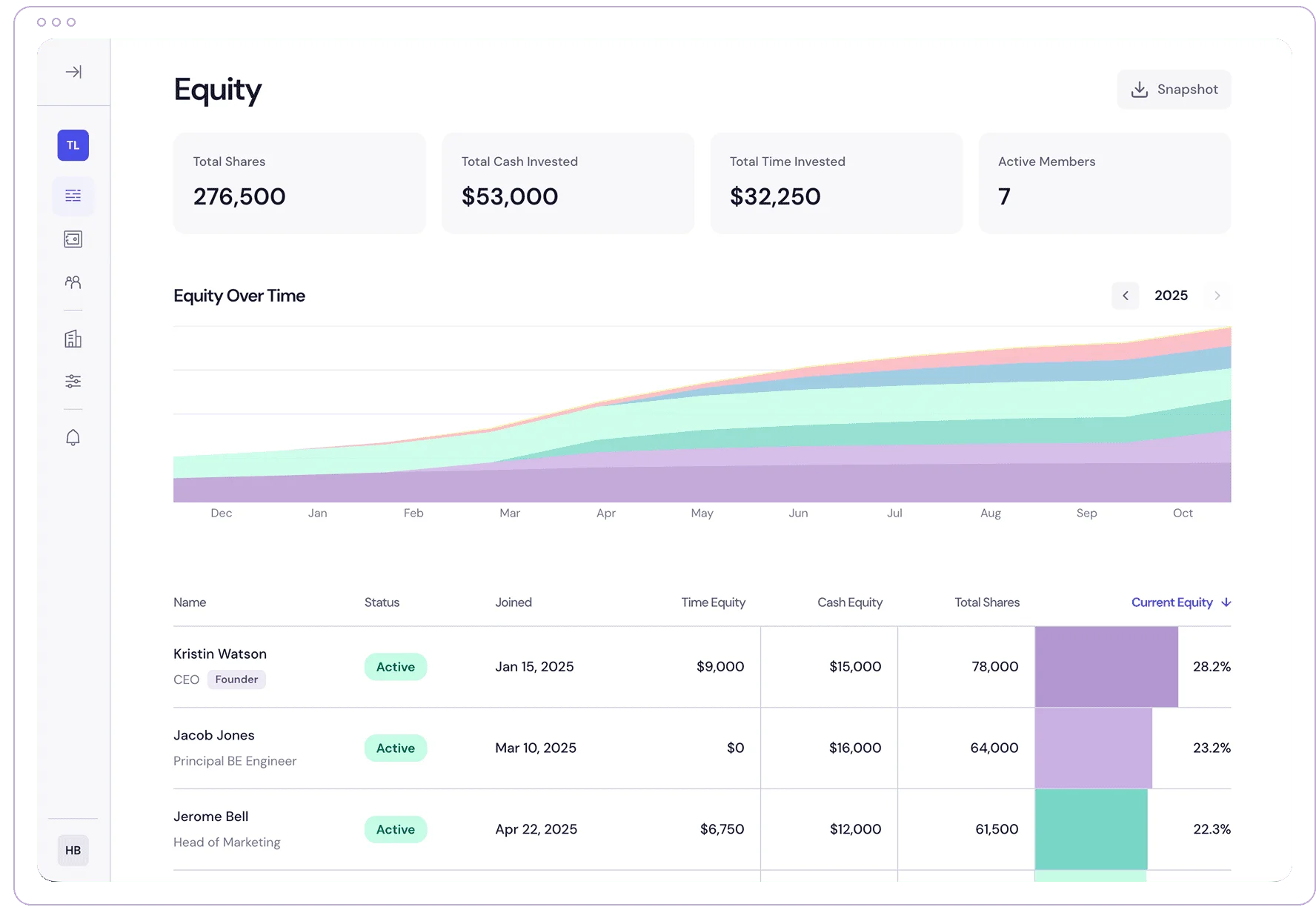
Equity Matrix tracks contributions and calculates ownership in real time, so when you sit down for your six-month review, the data is already there. You’re not guessing or reconstructing from memory. You’re looking at a dashboard and asking: does this match reality?
Frequently asked questions
How often should founders review their equity split?
Every six months for the first two years, then annually. More frequently if something changes: a co-founder’s commitment level shifts, you bring on a new partner, or you’re approaching a fundraise. The key is reviewing proactively, before resentment builds, not reactively after a blowup.
What if my co-founder refuses to discuss equity adjustments?
That’s a red flag, but it doesn’t mean the relationship is over. Start by sharing this framework and framing the review as routine maintenance, not an accusation. If they still refuse, consider bringing in a neutral third party: a startup attorney, an advisor, or a mediator. A co-founder who won’t discuss equity is often a co-founder who knows the split isn’t fair.
Can you adjust equity after a company is incorporated?
Yes, but it’s more complex than adjusting a handshake agreement. In an LLC, you amend the operating agreement. In a C-corp, you might issue new shares, implement reverse vesting, or use equity buybacks. You’ll need a startup attorney. The mechanics are solvable. The harder part is always the conversation, and that’s what the matrix helps with.
How do investors view equity that’s been restructured?
Most experienced investors view thoughtful equity restructuring as a positive signal. It shows founders are making rational decisions based on contribution, not clinging to an outdated agreement. What concerns investors is the opposite: a cap table that clearly doesn’t reflect reality, where someone holds 50% but obviously isn’t contributing 50%. That’s a liability, not an asset. See our guide on what investors look for in cap tables for more on this.
Ready to split equity fairly?
Equity Matrix tracks contributions and calculates ownership automatically.
Get Started FreeThis article is for informational purposes only and does not constitute legal, tax, or financial advice. Equity Matrix is not a law firm, accounting firm, or financial advisor. Consult a qualified professional for guidance specific to your situation.

Co-founder, Equity Matrix
Sebastian writes about startup equity, founder dynamics, and building fair partnerships.
Keep reading
Co-founders in different countries: how to set a fair rate
When one co-founder is in the US and another is in Lithuania, do you value their time at local rates or the same rate for the same work? How to set GHRR fairly across borders.
Read more →How to track co-founder contributions (before it costs you)
A practical system for tracking co-founder contributions: what to log, how often, the fields that matter, and where spreadsheets start to strain.
Read more →