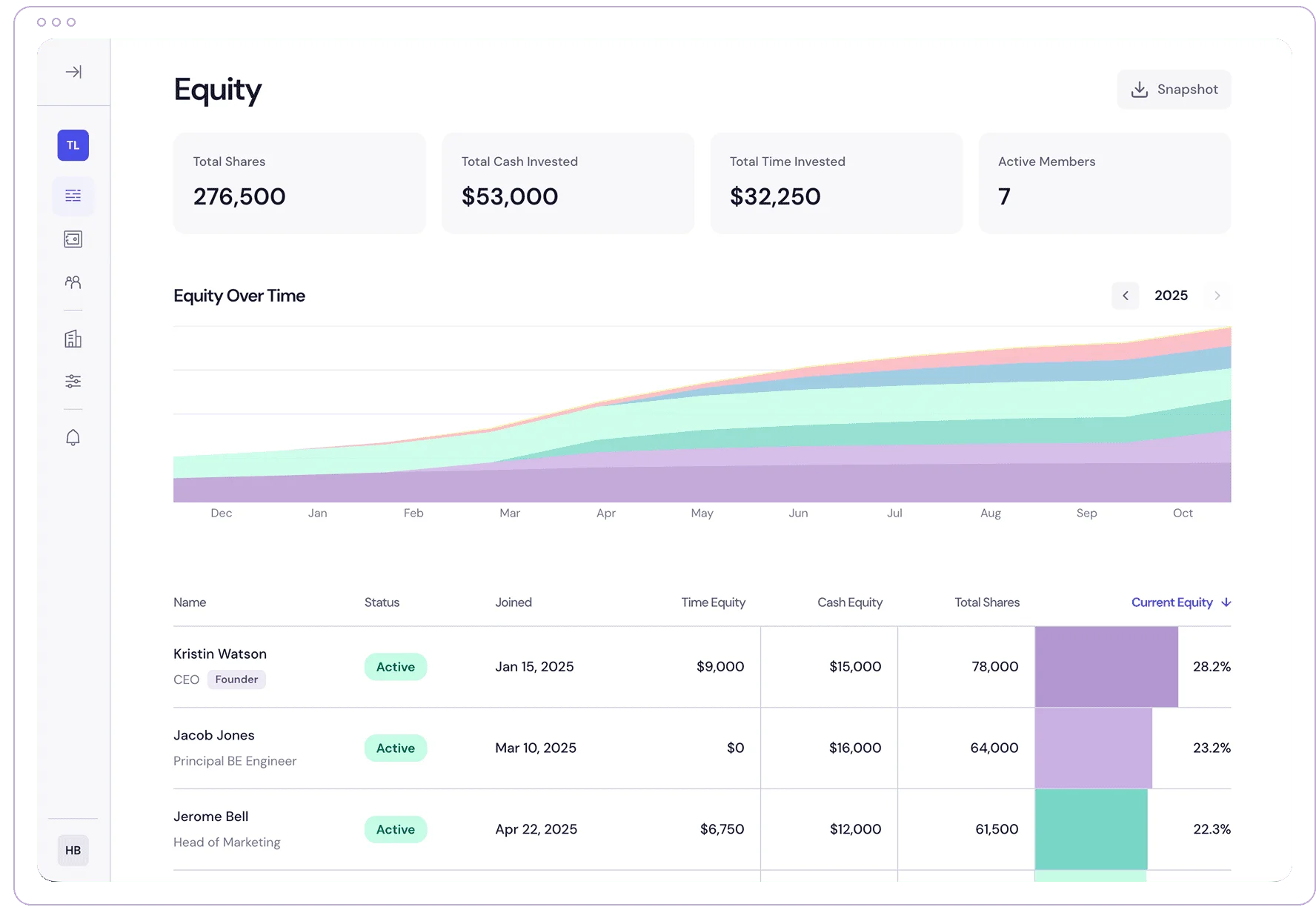
The biggest objection to dynamic equity is that it requires an LLC, and LLC interests do not qualify as QSBS. But you don’t have to choose: you can use an LLC early, then convert and receive C-corp stock that may qualify under the regime in effect when it is issued.
Here’s the problem most early-stage founders face. You’re pre-revenue, nobody’s taking a salary, contributions are uneven, and you have no idea what the company will be worth. Locking in a fixed equity split right now is a recipe for resentment and dead equity. Dynamic equity solves that — and the equity calculator can help you see what a fair split looks like based on each founder’s actual contributions before you freeze anything into a C-corp cap table.
But you also know that C-corps get the best tax treatment at exit, that investors require them, and that stock options only work in a corporate structure. So you feel stuck: do you pick the entity that’s right for today (LLC) or the one that’s right for the future (C-corp)?
The answer is both. Start with the LLC, use dynamic equity while things are messy, and convert to a C-corp when the time is right. You get fair equity in the early days and serious tax benefits at exit. This is the playbook.
What Is QSBS and Why Should You Care
QSBS stands for Qualified Small Business Stock. It’s a provision in the tax code (Section 1202) that lets you exclude capital gains from federal taxes when you sell stock in a qualifying C-corporation. For stock acquired after July 4, 2025, the One Big Beautiful Bill Act provides a $15 million per-taxpayer, per-issuer cap or 10 times basis, whichever is greater. The $15 million cap and $75 million asset limit are indexed for tax years after 2026, making 2027 the first adjustment year with 2025 as the base. Specific 2027 amounts are not available yet, and Treasury guidance remains pending as of September 2026.
To qualify, the company must be a C-corp and run an active business. For stock acquired after July 4, 2025, aggregate gross assets must not exceed $75 million before and immediately after issuance; the exclusion is 50% at three years, 75% at four, and 100% at five. Stock acquired on or before July 4, 2025 keeps the old five-year hold, $10 million or 10-times-basis cap, and $50 million ceiling. Contributed property is counted at fair market value for this gross-assets test.
The problem? Starting as a C-corp on day one creates headaches for early-stage teams, especially if you’re using dynamic equity. That’s where the LLC-first strategy comes in.
The Strategy at a Glance
Here’s the full path in one view:
Phase 1: Year 0 to 2
LLC
Dynamic equity. Track contributions. No shares, no tax headaches.
Phase 2: Year 2 to 3
Convert to C-Corp
Freeze equity. Issue shares. QSBS clock starts.
Phase 3: Year 5+
Exit
Potential QSBS exclusion under the regime applicable when the stock was issued.
The QSBS holding period starts at conversion, not at founding. Plan accordingly.
You get the flexibility of an LLC in the early days, the fundraising power of a C-corp when you need it, and one of the most generous tax exclusions available at exit.
Let’s walk through each phase.
Phase 1: Start with an LLC
Most startups don’t need to be C-corps on day one. In fact, starting as a C-corp too early creates unnecessary complexity. You’re issuing shares before anyone knows what the company is worth. You’re creating phantom tax events. And you’re locking people into fixed ownership percentages before the real work has even started.
An LLC avoids all of that.
Dynamic equity works cleanly in an LLC because LLCs don’t have shares. They have membership interests, which can be allocated however the operating agreement specifies. That means you can track contributions over time and let ownership adjust based on who’s actually building the company, without issuing stock certificates or filing 83(b) elections.
There are real structural advantages here:
- No phantom tax events. In a C-corp, issuing shares at a discount to fair market value can trigger taxable income for the recipient. In an LLC tracking dynamic equity, there are no shares to issue and no discount to worry about.
- Pass-through taxation. LLC income and losses flow through to individual members. There’s no double taxation. While you’re pre-revenue and burning savings, this structure is simpler and cheaper.
- Flexible ownership. You can structure profit-sharing, loss allocation, and equity percentages however makes sense for your team. The operating agreement governs everything.
- Lower overhead. No board of directors, no stock ledger, no annual shareholder meetings. Just build.
Equity Matrix is built specifically for this phase. You track contributions, the split adjusts dynamically, and everyone can see exactly where they stand. When it’s time to convert, you have a clean record of who earned what.
Phase 2: Convert to a C-Corp
The LLC phase doesn’t last forever. At some point, you’ll want to convert to a C-corp. Not just if you’re raising capital or hiring. Every startup that plans to eventually sell or exit should convert. The QSBS tax exclusion alone makes it worth it, even for a bootstrapped team of five founders who never take outside investment.
Think about it: if you and your co-founders build a company worth $10M and sell it, QSBS could save each of you hundreds of thousands of dollars in federal capital gains taxes. That benefit only exists for C-corp stock.
The most common triggers for conversion are:
- You’re ready to stop using dynamic equity. Everyone can take a salary, the split is settled, and it’s time to freeze ownership. This is the natural transition point.
- Raising institutional capital. VCs and most angel investors require C-corp structure. They want preferred stock, board seats, and standard corporate governance.
- Granting stock options. If you want to offer ISOs or NSOs to employees, you need a corporation.
- Pursuing QSBS benefits. QSBS only applies to C-corp stock. The clock doesn’t start until the C-corp issues qualifying shares. The sooner you convert, the sooner the clock starts.
The applicable $75M or $50M threshold is about gross assets, not valuation. This is a common point of confusion. The test generally uses adjusted tax basis for assets such as cash, equipment, and IP, while contributed property is counted at fair market value. It is measured before and immediately after issuance, not by what someone would pay for the company.
The sweet spot for conversion is when your dynamic equity split is settled and everyone is ready to move to a traditional structure. You don’t need to be raising money. You don’t need to be hiring. You just need to be confident the split is fair and it’s time to formalize.
One critical detail. The QSBS holding period starts at conversion, not at founding. Your time as an LLC does not count. If you’ve been operating as an LLC for two years and then convert, your QSBS clock starts at zero on the day the C-corp issues stock. Plan accordingly.
How the Conversion Works
A common approach is to structure the conversion as a nonrecognition exchange under IRC Section 351, though it is not the only conversion route. Section 351 is not a reorganization under Section 368. Done correctly, no gain or loss is recognized when members exchange property for C-corp shares, subject to the provision’s requirements.
Here’s what happens:
-
Your dynamic equity percentages freeze. Whatever the split is at the time of conversion becomes the fixed allocation. This is the moment where dynamic equity becomes a traditional cap table. Having a clean, auditable record of contributions makes this transition straightforward.
-
LLC membership units become C-corp shares. Each member receives shares proportional to their frozen equity percentage. The C-corp’s authorized share count and par value are set during incorporation.
-
Track both income-tax basis and the QSBS rule. Under Section 351, your basis in the new C-corp shares generally carries over from the property exchanged; that is not a general basis step-up. Separately, Section 1202 uses a special fair-market-value basis rule for property contributed in exchange for stock when applying its gain limitation. More on this below.
-
You may need to file 83(b) elections. If any shares are subject to vesting or other restrictions, the 83(b) election must be filed within 30 days. Missing this deadline can result in significant tax liability down the road.
-
You need a lawyer. This is not optional. A botched conversion can trigger taxable gains, invalidate QSBS eligibility, or create structural problems that surface years later during due diligence. Pay for a good corporate attorney. It’s one of the highest-ROI legal expenses a startup will ever incur.
You’ll also want a fair market valuation at the time of conversion. This establishes the baseline for your QSBS calculations and sets the price per share for future option grants.
Phase 3: The QSBS Timeline After Conversion
Once you’ve converted to a C-corp and issued qualifying stock, the QSBS clock starts. Under the updated rules from the One Big Beautiful Bill Act, the exclusion is now tiered based on how long you hold:
| Years After Conversion | QSBS Exclusion |
|---|---|
| Less than 3 years | 0% (no exclusion) |
| 3 years | 50% of gains excluded |
| 4 years | 75% of gains excluded |
| 5+ years | 100% of gains excluded |
Even a year-3 exit saves you real money. You don’t need to wait the full five years for QSBS to matter.
Important: the tiered table only applies to stock acquired after July 4, 2025. The One Big Beautiful Bill Act’s new 3-year and 4-year tiers are not retroactive. If your C-corp issued its stock on or before July 4, 2025, that stock follows the old rules, where you need the full five-year hold to get any exclusion at all, and it’s all-or-nothing (100% at five years, 0% before that). So the year you convert and issue stock determines which regime your shares fall under. If you’re converting now, you’re in the new tiered system. If you already converted before mid-2025, plan around the five-year cliff.
Estimated example: $10M exit at different holding periods
- Year 3 (50% excluded): $5M is excluded and $5M remains taxable under the special partial-exclusion rate rules.
- Year 4 (75% excluded): $7.5M is excluded and $2.5M remains taxable under those rules.
- Year 5+ (100% excluded): The gain may be fully excluded within the applicable $15M or 10-times-basis limit.
These are exclusion estimates, not tax-bill estimates. The 3.8% NIIT may apply, and state treatment varies; consult a tax professional.
Here’s the practical reality. Most startups won’t exit in less than three years after converting anyway. If you convert when you start generating real revenue or raise your first institutional round, you likely have three to five or more years before an acquisition or IPO. The holding period reset from LLC to C-corp sounds alarming, but it’s usually not a problem in practice.
The special QSBS basis rule
This is the part most people miss, and it actually works in your favor.
When property is contributed for stock, Section 1202 has a special rule that uses the property’s fair market value as the stock’s basis for its gain-limitation calculation. That can affect the 10-times-basis alternative, but it does not mean the shareholder receives a general income-tax basis step-up under Section 351.
This can actually be better than having started as a C-corp from day one.
Example: If property you exchange for post-July 4, 2025 qualifying stock has a $500K fair market value, the special Section 1202 basis rule makes the 10-times-basis component $5M. The $15M dollar cap is higher in that example. If the Section 1202 basis were above $1.5M, the 10-times-basis alternative could instead provide the higher limit.
Compare that with post-July 4, 2025 qualifying stock having a $1,000 Section 1202 basis: the 10-times-basis alternative would be $10,000, so the $15M dollar cap would be greater.
The takeaway: contributed property’s fair market value can produce a higher basis specifically for the QSBS gain limitation, potentially increasing the 10-times-basis alternative. Have counsel model both Section 351 carryover basis and Section 1202’s special rule.
What to Watch Out For
This strategy is powerful, but there are several ways to get it wrong.
The applicable gross-assets threshold. For stock acquired after July 4, 2025, aggregate gross assets must not exceed $75M before and immediately after issuance; earlier stock uses the $50M ceiling. The test generally uses adjusted tax basis, but contributed property counts at fair market value. Raised cash counts, so sequence conversion and financing with professional advice.
Active business requirement. At least 80% of the C-corp’s assets must be used in an active trade or business. Certain industries are excluded entirely: finance, insurance, farming, hospitality, mining, and professional services like law and accounting. Real estate holding companies don’t qualify either.
IRC Section 351 compliance. If you use Section 351, the nonrecognition exchange must satisfy its requirements. Other conversion routes exist, and a poorly structured exchange can trigger taxable gain. This is not a DIY project.
State-level nonconformity. Not all states recognize the federal QSBS exclusion. California, Alabama, Mississippi, and Pennsylvania do not offer a state-level QSBS benefit. New Jersey now conforms as of 2026. If you live in a nonconforming state, you’ll still owe state capital gains tax on the full amount, even if your federal gains are excluded.
This is complex tax law. Get a tax attorney involved. Seriously. The cost of professional guidance is trivial compared to the potential tax savings, and the cost of getting it wrong can be enormous.
The Full Timeline
Here’s how the strategy plays out in practice:
-
Year 0 to 2: LLC phase. Use dynamic equity to track contributions. No shares, no phantom tax events, no premature ownership commitments. Build the product, find customers, and figure out who’s actually doing the work. Equity Matrix handles this phase.
-
Year 2 to 3: Convert to C-corp. Freeze equity into a fixed cap table. Issue shares under IRC Section 351. File 83(b) elections if applicable. Get a 409A valuation. The QSBS clock starts now.
-
Year 3 to 5+: C-corp phase. Raise institutional capital. Grant stock options to employees. Build toward scale. Every year that passes increases your QSBS exclusion percentage.
-
Year 5 to 8+: Exit. Whether it’s an acquisition or IPO, qualifying post-July 4, 2025 stock may receive a 100% exclusion within the $15M or 10-times-basis per-taxpayer, per-issuer limit. Earlier stock remains subject to its old-regime limit.
The numbers are real. The strategy is well-established. And the earlier you plan for it, the better your outcome.
Disclaimer
This post is educational content about tax planning strategies. It is not tax advice. The specifics of QSBS eligibility, LLC-to-C-corp conversions, and nonrecognition exchanges depend on your individual circumstances. Tax law is complex, changes frequently, and varies by state. Consult a qualified tax attorney and CPA before making any decisions about entity structure, conversion timing, or tax elections. Nothing in this article should be relied upon as legal or financial guidance for your specific situation.
Frequently Asked Questions
Does time as an LLC count toward the QSBS holding period?
No. The QSBS holding period starts when the C-corp issues qualifying stock. Time spent operating as an LLC does not count toward the three, four, or five year thresholds. This is the single most important detail to understand when planning your conversion timeline.
Can I convert my LLC to a C-corp without triggering taxes?
Often, if the conversion is structured properly under IRC Section 351 as a nonrecognition exchange. Members may contribute their LLC interests or other property to the new C-corp for stock, and no gain or loss is recognized if the requirements are met. Section 351 is a common route, not the only one, and it is not a Section 368 reorganization. Work with a corporate and tax attorney.
What if I never plan to exit? Is the conversion still worth it?
QSBS is specifically about excluding capital gains at the time you sell your stock. If you’re building a lifestyle business with no plans for an acquisition or IPO, staying as an LLC may be simpler and more tax-efficient overall. The LLC-to-C-corp conversion strategy makes the most sense for companies that are targeting a future exit event where significant capital gains will be realized.
What is QSBS?
QSBS stands for Qualified Small Business Stock. For stock acquired after July 4, 2025, Section 1202 provides tiered exclusions subject to a $15 million or 10-times-basis cap and a $75 million gross-assets ceiling. Earlier stock keeps the five-year hold, $10 million or 10-times-basis cap, and $50 million ceiling. The company must also satisfy the active-business and other requirements.
Do I need to raise venture capital for this strategy to work?
No. This strategy works for bootstrapped companies too. You don’t need outside investors to convert from an LLC to a C-corp, and you don’t need them to qualify for QSBS. Even a team of co-founders who never take outside investment can benefit. The only requirement is that the company is a C-corp and the stock meets the Section 1202 criteria.
What’s the difference between gross assets and valuation?
Gross assets are not the company’s valuation. The Section 1202 test generally uses adjusted tax basis, but contributed property is counted at fair market value, and it is measured before and immediately after issuance. The applicable ceiling is $75 million for post-July 4, 2025 stock and $50 million for earlier stock.
Can each co-founder exclude $15 million individually?
For post-July 4, 2025 stock, the $15 million cap (or 10 times basis, whichever is greater) applies per taxpayer, per issuer. Earlier stock retains the $10 million or 10-times-basis cap. Actual eligibility and limits depend on each taxpayer’s facts, so consult a tax professional.
What happens if I convert too late and the company exceeds $75M in gross assets?
For post-July 4, 2025 stock, the company’s gross assets must not exceed $75 million both before and immediately after issuance; the corresponding ceiling is $50 million for earlier stock. Stock that satisfied the applicable test when issued may still qualify, subject to the other Section 1202 requirements.
Ready to split equity fairly?
Equity Matrix tracks contributions and calculates ownership automatically.
Get Started FreeThis article is for informational purposes only and does not constitute legal, tax, or financial advice. Equity Matrix is not a law firm, accounting firm, or financial advisor. Consult a qualified professional for guidance specific to your situation.

Co-founder, Equity Matrix
Sebastian writes about startup equity, founder dynamics, and building fair partnerships.
Keep reading
Washington just made equity clawbacks illegal. Check your vesting docs
A new Washington law extends its non-compete ban to equity forfeiture and clawback clauses. If your vesting docs claw back equity for competing, they may soon be void.
Read more →The R&D tax deadline just passed. Here's what founders can still do
OBBBA restored full R&D expensing and opened a retroactive refund window that closed July 6, 2026. What it means for your startup's taxes now, and what you can still do.
Read more →