Convertible notes and SAFEs are the two most common instruments for raising early-stage startup capital. Both let investors put in money now and receive equity later, but they differ in structure, complexity, and how they affect your cap table.
If you’re about to raise your first round, someone will ask: “Are you doing a SAFE or a note?” Your answer matters. It affects how much equity you give up, how fast you can close, and how complicated your next priced round becomes.
This post breaks down the real differences, with specific attention to dilution. That’s what actually costs you money.
The Basics
Convertible Notes
A convertible note is a loan that converts into equity. It has all the hallmarks of debt: a principal amount, an interest rate (typically 2-8% annually), and a maturity date (usually 12-24 months).
When you sign a convertible note, you’re technically borrowing money from the investor. If everything goes as planned, that debt converts to equity at your next priced round. The conversion price is usually set by a valuation cap, a discount rate, or both. The investor gets whichever produces a better deal.
If the note reaches maturity without converting, repayment of principal and accrued interest is the contractual default. In practice, companies and investors usually negotiate an extension or conversion, but the leverage shifts to the investor and the exact result depends on the note.
SAFEs
A SAFE (Simple Agreement for Future Equity) is not debt. There’s no interest rate, no maturity date, and no repayment obligation. It’s a contractual right: the investor gives you money now, and you promise them equity when a conversion event occurs (almost always a priced round).
Y Combinator created the SAFE in 2013 specifically because convertible notes were too heavy for early-stage deals. The goal was a founder-friendly instrument that could close in days, not weeks.
For a deeper dive into SAFE mechanics, valuation caps, and conversion math, see our complete SAFE guide.
Side-by-Side Comparison
| Feature | Convertible Note | SAFE |
|---|---|---|
| Legal classification | Debt | Neither debt nor equity |
| Interest rate | Yes (2-8% annual) | No |
| Maturity date | Yes (12-24 months) | No |
| Repayment obligation | Yes, at maturity | No |
| Document length | 8-15 pages | 5-6 pages |
| Typical legal costs | $2,000-$10,000+ | $0-$2,000 |
| Negotiation time | Days to weeks | Hours to days |
| Investor protections | More (debt covenants, maturity) | Fewer (contractual right only) |
| Dilution predictability | Lower (interest compounds) | Higher (fixed conversion math) |
| Balance sheet impact | Shows as debt | No debt on books |
| Standardization | Varies by law firm | YC template is standard |
The pattern is clear: SAFEs are simpler, cheaper, and faster. Convertible notes give investors more protection and leverage.
How Each Affects Dilution
This is where the choice really matters. The instrument you pick changes how much of your company you give away, sometimes by a meaningful amount.
Convertible Note Dilution: The Interest Problem
With a convertible note, interest accrues and converts to additional equity. That means the longer it takes you to raise a priced round, the more dilution you eat.
Here’s a concrete example:
- You raise $500,000 on a convertible note
- 5% annual interest rate
- 18 months until your Series A
- $5M valuation cap
The interest adds up: $500,000 x 5% x 1.5 years = $37,500 in accrued interest. At conversion, $537,500 converts rather than $500,000. That is 7.5% more conversion value; the actual extra shares and dilution depend on the note’s pre-money conversion price and the financing capitalization.
Now imagine you raised $1.5M across multiple notes, and it takes you 24 months to hit your Series A. The interest alone could add $100K+ in conversion value. That comes directly out of founder equity.
SAFE Dilution: What You See Is What You Get
Post-money SAFEs (the current YC standard since 2018) make dilution math straightforward.
Same example:
- You raise $500,000 on a post-money SAFE
- $5M post-money valuation cap
- 18 months until your Series A
The SAFE represents approximately $500,000 / $5,000,000 = 10% of the SAFE’s defined Company Capitalization before new money and the round’s option-pool increase. There is no interest creep, but the new priced round and new pool dilute the SAFE holder.
The Dilution Difference, Visualized
| Scenario | Convertible Note (5% interest) | Post-Money SAFE |
|---|---|---|
| $500K, converts at 12 months | $525,000 conversion value; shares depend on pre-money price | $500,000; ~10% of defined pre-round capitalization |
| $500K, converts at 18 months | $537,500 conversion value; shares depend on pre-money price | $500,000; ~10% of defined pre-round capitalization |
| $500K, converts at 24 months | $550,000 conversion value; shares depend on pre-money price | $500,000; ~10% of defined pre-round capitalization |
| $1M, converts at 24 months | $1,100,000 conversion value; shares depend on pre-money price | $1,000,000; ~20% of defined pre-round capitalization |
That last row shows $100,000 more note conversion value after two years. It does not establish a fixed two-percentage-point dilution difference: a note cap is a pre-money pricing mechanism, not a guaranteed post-money ownership percentage, so the resulting ownership depends on the conversion capitalization.
A Note on Pre-Money vs. Post-Money SAFEs
Before 2018, SAFEs used pre-money valuation caps, which made dilution harder to predict because every new SAFE affected the math for every other SAFE. The post-money version makes each SAFE’s percentage of its defined pre-financing Company Capitalization easier to estimate, while the priced round and its pool increase still dilute SAFE holders.
If you want the full breakdown of how these differ, our SAFE notes guide covers the conversion math in detail.
When to Use Each
Neither instrument is universally better. The right choice depends on your situation.
Use a SAFE When…
- You’re at pre-seed or seed stage. SAFEs were built for this. The speed and simplicity match the pace of early fundraising.
- You want to close quickly. A SAFE can close same-day with a DocuSign. Notes require more legal back-and-forth.
- You’re raising from many small investors. If you’re collecting $25K-$100K checks from 10-20 angels, the overhead of negotiating individual note terms is brutal. SAFEs standardize everything. (Worth noting: the INVEST Act passed by the House would raise the Reg CF crowdfunding cap from $5M to $10M and expand who qualifies as an accredited investor — changes that could meaningfully expand your investor pool for SAFE raises.)
- You’re coming out of an accelerator. YC, Techstars, and most accelerators use SAFEs. Investors in that ecosystem expect them.
- You want more predictable dilution. Post-money SAFEs make the pre-financing percentage easier to estimate, though the round and its pool increase still dilute holders.
- You don’t want debt on your balance sheet. SAFEs keep your books cleaner, which can matter if you’re applying for grants or government programs.
Use a Convertible Note When…
- Your lead investor requires it. Some institutional angels and small funds have a mandate to use notes. Don’t die on this hill. The terms matter more than the instrument.
- You have a longer expected timeline to your next round. If you know it’ll be 18-24+ months, sophisticated investors may want the interest as compensation for the wait. Offering a note can unlock capital you wouldn’t get with a SAFE.
- International investors are involved. Some jurisdictions don’t recognize SAFEs. Notes, as debt instruments, have clearer legal standing in many countries.
- You’re doing a bridge round. Between a seed and Series A, bridge notes are common. Existing investors top up with a note that converts at the next round.
- You want to signal seriousness to investors who value protections. Some investors see SAFEs as too founder-friendly. A note signals you’re willing to share risk.
Quick Decision Guide
| If you… | Consider a… |
|---|---|
| Are raising your first round | SAFE |
| Have 10+ small investors | SAFE |
| Want to close in days | SAFE |
| Need to raise from international investors | Convertible Note |
| Are bridging between priced rounds | Convertible Note |
| Have a lead who insists on debt protections | Convertible Note |
| Want the simplest possible cap table | SAFE |
| Expect 18+ months before next round | Either (note compensates wait; SAFE avoids interest) |
How Fundraising Instruments Interact with Dynamic Equity
If you’re using a dynamic equity model to split ownership among co-founders, you need to understand how fundraising fits in.
Get Your Internal Equity Right First
Before you talk to a single investor, your co-founder equity should make sense. If you haven’t figured out how to split equity among yourselves yet, do that first. No investor wants to fund a team that can’t agree on who owns what.
Dynamic equity models, where ownership adjusts based on contributions over time, are powerful for early-stage teams. But they’re designed for the pre-investment phase.
Fundraising Freezes Your Dynamic Split
When you sign a SAFE or convertible note, your dynamic equity effectively needs to become a fixed cap table. The instrument’s future conversion math requires a defined capitalization, even though a note cap does not guarantee a post-money percentage.
This is the moment where you convert your dynamic split to a fixed cap table. Your contribution-based percentages freeze, and you move to a traditional equity structure.
How Dilution Hits Each Co-Founder
The dilution from a SAFE or note hits every existing shareholder proportionally. Here’s how that looks:
Before SAFE:
| Co-Founder | Dynamic Split |
|---|---|
| Alice | 55% |
| Bob | 35% |
| Carol | 10% |
After a $500K SAFE on a $5M post-money cap, before the priced round (~10% of defined Company Capitalization):
| Co-Founder | Post-Investment |
|---|---|
| Alice | 49.5% |
| Bob | 31.5% |
| Carol | 9.0% |
| SAFE Investor | 10.0% |
This simplified table assumes no other SAFEs, notes, or options. The founders’ relative split stays the same, but the new priced round and any pool increase will dilute both founders and the SAFE investor.
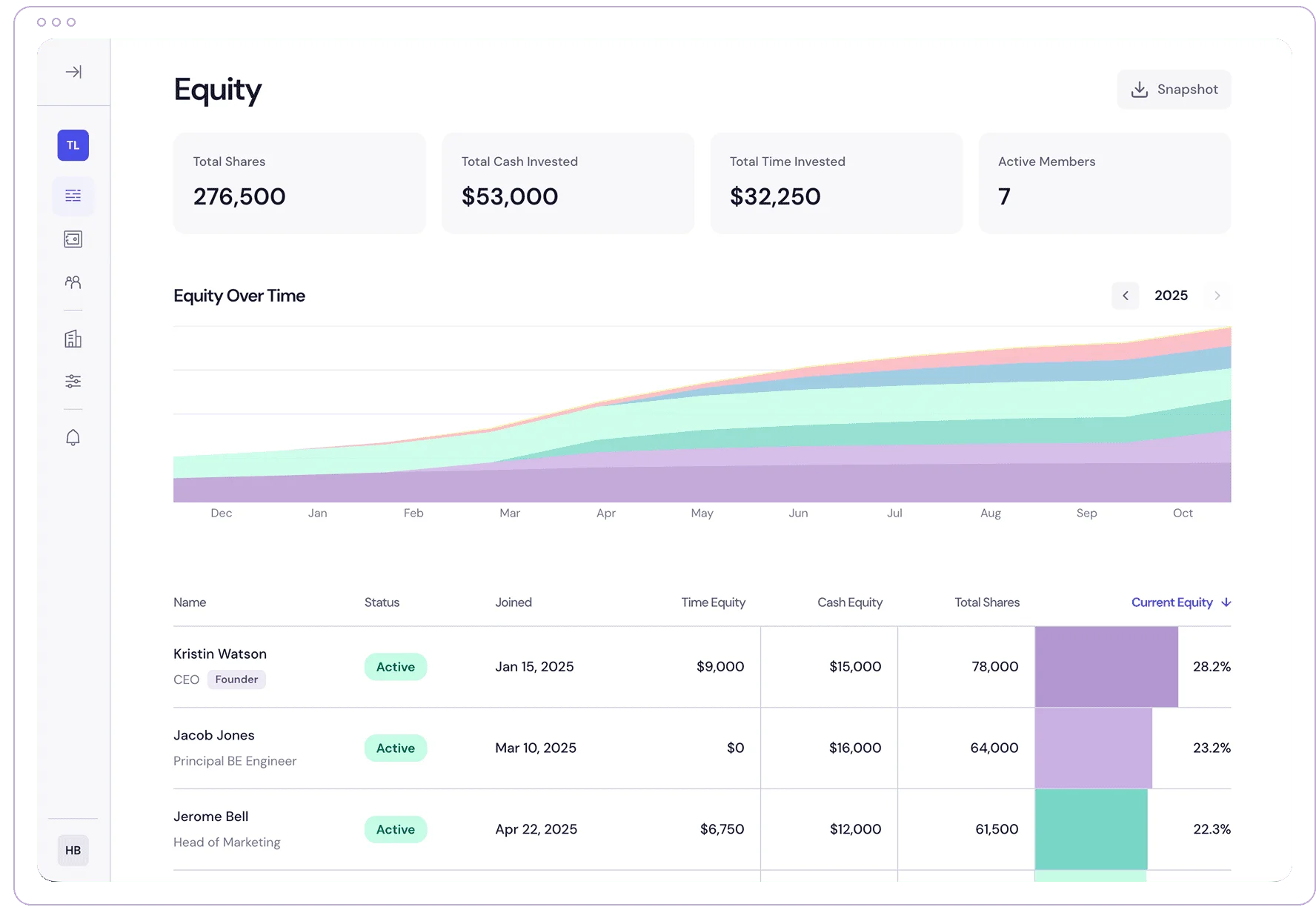
Equity Matrix is built to handle exactly this transition: tracking dynamic contributions before investment and modeling how SAFEs or notes will dilute each co-founder’s stake.
Frequently Asked Questions
Can I use both SAFEs and convertible notes in the same round?
Technically, yes. Some founders issue SAFEs to smaller angels and notes to a lead investor who demands them. But it complicates your cap table and your next round’s conversion math. Your Series A lawyers will charge you more, and the pro rata calculations get messy. If you can avoid mixing, do.
What happens if I never raise a priced round?
With a convertible note, principal plus accrued interest is contractually due at maturity if the note has not converted. In practice, most parties negotiate an extension or conversion, but the investor has leverage and the note’s terms control.
With a SAFE, nothing happens. There’s no maturity date and no repayment obligation. The SAFE just sits there indefinitely. If the company shuts down, SAFE holders are typically behind debt holders in the liquidation waterfall and often get nothing.
Do SAFEs show up as debt on my balance sheet?
No. SAFEs are not debt instruments. They’re classified as equity or a liability depending on the accounting treatment, but they don’t show up as a loan. Convertible notes do, which can affect your debt-to-equity ratios, loan applications, and how your financials look to future investors.
When should I convert my dynamic equity to a fixed cap table?
The short answer: when you’re about to raise outside capital or bring on employees who need stock options. The investment itself forces the conversion because the investor needs to know what percentage of the company they’re buying.
Ideally, lock in your dynamic split a few weeks before you start fundraising. This gives you time to resolve any disagreements and get the legal paperwork done. For a step-by-step walkthrough, see our guide on converting a dynamic split to a fixed cap table.
Whether you go with a SAFE or a convertible note, the most important thing is understanding what you’re giving up. Run the dilution scenarios before you sign anything — the equity calculator can help you model how a SAFE or note affects each co-founder’s stake before and after conversion.
SAFE Notes Explained: How They Work and How They Dilute Founder Equity
Converting a Dynamic Split to a Fixed Cap Table
If you want to model how a SAFE or note will affect your specific cap table, Equity Matrix makes it easy to run the numbers before you commit.
Ready to split equity fairly?
Equity Matrix tracks contributions and calculates ownership automatically.
Get Started FreeThis article is for informational purposes only and does not constitute legal, tax, or financial advice. Equity Matrix is not a law firm, accounting firm, or financial advisor. Consult a qualified professional for guidance specific to your situation.

Co-founder, Equity Matrix
Sebastian writes about startup equity, founder dynamics, and building fair partnerships.
Keep reading
SAFE notes explained: how they work and dilute equity
How SAFE notes actually work: conversion mechanics, valuation caps vs. discount rates, how much they dilute founders, and the terms you should negotiate before signing.
Read more →Pro forma cap table: how to model your equity before you raise
A pro forma cap table shows who owns what after your next round closes. How to build one, with a worked example of SAFE conversion and the option pool shuffle.
Read more →