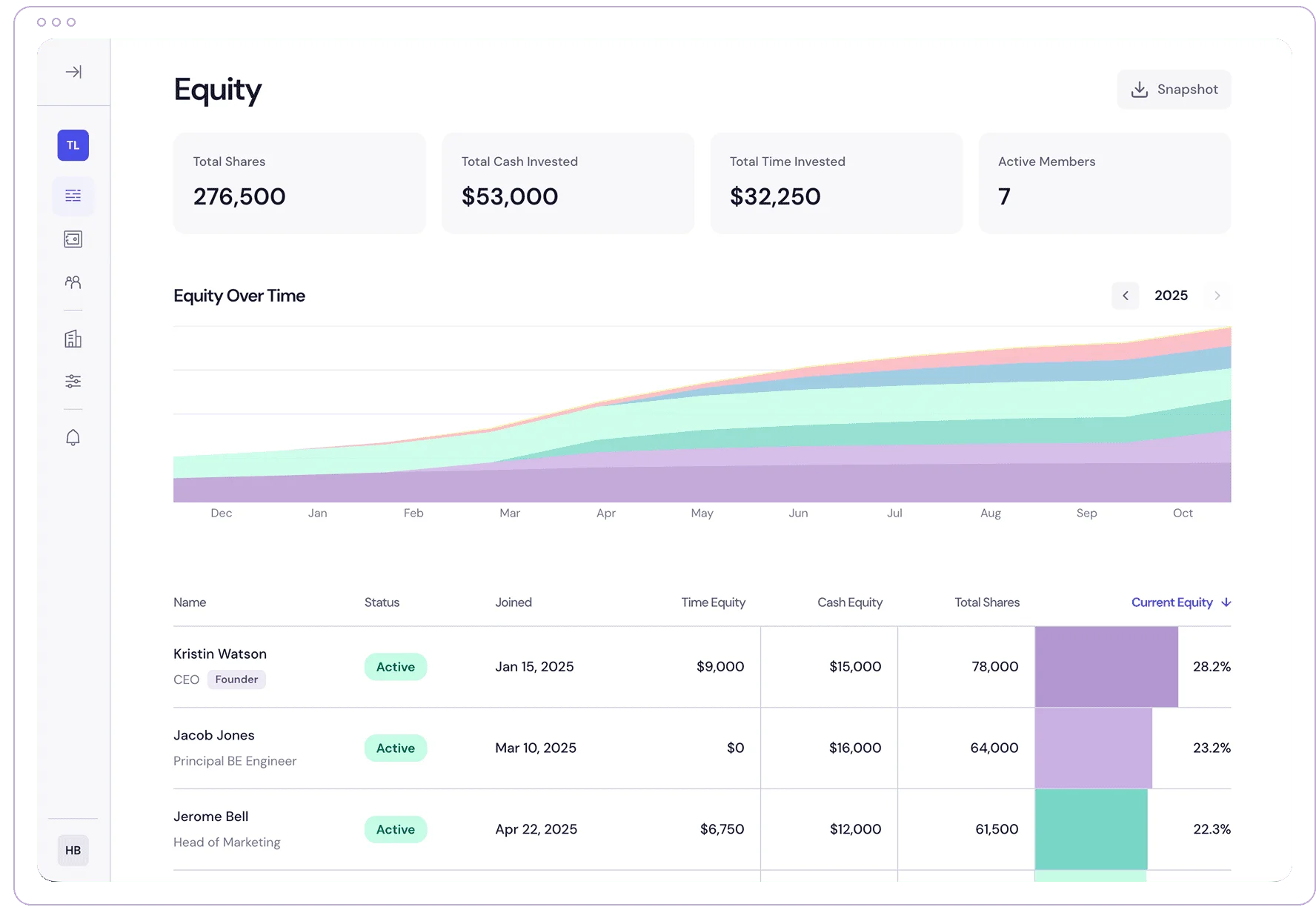
Dynamic equity adjusts ownership percentages based on ongoing contributions, while fixed equity locks in percentages on day one — the choice between them is one of the most consequential decisions a founding team makes.
Two founders start a company together. They split equity 50/50.
One year later, one founder has worked full-time while the other kept their day job and contributed evenings and weekends. Same equity. Very different contributions. This scenario shows up constantly — our 2026 equity split research found that only 3% of early-stage teams use contribution-based models, even though it’s the most recommended approach in founder communities.
Sound familiar?
This is the core problem with fixed equity splits. They’re decided once, usually on day one, based on predictions about who will contribute what. Those predictions are often wrong. This is exactly how 50/50 splits go wrong.
Dynamic equity offers an alternative. Instead of locking in ownership upfront, you track contributions over time and let the split reflect reality.
Both approaches have their place. Here’s how to know which one fits your situation.
Quick Comparison: Fixed vs. Dynamic Equity
| Factor | Fixed Equity | Dynamic Equity |
|---|---|---|
| When decided | Day one (or soon after) | Ongoing, based on contributions |
| Flexibility | None after signing | Adjusts as contributions change |
| Best for | Post-funding, established roles | Pre-funding, uncertain contributions |
| Complexity | Simple to set up | Requires tracking system |
| Investor preference | Required for funding | Must convert before raising |
How Fixed Equity Works
Fixed equity is the traditional approach. Founders negotiate a split, put it in writing, add vesting, and move on.
The split is locked. If circumstances change—someone contributes more than expected, someone less—the ownership percentages stay the same.
This is how most funded startups operate. It’s what investors expect. It’s what lawyers are used to drafting.
Advantages:
- Clean and simple
- Clear ownership from day one
- Required for institutional investment
- Standard legal templates exist
Disadvantages:
- Based on predictions that may be wrong
- Creates dead equity when someone underdelivers
- Hard to adjust without conflict
- Can breed resentment if contributions diverge
Fixed equity works best when you have high confidence in what everyone will contribute. The less certainty you have, the more risk you’re taking with a fixed split.
How Dynamic Equity Works
Dynamic equity flips the script. Instead of predicting future contributions, you track actual contributions as they happen.
The most well-known framework is the Slicing Pie model developed by Mike Moyer. The concept: every contribution earns “slices” of equity based on its fair market value. Time, money, ideas, relationships, equipment—everything gets tracked.
As you contribute more, you earn more slices. Your ownership percentage is your slices divided by total slices.
Example:
- Founder A: 5,000 slices (50%)
- Founder B: 3,000 slices (30%)
- Founder C: 2,000 slices (20%)
If Founder B puts in more work next month and earns 1,000 more slices, the split becomes:
- Founder A: 5,000 slices (45.5%)
- Founder B: 4,000 slices (36.4%)
- Founder C: 2,000 slices (18.2%)
Ownership adjusts automatically based on reality.
How to Calculate Dynamic Equity
Dynamic equity uses a straightforward formula. Your ownership percentage equals your contribution value divided by total contribution value.
The Core Formula
Ownership % = (Your Slices ÷ Total Slices) × 100
Where slices are calculated as:
Unpaid Time Contribution = Hours Worked × GHRR × 2
Cash Contribution = Amount Invested × Cash Multiplier
GHRR is the person’s fair-market annual salary divided by 2,000; it is not pre-multiplied. Standard Slicing Pie then applies 2x to non-recoverable unpaid time and 4x to at-risk cash.
Why This Formula Works
The formula ensures contributions are measured by their economic value, with the standard risk multiplier for each category. A founder contributing $50,000 in at-risk cash earns 200,000 slices; a founder would earn the same number from 1,000 unpaid hours at a $100 GHRR after applying the 2x time multiplier.
A Complete 6-Month Example
Let’s follow three co-founders through six months of building a startup. This shows exactly how dynamic equity calculations work in practice.
The Team:
- Alex: Technical co-founder, $150K market rate ($75/hr), can work 30 hrs/week
- Jordan: Business co-founder, $120K market rate ($60/hr), working part-time 15 hrs/week while employed
- Morgan: Contributing $30,000 seed capital, minimal time initially
Standard Multipliers: 2x for unpaid time and 4x for at-risk cash
Month 1
| Founder | Hours | GHRR | Time Slices (2x) | Cash | Cash Slices (4x) | Total Slices |
|---|---|---|---|---|---|---|
| Alex | 120 | $75 | $18,000 | $0 | $0 | 18,000 |
| Jordan | 60 | $60 | $7,200 | $0 | $0 | 7,200 |
| Morgan | 0 | $60 | $0 | $30,000 | $120,000 | 120,000 |
| Total | 145,200 |
Month 1 Ownership:
- Alex: 18,000 ÷ 145,200 = 12.4%
- Jordan: 7,200 ÷ 145,200 = 5.0%
- Morgan: 120,000 ÷ 145,200 = 82.6%
Morgan’s cash dominates early. This is expected—cash contributions front-load equity.
Month 3
| Founder | Cumulative Time Value | Cumulative Cash Value | Total Slices |
|---|---|---|---|
| Alex | $54,000 (360 hrs) | $0 | 54,000 |
| Jordan | $21,600 (180 hrs) | $0 | 21,600 |
| Morgan | $0 | $120,000 | 120,000 |
| Total | 195,600 |
Month 3 Ownership:
- Alex: 54,000 ÷ 195,600 = 27.6%
- Jordan: 21,600 ÷ 195,600 = 11.0%
- Morgan: 120,000 ÷ 195,600 = 61.3%
Time contributions are catching up. Alex has more than doubled their stake.
Month 6
| Founder | Cumulative Time Value | Cumulative Cash Value | Total Slices |
|---|---|---|---|
| Alex | $108,000 (720 hrs) | $0 | 108,000 |
| Jordan | $43,200 (360 hrs) | $0 | 43,200 |
| Morgan | $7,200 (60 hrs) | $120,000 | 127,200 |
| Total | 278,400 |
Month 6 Ownership:
- Alex: 108,000 ÷ 278,400 = 38.8%
- Jordan: 43,200 ÷ 278,400 = 15.5%
- Morgan: 127,200 ÷ 278,400 = 45.7%
Key Insight: Despite contributing $30,000 in cash, Morgan’s ownership has dropped from 82.6% to 45.7% as the others contributed time. The split now reflects six months of actual work patterns—not day-one guesses.
If this were fixed equity decided on day one, the team might have given Morgan 60% for the capital contribution. Six months later, Alex would be doing most of the work while owning far less. Dynamic equity prevented that misalignment.
The Case for Dynamic Equity
Dynamic equity solves several problems that plague early-stage startups.
It Prevents Dead Equity
With fixed equity, a co-founder who leaves early keeps their entire vested stake. With dynamic equity, their ownership reflects what they actually contributed. If their slices equal 10% of the pie when they leave, they keep only the slices permitted by the good-reason or bad-reason departure rules—not a fixed 10%. Their percentage continues to dilute as others add slices.
It Removes the Day-One Guessing Game
Most equity splits happen before founders really know what they’re building or who will do what. Research shows that 42% of founding teams decide on equity within a single day. That’s a huge decision made with almost no information.
Dynamic equity lets you delay that decision—not forever, but until you have real data.
Rob Walling’s TOC framework — Time, Opportunity Cost, Cash — packages the same contribution-tracking philosophy specifically for bootstrapped and indie SaaS founders and is worth reading as a complement to Slicing Pie.
It Aligns Incentives Continuously
In a fixed split, there’s no equity upside to working harder. Your slice is your slice. In a dynamic model, ongoing contributions earn ongoing equity. The person putting in 60-hour weeks gets rewarded for it.
Dynamic equity is especially powerful when co-founders have different situations. One is full-time, one is part-time. One is funded, one isn’t. One has a family, one is single. Contributions will naturally vary.
The Case for Fixed Equity
Dynamic equity isn’t right for every situation.
Investors Require Fixed Caps
You cannot raise institutional money with a dynamic equity structure. VCs need to know exactly who owns what. Before you take outside capital, you must freeze your split and convert to a traditional cap table.
It Can Create Anxiety
Some founders find dynamic equity stressful. There’s always a question hanging over the team: who’s contributing more? Who’s earning more slices? This can undermine trust if not managed well.
Tracking Requires Discipline
Dynamic equity only works if you actually track contributions. This means regular logging—weekly at minimum. If you’re bad at administrative tasks, the system breaks down.
Some Contributions Are Hard to Value
How many slices is a critical introduction worth? What about an idea? A patent? Some contributions resist easy quantification. You’ll need agreed-upon rules, and those rules will sometimes feel arbitrary.
When to Use Dynamic Equity
Dynamic equity fits best in these scenarios:
Pre-product, pre-funding. You’re still figuring out what you’re building and who will do what. Contributions are uncertain. This is especially true for AI startups, where compute costs can dwarf salaries and the relative value of capital versus labor contributions is genuinely hard to predict upfront.
Part-time founders. Not everyone can go full-time immediately. Dynamic equity lets you track different commitment levels fairly.
Founders with different situations. One founder is bootstrapping on savings. Another is working nights and weekends while employed. A third is contributing capital. Dynamic equity can value all these fairly.
Previous equity conflicts. If you’ve been burned by unequal contributions in a 50/50 split before, dynamic equity prevents repeating the mistake.
Sweat equity for cash-poor startups. When you can’t pay market salaries, tracking contributions as equity ensures fairness. Learn more about how to value sweat equity. Dynamic equity is also the natural tool for founders using a buy-back-your-time approach — when you delegate work to people who can’t be paid in cash yet, you need a system that fairly tracks what they’re contributing.
When to Use Fixed Equity
Fixed equity is appropriate when:
You’re raising institutional money. VCs will require it. No exceptions.
Roles are clearly defined. If you know exactly who’s doing what and you’re confident in commitment levels, fixed equity is simpler.
You’ve worked together before. Prior experience reduces uncertainty about who will contribute what.
Everyone is full-time. Equal commitment makes fixed splits less risky.
You’re beyond the at-risk stage. Once the business reaches breakeven or self-sufficiency, the uncertainty that makes dynamic equity valuable has largely resolved. Institutional funding can also require a freeze of your dynamic split. Revenue alone is not a freeze trigger.
The Transition: Dynamic to Fixed
Here’s the most practical approach: start dynamic, then freeze.
Use dynamic equity during the uncertain early period. Track contributions. Let the split reflect reality. Then, at breakeven or self-sufficiency—or when an event such as institutional funding requires fixed ownership—freeze the split.
At that moment, you take the current dynamic percentages and convert them to fixed ownership with standard vesting from that point forward.
Typical Freeze Points
| Trigger | Why It Makes Sense |
|---|---|
| Raising a priced round | Investors require a fixed cap table |
| Breakeven or self-sufficiency | At-risk contributions have ended |
| Another agreed conversion event | The event requires fixed ownership |
The freeze isn’t one-way. You can always negotiate changes to a fixed split. But having real contribution data makes that negotiation much easier.
What Investors Think About Dynamic Equity
Most institutional investors have not worked with dynamic equity directly. They expect fixed caps. But that doesn’t mean your dynamic equity history is a liability—it can be a strength. The legal picture is nuanced too: what lawyers actually say about dynamic equity covers both the attorneys who swear by it and the ones who advise caution, along with the specific objections that tend to be overblown versus the ones worth taking seriously.
The Investor Perspective
VCs need to know exactly who owns what percentage of the company. A dynamic, fluctuating cap table makes their job impossible:
- Can’t calculate ownership percentages post-investment
- Can’t project dilution across funding rounds
- Legal complexity for term sheets and shareholder agreements
This is why you must freeze your split before taking investment.
Why Investors Actually Like Contribution-Based Splits
Once frozen, your dynamic equity history becomes a selling point. Here’s what experienced investors hear when you explain it:
| What You Say | What Investors Hear |
|---|---|
| ”We tracked contributions for 18 months before freezing" | "These founders are data-driven and fair" |
| "The split reflects actual work, not day-one guesses" | "Lower risk of co-founder conflict" |
| "Everyone earned their stake" | "The team is aligned and committed" |
| "We have documented contribution records" | "These founders are organized and transparent” |
Compare this to: “We split it 50/50 because we started as friends.” That story raises red flags about future disputes.
Preparing for Due Diligence
Before your first investor meeting, have these ready:
- Clean cap table — Fixed percentages, standard vesting from freeze date
- Contribution summary — High-level overview of how the split was determined
- Agreement documentation — Signed dynamic equity agreement (shows legal foundation)
- Freeze rationale — Why you froze when you did (product milestone, team stability, etc.)
You don’t need to show detailed hour logs. Investors care about the outcome (fair, documented split) not the mechanics.
Understanding what investors look for in cap tables can help you prepare the full picture.
Setting Up Dynamic Equity
If you decide to use dynamic equity, here’s how to structure it:
1. Define What Gets Tracked
Typical categories:
- Time: Hours worked, valued at agreed hourly rates
- Cash: At-risk money invested, at the standard 4x multiplier
- Expenses: Non-recoverable unreimbursed business expenses, at the standard 2x multiplier
- Assets: Equipment, IP, or other resources contributed
2. Assign Values
The standard approach: value contributions at their fair market rate.
A founder who could earn $200K in the job market has a GHRR of $200K / 2,000 = $100/hour. If they’re working 20 unpaid hours a week, they earn 20 x $100 x 2 = $4,000 in slices per week. Our equity calculator can help you run these calculations.
At-risk cash gets the standard 4x multiplier because cash is scarcer than time for most startups.
3. Track Regularly
Weekly is ideal. Monthly at minimum. The more frequently you track, the more accurate your data.
4. Review Together
Monthly or quarterly, sit down and review the numbers. Make sure everyone agrees the tracking is accurate. Surface issues early. If you’re using a fixed split or transitioning out of dynamic equity, the equity review matrix framework provides a structured two-axis model — contribution-ownership gap vs. performance trajectory — for deciding whether and how to adjust.
5. Plan the Freeze
Agree in advance on what triggers the conversion to fixed equity. Put it in writing.
Common Mistakes With Dynamic Equity
Dynamic equity fails when teams skip the fundamentals. Avoid these errors.
Mistake 1: Not Agreeing on Hourly Rates Upfront
The most common conflict: founders disagree about what their time is worth. One claims $200/hour based on previous salary. Another says market rate is $100/hour.
The Fix: Research comparable salaries before you start tracking. Use sources like Glassdoor, Levels.fyi, or LinkedIn Salary. Document agreed rates in writing. Update them annually.
Mistake 2: Forgetting the Cash Multiplier
Cash is scarcer than time for most startups. Without a multiplier, the founder investing $50,000 gets the same equity as someone working 500 hours at $100/hour—but cash carries more risk.
The Fix: Use the standard 4x multiplier for at-risk cash. Document the treatment before anyone contributes cash.
Mistake 3: Tracking Inconsistently
Dynamic equity requires regular logging. Miss a few weeks and you’re reconstructing from memory. Miss a few months and the system collapses into arguments.
The Fix: Track weekly, minimum. Use a shared spreadsheet or dedicated tool. Review together monthly to catch discrepancies early.
Mistake 4: Valuing “Ideas” as Contributions
Ideas feel valuable but resist measurement. How many slices is “the original concept” worth? This debate has killed partnerships.
The Fix: Don’t value ideas separately. The founder who had the idea earns equity by executing on it—through time contributions. If you must credit an idea, cap it at a fixed, small amount (e.g., 5% of first-year contributions).
Mistake 5: Waiting Too Long to Freeze
Dynamic equity is a tool for uncertainty. Once you have product-market fit or outside funding, continuing to track contributions creates unnecessary complexity.
The Fix: Plan freeze triggers from day one. Breakeven or self-sufficiency is the normal endpoint; a priced institutional round or another event requiring a fixed cap table can also trigger conversion. Revenue alone and an arbitrary tracking date are not automatic freeze triggers.
Mistake 6: No Written Agreement
Handshake deals work until they don’t. Without documentation, contribution tracking has no legal weight.
The Fix: Sign a dynamic equity agreement before logging contributions. The Slicing Pie framework provides templates. Have a lawyer review for your jurisdiction.
Frequently Asked Questions
Can I use dynamic equity if I’m raising money?
Not during the raise. Investors require a fixed cap table. But you can use dynamic equity before raising, then freeze your split when you’re ready for investment. Many founders find this gives them a fairer, data-backed split.
How does dynamic equity handle someone who leaves?
When someone leaves a Slicing Pie arrangement, they hold slices, not the percentage shown on their departure date. As active contributors add slices, the departed contributor’s percentage keeps diluting. The agreement’s good-reason or bad-reason departure rules determine how many of their slices are retained or recovered.
Is dynamic equity legally binding?
It depends on your agreements. The Slicing Pie framework, for example, includes standard legal documents. But you should have a lawyer review your specific arrangement. The contribution tracking itself is just data; the legal agreements around it determine enforceability.
What if co-founders disagree on contribution values?
This is the most common source of conflict in dynamic equity. The solution is agreeing on valuation rules upfront. Document how you value time, money, and other contributions before you start tracking. Then stick to those rules.
Ready to track contributions fairly and build toward a data-backed equity split? Our equity calculator helps you model dynamic and fixed scenarios for your team.
Ready to split equity fairly?
Equity Matrix tracks contributions and calculates ownership automatically.
Get Started FreeThis article is for informational purposes only and does not constitute legal, tax, or financial advice. Equity Matrix is not a law firm, accounting firm, or financial advisor. Consult a qualified professional for guidance specific to your situation.

Co-founder, Equity Matrix
Sebastian writes about startup equity, founder dynamics, and building fair partnerships.
Keep reading
Co-founders in different countries: how to set a fair rate
When one co-founder is in the US and another is in Lithuania, do you value their time at local rates or the same rate for the same work? How to set GHRR fairly across borders.
Read more →How to track co-founder contributions (before it costs you)
A practical system for tracking co-founder contributions: what to log, how often, the fields that matter, and where spreadsheets start to strain.
Read more →