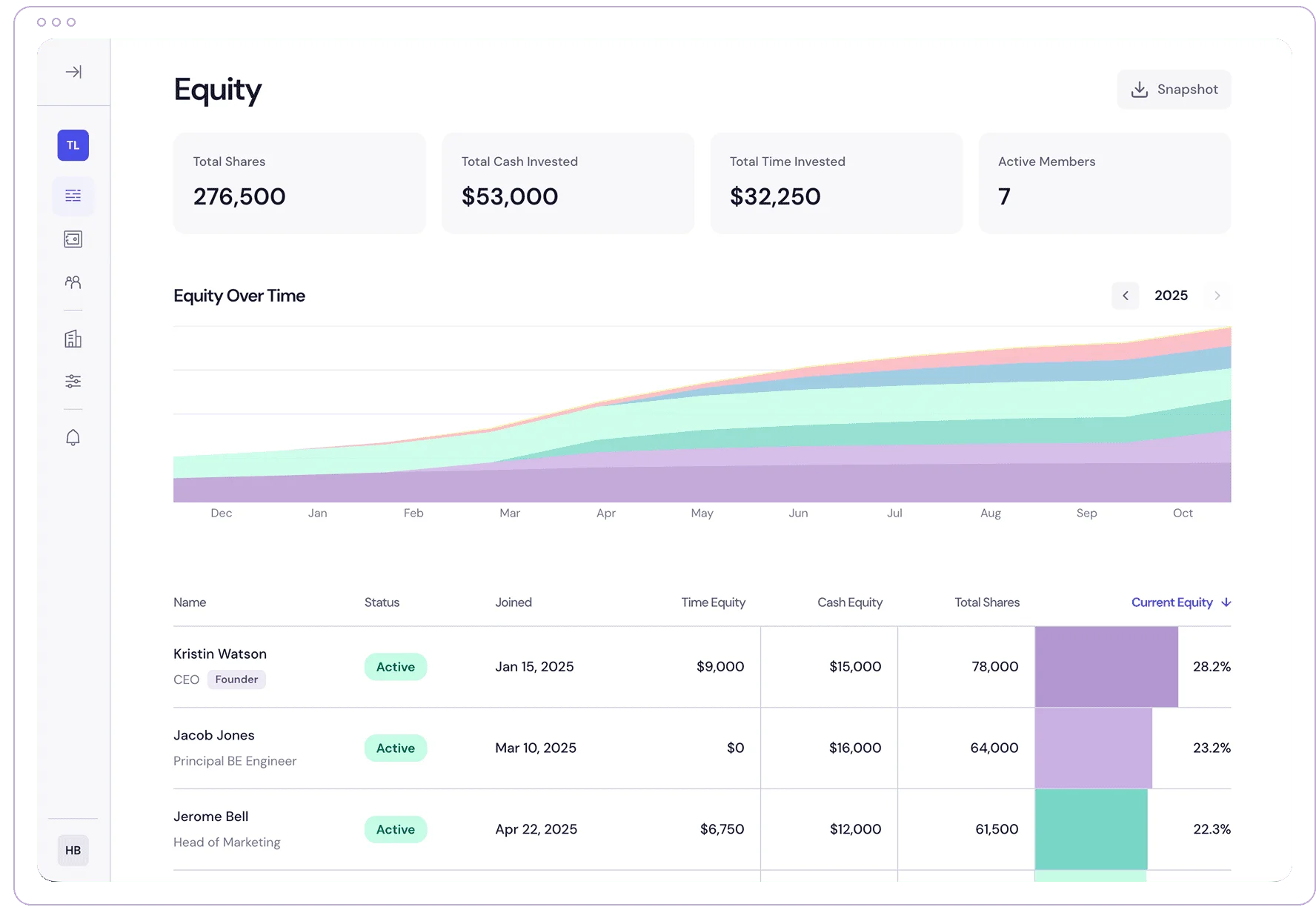
Equity splitting is the process of dividing ownership of a startup among its co-founders — the single most consequential decision most founding teams will ever make.
Before you lock anything in, run a few scenarios through the equity split calculator — it only takes a few minutes and can surface tradeoffs that are easy to miss in conversation. And if you want to see what other founders are actually doing (spoiler: only 3% use contribution-based equity), our 2026 research report has the data.
You’re starting a company with one, two, maybe three other people. Everyone’s excited. The idea is great. You’re moving fast.
Then someone asks the question: “So how are we splitting equity?”
And suddenly the room gets quiet.
This is the moment that shapes everything that follows. Get it right and you have aligned, motivated co-founders building toward a shared goal. Get it wrong and you’ll spend years dealing with resentment, dead equity, or worse — a company that implodes because the people building it feel cheated.
Quick Reference: Equity Split Approaches
| Approach | Best For | Risk Level |
|---|---|---|
| Equal split | Co-founders with identical commitment and skills | High — rarely reflects reality |
| Negotiated fixed split | Teams with clearly different roles and contributions | Medium — locks in assumptions |
| Dynamic / contribution-based | Teams still forming, evolving roles, uncertain commitment | Low — adjusts automatically |
Why This Decision Matters More Than You Think
Research by Noam Wasserman at Harvard Business School suggests that about 65% of high-potential startup failures trace to people problems, with co-founder conflict the largest category.
Here’s the thing most founders miss: your equity split isn’t just about money. It’s a signal.
It signals who matters. It signals how decisions get made. It signals whether your team values fairness or convenience. Investors read your cap table like a report card on your founding team’s judgment.
A sloppy equity split tells investors you didn’t think critically about the most important structural decision in your company. That’s not a great first impression.
The Three Main Approaches
1. Equal Splits
The simplest approach. Two founders? 50/50. Three founders? 33/33/34. Everyone gets the same.
Equal splits are popular. Data shows they’re actually increasing among early-stage startups. The logic is appealing: we’re all in this together, we all matter equally, let’s not complicate things.
But equal rarely means fair.
Unless every co-founder is contributing the same amount of time, money, expertise, and risk, an equal split is a compromise dressed up as fairness. It avoids a hard conversation now and pushes the consequences to later — when the stakes are much higher.
The hidden cost of 50/50 splits is real. When one founder is working 60 hours a week and another is doing 20, that “equal” split starts to feel very unequal.
2. Negotiated Fixed Splits
This is where most founders land. You sit down, talk about who’s contributing what, and agree on percentages. Maybe it’s 60/40. Maybe it’s 45/35/20. The startups that made these splits work — Google’s 50/50, Oracle’s 60/20/20, Instagram’s dominant-founder model — share common patterns worth understanding before you set your own numbers. Famous equity splits that actually worked breaks down what made each of those survive.
This is better than an equal split because it at least acknowledges that contributions differ. But it has a fundamental flaw: you’re locking in percentages based on assumptions about the future.
You’re guessing who will contribute more. You’re guessing how long everyone will stay. You’re guessing whose skills will matter most.
Those guesses are usually wrong.
The fix for this is vesting, which ensures equity is earned over time. But even with vesting, a fixed split doesn’t adapt to changing circumstances. If one founder pivots to part-time or another takes on a much larger role, the split stays frozen.
3. Contribution-Based (Dynamic) Splits
Dynamic equity tracks actual contributions and adjusts ownership accordingly. Instead of guessing up front, you let the data decide. Note that if you’re building a bootstrapped lifestyle business rather than a VC-track startup, the models look different — the indie hacker’s guide to equity splits covers profit sharing, hybrid models, and other approaches that work when an exit isn’t the goal.
Every contribution — hours worked, cash invested, equipment provided, IP contributed — gets tracked and valued. Your ownership percentage at any point reflects what you’ve actually put in relative to everyone else.
This is the approach described in the Slicing Pie model and the one Equity Matrix is built around. Rob Walling’s TOC framework covers the same territory from a bootstrapped SaaS perspective — with a particularly clear treatment of how to value cash contributions relative to time.
The advantage is obvious: it’s fair by design. No guesswork. No assumptions. If you contribute more, you own more. If someone stops contributing, their percentage naturally dilutes as others keep building.
Factors to Consider in Any Split
Whether you choose a fixed or dynamic approach, these are the inputs that matter.
Time Commitment
The biggest factor for most startups. Is everyone full-time? Is someone still at their day job? A founder working 60 hours a week is contributing three times more than someone working 20.
In a dynamic model, time gets valued at each person’s market rate — what they’d earn doing similar work for someone else. This puts a real dollar value on sweat equity.
Cash Investment
Money talks. A founder who invests $50,000 of their savings is taking a tangible financial risk that others aren’t. Cash typically carries a premium multiplier in contribution-based models — often 2x to 4x — because it’s scarcer and harder to replace than time.
Intellectual Property
Did someone bring a patent, a proprietary algorithm, or years of domain-specific research? That has value. The challenge is quantifying it. In dynamic models, IP is usually valued at its fair market rate or what it would cost to develop from scratch.
Opportunity Cost
What is each founder giving up? Someone leaving a $300K job at Google is making a very different sacrifice than someone leaving a $60K job or no job at all. This doesn’t always show up in formal equity calculations, but it should factor into the conversation.
Risk Tolerance
Not everyone can afford to go unpaid. Founders with families, mortgages, or debt obligations are taking on more personal risk. This doesn’t automatically mean they deserve more equity, but it means the equity structure needs to work for their situation — or they won’t be able to commit.
Domain Expertise
A co-founder with 15 years of industry connections and deep expertise brings value that’s hard to replicate. In a fixed split, this might justify a larger upfront share. In a dynamic model, it gets captured through the quality and impact of their contributions over time.
Common Mistakes
Splitting Too Early
The biggest mistake is deciding equity on day one. You barely know your co-founders yet. You don’t know who will actually show up. You don’t know whose skills will matter most.
Research shows that 42% of founding teams decide equity splits within a day or less. Fast decisions feel efficient. They’re usually just lazy.
If you must decide early, use a dynamic model that can adjust. Or at minimum, make sure you have proper vesting in place.
Ignoring Vesting
Equity without vesting is equity without protection. If a co-founder leaves after three months, they should not walk away with a permanent ownership stake.
The standard is a four-year vesting schedule with a one-year cliff. This is non-negotiable. Investors will require it anyway, so you might as well set it up from the start.
Not Accounting for Future Contributions
A fixed split assumes the future looks like today. It almost never does.
One founder might take on fundraising. Another might scale back for personal reasons. Roles evolve. Commitments change. If your equity structure can’t accommodate that, you’re building resentment into the foundation of your company.
Avoiding the Hard Conversation
Some founders skip the equity conversation entirely and just start building. This is worse than any bad split. Unspoken assumptions create unspoken expectations, and those always surface at the worst possible time — like when you’re raising money or considering an acquisition. If the conversation itself feels impossible — especially in a technical/non-technical co-founder pairing where the leverage feels unequal — the word-for-word scripts for the technical co-founder equity conversation give you exact language for the moments that stall most founders.
Have the conversation. It will be uncomfortable. That’s the point. It’s worth understanding why this conversation is uniquely hard — unlike investor dilution or employee grants, there’s no clean formula for co-founder splits. Paul Graham’s equity equation explains exactly why: the math that works for every other equity decision breaks down when there’s no “before” to compare against.
When Dynamic Equity Makes More Sense
Fixed splits work when the situation is clear: co-founders have known each other a long time, roles are well-defined, commitment levels are equal, and everyone is starting at the same time.
Dynamic equity makes more sense when:
- Commitment levels are uncertain. Not everyone is full-time yet. Some founders are still at their day jobs.
- The team is still forming. You might bring on additional co-founders in the next few months — if you’re a solo founder considering that move, the solo-to-co-founder transition guide covers when it makes sense and how to evaluate candidates before the equity conversation starts.
- Contributions vary widely. One person is coding full-time. Another is doing sales two days a week. Someone else invested cash but isn’t doing daily work.
- Trust is still being built. You haven’t worked together before and want a system that’s fair regardless of how things play out.
- You want to avoid the most common equity disputes. Dynamic equity eliminates the guesswork that causes most co-founder conflicts.
If any of these describe your situation, a contribution-based model will save you from fights down the road. Read more about how dynamic equity works.
How to Have the Equity Conversation
Start with Roles and Expectations
Before talking numbers, talk about what each person is actually going to do. How many hours per week? What responsibilities? Is anyone investing cash? Is anyone bringing IP or key relationships?
Write this down. Shared expectations prevent misunderstandings.
Discuss What “Fair” Means to Each Person
Everyone has a different definition of fair. For some, it means equal. For others, it means proportional to contribution. Surface these assumptions early so you can find alignment.
Put It in Writing
Whatever you agree on, document it. A verbal agreement is worth nothing when money is on the table.
If you’re doing a fixed split, get a lawyer to draft a founders’ agreement with vesting terms — our co-founder agreement template covers every section you need, with example language for equity allocation, vesting, IP, departures, and dispute resolution. If you’re doing a dynamic split, use a tool like Equity Matrix to track contributions and calculate ownership automatically.
Revisit Regularly
Your equity structure isn’t set-and-forget. Circumstances change. Check in quarterly. Make sure the split still reflects reality. If it doesn’t, address it before resentment builds.
The Bottom Line
There’s no single right way to split equity. But there are many wrong ways.
Equal splits feel easy but rarely reflect reality. Fixed splits require guessing about the future. Dynamic splits require ongoing tracking but produce the fairest outcomes.
Whatever you choose, the principles are the same: be honest about contributions, protect against early departures with vesting, and put everything in writing.
The equity conversation is hard. Avoiding it is harder. The startups that get this right are the ones that survive long enough to make the equity worth something.
Frequently asked questions
Is a 50/50 equity split a good idea?
A 50/50 split is fair only if both co-founders are contributing equally in time, money, expertise, and risk — which is rare in practice. Equal splits avoid a hard conversation upfront but often create resentment later when contributions diverge. If you do choose an equal split, make sure you have vesting schedules in place to protect against early departures. A contribution-based approach avoids the guesswork entirely.
How do you split equity with a non-technical co-founder?
The same way you split it with anyone: based on the value of their contributions. A non-technical co-founder handling sales, fundraising, strategy, or operations is contributing real value — just in a different form than code. Use market rates for their role to value their time, and factor in cash investment, relationships, or domain expertise they bring. The equity calculator can help you model different scenarios and find a split that reflects what each person is actually putting in.
When should co-founders decide on their equity split?
Not on day one. Research shows that 42% of founding teams decide their split within a day, and those fast decisions usually reflect convenience rather than careful thinking. Wait until you have clarity on each person’s role, time commitment, and financial contribution. If you need to start building before the split is finalized, use a dynamic equity model that tracks contributions and adjusts ownership automatically until you are ready to lock things in.
Do co-founders need a vesting schedule?
Yes, always. Vesting protects every co-founder from the risk of someone leaving early with a permanent ownership stake. The standard structure is four years with a one-year cliff, and investors will require it even if you skip it initially. Think of vesting as insurance: you hope you never need it, but without it, a co-founder departure can saddle the company with dead equity that makes future fundraising difficult.
Equity Matrix helps founding teams track contributions and calculate fair ownership splits automatically — so you can focus on building instead of arguing about who owns what.
Ready to split equity fairly?
Equity Matrix tracks contributions and calculates ownership automatically.
Get Started FreeThis article is for informational purposes only and does not constitute legal, tax, or financial advice. Equity Matrix is not a law firm, accounting firm, or financial advisor. Consult a qualified professional for guidance specific to your situation.

Co-founder, Equity Matrix
Sebastian writes about startup equity, founder dynamics, and building fair partnerships.
Keep reading
Co-founders in different countries: how to set a fair rate
When one co-founder is in the US and another is in Lithuania, do you value their time at local rates or the same rate for the same work? How to set GHRR fairly across borders.
Read more →How to track co-founder contributions (before it costs you)
A practical system for tracking co-founder contributions: what to log, how often, the fields that matter, and where spreadsheets start to strain.
Read more →