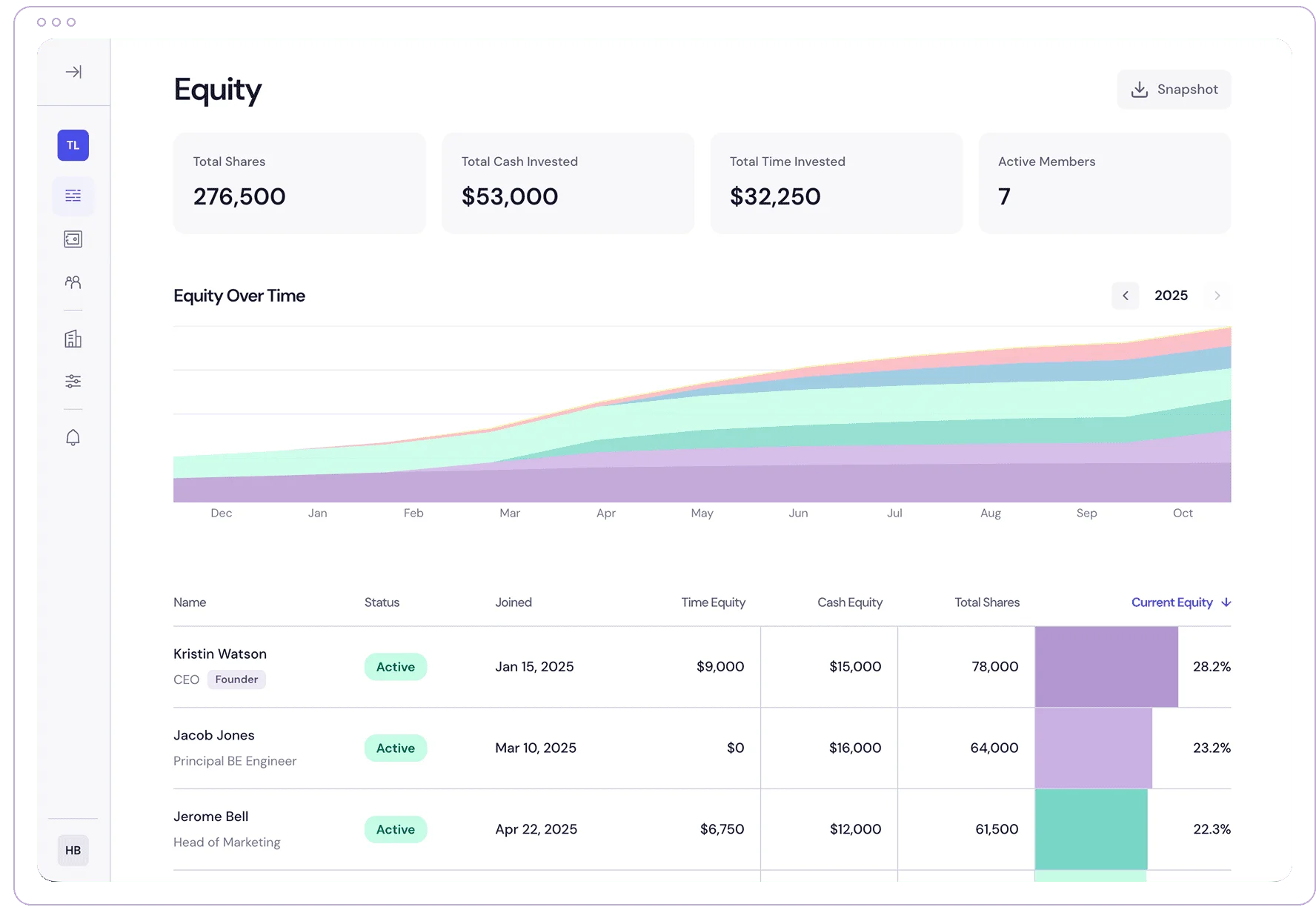
Sweat equity is ownership earned through labor, expertise, or time rather than cash investment — the most common form of compensation in early-stage startups where money is scarce but work is plentiful.
You’re building a startup. There’s no money to pay anyone. But people are contributing.
Time. Expertise. Late nights. Weekends. Work that would cost real money if you had it.
This is sweat equity. And if you’re not tracking it properly, you’re setting yourself up for conflict. For founders who think about delegation systematically — building a team to handle work they shouldn’t be doing — sweat equity is the compensation mechanism that makes it possible. The buy-back-your-time approach to equity frames this well: you’re not just giving people a stake, you’re building a fair system for compensating everyone who helps you focus on what matters most.
Sweat equity is deceptively simple in concept. Someone works, they earn ownership. But the details matter. How do you value an hour of work? What about different skill levels? What happens when someone stops contributing?
Get this wrong and you’ll end up with dead equity, resentful co-founders, or worse—a company that can’t raise money because the cap table is a mess.
Quick Reference: Sweat Equity Valuation
| Contribution Type | Valuation Method | Typical Multiplier |
|---|---|---|
| Time (hours) | Market rate for skills | 1x-2x |
| Cash investment | Actual dollars | 2x-4x |
| Equipment/assets | Fair market value | 1x |
| IP/patents | Case-by-case | Varies widely |
| Key relationships | Hard to value | Often fixed grants |
What Is Sweat Equity?
Sweat equity is ownership earned through work instead of money. The “sweat” is the labor. The “equity” is the ownership stake that compensates for it.
For bootstrapped startups, sweat equity is often the only currency available. You can’t pay market salaries, but you can offer a piece of the upside.
This creates an exchange: work now for ownership later. If the company succeeds, that ownership becomes valuable. If it doesn’t, everyone’s time was “paid” in worthless shares.
The fundamental principle: sweat equity should reflect the fair market value of contributions. Not what you wish you could pay. Not what feels generous. The actual value of the work.
Running a small business or LLC partnership, not a VC-funded startup? The dynamics are different when one partner brings capital and the other brings labor. See sweat equity in small businesses for a guide built around that structure, including how to handle the salary question and protect both partners.
How to Calculate Sweat Equity
The standard approach uses the Slicing Pie model or similar dynamic equity frameworks. Here’s how it works.
Step 1: Determine Fair Market Rate
Each contributor has a market value for their skills. What would they earn if they were employed somewhere else?
Example:
- Founder A (technical): $180K salary in the market = $90/hour
- Founder B (business): $120K salary in the market = $60/hour
- Contributor C (design): $100K salary = $50/hour
These rates become the baseline for valuing their time.
Step 2: Track Hours
Every hour worked earns equity at that hourly rate. If Founder A works 40 hours, they’ve contributed $3,600 in value. If Founder B works 20 hours, they’ve contributed $1,200.
This tracking needs to be regular and honest. Weekly logging is ideal. Monthly at minimum.
Step 3: Apply Multipliers (If Applicable)
Some systems apply multipliers to account for the risk of working without guaranteed pay. The logic: an hour of sweat equity is riskier than an hour of paid work, so it should earn more ownership.
Common multipliers:
- Time: 1x-2x (some systems use 2x since there’s no guaranteed pay)
- Cash: 2x-4x (cash is scarcer and more valuable to early startups)
Step 4: Calculate Ownership
Ownership = Your contribution value / Total contribution value
Example:
- Founder A contributed: $50,000 of time
- Founder B contributed: $30,000 of time
- Founder C contributed: $20,000 of time
- Total: $100,000
Ownership:
- Founder A: 50%
- Founder B: 30%
- Founder C: 20%
As new contributions are made, these percentages adjust.
Different Approaches to Valuation
Not everyone uses the same method. Here are the main approaches.
The Market Rate Method
Value time at what it would cost to buy on the open market. A developer worth $150K earns $75/hour. A salesperson worth $100K earns $50/hour.
Pros: Objective, market-based, hard to argue with. Cons: Doesn’t account for the risk of working for equity.
The Multiplier Method (Slicing Pie)
Value time at market rate, then apply a multiplier to account for risk. Mike Moyer’s Slicing Pie uses 2x for time and 4x for cash. A closely related approach is the TOC framework from Rob Walling, which adds a valuation-based treatment for cash contributions — useful when the team can agree on what the company is worth at the time of the investment.
Pros: Compensates for risk, makes equity more valuable. Cons: Can result in equity being “used up” faster than expected.
The Fixed Hourly Rate Method
Everyone earns the same hourly rate regardless of skill level. A $50/hour flat rate for all contributors.
Pros: Simple, avoids debates about who’s worth more. Cons: Undervalues skilled contributors, may not attract top talent.
The Negotiated Grant Method
Skip hourly tracking entirely. Negotiate fixed equity grants based on expected total contribution.
Pros: Simple, no tracking required. Cons: This is really just fixed equity with extra steps. You’re guessing about future contributions.
Dynamic vs Fixed Equity: Which Model Is Right for Your Startup?
Handling Different Contribution Types
Sweat equity isn’t just hours worked. Other contributions need valuation too.
Cash Contributions
Cash is king for early startups. It pays for servers, legal fees, and runway. Cash contributions typically get a multiplier—often 2-4x their face value.
Example: $10,000 cash at a 4x multiplier = $40,000 in contribution value.
Why the premium? Cash is scarce. Anyone can contribute time. Not everyone can contribute money.
Equipment and Assets
If someone provides equipment, software, or other assets, value them at fair market value. Used laptop worth $800? That’s an $800 contribution.
Be careful here. Some assets are hard to value. Others depreciate quickly. Set clear rules upfront.
Intellectual Property
If someone brings existing IP to the company—code they’ve already written, patents they hold—this needs negotiation.
IP can be extremely valuable or nearly worthless depending on how central it is to the business. There’s no standard formula. Negotiate case by case and document the agreement.
Relationships and Introductions
Some people contribute access rather than work. A key introduction to an investor. A relationship that lands your first customer.
This is the hardest to value. How much is an introduction worth? Some teams assign fixed equity grants for specific outcomes (e.g., 0.25% for a closed sale, 0.5% for a successful fundraise referral). Others skip equity entirely and pay referral bonuses.
Common Sweat Equity Mistakes
Not Tracking at All
The most common mistake. Founders agree to “figure out equity later” based on who contributed what. Later never comes. Memories differ. Conflict follows.
Track from day one. Even if the tracking is imperfect, having data beats having nothing.
Different Expectations
One founder thinks they’re earning $100/hour in equity. Another thinks it’s $50/hour. Neither knows because they never discussed it.
Agree on valuation rules before you start tracking. Put it in writing.
No Vesting
Sweat equity without vesting is risky. If someone contributes for three months and then leaves, their sweat equity is locked in. They’ve earned ownership that doesn’t continue to vest.
The standard protection: treat sweat equity like any other equity with a vesting schedule. You can argue about whether the cliff should apply to contributions already made, but there should be a mechanism to handle departures.
Overvaluing Ideas
Everyone thinks their idea is worth millions. It isn’t. Ideas are worth very little compared to execution.
If someone contributes “the idea,” that might be worth a few hundred hours of equivalent contribution. Not 50% of the company.
Ignoring Tax Implications
Sweat equity has tax consequences. The IRS considers equity compensation as taxable income. If you receive shares worth $50,000 in exchange for work, that’s $50,000 of taxable income—even if you can’t sell the shares.
The timing depends on the instrument. Restricted stock is generally taxed as it vests unless a timely 83(b) election accelerates taxation to the grant date; it does not defer tax. Nonqualified options are generally taxed at exercise, and RSUs at settlement. A qualifying LLC profits interest can be tax-free at grant under the applicable revenue-procedure safe harbor. Because classification changes the result, obtain tax advice before the grant; an 83(b) election has a non-extendable 30-day deadline when it applies.
When to Freeze the Split
Sweat equity is inherently dynamic. Contributions change. Ownership adjusts.
But at some point, you need to stop tracking and lock in a fixed cap table. This usually happens when:
You’re raising institutional money. Investors need to know exactly who owns what. Dynamic systems don’t work for a priced round.
The core team has stabilized. If the same people have been contributing consistently for 12-18 months, the split has likely found its natural level.
Contributions are evening out. When everyone is full-time and working similar hours, the ongoing adjustments become noise.
See our guide on when to convert dynamic equity to a cap table for detailed guidance on the transition.
Documentation Requirements
Sweat equity without documentation is worthless. Or worse—it’s ambiguous and contested.
At minimum, you need:
A founder agreement that specifies:
- How contributions are valued
- What counts as a contribution
- Tracking frequency and method
- Vesting terms
- What happens when someone leaves
- How and when the split freezes
Regular contribution logs showing:
- Date
- Contributor
- Hours or other contribution
- Category (time, cash, assets)
- Calculated value
Quarterly or monthly reconciliation where all contributors review and agree on the numbers.
Sweat Equity and Investors
Investors have mixed feelings about sweat equity and dynamic equity systems.
What they like: A founding team that can explain exactly how they arrived at their equity split based on real data. This suggests discipline and fairness. Understanding what investors look for in cap tables helps you prepare.
What they don’t like: Showing up to a pitch with a still-dynamic cap table. They need certainty before investing.
The practical advice: use sweat equity tracking internally, but freeze and convert before you start fundraising.
Some investors also scrutinize whether the equity distribution makes sense for the current state of the company. If someone owns 30% but hasn’t contributed in months, that’s a red flag. Clean up dead equity before investor meetings.
Dead Equity Kills Startups: How to Prevent It
Tools for Tracking Sweat Equity
You can track sweat equity in a spreadsheet, but purpose-built tools make it easier.
What to look for:
- Contribution logging (hours, cash, assets)
- Configurable valuation rules
- Automatic ownership calculation
- Historical records
- Export for cap table conversion
Our equity calculator is designed for exactly this purpose—tracking contributions and modeling ownership splits.
Frequently Asked Questions
How do I value sweat equity fairly?
Value contributions at their fair market rate—what the work would cost to buy in the market. A developer worth $150K/year contributes at $75/hour. Some systems apply a 2x multiplier to account for the risk of working for equity instead of cash.
Is sweat equity taxable?
Compensatory equity is generally taxable, but timing depends on the instrument. Restricted stock is generally taxed at vesting unless a timely 83(b) election accelerates tax to grant; NSOs are generally taxed at exercise and RSUs at settlement. A qualifying LLC profits interest can be tax-free at grant. Consult a tax advisor before the transfer.
What happens to sweat equity if someone leaves?
It depends on your agreements. With a standard vesting schedule, they keep vested equity and forfeit unvested equity. With pure dynamic tracking, they keep whatever percentage their contributions represent at departure. Make sure your agreements are clear on this before anyone contributes.
How is sweat equity different from stock options?
Sweat equity typically means receiving actual shares (restricted stock) in exchange for work. Stock options give you the right to buy shares at a set price. Options are more common for employees; sweat equity is more common for co-founders and very early contributors.
Ready to track sweat equity fairly from day one? Our equity calculator helps you value contributions and model ownership splits for your team.
Ready to split equity fairly?
Equity Matrix tracks contributions and calculates ownership automatically.
Get Started FreeThis article is for informational purposes only and does not constitute legal, tax, or financial advice. Equity Matrix is not a law firm, accounting firm, or financial advisor. Consult a qualified professional for guidance specific to your situation.

Co-founder, Equity Matrix
Sebastian writes about startup equity, founder dynamics, and building fair partnerships.
Keep reading
How much equity to give a contractor instead of cash
You can't pay full cash, so you're offering equity. Here's how to size a contractor or freelancer's grant, the risk multiplier to use, and the legal traps to avoid.
Read more →Sweat equity in small businesses: how to value time
When one business partner invests time and the other invests money, how do you split ownership fairly? A practical guide for LLCs and partnerships.
Read more →