Most cap table problems are not math errors. They are timing errors. Founders build their cap table too late, update it too infrequently, or realize halfway through a fundraise that nobody actually knows who owns what.
If you already know what a cap table is and why it matters, this post picks up where that one left off. This is the practical guide: how to build one from scratch, how it evolves through each stage of your company, and how to keep it from becoming a liability.
You Don’t Need a Corporation on Day One
Most cap table guides assume you’re starting with a C-corp. That’s the right structure if you’re raising venture capital, but it’s not where every founding team begins.
If you’re pre-revenue, still figuring out roles, or not sure you’ll raise outside money, you can start with an LLC and formalize later. Many founding teams operate as an LLC while they validate the idea and figure out who’s contributing what. When you’re ready to raise or bring on investors, you convert the LLC to a C-corp and issue shares based on actual ownership at that point.
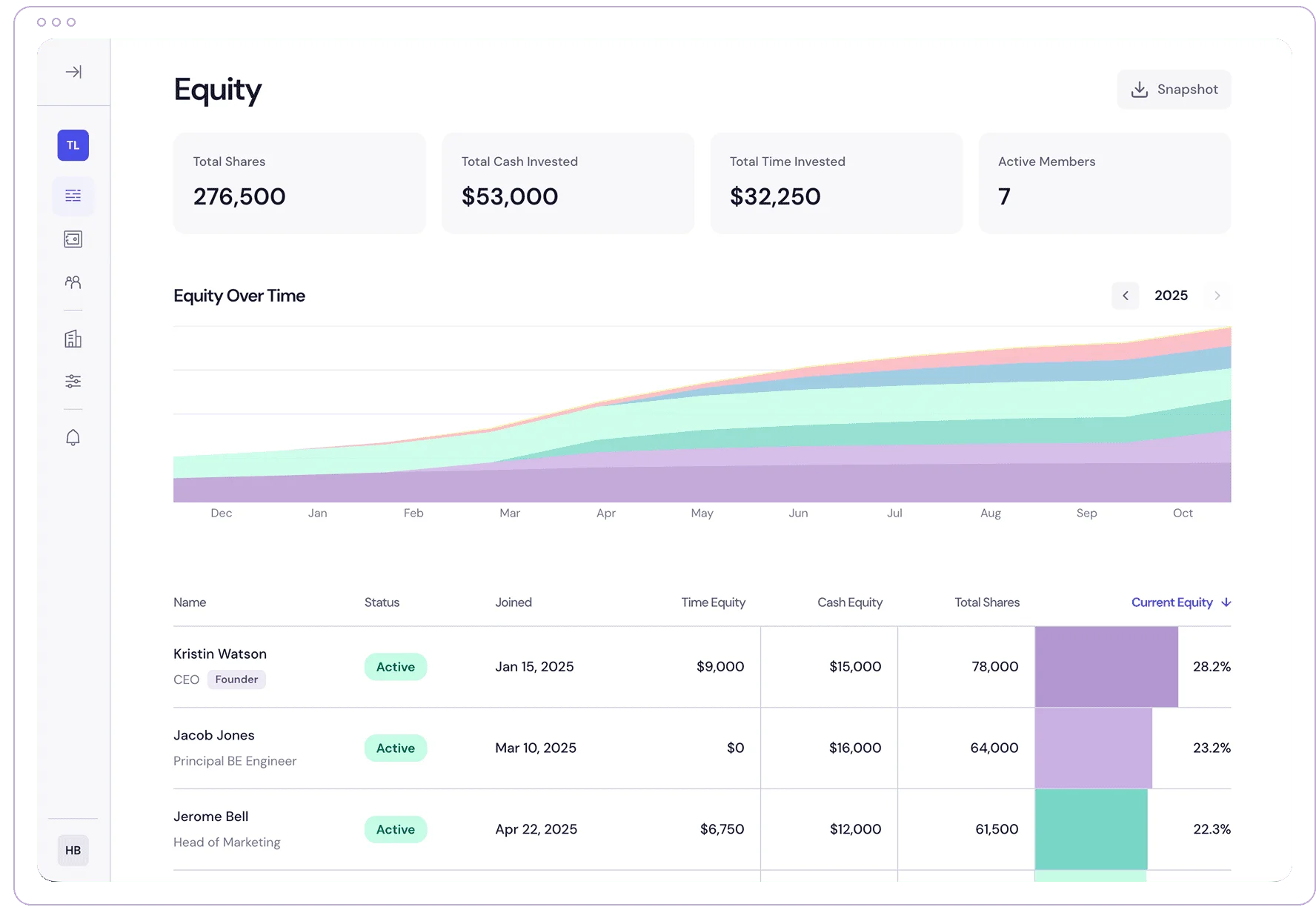
The dynamic equity approach: Instead of guessing at a fixed equity split on day one, track each founder’s time, capital, and contributions as they happen using dynamic equity. When you’re ready to incorporate, you convert your dynamic split to a fixed cap table with numbers that reflect real contributions, not assumptions. Equity Matrix is built for this workflow. For more on why LLCs work well during this phase, read why LLCs are ideal for dynamic equity.
The rest of this guide covers what happens once you do incorporate — whether that’s on day one or after a period of dynamic equity tracking.
Setting Up Your Cap Table at Incorporation
Your formal cap table begins the moment you incorporate as a C-corp. This is when you authorize shares, issue them to founders, and create the structure that investors, employees, and lawyers will reference for the life of the company.
A common starting point is 10,000,000 authorized shares. According to Cooley GO, it’s the industry default. You don’t issue all 10 million on day one — a typical split is roughly 8 million to founders and 2 million kept authorized but unissued, per Clerky’s formation guide.
Why 10 million? Four reasons:
- Buffer for early equity events. Those unissued shares become your option pool and early advisor grants. Issuing already-authorized shares only requires board approval. If you run out and need to authorize more, you need shareholder approval and a charter amendment filed with the state — that costs money and time.
- Granularity. With 10 million shares you can slice equity precisely across many people. Granting someone 50,000 shares out of 10 million is cleaner than granting 5 shares out of 1,000.
- Low per-share price. At par value ($0.0001 per share), early employees can exercise options cheaply, and 83(b) elections cost almost nothing to file.
- Perception. “You’re getting 50,000 stock options” lands better with a new hire than “you’re getting 5 options,” even when the percentage is identical. Not rational, but real.
You will authorize more shares later — every priced funding round involves authorizing a new class of preferred stock as part of the deal. But starting with 10 million means your early hires, advisor grants, and option pool don’t each require a corporate filing.
Step 1: Founder Share Issuance
Once you’ve incorporated and authorized 10M shares, you issue a subset to founders. A common approach is to issue about 8M to founders and reserve the rest for an option pool. Here’s what a two-founder cap table looks like on day one:
Founding Cap Table
| Shareholder | Share Type | Shares | Ownership % |
|---|---|---|---|
| Founder A (CEO) | Common Stock | 4,800,000 | 60.0% |
| Founder B (CTO) | Common Stock | 3,200,000 | 40.0% |
| Total Issued | 8,000,000 | 100.0% | |
| Authorized but unissued | 2,000,000 |
Notice 2M shares are still sitting in reserve. Those will become the option pool in step 2. No new shares need to be created — they’re already authorized.
A few things to note here.
Founder shares should vest. Even between co-founders. A standard vesting schedule is four years with a one-year cliff. This protects everyone: if one founder walks away after six months, the company doesn’t end up with dead equity locked in someone who’s gone.
The split should reflect actual contributions, not just who had the idea. If you used dynamic equity before incorporating (as we recommended above), your split is already based on real data. If you’re picking numbers at incorporation without that history, use our equity calculator to model different scenarios. For a deeper framework, read how to split equity in a startup.
Founders typically purchase their shares at par value (often $0.0001 per share), so the total cost for 4,800,000 shares would be $480. Yes, under five hundred dollars for 60% of a company. That’s the advantage of being early.
Step 2: Creating the Option Pool
Before you raise outside money (and sometimes before you make your first hire), you’ll want to create an option pool. An option pool is a block of shares set aside for future employees, advisors, and contractors who will receive equity compensation. For advisor-specific grants, the advisor equity calculator benchmarks the right percentage by stage.
Standard option pool sizes range from 10% to 20% of fully diluted shares, according to Carta’s equity data. Investors almost always require one before a priced round. Creating it early, before investor money is involved, means the dilution comes only from the founders.
Remember those 2M authorized-but-unissued shares? You designate them as the option pool. You may also authorize additional shares if you want a larger pool. Here’s the cap table after setting aside a 20% option pool:
Post-Option Pool Cap Table
| Shareholder | Share Type | Shares | Ownership % |
|---|---|---|---|
| Founder A (CEO) | Common Stock | 4,800,000 | 48.0% |
| Founder B (CTO) | Common Stock | 3,200,000 | 32.0% |
| Option Pool (unallocated) | Reserved | 2,000,000 | 20.0% |
| Total (Fully Diluted) | 10,000,000 | 100.0% |
Notice that each founder’s percentage dropped, but their share count stayed the same. The option pool shares were already authorized — they just got formally designated. On a fully diluted basis, the founders now own 80% instead of 100%. This is dilution in its simplest form.
Dilution is not theft. It’s the cost of growing the pie. What matters is whether the pie grows faster than your slice shrinks.
Step 3: First Equity Grants
Now you start hiring. Your first engineer or key hire gets an option grant from the pool. For benchmarks on how much to give, see employee equity benchmarks.
Say you grant your first engineer 200,000 options with a four-year vest and one-year cliff:
Post-First-Hire Cap Table
| Shareholder | Share Type | Shares | Ownership % |
|---|---|---|---|
| Founder A (CEO) | Common Stock | 4,800,000 | 48.0% |
| Founder B (CTO) | Common Stock | 3,200,000 | 32.0% |
| Engineer #1 | Stock Options | 200,000 | 2.0% |
| Option Pool (remaining) | Reserved | 1,800,000 | 18.0% |
| Total (Fully Diluted) | 10,000,000 | 100.0% |
The fully diluted total doesn’t change when you grant from the pool. Shares move from “unallocated pool” to “granted options,” but no new shares are created. This is why the pool is set up in advance.
Step 4: Seed Round
You raise a $1.5M seed round at a $6M pre-money valuation. Here’s the math:
- Pre-money valuation: $6M
- Investment amount: $1.5M
- Post-money valuation: $7.5M
- Investor ownership: $1.5M / $7.5M = 20%
New shares are issued to the investor. Your pre-money fully diluted count is 10,000,000. The investor gets 2,500,000 new shares (20% of the post-money total of 12,500,000).
Post-Seed Cap Table
| Shareholder | Share Type | Shares | Ownership % |
|---|---|---|---|
| Founder A (CEO) | Common Stock | 4,800,000 | 38.4% |
| Founder B (CTO) | Common Stock | 3,200,000 | 25.6% |
| Engineer #1 | Stock Options | 200,000 | 1.6% |
| Seed Investor | Series Seed Preferred | 2,500,000 | 20.0% |
| Option Pool (remaining) | Reserved | 1,800,000 | 14.4% |
| Total (Fully Diluted) | 12,500,000 | 100.0% |
Founder A went from 60% to 38.4% over these four steps. That’s normal. What matters is that 38.4% of a $7.5M company is worth $2.88M on paper, compared to 60% of $0.
If you had outstanding SAFEs or convertible notes before this round, they would convert here too, adding even more dilution. This is why tracking those instruments on your cap table before they convert is critical.
Step 5: Series A and Beyond
At Series A, the pattern repeats with higher stakes. Investors will likely ask you to top up the option pool (back to 15-20%), and you’ll negotiate a new valuation.
A typical Series A adds two layers of complexity:
Pool refresh. If your remaining option pool is below the target percentage, new shares get created to fill it back up. This dilutes everyone, including the seed investors.
Pro rata rights. Your seed investors may have the right to invest in this round to maintain their ownership percentage. This is a negotiation point, and it shows up on the cap table as additional preferred shares.
Post-Series A Cap Table (Illustrative)
| Shareholder | Share Type | Shares | Ownership % |
|---|---|---|---|
| Founder A (CEO) | Common Stock | 4,800,000 | 28.8% |
| Founder B (CTO) | Common Stock | 3,200,000 | 19.2% |
| Engineer #1 | Stock Options | 200,000 | 1.2% |
| 4 Additional Employees | Stock Options | 500,000 | 3.0% |
| Seed Investor | Series Seed Preferred | 2,500,000 | 15.0% |
| Series A Lead | Series A Preferred | 3,333,333 | 20.0% |
| Option Pool (refreshed) | Reserved | 2,133,333 | 12.8% |
| Total (Fully Diluted) | 16,666,666 | 100.0% |
By Series A, your cap table has gone from two rows to eight or more. Each new row represents a decision. Every one of those decisions should have been intentional, documented, and modeled in advance.
Spreadsheet vs. Software: When to Switch
Not every startup needs Carta on day one. But not every startup can survive on Google Sheets forever. Here’s a framework for deciding.
| Factor | Spreadsheet | Dedicated Software |
|---|---|---|
| Cost | Free | $100-$3,000+/year |
| Best for | Pre-funding, 2-4 stakeholders | Post-seed, 5+ stakeholders |
| SAFE/note modeling | Manual formulas, error-prone | Built-in conversion modeling |
| 409A valuations | Separate process | Often bundled or integrated |
| Scenario modeling | Possible but fragile | Core feature |
| Audit trail | None (unless you’re disciplined) | Automatic version history |
| Legal compliance | You’re on your own | Templates and workflows |
Popular Cap Table Tools
Carta is the market leader. Robust, but expensive for early-stage companies. Best fit once you have investors who expect institutional-grade reporting.
Pulley targets early-stage startups with simpler pricing. Good for seed-stage companies that have outgrown spreadsheets.
AngelList Stack (formerly Clerky + AngelList) bundles incorporation, cap table, and fundraising tooling for YC-style startups.
Equity Matrix takes a different approach. It starts with dynamic equity and contribution tracking during the pre-funding phase, then transitions into cap table modeling as you formalize. This is particularly useful if you’re still figuring out your equity split and want to base it on actual contributions rather than guesswork. Once you’ve built your cap table, the ongoing work of keeping it accurate is covered in our cap table management guide — tools, workflows, and the seven most common mistakes founders make.
A spreadsheet is fine until it’s not. The switch usually needs to happen at your first priced round, not after.
Pro Forma Modeling: See the Future Before It Happens
One of the most valuable things you can do with your cap table is model future scenarios before committing to them. This is called pro forma modeling. We walk through a full example, SAFE conversion and option pool shuffle included, in our pro forma cap table guide.
Before every fundraise, you should model at least two scenarios:
- What does the cap table look like if we raise at our target valuation?
- What if the valuation comes in 20-30% lower than expected?
For each scenario, map out:
- Post-money ownership for every stakeholder
- Option pool size after any required refresh
- Founder ownership after dilution
- How outstanding SAFEs or notes convert
Pro forma modeling is also essential when granting equity. Before offering 1% to a new VP of Engineering, model what that 1% looks like after your next round. If a Series A will dilute it to 0.7%, your candidate should know that up front.
Most dedicated cap table tools include scenario modeling. If you’re still on a spreadsheet, build a separate tab for each scenario. Keep the “current” cap table on one tab and use formulas to project forward on others.
Try running these scenarios in the Equity Matrix calculator to see how different fundraising terms affect founder ownership.
Red Flags That Your Cap Table Needs Attention
Some problems are obvious. Others hide until the worst possible moment (usually during due diligence for a round you need to close).
Ownership percentages that don’t add up to 100%. Sounds basic, but rounding errors and manual entry mistakes are disturbingly common.
Missing entries for SAFEs or convertible notes. If you raised money on a SAFE and it’s not on your cap table (even as a footnote showing potential dilution), you’re understating future dilution.
No vesting schedules recorded. Knowing that an employee has 100,000 options is not enough. You need to know the grant date, vesting start date, cliff date, and how many have vested to date.
Departed co-founders or employees still showing unvested shares. When someone leaves, their unvested shares should return to the pool. If your cap table doesn’t reflect that, your numbers are wrong.
More than one version of the cap table floating around. If your lawyer has one version, your lead investor has another, and your Google Drive has a third, none of them are reliable. There should be exactly one source of truth.
If your cap table hasn’t been updated in more than 90 days and anything has changed during that period, treat it as potentially inaccurate until verified.
Managing Your Cap Table Through Key Milestones
Different stages demand different levels of rigor. Here’s what should happen at each milestone.
At Incorporation
- Authorize shares (typically 10M)
- Issue founder shares with vesting
- Record everything, even if it’s just a spreadsheet
- File 83(b) elections within 30 days if receiving restricted stock
Before First Hire
- Create option pool (10-15%)
- Get a 409A valuation if issuing options
- Establish a process for approving and recording grants
Before Raising a Priced Round
- Reconcile every outstanding instrument (SAFEs, notes, warrants)
- Model conversion scenarios at different valuations
- Clean up any discrepancies between your records and legal documents
- Read what investors look for in cap tables so you know what they’ll scrutinize
After Closing a Round
- Update the cap table with actual (not projected) numbers
- Confirm share counts with your legal counsel
- Distribute updated cap tables to all shareholders
- Start modeling the next round’s impact immediately
At Each Board Meeting
- Present the current cap table as part of the board package
- Highlight any changes since the last meeting
- Flag upcoming events that will affect ownership (option grants, SAFE conversions, pool refreshes)
Frequently Asked Questions
How many shares should I authorize when incorporating?
10,000,000 is the most common starting point for venture-backed startups. It gives you enough room to issue founder shares, create an option pool, and still have authorized shares available for future rounds. You can always authorize more later with board and shareholder approval, but starting with a reasonable number avoids the administrative overhead of amending your charter early on.
When should I switch from a spreadsheet to cap table software?
The trigger is usually your first priced round or your fifth equity holder, whichever comes first. At that point, you’re juggling multiple share classes, vesting schedules, and conversion math that spreadsheets handle poorly. Before that, a well-organized spreadsheet is fine as long as you’re disciplined about updating it after every change.
Do SAFEs and convertible notes go on my cap table?
Yes, even though they haven’t converted to equity yet. They represent future dilution that affects everyone’s real ownership percentage. Best practice is to maintain both an “as-issued” view (what’s actually equity today) and a “fully diluted, as-converted” view that models what happens when those instruments convert. For more on how these instruments work, see SAFEs explained and convertible notes vs. SAFEs.
What happens to the cap table if a co-founder leaves?
It depends on their vesting schedule. Unvested shares typically return to the company (or the option pool). Vested shares stay with the departing founder unless there’s a repurchase agreement. This is exactly why vesting exists: it protects the company and the remaining founders from carrying dead equity. If there’s no vesting in place and a co-founder leaves with a large stake, you’re looking at a painful and potentially expensive legal negotiation.
Can I raise money if I’m using dynamic equity instead of a traditional cap table?
Yes, but not directly. Investors write checks into C-corps (or occasionally LLCs with specific structures), not into dynamic equity arrangements. The workflow is: use dynamic equity during your pre-funding phase to track contributions and determine fair ownership, then convert to a fixed cap table when you’re ready to raise. You incorporate, issue shares based on your tracked contributions, and go into fundraising with a clean cap table backed by real data. Investors actually prefer this to a cap table built on day-one guesses, because the numbers reflect what actually happened.
Your cap table is a living document. It changes every time you issue shares, grant options, close a round, or lose a team member. Building it right from day one is straightforward. Keeping it accurate as complexity grows is where most founders fall behind. Equity Matrix helps you track contributions, model dilution scenarios, and maintain a single source of truth from founding through fundraising.
Ready to split equity fairly?
Equity Matrix tracks contributions and calculates ownership automatically.
Get Started FreeThis article is for informational purposes only and does not constitute legal, tax, or financial advice. Equity Matrix is not a law firm, accounting firm, or financial advisor. Consult a qualified professional for guidance specific to your situation.

Co-founder, Equity Matrix
Sebastian writes about startup equity, founder dynamics, and building fair partnerships.
Keep reading
Pre-money valuation: how early-stage startups set a price
How to value a pre-revenue startup: Berkus method, scorecard method, cost-to-duplicate, and comparable transactions. Which method works at which stage, with examples.
Read more →What is a cap table (and why it matters)
A cap table tracks who owns what in your company. Here's what it includes, why investors care about it, and how to manage it from day one.
Read more →