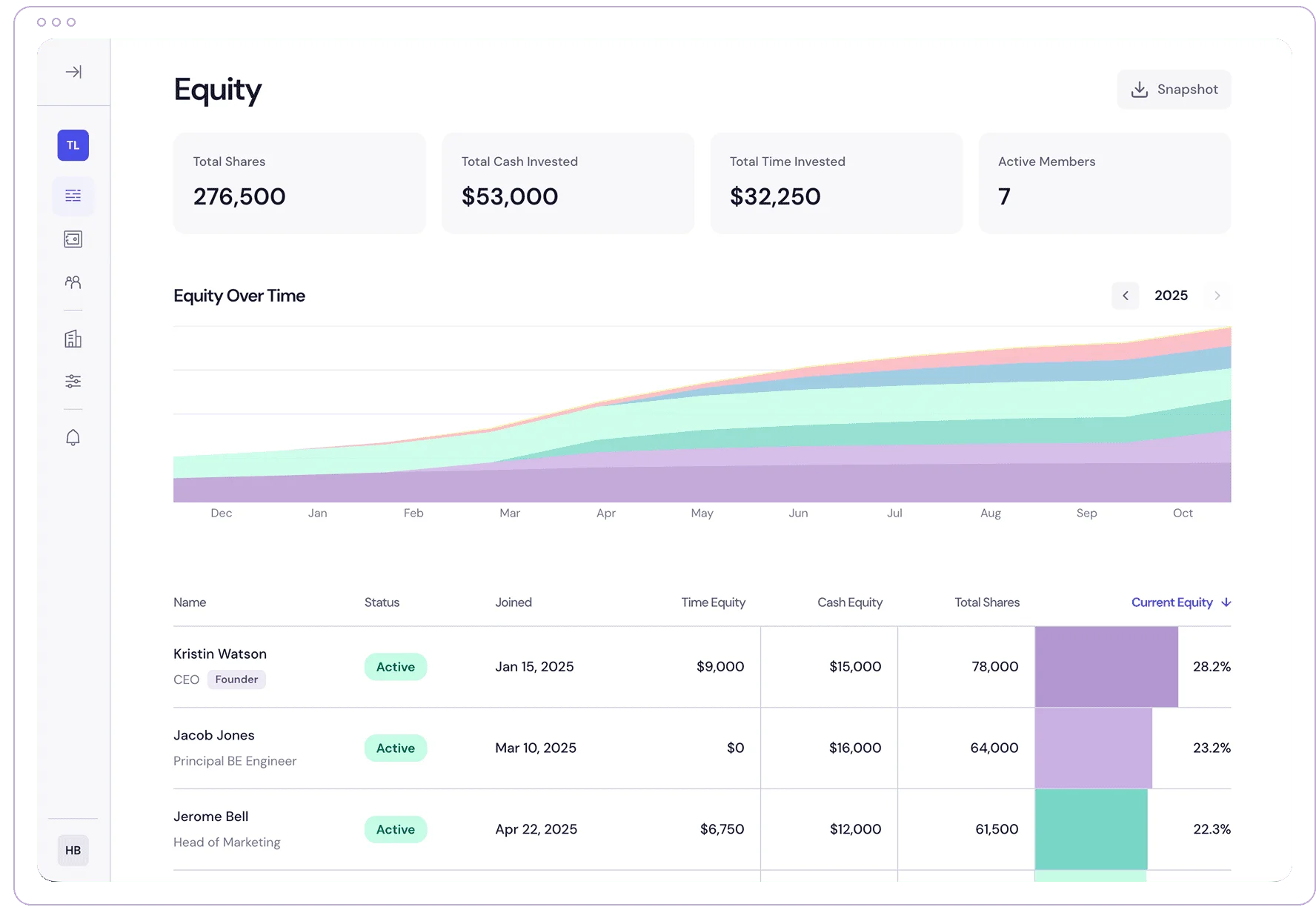
An equity calculator is a tool that converts different types of startup contributions — time, money, equipment, intellectual property — into a single ownership percentage for each contributor.
The concept is straightforward. The execution is where most people get confused.
You have three co-founders. One is coding full-time. Another invested $40,000 and works part-time on sales. A third brought a patent and works weekends on product design. How much does each person own?
An equity calculator answers that question by putting every contribution into the same unit of measurement: dollar value. Once everything is expressed in dollars, calculating percentages is simple math.
Quick Reference: How Contributions Convert to Equity
| Contribution Type | How It’s Valued | Typical Multiplier |
|---|---|---|
| Unpaid time (hours worked) | Hours x GHRR | 2x |
| At-risk cash invested | Actual dollar amount | 4x |
| Non-recoverable unreimbursed expenses | Actual dollar amount | 2x |
| Equipment/assets | Fair market value | 1x |
| Intellectual property | Development cost or market value | Varies |
| Key relationships | Often a fixed grant | N/A |
What an Equity Calculator Actually Does
At its core, an equity calculator does three things:
- Values each contribution in dollars. An hour of engineering time becomes $90. A $10,000 investment becomes $10,000 (or more, with multipliers).
- Sums up each person’s total contribution value.
- Divides each person’s total by the overall total to get ownership percentages.
That’s it. The complexity isn’t in the math — it’s in the inputs.
How do you decide what an hour of someone’s time is worth? How much more valuable is cash than sweat equity? Should early contributions count for more than later ones?
These are the questions that separate a good equity calculator from a bad one.
How Market Rates Are Determined
The foundation of any contribution-based model is the market rate — the dollar value assigned to each person’s time.
The standard approach: what would this person earn doing equivalent work as an employee?
If your technical co-founder could command a $180,000 salary as a senior engineer, their market rate is roughly $90 per hour (based on ~2,000 working hours per year). If your business co-founder would earn $130,000 in a comparable role, their rate is $65 per hour.
This isn’t about what you think someone’s time is worth. It’s about what the market says. Use salary data from sites like Levels.fyi, Glassdoor, or Payscale to anchor your rates in reality.
A few important nuances:
- Use realistic rates, not aspirational ones. If your co-founder has two years of experience, don’t assign them a staff engineer’s rate.
- Rates should reflect the work being done, not the person’s best possible job. A CTO doing basic frontend work should be valued at a frontend developer rate for those hours.
- Update rates as skills and market conditions change. What was fair at founding might not be fair two years later.
How Cash Contributions Are Weighted
Cash is not treated the same as time in most equity calculators. There’s a good reason for this.
When someone invests cash, they’re giving up something they already have — money they could spend, invest, or save. When someone contributes time, they’re giving up something they might have earned — opportunity cost, not actual loss.
This is why most dynamic equity models apply a cash multiplier. In canonical Slicing Pie, the standard multiplier for at-risk cash is 4x.
Equity Matrix exposes adjustable multipliers for teams that deliberately choose a customized methodology. That flexibility is an Equity Matrix customization, not a statement that Mike Moyer’s standard cash multiplier ranges from 2x to 4x. The live calculator defaults to the canonical 4x cash value.
If a team changes the default, it should label that choice as a custom rule, document it before contributions begin, and apply it consistently.
The Role of Multipliers
Beyond cash, some equity calculators apply additional multipliers to account for timing and risk.
Risk Timing Multiplier
Contributions made earlier are riskier. Working on a startup in month one — when there’s no product, no users, no revenue — is fundamentally different from contributing in year two when traction exists.
Some models apply a declining multiplier over time. Early contributions might get a 2x multiplier that gradually decreases to 1x as the startup de-risks.
No-Pay vs. Below-Market Multiplier
The Slicing Pie model uses a 2x multiplier for all unpaid time contributions. The logic: working for free is twice as risky as working for pay, so it should earn twice the equity.
If someone is receiving partial pay — say, half their market rate — only the unpaid portion gets the multiplier. They earn equity on the gap between what they’re paid and what they’d earn elsewhere.
Unreimbursed Expenses
Office space, software subscriptions, travel costs, supplies — when a founder covers non-recoverable business expenses out of pocket and is not reimbursed, canonical Slicing Pie applies the 2x multiplier, not the 4x cash multiplier.
Example: Three Founders, Different Contributions
Let’s walk through a real scenario.
The founders:
- Alex (technical): Market rate $90/hr. Working full-time, unpaid. Contributed 500 hours over 3 months.
- Jordan (business): Market rate $65/hr. Working part-time, unpaid. Contributed 200 hours. Also invested $25,000 cash.
- Sam (design): Market rate $55/hr. Working weekends, unpaid. Contributed 120 hours. Brought a design system worth $8,000 in development cost.
Using a 2x time multiplier and 4x cash multiplier:
| Founder | Contribution | Base Value | Multiplier | Adjusted Value |
|---|---|---|---|---|
| Alex | 500 hrs x $90 | $45,000 | 2x | $90,000 |
| Jordan | 200 hrs x $65 | $13,000 | 2x | $26,000 |
| Jordan | $25,000 cash | $25,000 | 4x | $100,000 |
| Sam | 120 hrs x $55 | $6,600 | 2x | $13,200 |
| Sam | $8,000 IP | $8,000 | 1x | $8,000 |
| Total | $237,200 |
Resulting ownership:
- Alex: $90,000 / $237,200 = 37.9%
- Jordan: $126,000 / $237,200 = 53.1%
- Sam: $21,200 / $237,200 = 8.9%
Notice how Jordan’s cash investment dramatically shifts the split. Without the 4x multiplier, Jordan’s ownership would be much lower. This reflects the principle that cash carries outsized value in early-stage startups.
These numbers aren’t fixed either. Next month, if Alex logs another 200 hours and Jordan doesn’t contribute additional time or cash, the split shifts. That’s the point — it stays fair as circumstances evolve.
Limitations of Calculator-Based Approaches
Equity calculators are powerful, but they’re not perfect. Be aware of these limitations:
They can’t capture everything. Some contributions are hard to quantify. A co-founder who introduces you to your first customer or helps you pivot at a critical moment is creating value that doesn’t fit neatly into an hourly rate.
Garbage in, garbage out. If market rates are wrong or hours are inflated, the output is meaningless. Honest, accurate input is non-negotiable.
They require consistent tracking. A calculator only works if everyone logs their contributions regularly. Skip a few weeks and you’re reconstructing from memory, which defeats the purpose.
Custom multiplier choices change the methodology. Canonical Slicing Pie uses 4x for at-risk cash and 2x for non-recoverable unpaid time and unreimbursed expenses. Equity Matrix lets teams adjust multipliers, but any departure from those defaults should be clearly documented as a customization and agreed upfront.
They don’t replace legal agreements. A calculator tells you what the split should be. A lawyer makes it binding. You still need proper legal documentation — especially before converting to a formal cap table.
Frequently asked questions
How accurate are equity calculators?
Equity calculators are only as accurate as the inputs you provide. If market rates are realistic, hours are tracked consistently, and the team agrees on multiplier values upfront, the output is a reliable and fair reflection of each person’s contribution. The key is honest, regular tracking — if you skip weeks and reconstruct from memory, the results lose their value. Use a tool like Equity Matrix to automate tracking and remove guesswork.
What is the difference between a fixed split and a contribution-based calculator?
A fixed split locks in ownership percentages at the beginning based on assumptions about future contributions. A contribution-based calculator adjusts ownership dynamically as people actually contribute time, cash, or other resources. Fixed splits require guessing; calculators use data. Dynamic models work especially well when commitment levels are uncertain or the team is still forming.
How should cash contributions be weighted compared to time?
Canonical Slicing Pie applies a 4x multiplier to at-risk cash and a 2x multiplier to non-recoverable unpaid time. Equity Matrix uses those values as its calculator defaults while allowing teams to document a customized multiplier if their agreement calls for one. Learn more about how this works in the Slicing Pie model.
When should founders stop using a dynamic equity calculator?
Founders typically transition from dynamic equity to a formal cap table when the company raises its first priced round, hires employees who need stock options, or reaches a point where the founding team’s roles and contributions have stabilized. At that point, the dynamic split gets locked in as a fixed ownership structure with vesting schedules applied going forward.
Using Equity Matrix as Your Calculator
Equity Matrix automates this entire process. You set market rates, log contributions, and the system calculates ownership in real-time.
No spreadsheets. No manual math. No arguments about who contributed what — the data speaks for itself.
If you’re splitting equity among co-founders and want a system that’s fair from day one, try the Equity Matrix calculator and see what your contributions are actually worth.
Ready to split equity fairly?
Equity Matrix tracks contributions and calculates ownership automatically.
Get Started FreeThis article is for informational purposes only and does not constitute legal, tax, or financial advice. Equity Matrix is not a law firm, accounting firm, or financial advisor. Consult a qualified professional for guidance specific to your situation.

Co-founder, Equity Matrix
Sebastian writes about startup equity, founder dynamics, and building fair partnerships.
Keep reading
Slicing Pie calculator: what the numbers mean
A step-by-step guide to using the Slicing Pie calculator. Learn how market rates, multipliers, and contribution types affect your equity split, with real examples.
Read more →Co-founders in different countries: how to set a fair rate
When one co-founder is in the US and another is in Lithuania, do you value their time at local rates or the same rate for the same work? How to set GHRR fairly across borders.
Read more →