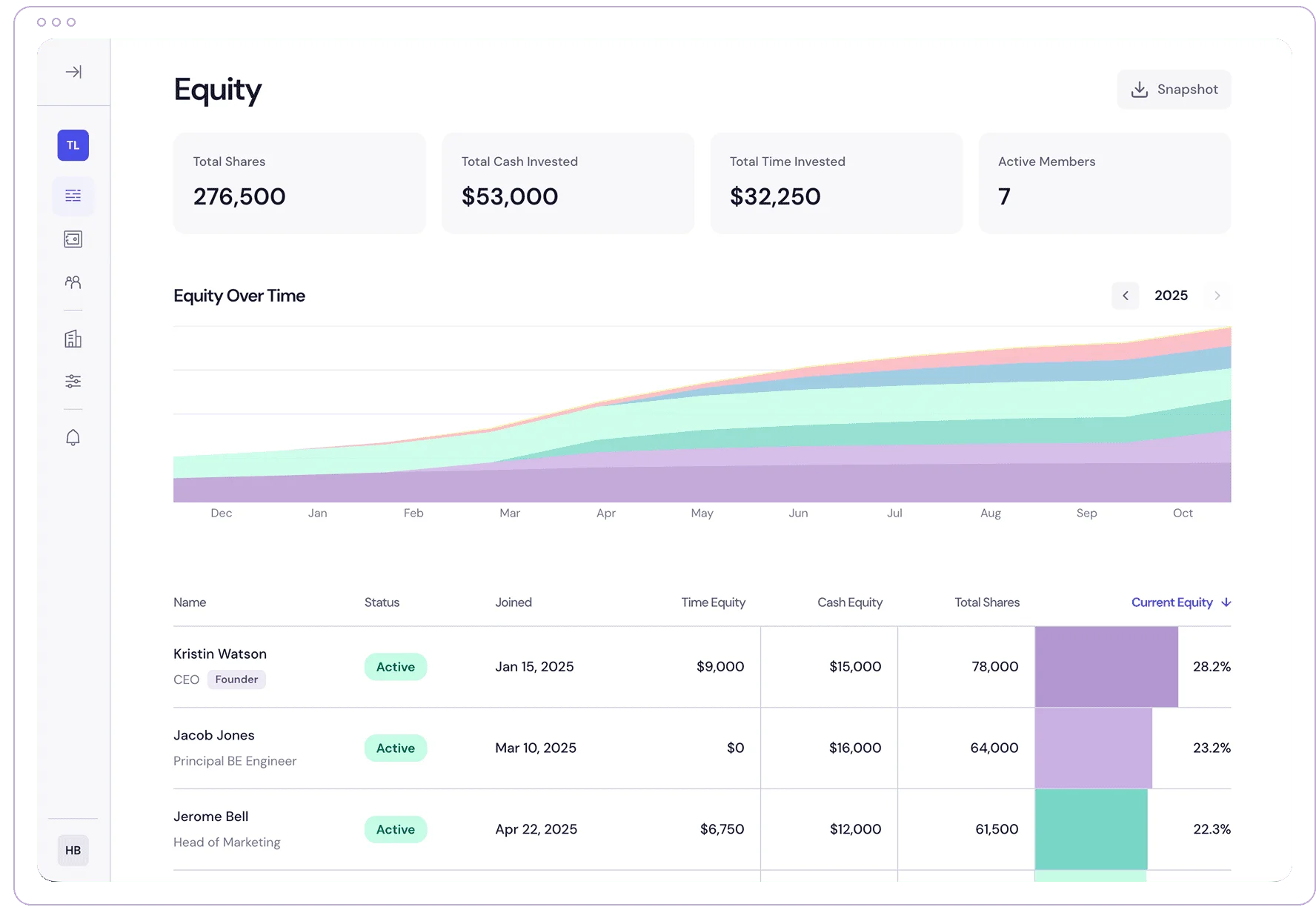
A Slicing Pie calculator converts each co-founder’s contributions (time, cash, ideas, relationships, and equipment) into a fair equity percentage based on the relative value of what everyone has put in.
If you have been reading about the Slicing Pie model and want to see how it actually works with numbers, this is where it gets practical. The calculator takes your inputs, applies the formula, and shows you what each person’s equity share looks like today. No guesswork, no negotiation. Just math.
This post walks you through how to use the calculator step by step, explains what each input means, and shows a worked example so you can see the formula in action. If you want background on the model itself first, start with our complete Slicing Pie guide. Otherwise, you can jump straight in and try the calculator right now.
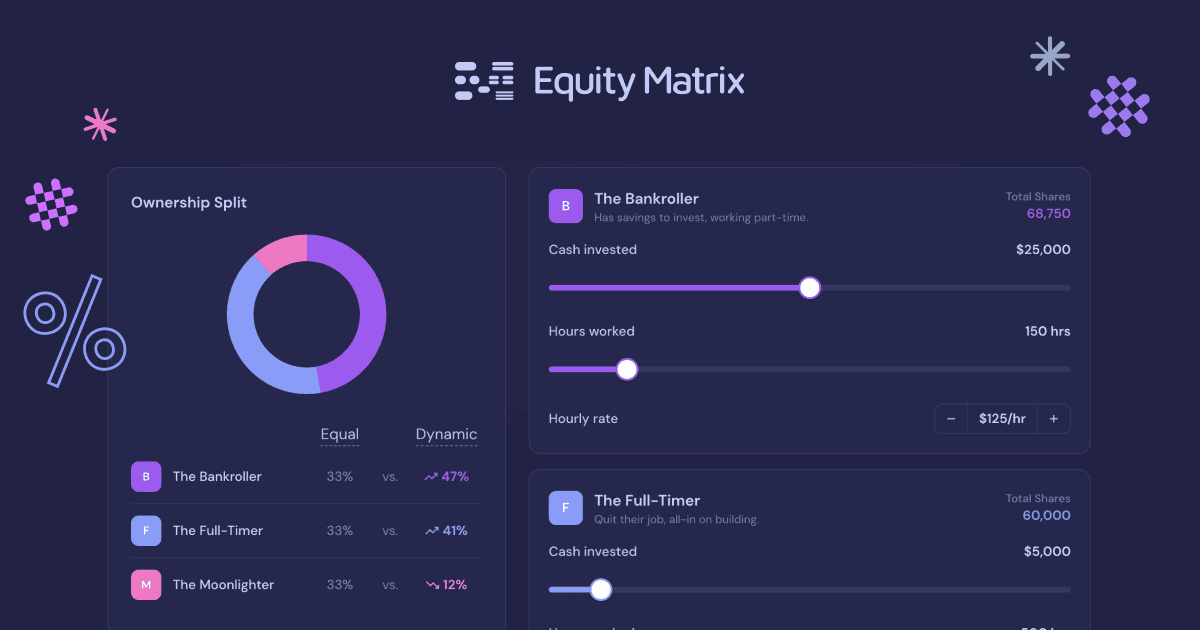
What the Calculator Does
The Slicing Pie model assigns “slices” to each contributor based on the fair market value of what they put in. Unpaid time contributions are valued at hours worked multiplied by the person’s GHRR and then by the standard 2x time multiplier. GHRR (Grunt Hourly Resource Rate) is the person’s fair-market annual salary divided by 2,000; it is not pre-multiplied. At-risk cash uses the standard 4x multiplier.
The calculator handles the math for you. You add your co-founders, enter their contribution details, and it outputs each person’s slice count and equity percentage. The key idea is that equity is always proportional. If you have contributed 40% of the total value, you own 40% of the pie.
It is a simple concept, but doing it by hand across multiple people and contribution types gets messy fast. The calculator keeps everything clean and transparent.
Ready to see your numbers? Try the Slicing Pie Calculator.
Step-by-Step Walkthrough
Here is how to use the calculator from start to finish.
1. Add Your Contributors
Start by adding each co-founder or contributor by name. You can add as many people as you need. Each person gets their own row where you will enter their specific contribution details.
2. Set Market Rates
For each person, enter their fair market rate per hour. This should reflect what they would earn doing similar work at a real company. A senior developer might be $150/hr, a business strategist $100/hr, a designer $120/hr. Be honest here. Inflating rates just inflates your slice count, and everyone can see the numbers.
3. Enter Hours Worked
Input the total hours each person has contributed. This is cumulative, so if you are checking in monthly, add up all hours from the start of the project through today.
4. Enter Cash Contributions
If anyone has put cash into the venture, enter the amount. Cash is treated differently from time because it carries more risk. You could have spent that money elsewhere. The model accounts for this with a multiplier.
5. Set the Cash Multiplier
The standard Slicing Pie cash multiplier is 4x, meaning $10,000 in at-risk cash is worth $40,000 in slices. The calculator uses 4x as its default.
6. Review Your Output
The calculator shows each person’s total slices, their percentage of the pie, and a breakdown of how those slices were earned. You can adjust inputs and see the equity split update in real time.
Open the calculator and follow along with your own numbers.
Understanding the Inputs
Each input in the calculator maps directly to a concept in the Slicing Pie model. Here is what they mean and why they matter.
Market Rate
Your market rate is the hourly rate you could reasonably charge for your work on the open market. This is not your dream salary or your previous job’s pay. It is what a company would pay for the specific skills you are contributing to this startup.
Getting market rates right is one of the hardest parts of the model. If you are unsure how to determine a fair rate, our guide on sweat equity valuation covers several approaches for benchmarking.
Hours Worked
Straightforward: the number of hours you have actually worked on the venture. The model rewards effort, so more hours means more slices. Track your hours honestly and consistently. Many teams use simple time-tracking tools or even shared spreadsheets to keep everyone accountable.
Cash Contributions
Any money a co-founder puts into the business counts as a cash contribution. This includes funds for hosting, equipment, marketing spend, legal fees, or anything else the business needs. Cash is distinct from time because it represents immediate, tangible risk.
The Cash Multiplier
The multiplier compensates cash contributors for the extra risk of putting real money into an early-stage venture. The logic is simple: a dollar of cash is harder to part with than a dollar of unpaid time, because cash has guaranteed alternative uses.
The standard Slicing Pie cash multiplier is 4x. This is distinct from the 2x multiplier for non-recoverable unpaid time and unreimbursed expenses.
The multiplier you choose should be agreed upon by all co-founders before contributions begin. Changing it retroactively creates conflict.
Worked Example: Three Co-Founders
Let us walk through a concrete scenario. Three co-founders have been working on a startup for several months.
The Setup
- Alex (Developer): Market rate $150/hr, 500 hours worked, $0 cash
- Jordan (Business): Market rate $100/hr, 400 hours worked, $10,000 cash
- Sam (Designer): Market rate $120/hr, 300 hours worked, $5,000 cash
Calculating slices (2x time and 4x cash multipliers)
Alex’s slices:
- Time: $150 x 500 hours x 2 = 150,000 slices
- Cash: $0
- Total: 150,000 slices
Jordan’s slices:
- Time: $100 x 400 hours x 2 = 80,000 slices
- Cash: $10,000 x 4 = 40,000 slices
- Total: 120,000 slices
Sam’s slices:
- Time: $120 x 300 hours x 2 = 72,000 slices
- Cash: $5,000 x 4 = 20,000 slices
- Total: 92,000 slices
The Equity Split
Total slices across all three: 362,000
| Co-Founder | Slices | Equity % |
|---|---|---|
| Alex | 150,000 | 41.4% |
| Jordan | 120,000 | 33.1% |
| Sam | 92,000 | 25.4% |
Alex has the largest share because the combination of a high market rate and the most hours worked creates significant value. Jordan’s cash contribution closes the gap despite fewer hours and a lower rate. Sam’s share reflects solid design contributions plus a modest cash investment.
Why both multipliers matter
The example reproduces the live calculator defaults: cash x 4 and unpaid hours x GHRR x 2. Applying both standard multipliers keeps the comparison consistent; the GHRR itself remains the unmultiplied fair-market hourly rate.
Run your own numbers in the calculator to see how contributions affect your split.
What to Do With Your Results
The calculator gives you a snapshot, but equity in a startup is not static. People keep contributing. New co-founders join. Circumstances change.
Here is how to make the most of your results.
Use them as a starting point for conversation. Share the output with your co-founders. If someone is surprised by their percentage, talk about why. The transparency of the formula usually makes these conversations easier, not harder.
Recalculate regularly. The Slicing Pie model is designed to be updated as contributions change. Monthly or quarterly recalculations keep the split accurate and prevent surprises.
Consider a dedicated tracking tool. A calculator works for one-time snapshots, but if you want to track equity over time with proper protections, vesting schedules, and scenario modeling, Equity Matrix is built for exactly that. It takes the Slicing Pie principles and adds the ongoing management layer that startups need as they grow.
For a detailed walkthrough of putting the model into practice, see our implementation guide.
Limitations to Keep in Mind
The Slicing Pie calculator is a powerful tool, but it has boundaries. Understanding them helps you use it wisely.
It is a snapshot, not a system. The calculator shows equity at one point in time. It does not track changes, handle departures, or enforce agreements. For ongoing equity management, you need something more robust.
The model itself has gaps. Slicing Pie works well for early-stage startups, but it does not account for every scenario. What happens when a co-founder leaves? How do you value non-monetary contributions like industry connections? Our post on Slicing Pie problems covers the areas where the model falls short.
Common mistakes can skew results. Inflated market rates, inconsistent time tracking, and retroactive multiplier changes are the most frequent issues. If any of these sound familiar, read our breakdown of Slicing Pie mistakes that sink startups before you finalize your split.
It is one approach among several. Slicing Pie is popular for good reason, but it is not the only way to handle equity. For a side-by-side comparison of how it stacks up against more comprehensive tools, see our Equity Matrix vs. Slicing Pie comparison.
Try the Calculator Now
If you have been thinking about equity splits but have not put numbers on paper yet, this is the easiest way to start. Enter your co-founders, plug in the contributions, and see where you stand.
Try the Slicing Pie Calculator now.
It is free, requires no signup, and gives you a clear picture in under five minutes.
FAQ
Is the Slicing Pie calculator free?
Yes. The calculator is completely free to use with no signup required. Enter your data, get your results, and share them with your team.
How is the Slicing Pie calculator different from Equity Matrix?
The calculator gives you a one-time snapshot of equity based on contributions to date. Equity Matrix is an ongoing equity management platform that tracks contributions over time, includes vesting protections, handles co-founder departures, and provides scenario modeling. Think of the calculator as a starting point and Equity Matrix as the long-term solution.
What cash multiplier should I use?
The standard Slicing Pie recommendation is 4x for at-risk cash. Non-recoverable unpaid time and unreimbursed expenses use 2x. The key is to document the rules before contributions begin and apply them consistently.
Can I save my calculator results?
Yes. The calculator generates a shareable link that captures your inputs and results. You can send it to co-founders for review or bookmark it for future reference.
The Complete Guide to Slicing Pie
Ready to split equity fairly?
Equity Matrix tracks contributions and calculates ownership automatically.
Get Started FreeThis article is for informational purposes only and does not constitute legal, tax, or financial advice. Equity Matrix is not a law firm, accounting firm, or financial advisor. Consult a qualified professional for guidance specific to your situation.

Co-founder, Equity Matrix
Sebastian writes about startup equity, founder dynamics, and building fair partnerships.
Keep reading
7 Slicing Pie alternatives for tracking equity in 2026
Find the best Slicing Pie alternative for contribution-based equity: Equity Matrix, SliceFair, WE.VESTR, Cake Equity, Vestd, spreadsheets, and cap table tools.
Read more →Rob Walling's TOC framework for splitting equity
Rob Walling's TOC framework splits equity based on Time, Opportunity Cost, and Cash. Here's how it works, how it compares to Slicing Pie, and how to use it with a calculator.
Read more →