Paul Graham, co-founder of Y Combinator, wrote one of the most influential essays in startup history about equity. It’s called The Equity Equation. And it says nothing about how co-founders should split ownership.
That silence is worth examining.
Graham’s essay gives founders a clean mathematical framework for evaluating any equity trade: hiring an employee, taking an investment, joining an accelerator. But when it comes to the most consequential equity decision most founders will ever make — dividing ownership among themselves — the essay is silent.
This isn’t an oversight. It tells us something about how the smartest people in startups think about the hardest equity problem.
What the equity equation actually says
Graham’s formula is elegant. You should give up n% of your company if what you trade it for makes the remaining (100 - n)% worth more than the whole company was before.
The math: 1/(1 - n).
Give an investor 5%? Your company needs to be worth at least 5.3% more afterward. Give an accelerator 7%? The company needs to improve by at least 7.5%. Give a key hire 3%? They need to move the needle by at least 3.1%.
Every equity decision becomes a simple comparison. Is what you’re getting worth more than what you’re giving up?
Graham himself noted that by this math, Y Combinator’s deal (7% for $125K plus the program) only needed to improve a startup’s outcome by about 7.5% to break even. His data suggested the actual improvement was far higher.
You should give up n% of your company if what you trade it for improves your average outcome enough that the (100 - n)% you have left is worth more than the whole. — Paul Graham, The Equity Equation
The framework also works in reverse. Graham pointed out that by this formula, top-tier VCs like Sequoia — who typically take around 30% — would need to improve outcomes by at least 43% to justify the dilution. That’s a high bar, even for the best firms.
Why the equation breaks down for co-founders
Graham’s framework works beautifully when one party (the company) is trading equity for something external (money, talent, expertise). There’s a clear before and after. You can estimate whether the trade makes you better off.
Co-founder equity doesn’t work this way.
When two or three people start a company together, there is no “before.” The company doesn’t exist without them. You can’t calculate whether adding your co-founder improves the company’s outcome by X%, because without your co-founder there might not be a company at all.
Why the Equity Equation Doesn't Apply to Co-Founders
| Equity Decision | Before | After | Equation Works? |
|---|---|---|---|
| Hiring employee #10 | Company exists, growing | Company + new hire | Yes — measurable improvement |
| Taking seed funding | Company exists, needs capital | Company + capital + investor | Yes — clear value exchange |
| Joining an accelerator | Company exists, needs help | Company + program benefits | Yes — can estimate improvement |
| Splitting equity with co-founder | Nothing exists yet | Company comes into being | No — there’s no “before” to compare |
This is the fundamental problem. Graham’s equation assumes the company already exists and you’re evaluating a marginal addition. Co-founder equity isn’t marginal. It’s foundational.
What Graham did say about co-founders (elsewhere)
While the Equity Equation essay sidesteps co-founder splits, Graham has addressed co-founder dynamics in other contexts.
He’s been vocal that co-founder breakups are among the top reasons startups fail. In YC’s early data, roughly 20% of startups experienced a founder departure. He’s written extensively about the importance of choosing co-founders carefully, comparing it to choosing a spouse.
But on the specific question of how to divide equity, Graham defers. The essay that defines how to think about every other equity decision leaves the co-founder question untouched.
Meanwhile, his successor at YC, Michael Seibel, has been explicit: split it equally. Seibel argues that “small variations in year one do not justify massively different founder equity splits in years two through ten.” Sam Altman, in his Startup Playbook, offers a more nuanced version: “nearly equal” with one extra share to prevent deadlock — a subtle but important distinction that most founders who quote him miss.
That’s a reasonable position. But it’s also a simplification.
The problem with applying the equation backward
Some founders try to use Graham-style thinking for co-founder splits anyway. The logic goes: “My co-founder is a great engineer. Having a great CTO probably makes this company 2x more likely to succeed. So by the equity equation, giving them up to 50% would be worth it.”
The math technically works, but it creates a dangerous illusion of precision.
The equity equation assumes you can estimate the improvement factor. For investors and employees, you have market data: comparable rounds, salary benchmarks, track records. For co-founders at day zero, you’re guessing.
And the guess has to cover not just year one, but years two through ten. Will your co-founder’s commitment stay the same? Will their skills stay relevant as the company evolves? Will life circumstances change?
Research from Noam Wasserman at Harvard found that 73% of founding teams set their equity split within the first month. They’re making a decade-long bet based on a few weeks of information. No equation can make that bet reliable.
What Graham’s silence actually teaches us
Graham is one of the clearest thinkers in the startup ecosystem. If he could have reduced co-founder equity to a formula, he would have. The fact that he didn’t is the most important signal in the essay.
Co-founder equity is different from every other equity decision because:
1. There’s no external benchmark. When you hire an engineer, you can look at market rates for equity compensation. When you take funding, you can compare term sheets. When you split equity with a co-founder, there’s no market. Every founding team is different.
2. Contributions change over time. An investor’s contribution (capital) is fixed at the moment of investment. An employee’s contribution is roughly bounded by their role. A co-founder’s contribution can vary enormously over the life of the company — from working 60-hour weeks to barely showing up.
3. The relationship is existential. Getting equity wrong with an employee is painful. Getting equity wrong with a co-founder can destroy the company.
About 65% of high-potential startup failures trace to people problems. — Noam Wasserman, Harvard Business School
If Graham were to write a co-founder equation
He hasn’t, but if he did, it might look something like this:
A co-founder equity split is fair when each person’s ownership reflects their expected contribution over the life of the company, with protections for when expectations don’t match reality.
That’s not a formula. It’s a framework. And it requires two things that founders often skip:
Honest assessment of contributions. Not just “we’re both working hard,” but a specific accounting of time, money, skills, opportunity cost, and risk. What is each person actually putting in, and what will they put in over the next several years?
Structural protections. Vesting to handle departures. Governance mechanisms to handle deadlock. Operating agreements to handle disagreements about direction.
This is harder than plugging numbers into 1/(1 - n). But it’s more honest about the complexity of the problem.
A better approach to the co-founder problem
If the equity equation can’t solve co-founder splits, what can?
Track contributions instead of guessing
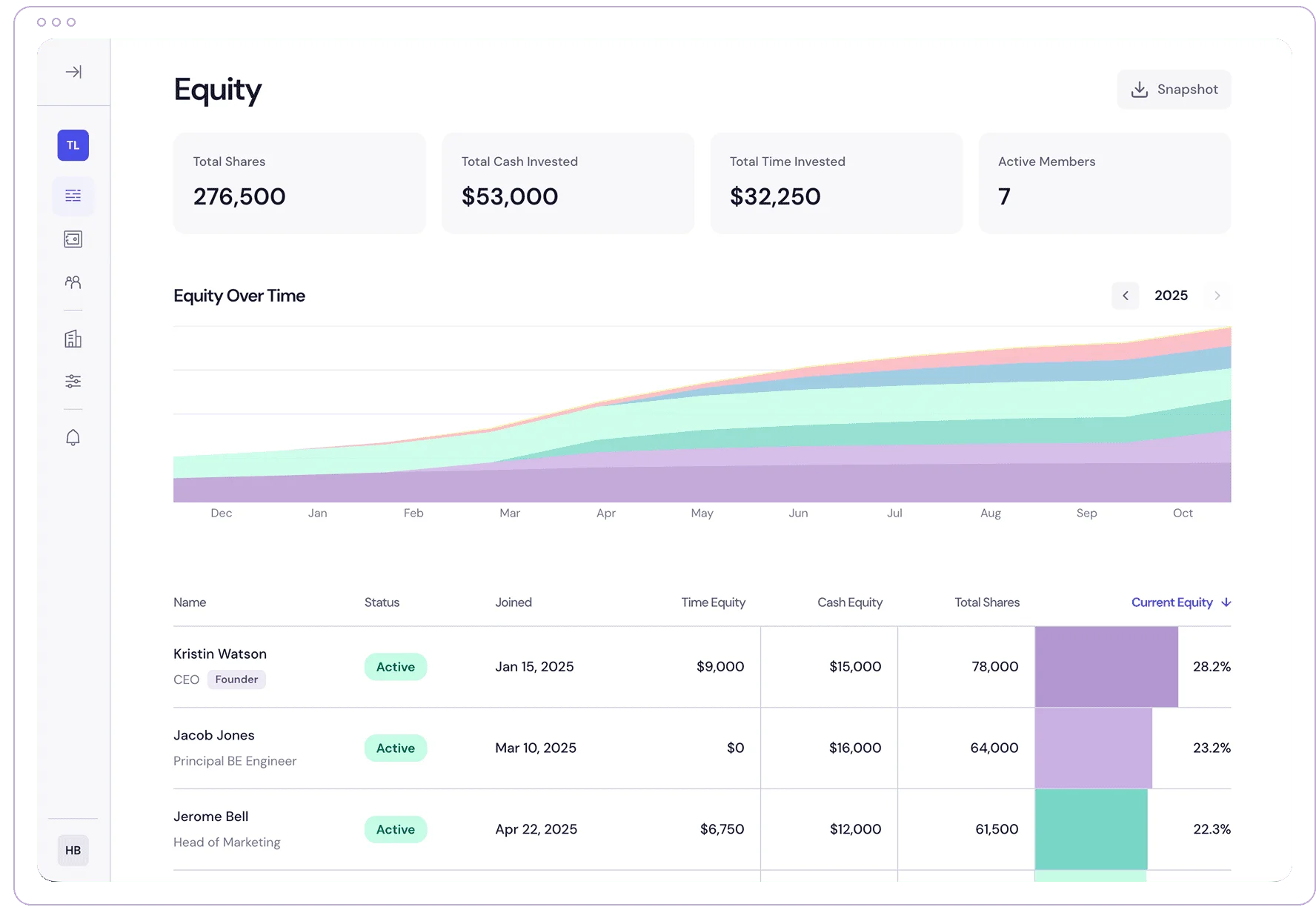
Dynamic equity replaces the upfront negotiation with ongoing measurement. Each founder’s ownership adjusts based on what they actually contribute: time at agreed rates, capital invested, expertise applied, assets brought in.
This solves Graham’s core problem. You don’t need to predict the future. You measure the present and let equity reflect reality.
If contributions turn out equal, you get a 50/50 split. If they diverge — as research suggests they usually do — equity adjusts accordingly. Nobody is overpaid. Nobody is subsidizing their co-founder’s stake.
Use vesting as your safety net
Even Graham would agree with this one. Four-year vesting with a one-year cliff means that early departures don’t create dead equity. It’s the closest thing to a universal rule in startup equity.
Have the conversation
Graham’s essay gives founders permission to think mathematically about equity. That’s powerful. But co-founder equity requires a conversation that math alone can’t replace.
The co-founder agreement is where that conversation gets documented. Roles, responsibilities, decision domains, buyout provisions, what happens when things change. The founders who do this work upfront are the ones who survive the inevitable disagreements later.
The bottom line
Paul Graham’s Equity Equation is brilliant for evaluating investors, employees, and accelerators. It gives founders a clear, mathematical way to think about dilution.
But co-founder equity lives in a space that formulas can’t reach. The absence of a co-founder equation in Graham’s essay isn’t a gap. It’s a statement about the nature of the problem.
Co-founder splits require honest conversation, structural protections, and ideally a system that tracks contributions over time rather than locking in a guess on day one.
Use the equity calculator to see what a contribution-based split looks like for your founding team. Graham’s equation works for everything else. For the co-founder question, you need a different tool.
Frequently asked questions
Does Paul Graham recommend equal co-founder equity splits?
Not directly. Graham’s Equity Equation essay addresses investor dilution, employee compensation, and accelerator equity but doesn’t prescribe a co-founder split formula. Other YC leaders, particularly Michael Seibel, have been more explicit about recommending equal or near-equal splits. Graham’s silence on the topic suggests he recognizes that co-founder equity is a fundamentally different problem than other equity decisions.
Can I use the equity equation to evaluate bringing on a co-founder?
Technically yes, but with significant limitations. The equation (1/(1 - n)) tells you that giving a co-founder 40% only makes sense if their involvement makes the company at least 67% more likely to succeed. But at the earliest stages, you’re guessing at those numbers. The equation works best when you have data to estimate the improvement factor, which is rare for co-founder decisions at day zero.
What does Paul Graham say about co-founder relationships?
Graham has written and spoken extensively about the importance of co-founder selection. He compares choosing a co-founder to choosing a spouse and has noted that roughly 20% of YC startups experienced a founder departure. His advice emphasizes knowing your co-founder well before starting a company, but he stops short of prescribing a specific equity split methodology.
Is the equity equation still relevant for modern startups?
Yes. The core math — evaluating whether what you give up in equity is worth what you get in return — is timeless. The framework applies to fundraising, hiring, and joining accelerators. For co-founder equity specifically, tools like dynamic equity and contribution-based calculators provide what the equation can’t: a way to measure and adjust ownership based on actual input rather than day-one predictions.
Ready to split equity fairly?
Equity Matrix tracks contributions and calculates ownership automatically.
Get Started FreeThis article is for informational purposes only and does not constitute legal, tax, or financial advice. Equity Matrix is not a law firm, accounting firm, or financial advisor. Consult a qualified professional for guidance specific to your situation.

Co-founder, Equity Matrix
Sebastian writes about startup equity, founder dynamics, and building fair partnerships.
Keep reading
Sam Altman's co-founder equity advice, explained
Sam Altman's Startup Playbook recommends nearly equal co-founder splits with one extra share to prevent deadlock. Here's what that advice means in practice and where it falls short.
Read more →What YC gets right (and wrong) about equal equity splits
Y Combinator says split equity equally. Noam Wasserman's research says that kills startups. Who's right? Both, depending on your team. Here's the nuance YC skips.
Read more →