Most founders ask “can I raise VC?”
The better question is “should I?”
The honest answer, for most startups, is no.
The uncomfortable truth
Venture capital operates on power law economics. Roughly 65% of VC investments fail to return capital. About 1% drive the majority of returns.
That means VCs need every investment to have billion-dollar potential. Not because they’re greedy. Because most won’t get there, and the winners have to cover all the losses.
Very few startups can deliver the 100x to 1000x returns that VCs need. Fewer than 1% of VC-backed companies become billion-dollar exits. If the other 99% raise VC, the founders often end up with nothing.
That’s not pessimism. It’s math.
The question isn’t “can you” — it’s “should you”
Most tools that assess VC readiness ask the wrong questions. They check if you have traction, a Stanford degree, or FAANG experience. That tells you whether VCs might be interested.
It doesn’t tell you whether raising is actually good for you.
Here’s what you should actually be asking:
Is your market actually $1 billion+?
VCs need massive markets because they need massive exits. A $50M exit is life-changing for you but worthless to them. If your honest TAM is under $1B, VC math doesn’t work.
Can you realistically build a $100M+ revenue business?
Not “could it theoretically scale” — actually get there. Many great businesses top out at $5-20M revenue. That’s excellent for a bootstrapped founder. It’s a failure for a VC portfolio company.
Are you comfortable owning less than 10% at exit?
By Series C, most founders own 15-25% of their company. After exit, often less than 10%. A $100M exit sounds great until you realize your share might be $8M before taxes.
Do you need capital to grow faster, or just to survive?
VC money should accelerate growth in a market where speed wins. If you’re raising because you can’t reach profitability otherwise, that’s a warning sign — not a funding opportunity. If you’re considering raising through crowdfunding as an alternative, it’s worth knowing that the INVEST Act passed by the House would raise the Reg CF limit from $5M to $10M and expand the accredited investor pool — changes that could make non-VC fundraising more viable.
What Investors Look For in Cap Tables
Are you okay with a 7-10 year exit timeline?
VC funds have lifecycles. They need exits within their fund’s window. If you want to build a company you run for 20 years, VC creates misaligned incentives.
When each path makes sense
| Raise VC if… | Bootstrap if… |
|---|---|
| Your market is $1B+ and growing | Your market is niche but profitable |
| Winner-take-most dynamics favor speed | You can reach profitability without capital |
| You can deploy capital for faster growth | You value control and long-term ownership |
| You’re targeting a $1B+ outcome | You’d be happy with a $10-50M exit |
| You accept the exit timeline pressure | Work/life balance matters to you |
What you give up when you raise
What Happens to Founder Ownership
A $100M exit sounds great until you realize your share might be $8M before taxes.
Equity and ownership. By Series C, founders typically own 15-25% of their company. A founder starting at 100% may end up with less than 10% at exit after multiple rounds of dilution.
Control and decision-making. Board seats give investors veto rights. Protective provisions can block selling the company, taking on debt, or changing board composition. Board seats are nearly impossible to remove.
Exit flexibility. VCs expect 10x+ returns, creating pressure to IPO or sell at high valuations. A $30M acquisition that would be life-changing for you might be blocked because it doesn’t move the needle for the fund.
Growth-at-all-costs pressure. “Our investors told us to spend money fast to increase growth. 4 months later, we were running out of money.” Growth targets may conflict with product quality or founder sanity.
Cautionary tales
These companies raised billions. They had elite teams, massive markets, and plenty of hype. They still failed — often because VC pressure pushed them toward unsustainable growth.
WeWork raised billions, reached $47B valuation, imploded to $8.3B. High valuation, zero discipline.
Quibi raised $1.75B with entertainment veterans. Shut down 6 months after launch.
Fab.com raised $336M, expanded rapidly. No retention, constant pivots. From $1B valuation to firesale.
Jawbone raised $900M+ for wearables. Product failures, high burn. Liquidated in 2017.
The pattern: Premature scaling, misaligned expectations, and loss of discipline. Too much capital can result in irresponsible decisions about hiring, spending, and scaling.
The alternative: Build with what you have
Mailchimp sold for $12 billion without ever taking VC money. Basecamp has been profitable for 20+ years. Atlassian started with $10K and went public.
These aren’t flukes — they’re evidence that the VC path isn’t the only path.
The bootstrapped path is slower. You won’t have war chests for marketing blitzes or talent raids. But you’ll own what you build. You’ll make decisions based on customers, not investors. And a smaller exit — one that VCs would call a “failure” — can still be life-changing.
Dynamic equity makes bootstrapping work
The hardest part of bootstrapping with co-founders is splitting equity fairly when you can’t pay salaries. Who contributes more? How do you adjust when circumstances change?
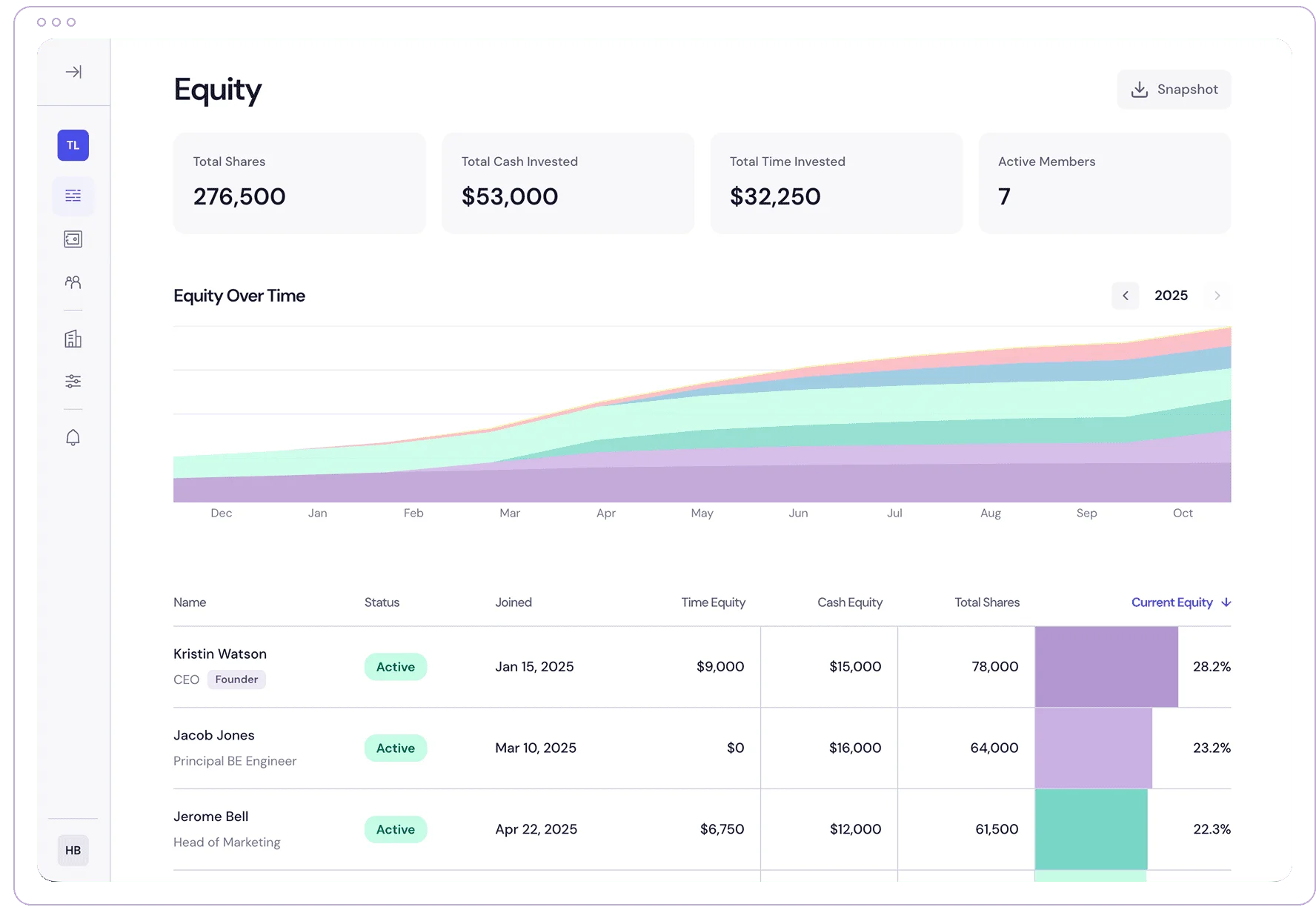
Dynamic equity solves this. Instead of guessing at a fixed split, ownership adjusts based on what each person actually contributes — time, money, or both. No resentment. No dead equity. Just fair ownership that reflects reality. If you’re building a bootstrapped product or indie business specifically, the indie hacker’s guide to equity splits covers profit sharing, hybrid models, and part-time founder scenarios that standard VC-track advice ignores.
The Complete Guide to Slicing Pie: Dynamic Equity for Startups
The bottom line
The best funding is the funding you don’t need.
Build a company that’s profitable from the start. Track contributions fairly. Keep the equity you’ve earned.
Not sure if you’re VC-fundable? Take the quiz to find out where you stand — and what path makes the most sense for your startup.
Ready to start tracking equity fairly? Try the Dynamic Equity Calculator.
Frequently Asked Questions
How much equity do founders typically give up to VCs?
After a seed round, founders typically own 80-90% combined. After Series A, 60-70%. By Series C, most founders own 15-25% of their company. After exit, often less than 10% when you account for option pools and liquidation preferences.
Can you bootstrap a tech startup without VC?
Yes. Many successful tech companies were bootstrapped, including Mailchimp ($12B exit), Basecamp (profitable for 20+ years), Atlassian (started with $10K), and Zoho (profitable B2B SaaS). The key is reaching profitability before running out of runway.
What’s the failure rate for VC-backed startups?
Roughly 65% of VC-backed startups fail to return capital to investors. About 75% fail to return the original investment, and only about 1% become the “home run” exits that drive fund returns.
Is it bad if VCs won’t fund my startup?
Not at all. VC is designed for a specific type of company: one pursuing a massive market with winner-take-most dynamics. Most successful businesses don’t fit that profile. Being “unfundable” by VC standards often means you can build a profitable, sustainable business on your own terms.
Ready to split equity fairly?
Equity Matrix tracks contributions and calculates ownership automatically.
Get Started FreeThis article is for informational purposes only and does not constitute legal, tax, or financial advice. Equity Matrix is not a law firm, accounting firm, or financial advisor. Consult a qualified professional for guidance specific to your situation.

Co-founder, Equity Matrix
Sebastian writes about startup equity, founder dynamics, and building fair partnerships.
Keep reading
Co-founders in different countries: how to set a fair rate
When one co-founder is in the US and another is in Lithuania, do you value their time at local rates or the same rate for the same work? How to set GHRR fairly across borders.
Read more →How to track co-founder contributions (before it costs you)
A practical system for tracking co-founder contributions: what to log, how often, the fields that matter, and where spreadsheets start to strain.
Read more →