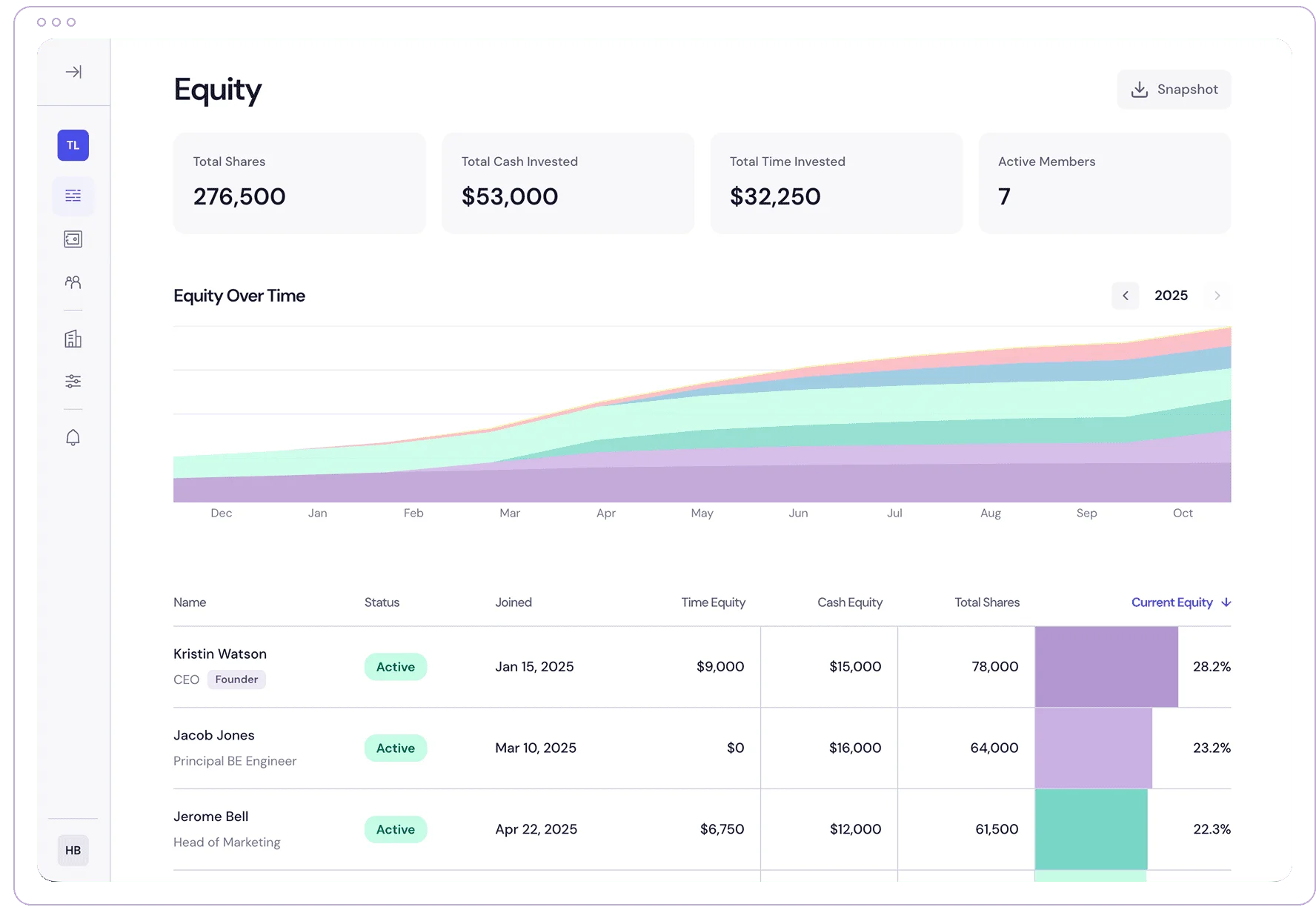
A co-founder agreement is the document that defines who owns what, who does what, and what happens when things change. Most startups never write one. The ones that do are far more likely to survive.
Legal and tax warning: The clauses below are illustrative only and are not a usable agreement as written. Entity type, state or national law, securities rules, tax classification, employment law, and each founder’s circumstances can change the result. Have entity/state counsel and a qualified tax advisor adapt the documents before anyone signs, receives equity, or relies on a dynamic allocation.
If you’re searching for a co-founder agreement template, you’re already ahead of the majority of founding teams. Research from Harvard Business School found that half of founding teams never formalized equity or departure terms in writing. Those teams were significantly more likely to experience destructive conflict.
This post walks through every section a co-founder agreement should include, explains what each section should say and why, and shows you what the language looks like in practice. If you want a deeper look at the reasoning behind each section, read our companion piece on founder agreements: what to include and why.
Why most startups skip it
The reasons are always the same. You’re excited. You trust each other. Talking about what happens if someone leaves feels like planning for a divorce before the wedding. So you skip it, shake hands, and start building.
Noam Wasserman’s research at Harvard Business School suggests that about 65% of high-potential startup failures trace to people problems, with co-founder conflict the largest category.
The cautionary tale everyone should know: Snapchat’s Reggie Brown was part of the original founding team but had no written agreement. When Evan Spiegel and Bobby Murphy pushed him out, Brown had to sue. The settlement was reportedly $157.5 million. That’s an expensive lesson in the value of paperwork.
A co-founder agreement doesn’t mean you don’t trust each other. It means you’re serious about building something together.
Figure out the equity split before you write the agreement.
Model each co-founder's contributions and see what a fair ownership split looks like.
Try the calculator →What a co-founder agreement covers
A complete co-founder agreement addresses eleven areas. Skip any of them and you’re leaving a gap that will surface at the worst possible time.
Co-founder agreement sections
| Section | What it covers | Why you need it |
|---|---|---|
| Parties and company | Who’s in the agreement, what company it governs | Legal foundation |
| Equity allocation | How ownership is divided or calculated | The core deal |
| Vesting | How equity is earned over time | Protection against early departures |
| Roles and responsibilities | Who does what | Prevents overlap and conflict |
| Contributions | How time, money, and assets are valued | Fairness and transparency |
| Compensation | When founders get paid and how | Prevents resentment and imbalance |
| Departure and forfeiture | What happens when someone leaves | Prevents dead equity |
| Dissolution and sale | What happens if the company sells or shuts down | Protects all founders on exit |
| Intellectual property | Who owns what’s created | Protects the company’s assets |
| Confidentiality and non-compete | Protections after departure | Prevents competitive harm |
| Dispute resolution | How disagreements are handled | Avoids litigation |
Section 1: parties and company information
Every agreement starts by identifying who’s involved and what company this governs.
What it should include:
- Full legal names of all co-founders
- The company’s legal name and entity type (LLC, C-Corp, etc.)
- State or jurisdiction of incorporation
- The effective date of the agreement
Example language:
This Agreement is entered into as of [DATE], by and among [FOUNDER NAME 1] and [FOUNDER NAME 2] (collectively, the “Members”), as members of [COMPANY NAME] LLC (the “Company”), organized under the laws of [STATE/JURISDICTION].
This seems simple, but getting it in writing establishes that a formal agreement exists. You’d be surprised how many co-founder disputes start with one person claiming “we never agreed to anything.”
Section 2: equity allocation
This is the core of the agreement. How is ownership divided?
There are two approaches:
Fixed split
You agree on percentages upfront. 60/40, 55/45, 50/50, or whatever reflects your assessment of contributions.
Example language:
Ownership shall be allocated as follows: [FOUNDER 1] shall hold 55% of the Company’s membership interests, and [FOUNDER 2] shall hold 45% of the Company’s membership interests, subject to the vesting schedule described in Section 3.
The problem with fixed splits is that they’re based on a guess about future contributions. If one person ends up contributing significantly more than expected, the split doesn’t reflect reality. This is why 50/50 splits are risky and why most equity disputes happen within the first two years. If you’re splitting equity between two people, read how to split equity in a two-person startup before you decide on numbers.
Dynamic equity (contribution-based)
Instead of guessing, you track contributions and let the math determine ownership. For a full comparison of the two approaches, see dynamic vs. fixed equity.
Example language:
Each Member’s ownership percentage shall be determined by their relative contributions to the Company, as tracked through the Equity Matrix platform. Contributions shall be converted into units (“Slices”) using the multipliers defined in this Agreement. Each Member’s ownership at any point in time equals their total Slices divided by all Members’ total Slices.
Dynamic equity eliminates the negotiation. The equity calculator handles the math, and the split always reflects who actually put in the work. When you’re ready to formalize, you freeze into a fixed cap table.
We used this approach for Equity Matrix. After trying a 50/50 split and watching it fail, we switched to contribution-based tracking. It removed the arguments and replaced them with data. Read the full story.
Section 3: vesting schedule
Vesting ensures equity is earned over time. Without it, someone who leaves after three months keeps their full stake.
What it should include:
- Total vesting period (typically 4 years)
- Cliff period (typically 1 year)
- Vesting frequency after the cliff (monthly or quarterly)
- What happens to unvested equity upon departure
Example language:
All equity allocations are subject to a vesting schedule of four (4) years with a one (1) year cliff. During the cliff period, no equity shall vest. Upon completion of the cliff period, 25% of the Member’s equity allocation shall vest immediately. Thereafter, the remaining 75% shall vest in equal monthly installments over the following thirty-six (36) months.
If a Member departs the Company before completing the cliff period, all of their equity allocation shall be forfeited and returned to the Company.
This is the section most first-time founders skip, and it’s the one that causes the most pain later. Every investor will require vesting. Don’t wait for them to make you add it. For a deeper dive on schedule types, see our guide to vesting schedules explained.
Acceleration provisions
Acceleration provisions define what happens to unvested equity when a major event occurs — typically an acquisition. Your agreement should specify which type applies.
| Trigger type | What it means | When it applies |
|---|---|---|
| Single trigger | Vesting accelerates on a qualifying event (usually acquisition) | Protects founders from losing unvested shares in a sale |
| Double trigger | Vesting accelerates only if the founder is also terminated after acquisition | More investor-friendly; prevents windfall exits |
Most early-stage agreements use single-trigger acceleration for founders. Know the tradeoff: investors often push for double trigger because it keeps founders incentivized post-acquisition. Decide before you’re in a term sheet negotiation.
Section 4: roles and responsibilities
Define who’s responsible for what. This prevents two founders from both trying to make product decisions, or neither founder handling sales.
What it should include:
- Each founder’s title and primary domain
- Decision-making authority within each domain
- Who has final say when domains overlap
Example language:
[FOUNDER 1] shall serve as Chief Executive Officer and shall be primarily responsible for business strategy, fundraising, sales, and external partnerships. [FOUNDER 2] shall serve as Chief Technology Officer and shall be primarily responsible for product development, technical architecture, and engineering.
Each Member shall have primary decision-making authority within their designated domain. Decisions that affect both domains or the Company as a whole shall require agreement of both Members. In the event of a deadlock, [FOUNDER 1 / a designated tiebreaker mechanism] shall have final authority.
The deadlock clause matters more than you think. With a 50/50 split, every disagreement is a potential standoff. Define the tiebreaker before you need it.
Decision-making and governance
Beyond day-to-day authority, your agreement should define what requires unanimous consent versus a majority vote. At minimum, these decisions should require unanimous agreement:
- Issuing new equity or diluting existing shareholders
- Taking on debt above a specified threshold
- Selling the company or substantially all assets
- Changing the terms of the founder agreement itself
For everything else, a clear chain of authority based on roles (defined above) keeps decisions moving. If you’re doing a 50/50 split, this section is especially important — equal splits create deadlock risk on any decision where both founders disagree and neither has a structural tiebreaker. Consider mechanisms like a trusted advisor vote, binding mediation, or a rotating tiebreaker.
Example language:
Decisions requiring unanimous consent of all Members include: (i) issuance of new equity interests, (ii) incurring indebtedness exceeding $[THRESHOLD], (iii) any sale, merger, or disposition of all or substantially all of the Company’s assets, and (iv) amendment of this Agreement. All other decisions within a Member’s designated domain shall be made by that Member without requiring approval of the other Members.
Section 5: contribution types and multipliers
If you’re using dynamic equity, this section defines how different types of contributions are valued.
What it should include:
- What counts as a contribution (time, cash, assets)
- The hourly rate used to value time contributions
- The multiplier applied to cash contributions
- How contributions are tracked and verified
Example language:
The Company recognizes the following contribution types:
Time: Each Member’s time contributions shall be valued at their agreed-upon hourly rate. [FOUNDER 1]‘s rate is $[X]/hour. [FOUNDER 2]‘s rate is $[Y]/hour.
Cash: Monetary contributions shall receive a multiplier of [4]x, reflecting the higher risk and opportunity cost of cash investment.
All contributions shall be logged through the Equity Matrix platform within seven (7) days of the contribution occurring. Each Member shall have access to view all logged contributions at any time.
The cash multiplier is standard in dynamic equity frameworks. Cash carries more risk than time because it’s after-tax, already-earned money that can’t be recovered if the company fails. A 2x to 4x multiplier is typical. Learn more about how equity calculators work.
Section 6: compensation
When do founders start getting paid? Most early-stage founders take no salary or well-below-market pay. That’s fine — but document it.
What it should include:
- Initial compensation for each founder (including $0 if applicable)
- Conditions that trigger salary increases (e.g., closing a seed round)
- How future compensation decisions are made
- Whether deferred compensation is tracked and how it gets repaid
Example language:
Initial compensation. As of the effective date of this Agreement, no Member shall receive a salary from the Company. Members acknowledge they are contributing on a deferred-compensation basis.
Conditions for salary. The Company shall begin paying market-rate salaries to Members upon: (i) raising a seed round of no less than $[AMOUNT], or (ii) generating monthly revenue of no less than $[AMOUNT] for three consecutive months, whichever occurs first. Specific salary amounts shall be determined by unanimous consent of all Members at that time.
Deferred compensation tracking. If any Member’s compensation is formally deferred (rather than waived), the Company shall maintain a written record of amounts deferred and the agreed repayment terms.
Transparency here prevents the slow poison of one founder feeling underpaid or another drawing from the company before it can afford it.
Section 7: departure and forfeiture
What happens when someone leaves is the section that prevents dead equity. This is where the money is.
What it should include:
- Distinction between voluntary departure and termination for cause
- What happens to unvested equity
- What happens to vested equity
- Buyout process and timeline
- Definition of “cause”
- Right of first refusal on departing founder’s shares
- Death and permanent disability provisions
Example language:
Voluntary departure in good standing. If a Member departs voluntarily after completing the cliff period, they retain their vested equity. Their ownership percentage may be diluted over time as remaining Members continue to contribute.
Termination for cause. If a Member is removed due to material breach of this Agreement, fraud, gross misconduct, or willful harm to the Company, all of the terminated Member’s equity (both vested and unvested) shall be forfeited.
Buyout. The Company or remaining Members may elect to purchase a departing Member’s vested equity. If the parties cannot agree on a price within thirty (30) days, the equity shall be valued by an independent third-party appraiser mutually selected by the parties, with costs shared equally. The valuation shall be completed within ninety (90) days.
Right of first refusal. Before transferring any equity interest to a third party, a departing Member must first offer the interest to the Company and then to the remaining Members, pro rata, at the same price and on the same terms as the proposed third-party transfer. The Company and remaining Members shall have thirty (30) days to exercise this right.
Death or permanent disability. If a Member dies or becomes permanently disabled, the Company and remaining Members shall have the right to purchase that Member’s vested equity from the estate or legal representative at fair market value, as determined by independent appraisal. Any unvested equity shall be forfeited in accordance with the vesting schedule.
Most template agreements treat all departures the same. They shouldn’t. Someone who leaves to pursue another opportunity is different from someone who commits fraud. Your agreement should reflect that. For more on what happens when a co-founder stops contributing, we wrote a detailed guide.
Section 8: dissolution and sale
What happens if the company shuts down or someone wants to sell? Don’t leave this to default state law.
What it should include:
- Vote threshold required to approve a sale or dissolution
- How proceeds are distributed
- Drag-along and tag-along rights
Example language:
Approval threshold. Consistent with the governance example above, any sale of the Company, merger, or dissolution shall require unanimous consent of all Members.
Proceeds distribution. Upon sale or dissolution, proceeds shall be distributed as follows: (i) payment of all Company debts and obligations, (ii) any deferred compensation owed to Members, (iii) remaining proceeds distributed to Members in proportion to their equity ownership.
Two provisions worth including in any agreement:
| Provision | What it does |
|---|---|
| Drag-along rights | If a supermajority of shareholders approve a sale, minority holders must participate on the same terms |
| Tag-along rights | If a majority shareholder sells their stake, minority holders have the right to join the transaction at the same price |
Drag-along prevents a minority holder from blocking a sale once the agreement’s approval threshold is met. Tag-along prevents a majority holder from selling themselves out while leaving minority holders behind. A supermajority threshold such as 75% is an alternative to unanimity, not an additional rule; if founders choose it, counsel should revise every reserved-matter and drag-along clause consistently.
Section 9: the 83(b) election — don’t miss this
This isn’t a section of the co-founder agreement itself, but it’s directly triggered by signing one. If founders receive restricted stock subject to vesting, you have exactly 30 days from the grant date to file an 83(b) election with the IRS. Miss the deadline and there is no extension, no exception.
Without the 83(b) election, you’ll owe ordinary income tax on your shares as they vest — based on their fair market value at the time of vesting. If your company has grown by then, that tax bill can be enormous, and you’ll owe it before you’ve ever sold a share.
With the election, you pay tax on the value at the time of grant — which for most early-stage startups is close to zero.
This is one of those details that feels like an afterthought until it costs you tens of thousands of dollars. Read the full breakdown of 83(b) elections before you file your paperwork.
Section 10: intellectual property
All IP created for the company should belong to the company. This seems obvious until you’re in a dispute about who owns the codebase.
What it should include:
- Assignment of work product to the company
- Moral rights waiver (where applicable)
- Pre-existing IP carve-outs
- Employee invention statute protections
Example language:
All intellectual property created by any Member in the course of their work for the Company, including but not limited to software, designs, inventions, processes, and written content, shall be the sole property of the Company. To the extent that assignment is not permitted under applicable law, each Member grants the Company an exclusive, irrevocable, worldwide, royalty-free license to use, reproduce, modify, and commercially exploit such works.
Each Member shall disclose any pre-existing intellectual property they intend to use in connection with the Company’s business. Pre-existing IP remains the property of the contributing Member, with a license granted to the Company for business use.
The pre-existing IP clause is often overlooked. If your technical co-founder brings a framework they built before the company existed, who owns it? Define this upfront.
Section 11: confidentiality and non-compete
Protect the company’s information and prevent departing members from immediately building a competitor.
What it should include:
- Confidentiality obligations (during and after involvement)
- Non-solicitation period
- Non-compete scope and duration
- Severability clause for jurisdictions that restrict non-competes
Example language:
Confidentiality. Each Member shall maintain the confidentiality of all proprietary information, trade secrets, business strategies, and financial data of the Company, both during and after their involvement. This obligation survives the termination of this Agreement.
Non-competition. For a period of twelve (12) months following departure, a former Member shall not develop, launch, or participate in a product or service that directly competes with the Company’s core business.
This section shall not apply to the extent prohibited by the laws of the Member’s jurisdiction of residence. Where any provision is deemed unenforceable, the remaining provisions shall continue in full force and effect.
The jurisdictional carve-out is critical. Non-competes are void in California and restricted in many other states and countries. In September 2025, the FTC formally withdrew its proposed nationwide non-compete ban, leaving enforceability entirely to state law — a patchwork that varies widely. For a full breakdown of what this means for your agreements, see our guide on the FTC non-compete ban and what founders need to know. Your agreement needs to survive regardless of where your co-founders live. The confidentiality clause, on the other hand, is enforceable virtually everywhere.
Section 12: dispute resolution
Define how disagreements are resolved before you have one.
What it should include:
- Mediation as a first step
- Arbitration as a fallback
- Which jurisdiction’s laws govern
- Who pays for dispute resolution
Example language:
Any disputes arising under this Agreement shall be resolved first through good-faith mediation. If mediation is unsuccessful within thirty (30) days, the dispute shall be resolved through binding arbitration in accordance with the rules of the applicable arbitration body in the jurisdiction in which the Company is organized.
This Agreement shall be governed by the laws of [STATE/JURISDICTION].
Arbitration is faster and cheaper than litigation. Mediation is faster and cheaper than arbitration. Structure your agreement to use the lightest tool first.
What most templates get wrong
They assume a fixed split
Most co-founder agreement templates are built around a fixed equity split negotiated on day one. But research consistently shows that equal splits are rising and causing more problems. A template that only supports fixed splits forces you to guess about contributions you haven’t made yet.
The alternative: build your agreement around contribution tracking and let the data determine the split. That’s what dynamic equity does.
They skip the departure details
Generic templates often have a single line about departures: “If a member leaves, their equity is forfeited.” That’s not enough. You need different outcomes for different situations, a buyout process with a timeline, and clear definitions of what constitutes “cause.”
They don’t account for international teams
Many templates assume a US C-Corp structure. If your team spans multiple countries, your agreement needs to handle different IP assignment rules, non-compete enforceability, and governing law considerations. Default partnership rules vary by US state and differ significantly across European countries. Using “the country in which the Company is organized” isn’t specific enough in federal systems like the US or Canada.
Get a co-founder agreement that works
You have two paths:
DIY: Use the sections above as your framework. Write your own agreement. Have a lawyer review it. This works, but it takes time, legal fees, and the willingness to research each section thoroughly.
Use Equity Matrix: When you set up your company on Equity Matrix, we generate a dynamic equity allocation framework based on your settings: multipliers, cliff periods, contribution types, and more. Your co-founders accept it when they join. Everything is tracked automatically, and the agreement evolves with your business.
We built this because we went through the pain of trying to create our own agreement from scratch, paying lawyers who didn’t understand dynamic equity, and realizing that the tools we needed didn’t exist. Read the full story.
Try the equity calculator to see what a contribution-based split looks like, or sign up to generate your agreement.
Frequently asked questions
Do I need a lawyer to create a co-founder agreement?
You don’t need a lawyer to write the agreement, but you should have one review it. Any two people can enter into a contract. The value of a lawyer is making sure the language holds up in your specific jurisdiction and that you haven’t missed anything critical. Budget $1,000 to $3,000 for a startup attorney to review a co-founder agreement.
One important note: each founder should consult their own attorney — not one shared lawyer. Your own. It costs more, but it ensures everyone fully understands what they’re signing and that no single lawyer is in the position of representing conflicting interests.
What’s the difference between a co-founder agreement, an operating agreement, and a shareholder agreement?
These terms get used interchangeably, but they’re different documents that serve different purposes.
| Founder agreement | Operating agreement | Shareholder agreement | |
|---|---|---|---|
| When created | Before or at founding | At incorporation (LLC) | At incorporation (Corp) |
| Entity type | Any or pre-entity | LLC | C-Corp or S-Corp |
| Who it governs | Co-founders specifically | All LLC members | All shareholders |
| Key focus | Equity splits, roles, vesting, IP, departures | Management structure, profit distribution, member rights | Share classes, board seats, investor rights, transfer restrictions |
A founder agreement typically comes first — it captures the commitments between co-founders before the legal entity even exists. Once you incorporate, it gets supplemented (and sometimes superseded) by an operating agreement if you form an LLC, or a shareholder agreement if you form a corporation. If you’re considering an LLC structure — especially for dynamic equity arrangements — read about why LLCs work well for dynamic equity.
When should we sign a co-founder agreement?
Before you write any code, spend any money, or tell anyone you’re starting a company. The conversation about equity doesn’t get easier with time. Have it early, when the stakes are zero and walking away is easy.
Can we change the agreement later?
Yes, but it requires all parties to agree. Amendments should be documented in writing. If you’re using dynamic equity through Equity Matrix, changes to multipliers or terms are tracked and all members are notified and must accept the updated framework before continuing.
Is a co-founder agreement legally binding?
Yes. A signed co-founder agreement is a legally binding contract. Electronic signatures are valid under the ESIGN Act (US), eIDAS (EU), and equivalent laws in most jurisdictions. The key requirements are: clear intent to agree, accessible records, and all parties having the opportunity to review the terms.
What happens if we don’t have a co-founder agreement?
Without an agreement, equity ownership, IP rights, and departure terms are governed by default state or country laws, which rarely reflect what the founders intended. LLC defaults vary by state and may treat management rights, distributions, and economic interests differently; there is no universal rule that an LLC without an operating agreement has equal ownership. This is how famous co-founder disputes happen.
Ready to split equity fairly?
Equity Matrix tracks contributions and calculates ownership automatically.
Get Started FreeThis article is for informational purposes only and does not constitute legal, tax, or financial advice. Equity Matrix is not a law firm, accounting firm, or financial advisor. Consult a qualified professional for guidance specific to your situation.

Co-founder, Equity Matrix
Sebastian writes about startup equity, founder dynamics, and building fair partnerships.
Keep reading
Co-founders in different countries: how to set a fair rate
When one co-founder is in the US and another is in Lithuania, do you value their time at local rates or the same rate for the same work? How to set GHRR fairly across borders.
Read more →How to track co-founder contributions (before it costs you)
A practical system for tracking co-founder contributions: what to log, how often, the fields that matter, and where spreadsheets start to strain.
Read more →