Most founders don’t realize their equity split is unfair until it’s too late.
By then, resentment has built up. Conversations have become arguments. Someone’s already talking to a lawyer.
According to research from Harvard Business School, 73% of co-founder conflicts stem from poorly designed initial equity allocations. Not product disagreements. Not strategic differences. Equity.
The good news: the warning signs are recognizable. If you catch them early, you can fix the problem before it destroys your company.
The Core Problem: Contribution vs. Ownership
An equity split is unfair when ownership doesn’t reflect actual contributions.
That sounds obvious. But in practice, most founders never compare the two. They set a split early, maybe 50/50 to avoid an awkward conversation, and never revisit it.
Months pass. Contributions diverge. The gap between what someone owns and what they’ve earned widens.
Harvard research found that nearly 40% of startup teams spend a day or less deciding their equity split. Teams that rush this decision are 3x more likely to be unhappy with splits that were divided equally by default.
Here’s how to know if you’re headed for trouble.
Red Flag #1: One Founder Is Doing Most of the Work
The clearest sign of an unfair split: unequal effort, equal ownership.
One founder works 60 hours a week. The other checks in for a few hours on weekends. Both own 50%.
This pattern shows up constantly. Maybe one founder has a day job they haven’t quit. Maybe one lost motivation after the initial excitement faded. Maybe one handles “strategy” while the other handles everything else.
As founder Melissa Kwan wrote about her own experience: “‘Cofounders’ does not necessarily mean equal partners. I handled biz dev, sales, marketing, customer success, product management, QA, support, recruiting, HR, accounting, and ops. My cofounder wrote code. We split 50/50.”
She learned the hard way. You don’t have to.
What to watch for:
- You’re working full-time while your co-founder has another job
- You’ve closed every customer while they “focus on product”
- You handle operations, sales, marketing, support, and hiring while they handle one function
- They take vacations while you pull all-nighters
If you’re keeping score, something is already wrong. But if you refuse to keep score while your co-founder contributes less, you’re setting yourself up for a blowup.
Red Flag #2: No Vesting Protection
Without vesting, a co-founder can walk away with their full equity stake after contributing almost nothing.
Imagine this: you and a co-founder split equity 50/50. Six months later, they leave for a full-time job. Without vesting, they keep 50% of your company forever.
You continue building for the next five years. They own half of everything you create.
This isn’t hypothetical. It happened at Zipcar. Co-founder Antje Danielson was fired in January 2001, but because her equity wasn’t subject to vesting, she retained her full stake. The company’s other founder, Robin Chase, ended up diluted to 3% through subsequent funding rounds while building the company that sold for $500 million.
Standard protection: Four-year vesting with a one-year cliff. Both founders should be subject to it. No exceptions.
If your co-founder resists vesting, ask yourself why. Someone who’s committed to the long haul shouldn’t fear a structure that rewards commitment.
Vesting Explained: How It Works and Why It Matters
Red Flag #3: The “Idea Premium”
Most ideas are worth almost nothing. Execution is everything.
Yet many founders who had the original idea claim an outsized equity stake. “I came up with this, so I should get 70%.”
Research on startup equity shows that idea generation is one of the factors most likely to cause disagreements about fair splits. The founder with the idea feels entitled to more. The founders doing the execution feel underpaid.
Here’s the reality: ideas multiply in value only through execution. A billion-dollar idea with no execution is worth zero. A mediocre idea with great execution can be worth billions.
If your co-founder is claiming a premium for “the idea” while you’re doing most of the building, your split is probably unfair.
What fair looks like: The idea matters, but it’s one input among many. Time, skills, cash, connections, opportunity cost, and risk tolerance all matter too. No single contribution should dominate unless it genuinely dominates the value created.
Red Flag #4: Static Splits in Dynamic Situations
Startups change constantly. Roles evolve. Circumstances shift.
A split that was fair in month one might be wildly unfair by month twelve.
Maybe one founder got promoted at their day job and reduced their startup commitment. Maybe one founder pivoted the product and took over a function that didn’t exist before. Maybe one founder’s skills became less relevant as the company grew.
Static equity can’t account for any of this. It locks in a snapshot of contribution that becomes increasingly divorced from reality.
What to watch for:
- Your roles have changed significantly since you set the split
- One founder’s skills are no longer central to the business
- Commitment levels have diverged from what you originally agreed
- You’ve never revisited the split even though everything else has changed
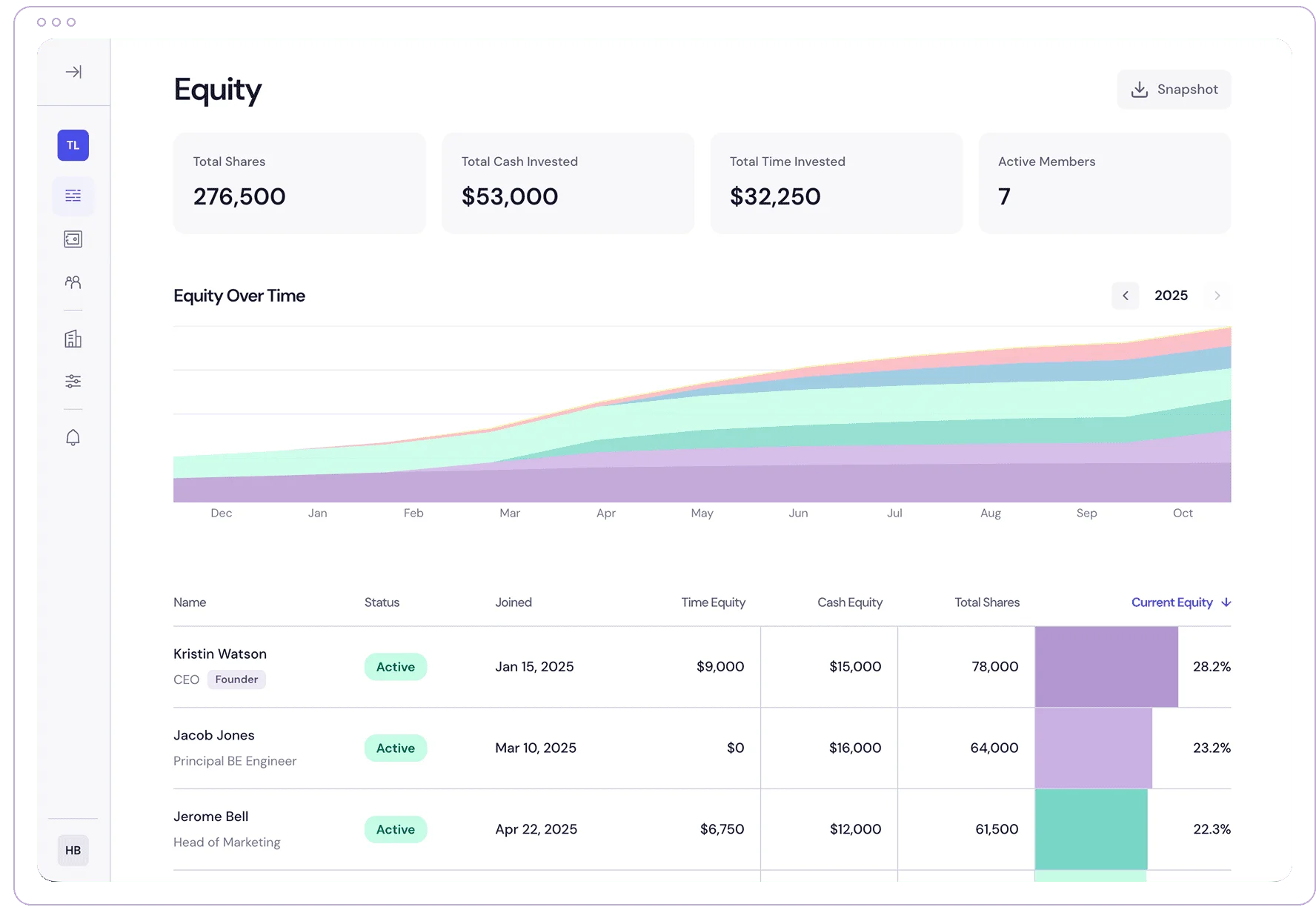
This is exactly why dynamic equity exists. Instead of guessing the future, you track contributions as they happen. Ownership adjusts automatically. No awkward renegotiation required.
Red Flag #5: You’re Afraid to Discuss It
If you can’t bring up equity concerns with your co-founder, that’s a sign in itself.
Maybe you’re worried they’ll get defensive. Maybe you’re worried they’ll threaten to leave. Maybe you’ve tried before and the conversation went badly.
Fear of the conversation usually means you already know something is wrong.
Professor Noam Wasserman’s research found that founders who avoid hard conversations early are more likely to face catastrophic conflicts later. The discomfort you’re avoiding now compounds into resentment, lawyers, and failed companies.
The test: Could you have a calm, factual conversation about whether your equity split still reflects contributions? If not, you have a problem, whether or not you address it.
What Unfair Splits Actually Cost
These aren’t theoretical concerns. Unfair splits have destroyed some of the most famous companies in tech.
Snapchat: Reggie Brown came up with the idea for disappearing photos. He brought in Evan Spiegel and Bobby Murphy. By August 2011, he was pushed out with 0%. No equity, no credit, no seat at the table. He sued and settled for $157.5 million, but he could have been a billionaire.
Twitter: Noah Glass was the driving force behind Twitter’s creation. He came up with the name. He pushed for the project when others were skeptical. Then Jack Dorsey went to the board and had him fired. Glass walked away with a sliver of equity. At IPO, Dorsey’s stake was worth over $1 billion. Glass’s name didn’t appear in the S-1 filing.
Facebook: Eduardo Saverin put up the initial money and co-founded the company with Zuckerberg. His 30% stake was diluted to approximately 0.03% through a series of maneuvers. He sued, settled, and retained about 4-5%, worth around $2 billion at IPO. He’s a billionaire, but it took years of litigation to get there.
These stories ended with settlements. Most don’t. Most end with one founder walking away with nothing, or both founders too exhausted from fighting to build anything worthwhile.
What Investors See
If you ever raise money, investors will scrutinize your cap table. An unfair or poorly-structured split sends signals you don’t want to send.
| What They See | What They Think |
|---|---|
| 50/50 split without justification | CEO can’t have hard conversations |
| Extreme splits (80/20) | One founder is undervalued |
| No vesting | Risk of dead equity |
| Large chunks to “friends or early helpers” | Poor equity management |
| Many tiny shareholders | Future signature headaches |
As one investor noted, equal splits often signal that founders avoided having difficult but critical conversations. That’s not a trait investors want to fund.
Understanding what investors look for in cap tables can help you structure equity properly from the start.
How to Fix an Unfair Split
If you recognize these red flags, you have options.
Start with data
Before any conversation, get clear on the facts. How many hours has each founder contributed? What cash has each put in? What milestones has each achieved?
The partnership fairness calculator is the fastest way to diagnose the gap — enter each person’s time, capital, and role value to see what a fair split would look like given actual contributions. Our equity calculator can also help you model what fair looks like based on actual contributions. When you bring numbers to the conversation, it’s harder to argue from emotion. For a structured way to evaluate both the gap and each co-founder’s trajectory, the equity review matrix framework maps contribution-ownership gaps against performance trends and gives you a clear action for each combination.
Have the conversation
Avoiding the conversation makes everything worse. The sooner you address it, the less resentment has built up.
Frame it around contributions and the company’s needs, not personal worth. “Our contributions have diverged from what we expected. How should we adjust?” is easier to hear than “You’re not pulling your weight.”
Consider dynamic equity going forward
If you’re early enough, switching to dynamic equity can solve the problem structurally. Ownership adjusts based on ongoing contributions. No one has to guess the future or renegotiate quarterly.
Get help if needed
If the conversation is too charged, bring in a neutral third party. An advisor, a mediator, or even a mutual friend with business experience can help keep things productive.
The goal isn’t to win an argument. It’s to build a structure that works for both founders and gives the company its best chance of success.
The Earlier You Act, the Better
Every month you wait, the problem gets worse. Resentment builds. Positions harden. The gap between what’s fair and what’s documented widens.
The founders who handle equity well aren’t the ones who got lucky with perfect co-founders. They’re the ones who set up structures that adapt to reality, have hard conversations early, and treat equity like the serious business decision it is.
An unfair split doesn’t have to sink your company. But ignoring an unfair split almost certainly will.
Frequently Asked Questions
How do I know if my equity split is unfair?
Compare contributions to ownership. If one founder is contributing significantly more time, cash, skills, or risk than their equity stake reflects, the split may be unfair. Other signs include fear of discussing the topic, missing vesting protection, and resentment building between founders.
Can you renegotiate equity after the company is formed?
Yes, though it gets harder as the company grows and especially after outside investment. The earlier you address an unfair split, the easier it is to fix. Some founders use dynamic equity specifically to avoid the need for renegotiation.
What percentage of co-founder disputes are about equity?
Research from Harvard Business School found that 73% of co-founder conflicts stem from poorly designed initial equity allocations. Equity is the most common source of serious co-founder disputes.
Is a 50/50 split always unfair?
No. If both founders are genuinely contributing equally in time, cash, skills, and risk, 50/50 can be fair. The problem is when 50/50 is used as a default to avoid hard conversations, or when contributions diverge over time but the split stays static.
Ready to see if your equity split reflects reality? Our equity calculator models fair ownership based on actual contributions, not guesswork.
Ready to split equity fairly?
Equity Matrix tracks contributions and calculates ownership automatically.
Get Started FreeThis article is for informational purposes only and does not constitute legal, tax, or financial advice. Equity Matrix is not a law firm, accounting firm, or financial advisor. Consult a qualified professional for guidance specific to your situation.

Co-founder, Equity Matrix
Sebastian writes about startup equity, founder dynamics, and building fair partnerships.
Keep reading
Co-founders in different countries: how to set a fair rate
When one co-founder is in the US and another is in Lithuania, do you value their time at local rates or the same rate for the same work? How to set GHRR fairly across borders.
Read more →How to track co-founder contributions (before it costs you)
A practical system for tracking co-founder contributions: what to log, how often, the fields that matter, and where spreadsheets start to strain.
Read more →