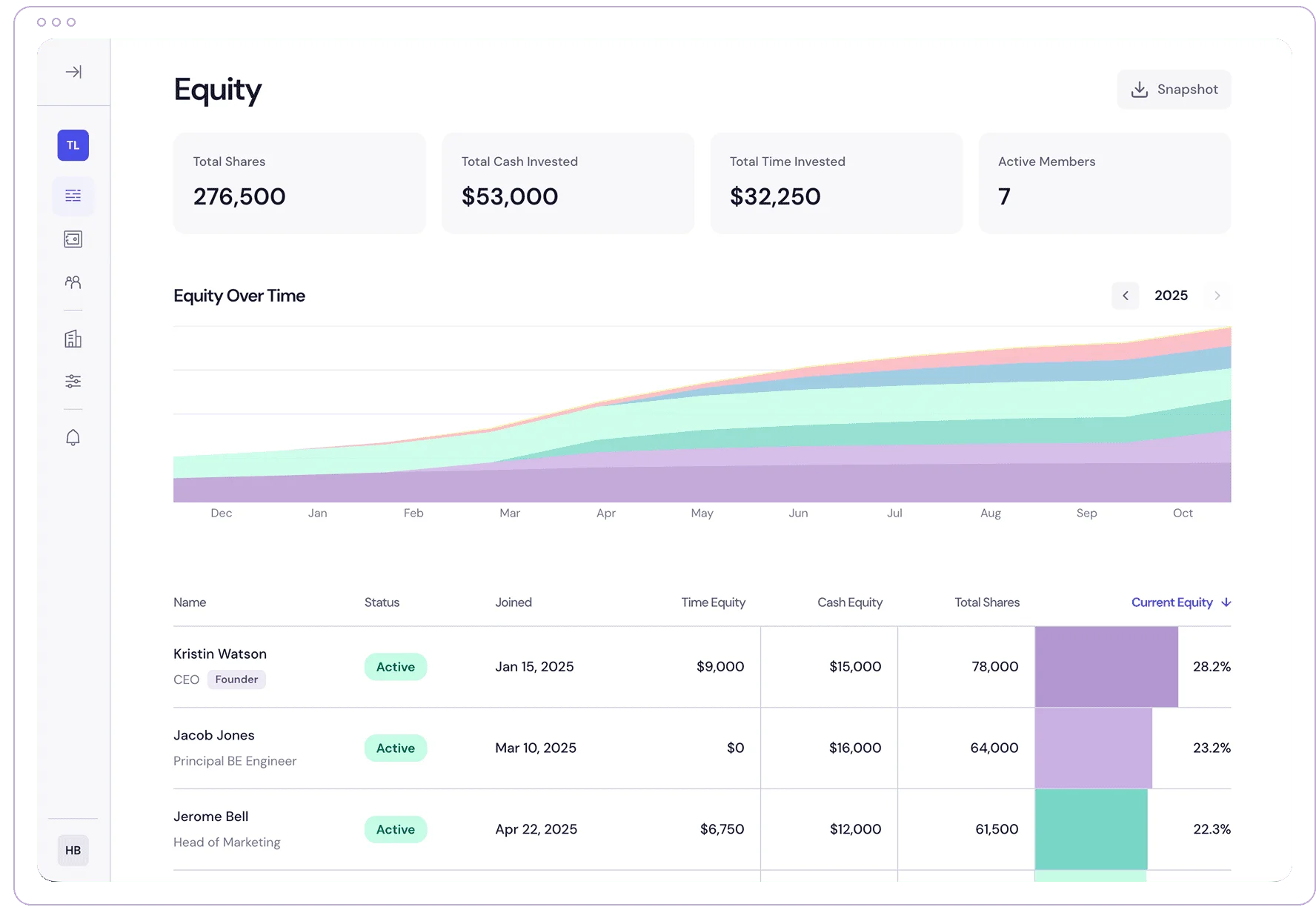
Slicing Pie has three critical gaps the book doesn’t fully address: the lack of cliff protection for early departures, the complexity of handling advisor equity, and the challenge of converting to a fixed cap table when raising institutional capital.
Mike Moyer’s Slicing Pie is one of the most important books ever written about startup equity. It gave founders a framework to solve a problem that had destroyed countless companies: how do you split ownership fairly when you don’t know what the future holds?
The answer Moyer proposed was elegant. Track contributions. Assign multipliers. Let ownership reflect actual input rather than arbitrary guesses on day one.
I’m a fan of the book. EquityMatrix exists because of the ideas it contains.
But after using the system myself and building software to implement it, I’ve found gaps that the book doesn’t address. They’re not problems with the core concept. They’re gaps in the implementation guidance.
Here’s what the book doesn’t tell you.
Problem 1: No Cliff Period Creates Dead Equity Risk
Traditional vesting schedules have cliffs for a reason. A cliff protects the company from someone who joins, contributes briefly, and leaves with meaningful ownership.
Slicing Pie doesn’t have cliffs.
If someone joins your startup, works for two weeks, then ghosts you, they’ve still earned slices. Those slices represent ownership. And unlike vested shares, there’s no mechanism in the standard Slicing Pie model to claw them back or prevent them from accumulating in the first place.
Two weeks of contribution might earn 2% of your company. That 2% stays with the person forever, even if they never contribute another minute.
This is exactly the dead equity problem that makes investors nervous and kills founder motivation. Research shows that 65% of high-potential startups fail due to people problems. A lot of those people problems stem from ownership that doesn’t match contribution.
Moyer addresses this partially with the “recovery” framework, where you can potentially recoup equity from departed contributors. But the recovery process is reactive, not preventive. And it requires either agreement from the departing party or a lawsuit.
What’s missing: Loyalty protections built into the model itself. A minimum contribution threshold before equity begins accruing. A cliff period that ensures commitment before ownership transfers.
Vesting Explained: Everything Founders Need to Know
Problem 2: The Trust and Legitimacy Gap
Moyer offers the Pie Slicer app for tracking contributions. Many teams also use Google Sheets, Notion, or Airtable.
These tools work. But they create a subtle problem that founders don’t anticipate: tracking equity in a generic tool undermines trust and makes your company feel like a side project.
Here’s the psychology:
When you track ownership in the same tool you use for grocery lists and meeting notes, it sends a signal. It says “we’re not serious enough to have real infrastructure.” It says “this might not work out.” It says “we’re winging it.”
That signal matters. Co-founders notice. They start wondering if their contributions are really being tracked properly. They wonder if the numbers will hold up if things go sideways. They wonder if this whole arrangement is actually enforceable.
The tool you use to track equity shapes how seriously people take it. A spreadsheet feels like a draft. Purpose-built software feels like a commitment.
And there are practical issues too:
| Problem | What Happens | Impact |
|---|---|---|
| No approval workflow | Contributions get logged without sign-off | Creates disputes later |
| Accidental edits | Someone sorts a column wrong or overwrites a formula | Data integrity issues |
| Audit trail limitations | Version history exists but isn’t designed for legal disputes | Hard to prove what happened |
| Feels informal | Using generic tools signals “side project” | Undermines co-founder trust |
The legitimacy issue compounds over time. Investors ask about your cap table and you show them a Google Sheet. Potential hires ask about equity and you point them to a Notion database. It doesn’t inspire confidence.
What’s missing: A system that signals commitment, creates accountability, and makes everyone feel like their equity is being tracked with the seriousness it deserves.
Problem 3: Tax Strategy Is an Afterthought
The book explains what Slicing Pie is. It doesn’t explain the tax implications of implementing it. That’s backwards.
Tax strategy should come first, not last. You can create tax headaches in the first few weeks of your company, before you even think to call a lawyer.
Here’s a common scenario:
Two founders read Slicing Pie. They love it. They file for a C-Corp because that’s what tech startups do. They start tracking contributions. A few months in, they realize that every time ownership shifts in a corporation, that’s potentially a taxable event. They should have filed 83(b) elections. They might owe taxes on equity they can’t sell. The IRS doesn’t care that they were just trying to be fair.
The entity structure decision has to come first, not after you’ve already started:
| Entity Type | Dynamic Equity Compatibility | Tax Complexity |
|---|---|---|
| C-Corp | Poor | Every ownership change can trigger taxes |
| S-Corp | Poor | Same issues plus ownership restrictions |
| LLC | Good | Membership interests can shift without taxable events |
This is why we wrote an entire article on why LLCs work better for dynamic equity. The short version: LLCs let you adjust ownership percentages without creating the tax events that corporations do.
The advice to “get a lawyer” is correct. But by the time most founders get around to it, they’ve already made entity structure decisions that create unnecessary complexity.
Moyer likely generates leads for lawyers through his platform, which is fine. But founders need to understand the tax strategy implications before they file their formation documents, not after.
What’s missing: Upfront guidance on entity structure and tax strategy, before founders make decisions they’ll spend years unwinding.
Problem 4: The Built-In Expiration Date
Slicing Pie assumes you’ll eventually freeze. Once the company is profitable and everyone’s on salary, the model ends. Slices become fixed shares. The pie stops changing.
This is a fundamental limitation, not just an ambiguity.
It means Slicing Pie only works for very early-stage companies that can’t yet pay salaries or turn a profit. Once you reach sustainability, you’re supposed to lock in ownership and move on.
But why? Why should dynamic equity stop working just because the business is healthy?
| Business Type | Slicing Pie Fit | The Problem |
|---|---|---|
| Pre-revenue startup | Good | This is what it’s designed for |
| Profitable startup | Poor | Model says to freeze once sustainable |
| Small business (SMB) | Poor | Never in the “pre-salary” phase |
| Partnership | Poor | Contributions vary long-term by design |
Think about a law firm, an agency, or a small business with partners who contribute differently year to year. One partner brings in more clients this year. Another takes a sabbatical. Contributions shift. Why shouldn’t ownership reflect that ongoing reality?
The forced freeze assumption makes Slicing Pie almost irrelevant for SMBs and partnerships. It’s designed for the narrow window between “we have an idea” and “we can pay ourselves.” That’s maybe 18-24 months for most startups.
There’s no fundamental reason dynamic equity has to end. The requirement to freeze is a design choice, not a necessity.
Yes, investors often require a fixed cap table. That’s a real constraint for companies raising capital. But plenty of businesses never raise, and they shouldn’t be forced into a model that expires.
We’re building EquityMatrix to support long-term dynamic equity. Contributions can keep adjusting for as long as it makes sense for your business. You can freeze when you need to (for investors, for an acquisition, for simplicity), but you’re not required to.
What’s missing: A version of dynamic equity that works beyond the early-stage startup window.
Problem 5: Motivation and Gaming
The Slicing Pie model tracks what people contribute. It doesn’t set expectations for what they should contribute.
This creates a subtle but real problem.
Without minimum contribution thresholds, someone can coast along making small contributions indefinitely. They’re technically participating. Their slice grows slowly. But they’re not pulling their weight.
By the time it becomes obvious that someone is underperforming, they’ve already accumulated meaningful equity. You can stop tracking new contributions from them, but you can’t undo what they’ve already earned.
The Slicing Pie model is purely additive. There’s no mechanism for negative consequences until someone completely stops contributing.
Gaming the system is also possible. Someone who knows the multiplier structure can optimize for high-multiplier activities rather than what actually helps the company. If cash contributions have a higher multiplier than time, a co-founder might choose to write small checks rather than do high-value work.
Traditional employment has performance reviews, minimum expectations, and consequences for underperformance. Dynamic equity needs similar structures.
What’s missing: Minimum contribution requirements, performance thresholds, and mechanisms for addressing underperformance before it becomes an equity dispute.
What Happens When a Co-Founder Stops Contributing?
In practice: the implementation mistakes that compound these problems
The five structural gaps above describe what the Slicing Pie model is missing. What follows is what goes wrong when real teams try to use it anyway. These aren’t hypothetical failure modes — they’re the patterns that surface repeatedly once a team is a few months into their implementation.
Tracking discipline collapses
This is the most commonly cited killer. Nothing else matters if you don’t track consistently.
Week one, everyone logs their hours religiously. Week four, someone forgets. Week eight, nobody remembers what they worked on last month. By month three, the spreadsheet is a fiction and equity conversations get awkward again.
If you don’t track, you don’t have dynamic equity. You have good intentions and a broken spreadsheet.
The model is only as good as the data feeding it. When logging becomes a chore, the whole system falls apart — and it almost always becomes a chore. The fix is making logging take less than two minutes, setting a weekly cadence everyone commits to, and using purpose-built software instead of a generic spreadsheet.
Hourly rate disputes
Every founder thinks they’re worth more.
The technical co-founder argues she could make $200/hour as a consultant. The business co-founder insists his MBA and network justify $175/hour. These conversations go in circles because there’s no objective answer — and rate disputes often mask deeper concerns about respect and recognition.
| Argument | What they really mean |
|---|---|
| ”I could earn $X elsewhere" | "I want a higher rate than you" |
| "My skills are more specialized" | "I think I’m contributing more" |
| "The market rate for my role is…" | "I Googled something that supports my position” |
When two founders can’t agree on rates, they usually can’t agree on a lot of other things either. The fix: set rates before anyone logs a single hour, use market data from sources like the Bureau of Labor Statistics as a starting point, document the agreement, and move on.
Time doesn’t equal value
Sixty hours of unfocused work isn’t worth more than twenty hours of shipping features.
Slicing Pie treats all hours the same. An hour of busywork earns the same slices as an hour of brilliant product work. This creates a perverse incentive: look busy, not effective. Some founders log hours “thinking about the company” during their commute. Others pad time spent on low-value tasks.
This is distinct from the gaming problem described in Problem 5 — that’s about optimizing for multipliers. This is about the more fundamental issue that presence doesn’t equal output. The model rewards hours by design, and hours don’t always correspond to what actually moves the company forward.
The fix is supplementing hour tracking with explicit conversations about deliverables. What did you actually ship this week? Focus on that.
Ideas get overvalued
“I came up with the idea. That should count for something.”
The Slicing Pie model technically allows valuing ideas through the “asset” contribution bucket, applying a cash multiplier to intellectual property. This is where disputes get ugly fast. Most successful companies pivoted far from their original concept — the idea is table stakes, not the bulk of the value.
Be conservative on idea valuation. Very conservative. If someone can’t also execute, the idea probably isn’t worth much. Consider not valuing ideas at all until they’re validated with customers.
People inflate their time
If you can’t trust your co-founders to log hours honestly, no equity model will save you.
Some founders worry that Slicing Pie creates incentives to pad hours — logging ten hours for five hours of work. It happens. But dishonest time reporting isn’t a Slicing Pie problem. It’s a trust problem. If someone’s inflating their hours, they’d be just as problematic on a salary. The equity model didn’t create that behavior.
No system is going to solve trust. If you can’t trust your co-founders with an honor system, you have a co-founder problem, not a tracking problem.
The best mitigation is making contributions visible to the whole team. When everyone can see what everyone else is logging, social accountability kicks in. Address concerns immediately — if you suspect padding, have the conversation now, not in six months when the equity gap has compounded.
Renegotiation hostage situations
“I’ve been thinking, and my hourly rate should be higher.”
Once someone has accumulated significant slices, they have leverage. They can threaten to leave, knowing their slices come with them. They can demand rate adjustments, retroactive changes, or special treatment. The more someone has contributed, the more power they have to renegotiate terms. This can feel like hostage-taking, especially if the startup is too dependent on one person.
The fix is airtight upfront documentation: rates, rules, and exit provisions in writing before contributions start. Build in explicit clauses about how changes work — majority vote, unanimous consent — so there’s no ambiguity to exploit later.
Transparency creates anxiety
When everyone sees the numbers in real-time, some people spiral.
“Why did their percentage go up this week?” “Am I contributing enough?” “Should I be logging more hours?”
The visibility that makes dynamic equity fair can also create obsessive scorekeeping. Some founders check the dashboard daily, watching percentages shift, worrying about falling behind. The fix is setting expectations upfront — the numbers will move, that’s the point — and reviewing monthly rather than daily. Short-term fluctuations don’t matter. The math handles itself if contributions are genuine.
The hidden cost of 50/50 equity splits
The meta-problem: trust
Notice a pattern?
Most of these implementation failures come down to trust. Trusting people to log honestly. Trusting people to stay committed. Trusting people to argue in good faith about rates. Trusting people not to game the system.
Slicing Pie provides a framework for fairness. But no framework can substitute for trustworthy co-founders. If you’re spending more time policing the equity model than building the company, you have the wrong team.
Pick the right co-founders first. Then pick the right equity model.
The five structural problems in this post are gaps in the model itself — things Moyer’s framework doesn’t address. The seven implementation mistakes above are human problems that the model doesn’t solve on its own. Both matter. But the second list is only a problem if you have the wrong people. The first list is a problem regardless.
How EquityMatrix Addresses These Gaps
We built EquityMatrix because we love the core ideas in Slicing Pie but kept seeing the same implementation problems derail companies.
Here’s how we address each gap:
Loyalty Protections
EquityMatrix allows you to set contribution requirements before equity begins accruing. You can establish cliff periods, minimum monthly contributions, and thresholds that must be met before someone becomes a true equity-earning member of the team.
This prevents the two-week-and-gone problem without abandoning the fairness of contribution-based ownership.
Real Software with Audit Trails
No more spreadsheet chaos. Multiple team members can access the same real-time data. Every contribution entry is timestamped and attributed. Historical records are immutable. Disputes become resolvable because the data is clear.
Try our equity calculator to see how this works in practice — or for a step-by-step walkthrough of how each input (market rates, multipliers, cash contributions) affects the final split, the Slicing Pie calculator guide has a worked example that makes the math concrete before you commit to a system.
Legal Document Generation
EquityMatrix generates the operating agreements, contribution tracking agreements, and transition documents you need to make dynamic equity legally enforceable. You can customize templates to your situation, then have a lawyer review them for a fraction of the cost of drafting from scratch.
Clear Freeze and Conversion Guidance
Our platform walks you through the decision of when and how to freeze your dynamic split. We provide frameworks for conversion, not just explanations of what conversion means.
Contribution Tracking with Accountability
You can set expectations for minimum contributions. Dashboards show who’s contributing what. Everyone has visibility into the real-time split. Underperformance becomes visible before it becomes a crisis.
See how it works to understand the full contribution tracking system.
Should You Still Use Slicing Pie?
Yes. The core concept remains one of the best approaches to early-stage equity splits.
The alternative is worse. Splitting equity based on guesses on day one leads to dead equity, co-founder disputes, and the hidden cost of 50/50 splits. Our 2026 research found only 3% of teams use contribution-based equity, and the other 97% are the ones filling forums with disputes.
Slicing Pie’s core insight is correct: ownership should reflect actual contribution. The problems we’ve discussed are implementation gaps, not fundamental flaws. If you’re looking for tools that address these gaps, see Slicing Pie alternatives for a breakdown of every major option.
Think of Slicing Pie as the theory. EquityMatrix is the practice.
If you’re bootstrapping a company with co-founders whose contributions will vary, dynamic equity is almost certainly the right choice. Just make sure you address the gaps before they become problems.
Frequently Asked Questions
What are the main problems with the Slicing Pie model?
The main Slicing Pie problems include no cliff period protection against short-term contributors, reliance on spreadsheets for tracking, lack of legal implementation guidance, unclear criteria for when to freeze the split, and no mechanisms for addressing underperformance before it creates equity disputes.
Does Slicing Pie work for all startups?
Slicing Pie works best for bootstrapped companies where contributions vary significantly between founders. If you’re raising venture capital immediately or have a stable team where everyone contributes equally, you might not need dynamic equity. But for the vast majority of early-stage startups with uncertain contribution levels, the framework provides valuable fairness.
How do you legally implement Slicing Pie?
The book doesn’t provide legal templates. You need an operating agreement that references your contribution tracking methodology, a contribution agreement signed by all participants, and proper entity structure (typically an LLC for early-stage dynamic equity). EquityMatrix provides these documents, or you can have an attorney draft custom agreements.
What is the cliff problem with Slicing Pie?
Traditional vesting has a cliff period (usually one year) where no equity is earned. This protects against someone joining briefly and leaving with ownership. Slicing Pie lacks this protection. Someone can contribute for two weeks and leave with equity, creating dead equity problems.
When should you stop using Slicing Pie and freeze the split?
Common triggers for freezing include: raising outside investment (investors require a fixed cap table), the business becoming self-sustaining with everyone on salary, hiring employees who need equity certainty, or a co-founder departure. If contributions are still varying significantly, you can keep using dynamic equity indefinitely.
Does Slicing Pie create incentives to work more hours instead of smarter?
Yes, the model treats all hours equally regardless of output quality. A founder logging sixty hours of unfocused work earns more slices than someone shipping valuable features in twenty hours. The fix is supplementing hour tracking with conversations about actual deliverables and addressing underperformance directly — hours are a proxy for contribution, not a perfect measure of it.
How do you prevent co-founders from inflating their hours?
You can’t fully prevent it without surveillance. The real question is trust. If you can’t trust co-founders to log honestly, you have a people problem that no equity model solves. Visible contribution tracking and regular reviews create social accountability, but trust must be the foundation. Choose co-founders you’d trust with an honor system — because that’s exactly what Slicing Pie is.
Slicing Pie gave founders a better way to think about equity. EquityMatrix gives them a better way to implement it.
Ready to get started? Check out our step-by-step implementation guide, or run your team’s contributions through the Slicing Pie calculator to see what a contribution-based split looks like today. It’s free, needs no signup, and gives you a baseline before you commit to any tool.
Ready to split equity fairly?
Equity Matrix tracks contributions and calculates ownership automatically.
Get Started FreeThis article is for informational purposes only and does not constitute legal, tax, or financial advice. Equity Matrix is not a law firm, accounting firm, or financial advisor. Consult a qualified professional for guidance specific to your situation.

Co-founder, Equity Matrix
Sebastian writes about startup equity, founder dynamics, and building fair partnerships.
Keep reading
7 Slicing Pie alternatives for tracking equity in 2026
Find the best Slicing Pie alternative for contribution-based equity: Equity Matrix, SliceFair, WE.VESTR, Cake Equity, Vestd, spreadsheets, and cap table tools.
Read more →Slicing Pie calculator: what the numbers mean
A step-by-step guide to using the Slicing Pie calculator. Learn how market rates, multipliers, and contribution types affect your equity split, with real examples.
Read more →