You’ve decided to use Slicing Pie. Good call.
Now comes the hard part: actually doing it. Most founders understand the concept of dynamic equity but get stuck on execution. What exactly do you track? How often? What tools? When do you stop?
If you need a refresher on how the model works, start with our complete guide to Slicing Pie. Already familiar with the basics? Let’s get into implementation.
This guide walks you through Slicing Pie implementation step by step. No theory, just practical instructions.
Why Implementation Matters More Than Understanding
Plenty of founders read Mike Moyer’s book, nod along, and then never actually implement it. Three months later, they’re back to awkward conversations about who deserves what.
The value of Slicing Pie isn’t the concept. It’s the discipline of tracking contributions consistently over time.
If you don’t track, you don’t have dynamic equity. You just have good intentions.
Step 1: Get Your Co-Founders Aligned
Before you track a single hour, everyone needs to be on the same page.
Have the conversation. Not a quick mention over coffee. A real sit-down where you explain the model, discuss expectations, and get genuine buy-in.
Here’s what you need to cover:
Why dynamic equity matters. Most founders default to 50/50 splits because they’re easy. But easy upfront often means painful later. When one person is working 60-hour weeks and the other is “helping out” on evenings, resentment builds fast. Dynamic equity prevents that.
Dynamic vs. Fixed Equity: Which Model Fits Your Startup?
How the model works. Contributions get tracked. Everyone’s slice of the pie grows based on what they actually put in. When someone does more, they get more. Simple.
What this means practically. Everyone needs to log their time, expenses, and other contributions. Regularly. Without reminders. If someone isn’t willing to do that, address it now.
Alignment Checklist
- All co-founders understand how Slicing Pie works
- Everyone agrees to track their contributions
- You’ve discussed what happens if someone leaves
- You’ve set expectations for contribution levels
Don’t skip this step. Misalignment at the start causes blowups later.
Step 2: Define What You’ll Track
Slicing Pie tracks contributions using “slices.” Each contribution type converts to slices using a multiplier. If you want to see how these inputs translate into real ownership percentages before you start tracking, the Slicing Pie calculator guide walks through the math with a worked three-person example — useful for calibrating rates and multipliers before everyone commits to the system.
Time Contributions
The core of most dynamic equity arrangements.
Hourly rate × hours worked × 2 = slice value for unpaid time
Set reasonable hourly rates based on what each person could earn elsewhere. A senior developer might be $150/hour. A business generalist might be $75/hour. These don’t have to match actual market rates perfectly, but they should reflect relative value.
| Role | Suggested Rate Range |
|---|---|
| Technical co-founder (senior) | $100-200/hour |
| Business/operations | $75-150/hour |
| Sales/marketing | $75-125/hour |
| Junior contributor | $40-75/hour |
Track actual hours worked. Not time “thinking about the company” or “available if needed.” Actual work.
Cash Contributions
Money invested in the business gets tracked differently.
Standard Slicing Pie uses a 4x multiplier for at-risk cash. Someone who invests $10,000 gets $40,000 worth of slices. The multiplier compensates for the risk of investing cash in an unproven venture.
Expenses
Equipment, software, travel costs, hosting fees. Things you pay for out of pocket that benefit the company.
Non-recoverable unreimbursed expenses typically use a 2x multiplier. You’re not just giving the company the value of the expense, you’re also risking that money.
Other Assets
This gets trickier. Intellectual property, key relationships, existing customers.
If someone brings in a patent, a major client relationship, or working software they built previously, that has value. Assign a dollar value based on what the company would have paid for it, then agree in advance on how that type of asset earns slices.
Be conservative here. Overvaluing “assets” is a common source of disputes.
Multiplier Summary
| Contribution Type | Typical Multiplier |
|---|---|
| Time (unpaid) | 2x (hourly rate × hours × 2) |
| Cash | 4x |
| Expenses | 2x |
| IP/Assets | Agreed valuation and treatment |
Step 3: Set Up Your Tracking System
You need somewhere to log contributions and calculate ownership. Two options.
Option A: Spreadsheets
The budget option. Create a shared spreadsheet with columns for:
- Date
- Contributor name
- Contribution type (time, cash, expense)
- Amount
- Description
- Calculated slice value
Pros: Free. Familiar. Full control.
Cons: Manual calculations. Version control issues. Someone has to maintain it. Easy to mess up formulas. Doesn’t scale well.
Spreadsheets work for two co-founders tracking weekly. Beyond that, things get messy fast.
Option B: Equity Matrix (Recommended)
We built Equity Matrix specifically for this.
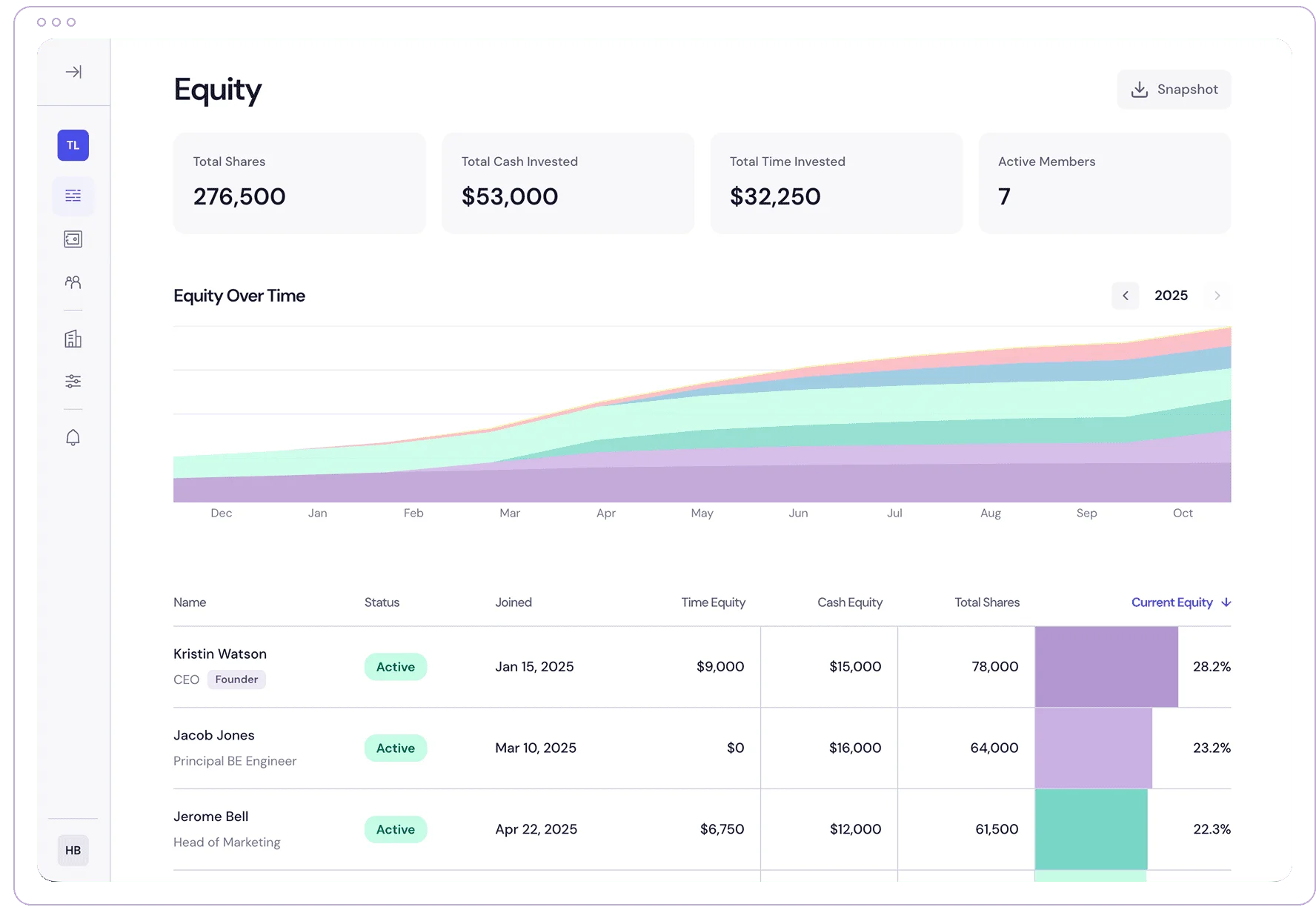
Log contributions in seconds. The app handles the math automatically. Everyone sees their current ownership percentage in real-time. No formula errors. No version conflicts.
What you get:
- Real-time ownership calculations
- Contribution logging (time, cash, expenses)
- Historical tracking and audit trail
- Tax snapshots for LLC K-1 reporting
- Export to cap table when you’re ready to freeze
If you’re serious about Slicing Pie implementation, using proper tooling isn’t optional. Spreadsheets create more problems than they solve once you’re past the first few months.
What to Track (Either Option)
Every contribution entry needs:
| Field | Purpose |
|---|---|
| Date | When the contribution happened |
| Contributor | Who contributed |
| Type | Time, cash, expense, asset |
| Amount | Hours, dollars, or quantity |
| Rate/multiplier | Applied calculation factor |
| Description | What specifically was done |
| Slice value | Calculated contribution in slices |
Step 4: Establish Ground Rules
Before you start tracking, write down the rules everyone will follow.
Meeting Cadence
How often will you review the numbers?
Monthly works for most teams. Review total contributions, discuss any questions, address concerns. Don’t let months go by without checking in.
For the actual logging, weekly or bi-weekly is ideal. Log contributions while they’re fresh.
What Counts as a Contribution
Get specific. Vague rules create arguments.
- Does a 30-minute call with an advisor count? (Probably yes)
- Does commuting to a meeting count? (Probably no)
- Does research and reading count? (Depends, set a rule)
- Does attending a networking event count? (Maybe partially)
Write it down. When someone asks “does X count?” six months from now, you have an answer.
How to Handle Disputes
Someone will disagree about something eventually. Have a process before you need one.
Options:
- Majority vote among founders
- Third-party advisor makes the call
- Default to no for disputed items
Pick a method. Document it.
Loyalty Protections
Consider adding protections for commitment:
Cliff period. No one keeps slices if they leave before a minimum period (commonly 3-6 months).
Minimum contribution. If someone contributes below a threshold for too long, address it directly.
Exit provisions. What happens to someone’s slices if they leave? Do they keep them all? Forfeit unvested portions? Get bought out?
These aren’t standard Slicing Pie, but they’re smart additions that prevent dead equity problems.
Step 5: Document It Legally
A tracking system without legal backing is just notes.
Operating Agreement (For LLCs)
If you’re structured as an LLC (which you probably should be for dynamic equity), your operating agreement should specify:
- How contributions are valued and tracked
- The formula for calculating ownership percentages
- What happens when someone exits
- How and when the dynamic period ends
Contributor Agreements
Each person contributing should sign an agreement that covers:
- Their hourly rate
- What contribution types apply to them
- Commitment to honest logging
- Understanding of how slices work
This protects everyone. No one can later claim they didn’t understand the arrangement.
Get a Lawyer Involved
Not for the tracking itself, but for the legal documents. Find a startup attorney familiar with dynamic equity or contribution-based models.
The operating agreement is a one-time cost that prevents massive headaches later.
Step 6: Track Consistently
The system only works if people use it.
Weekly Logging Rhythm
Set a recurring reminder. Every Friday afternoon, everyone logs their week.
What to log:
- Hours worked (broken down by day or task is ideal)
- Any cash invested
- Any expenses paid out of pocket
- Any other contributions (introductions made, assets contributed)
Monthly Review Meetings
Once a month, review the numbers together.
- Current slice totals for each person
- Current ownership percentages
- Any questionable entries to discuss
- Upcoming contribution expectations
These meetings catch problems early. If someone’s falling behind on contributions, address it before resentment builds.
Keep Everyone Accountable
The most common Slicing Pie failure? People stop logging.
Life gets busy. Tracking feels like homework. Someone skips a week, then a month, then the whole system falls apart.
Solutions:
- Make logging take under 2 minutes (this is why tools beat spreadsheets)
- Review at every team meeting
- If someone repeatedly skips, have a direct conversation
Dynamic equity fails not because the math is wrong, but because people don’t maintain the discipline.
How to Value Sweat Equity Contributions
Step 7: Know When to Freeze
Dynamic equity doesn’t last forever for most companies.
At some point, you may want to convert to a fixed cap table. Here’s when to consider it.
Signs It’s Time
The business is self-sustaining. Everyone’s getting paid real salaries. Contributions are normalizing. The “sweat equity” phase is ending.
You’re raising outside investment. Investors want to know exactly what they’re buying. A moving ownership target makes due diligence difficult.
A co-founder is leaving. Natural time to lock in what they earned.
Contributions have stabilized. If everyone’s contributing roughly equally month after month, dynamic equity isn’t adding value anymore.
How to Freeze
- Run final calculations
- Get agreement from all founders on the numbers
- Document the final percentages in an amended operating agreement
- Consider adding vesting going forward
- Set up a traditional cap table
The Easy Way: Use Equity Matrix
We built Equity Matrix because tracking Slicing Pie in spreadsheets is painful.
Founders were using clunky Google Sheets, making formula errors, arguing about who logged what. Dynamic equity is a great model. The implementation tools available were not.
What you get with Equity Matrix:
- One-click contribution logging
- Automatic ownership calculations
- Real-time dashboard everyone can see
- Tax snapshots for year-end reporting
- Cap table export when you’re ready to freeze
Setup takes 15 minutes. Logging contributions takes seconds.
Start tracking equity the right way →
Slicing Pie Implementation Checklist
Use this to track your progress:
- All co-founders understand and agree to the model
- Hourly rates set for each contributor
- Multipliers defined for cash and expenses
- Tracking system chosen and set up
- Ground rules documented (what counts, meeting cadence, dispute resolution)
- Operating agreement drafted with dynamic equity provisions
- Contributor agreements signed
- First contributions logged
- Monthly review meetings scheduled
- Exit provisions and loyalty protections in place
Frequently Asked Questions
How do I implement Slicing Pie step by step?
Start by aligning your co-founders on the model and getting genuine buy-in. Then define what you’ll track (unpaid time at hourly rates with a 2x multiplier, at-risk cash at 4x, and non-recoverable unreimbursed expenses at 2x). Set up a tracking system (spreadsheet or Equity Matrix). Establish ground rules for meetings, what counts as contributions, and how to handle disputes. Document everything legally in your operating agreement. Finally, maintain discipline with weekly logging and monthly reviews.
What tools should I use for Slicing Pie tracking?
You can use spreadsheets for basic tracking, but they create maintenance headaches and formula errors as your team grows. Purpose-built tools like Equity Matrix handle calculations automatically, provide real-time ownership dashboards, and generate tax-ready snapshots. Most teams that start with spreadsheets eventually switch to dedicated software. For a side-by-side comparison of the main options, see Slicing Pie alternatives.
How often should we log Slicing Pie contributions?
Log contributions weekly while they’re fresh. Set a recurring reminder (Friday afternoons work well) for everyone to enter their hours, expenses, and other contributions. Review the totals together monthly to catch discrepancies early and ensure everyone stays accountable. Consistency matters more than perfection.
When should we stop using Slicing Pie and freeze the split?
Consider freezing when the business reaches breakeven or becomes self-sustaining and everyone is earning market salaries, or when an event such as institutional funding requires fixed ownership. Revenue by itself, a co-founder leaving, or an arbitrary date does not automatically freeze the pie. The freeze converts your dynamic percentages into a traditional cap table.
Ready to implement Slicing Pie without the spreadsheet headaches? Try our Slicing Pie calculator to model different scenarios, or get started with Equity Matrix to track contributions effortlessly.
Want to understand the common pitfalls before you begin? Read about the problems with Slicing Pie and the 10 mistakes that sink Slicing Pie implementations.
Ready to split equity fairly?
Equity Matrix tracks contributions and calculates ownership automatically.
Get Started FreeThis article is for informational purposes only and does not constitute legal, tax, or financial advice. Equity Matrix is not a law firm, accounting firm, or financial advisor. Consult a qualified professional for guidance specific to your situation.

Co-founder, Equity Matrix
Sebastian writes about startup equity, founder dynamics, and building fair partnerships.
Keep reading
Rob Walling's TOC framework for splitting equity
Rob Walling's TOC framework splits equity based on Time, Opportunity Cost, and Cash. Here's how it works, how it compares to Slicing Pie, and how to use it with a calculator.
Read more →Slicing Pie: complete guide to dynamic equity
How the Slicing Pie model works: formulas, GHRR calculations, multipliers, and real examples. Plus the problems Mike Moyer's book doesn't cover and how to solve them.
Read more →