Every co-founder equity disaster starts the same way: two people who didn’t have the conversation.
They were too excited about the idea. Too worried about offending their partner. Too convinced that “we’ll figure it out later.” So they shook hands on 50/50, or avoided the topic entirely, and went back to building.
Months later, one person is working 60-hour weeks while the other is working 15. One invested $40K while the other invested nothing. One quit their job while the other kept theirs. And nobody ever established what should happen when contributions aren’t equal.
The equity conversation is the single most important discussion you’ll have as co-founders. It’s also the one most founders skip. Here’s how to actually have it.
Why founders avoid this conversation
Let’s be honest about why this is hard.
It feels like you’re putting a price on the relationship. When someone says “I think I deserve 55%,” the other person hears “I think I’m worth more than you.” That’s painful, especially at the start when both people are excited and trusting.
Conflict avoidance is baked into startup culture. The mythology is two friends in a garage, equals in every way. Suggesting an unequal split feels like breaking the story.
Nobody teaches you how to do this. Business school covers negotiation tactics for deals with strangers. It doesn’t prepare you for negotiating with someone you’re about to spend the next decade building a company with.
And the kicker: research shows that 73% of founding teams set their equity split within the first month. Most founders rush through the most important decision they’ll make together.
When to have the conversation
Before you write any code, spend any money, or tell anyone you’re starting a company.
The equity conversation should happen when the stakes are zero. When you’re both still exploring whether this partnership makes sense. When walking away is easy and staying requires commitment.
Once you’ve been working together for months, the conversation becomes a negotiation. One person has built the MVP. Another has been doing sales. Contributions are already unequal, and now the split has to account for past work plus future expectations. This is exponentially harder.
The conversation about the equity split does not get easier with time — it’s better to set it early on. — Sam Altman, Startup Playbook
If you’re already past the early stage and haven’t had this conversation, don’t panic. Have it now. It will be harder than it would have been at the start, but it’s better than having it after your first investor asks to see your cap table.
Step 1: agree on the principle before the numbers
Don’t start with “I think I should get 55%.” Start with a question:
“Do we agree that equity should reflect what each of us is contributing to this company, both now and over time?”
If the answer is yes, you’ve established the framework. Now you’re not arguing about who deserves more — you’re collaborating on how to measure contributions.
If the answer is no — if your co-founder insists on equal regardless of contributions — that’s important information. Not necessarily a dealbreaker, but a signal about how they’ll handle future disagreements.
Step 2: list contributions honestly
Each person should independently write down what they’re bringing to the partnership. Be specific.
Contribution Categories
| Category | What to Document |
|---|---|
| Time | Hours per week now, expected hours going forward, full-time vs. part-time |
| Capital | Cash invested or committed, loans made to the company |
| Opportunity cost | Salary being given up, benefits being lost, career risk being taken |
| Prior work | MVP already built, customers already acquired, research already completed |
| Expertise | Domain knowledge, technical skills, industry relationships, years of experience |
| Assets | IP being contributed, equipment, existing customer lists, brand equity |
| Connections | Investor relationships, potential customers, advisor network |
Compare lists. Discuss differences. This isn’t a competition — it’s inventory. You’re both trying to see the full picture of what each person brings.
Be honest about asymmetries. If one person is full-time and the other is part-time, say so. If one person invested $50K and the other invested nothing, acknowledge it. If one person has 15 years of industry experience and the other is fresh out of school, that matters.
The founders who get this right are the ones who can say: “You’re contributing more in X, I’m contributing more in Y, and here’s how we value those differences.”
Step 3: assign relative values
This is where it gets concrete. You need to agree on how different contribution types compare.
Time: What hourly rate reflects the market value of each person’s work? A senior engineer’s time has a different market rate than a junior business person’s. Be honest about this.
Capital: How much is a dollar of investment worth compared to an hour of work? Many frameworks value cash at 2-4x the equivalent time contribution, because cash carries more risk (you can’t get it back) and has immediate utility.
Prior work: If one founder built a prototype over 6 months before the other joined, what’s that worth? Calculate it the same way you value ongoing time: hours spent multiplied by the agreed rate.
Expertise and connections: These are the hardest to quantify, but they’re real. A co-founder with 10 years of industry relationships can open doors that would take years to build. A co-founder with deep technical expertise can build in months what would take others a year.
You don’t need perfect numbers. You need relative values that both founders agree reflect reality.
Step 4: do the math (or let a tool do it)
Add up each person’s contributions. Convert to percentages.
Example:
Founder A: 1,000 hours at $150/hr ($150K) + $30K invested (valued at 2x = $60K) = $210K in contributions
Founder B: 600 hours at $100/hr ($60K) + $0 invested + prior MVP work valued at $80K = $140K in contributions
Total: $350K
Founder A: 60%. Founder B: 40%.
This is a starting point, not a final answer. Both founders should look at the result and ask: does this feel right? Adjustments are fine. The value of doing the math is that it grounds the conversation in something concrete rather than feelings.
The equity calculator runs these numbers for you and accounts for contribution categories that are easy to overlook.
Step 5: address the future, not just the present
A common mistake: setting the split based on contributions so far and assuming everything stays the same.
Everything changes. One person might go full-time while the other stays part-time. Capital needs might increase. The product might pivot to require different skills. Life circumstances shift.
You have two options for handling this:
Option A: fixed split with protections
Agree on a split now and protect it with:
- Vesting: Four years with a one-year cliff. If someone leaves, unvested shares return to the company.
- Buyout provisions: What happens if one founder wants out? How is their stake valued?
- Decision domains: Who has final say on product? On business? On hiring?
- Review triggers: Agree to revisit the split if circumstances change materially (someone goes part-time, significant capital is raised, etc.)
Option B: dynamic equity
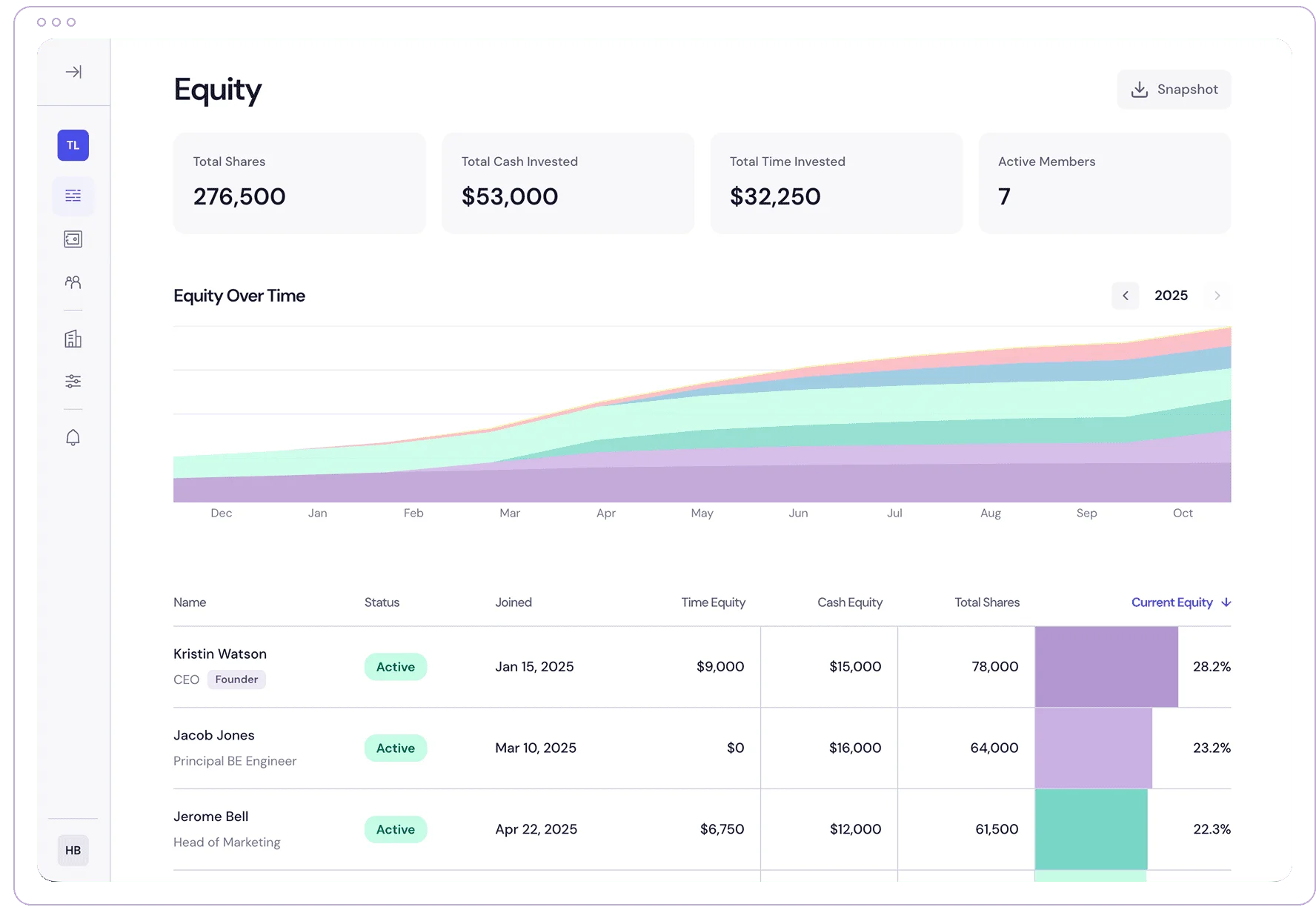
Instead of fixing a split and hoping it holds, track contributions as they happen. Dynamic equity adjusts ownership based on actual input — time, money, expertise — so the split always reflects reality.
When you’re ready, freeze the split into a fixed cap table. This typically happens at incorporation, when you’re ready to raise, or when you’ve worked together long enough that the pattern is clear.
Dynamic equity is especially useful when:
- Founders have different time commitments (one full-time, one part-time)
- One founder will ramp up later
- Contributions are genuinely hard to predict
- You want to remove the emotional difficulty of the negotiation entirely
The conversation you avoid becomes the lawsuit you can’t.
Step 6: document everything
A verbal agreement isn’t an equity agreement. Write it down.
Your co-founder agreement should include (see our co-founder agreement template for exact language on each section):
- The equity split and how it was determined
- Vesting schedule (standard: 4 years, 1-year cliff)
- Roles and responsibilities for each founder
- Decision-making authority — who has final say in each domain
- What happens if someone leaves — buyout terms, valuation methodology
- What happens if founders disagree — mediation, arbitration, deadlock resolution
- IP assignment — all intellectual property belongs to the company
- Non-compete and non-solicitation terms
You don’t need a lawyer to start this document (though you should have one review it before signing). The act of writing it down forces clarity on points that verbal agreements leave vague.
Common objections (and responses)
“Talking about equity will hurt our relationship”
If the relationship can’t survive a conversation about equity, it can’t survive a startup. Startups involve harder conversations than this: firing employees, cutting features, turning down funding, pivoting the business. If you can’t talk about equity, you’re not ready to be co-founders.
”We trust each other, so we don’t need a formal agreement”
Trust is wonderful. Document it anyway. The agreement isn’t a substitute for trust — it’s a manifestation of it. If you trust each other, the agreement is easy to write. If writing the agreement feels risky, the trust might not be as solid as you think.
”We’re both contributing equally, so it should be 50/50”
Maybe. But have you actually measured? When founders track contributions carefully, the numbers almost never land at exactly 50/50. One person usually contributes more time, more capital, or more expertise in a given period. If tracking confirms equal contributions, great — your 50/50 split is backed by data. If it doesn’t, you’ve saved yourself from the resentment that builds when equity doesn’t match reality.
”What if my co-founder gets offended by the conversation?”
Frame it as collaboration, not confrontation. “I want to make sure we both feel ownership reflects our contributions, now and in the future. Can we sit down and map out what each of us is putting in?” Most reasonable people respond well to this framing. If your co-founder responds with defensiveness or anger to a fair, honest conversation about equity, that’s a red flag about the partnership itself.
”Can’t we just split it 50/50 and adjust later?”
Technically yes, but it almost never happens. Once equity is set, inertia takes over. Nobody wants to be the person who says “I think I deserve more.” And legally, changing equity requires both parties to agree, which is exactly the conversation you’re trying to avoid. It’s much easier to set it right the first time.
Scripts that work
Sometimes the hardest part is finding the words. Here are conversation starters that founders have used successfully. If you’re navigating the specific dynamic of a non-technical founder partnering with a technical co-founder — where the power imbalance feels real and the leverage feels unequal — the word-for-word scripts for the technical co-founder equity conversation go deeper on exactly what to say in each scenario.
Opening the conversation: “I want to make sure we start this right. Can we sit down and talk through how we want to handle equity? I read that most co-founder problems start because people skip this conversation.”
Addressing unequal contributions: “I think we’re both bringing important things to this. I’m contributing X, you’re contributing Y. How should we value those relative to each other?”
Suggesting dynamic equity: “What if instead of negotiating a split right now, we track our contributions and let the numbers determine it? That way neither of us has to argue for a specific percentage.”
Raising governance: “Even if we’re close to equal, I think we should designate one of us as the tiebreaker for major decisions. Sam Altman recommends this. It doesn’t mean one of us is more important — it just means we’ll never be deadlocked.”
After the conversation
Once you’ve agreed on a structure, three things need to happen:
1. Write the co-founder agreement. Capture the split, vesting, roles, decision rights, and exit provisions. Review it with a lawyer.
2. Set up tracking. Whether you’re using dynamic equity or a fixed split with vesting, you need a system that tracks ownership over time. Spreadsheets work for simple cases. Tools like Equity Matrix work for anything more complex.
3. Schedule a check-in. Agree to revisit the equity conversation in 6 months or when a significant milestone occurs (first revenue, first hire, first funding). Not to renegotiate — just to confirm that the structure still reflects reality.
The conversation doesn’t end when you sign the agreement. But the hardest part is over.
Frequently asked questions
How long should the equity conversation take?
Plan for at least two separate sessions. The first session is for listing contributions, discussing principles, and exploring options. The second session is for reviewing numbers, addressing concerns, and making decisions. Rushing through in a single sitting often leads to one person feeling steamrolled. Give it the time it deserves.
What if we’ve been working together for months and never discussed equity?
Have the conversation now. It’s harder than it would have been at the start, but it’s easier than it will be in another six months. Acknowledge the past contributions — time, money, work product — and factor them into the split. If quantifying past contributions feels impossible, dynamic equity can start tracking from today forward, with an agreed-upon adjustment for work already done. If one of you started significantly earlier than the other — more of a solo-to-co-founder transition than a simultaneous founding — the solo-to-co-founder transition guide covers how to frame and value that head start before the equity conversation begins.
Should we involve a lawyer in the equity conversation?
Not necessarily in the conversation itself, but a lawyer should review your co-founder agreement before you sign it. The conversation is about values, contributions, and partnership. The legal documentation is about protecting those agreements in a way that holds up. Most startup attorneys charge $1,000 to $3,000 to draft or review a co-founder agreement.
What if we genuinely can’t agree on a split?
If you’ve listed contributions, run the numbers, discussed principles, and still can’t agree, that’s a signal worth paying attention to. Consider using a neutral calculator to generate a data-driven starting point. If the disagreement persists, you might consider whether the partnership itself is the right fit. Co-founder conflicts about equity at the start tend to get worse, not better, as the company grows.
Ready to split equity fairly?
Equity Matrix tracks contributions and calculates ownership automatically.
Get Started FreeThis article is for informational purposes only and does not constitute legal, tax, or financial advice. Equity Matrix is not a law firm, accounting firm, or financial advisor. Consult a qualified professional for guidance specific to your situation.

Co-founder, Equity Matrix
Sebastian writes about startup equity, founder dynamics, and building fair partnerships.
Keep reading
Co-founders in different countries: how to set a fair rate
When one co-founder is in the US and another is in Lithuania, do you value their time at local rates or the same rate for the same work? How to set GHRR fairly across borders.
Read more →How to track co-founder contributions (before it costs you)
A practical system for tracking co-founder contributions: what to log, how often, the fields that matter, and where spreadsheets start to strain.
Read more →