The equity conversation with a technical co-founder is one of the most uncomfortable conversations in startup life. Not because the math is hard, but because the relationship dynamics make it feel impossible to bring up without sounding like you’re putting a price on the partnership.
If you’re a non-technical founder, you probably already feel this tension. Your co-founder can build the product. You can’t. That creates an unspoken power dynamic that makes talking about equity feel like you’re negotiating from weakness.
And if you’re the technical co-founder, you might be wondering why equity needs a conversation at all. You’re writing the code. The product is the company. Shouldn’t that be obvious?
Both perspectives are valid. Both are incomplete. About 65% of high-potential startup failures trace to people problems, with co-founder conflict the largest category.
This post gives you actual scripts for having this conversation. Not theory. Not frameworks. Words you can say.
Why this conversation is so hard
The leverage imbalance feels real
Non-technical founders often feel like the technical co-founder holds all the cards. “If they walk, there’s no product. If I walk, they just need to find someone who can sell.”
This isn’t actually true. Ideas, customers, fundraising, market knowledge, and business strategy are all critical. But it feels true in the moment, and that feeling makes the non-technical founder avoid the conversation or accept terms they shouldn’t.
Nobody wants to go first
Saying “I think the split should be 55/45” forces you to reveal what you think you’re worth. That’s vulnerable. If the other person disagrees, it feels like a personal rejection, not a business negotiation.
So both founders wait. They hope the other person brings it up. Or they assume they’ll “figure it out later.” Later never comes until there’s money on the table and the stakes are real.
The contributions are hard to compare
How do you compare 200 hours of coding to 200 hours of customer research? What’s a working prototype worth versus a signed letter of intent from a customer? What about the person who quit their $180K job versus the person who’s working evenings and weekends?
There’s no standard conversion rate. Every founding team is different. And that ambiguity makes people freeze.
It feels like you’re planning for failure
Talking about what happens if someone leaves, or what happens if contributions diverge, feels like you’re already preparing for the relationship to end. Nobody wants to be the person who says “what if this doesn’t work out” when you’re both supposed to be all-in.
The conversation you avoid doesn’t go away. It just waits for the worst possible moment to surface.
Before you have the conversation
Get clear on what each person is actually contributing
Write it down before you talk. Not what you hope each person will contribute. What’s actually happening right now.
Contribution inventory
| Category | You (non-technical) | Your co-founder (technical) |
|---|---|---|
| Time per week | Full-time / Part-time? | Full-time / Part-time? |
| Cash invested | How much? | How much? |
| Salary given up | What did you leave? | What did they leave? |
| Work completed | Customer research, pitch deck, partnerships | MVP, architecture, technical decisions |
| Unique expertise | Domain knowledge, industry relationships | Engineering skills, technical vision |
| Risk taken | Quit your job? Using savings? | Quit their job? Turning down offers? |
Be honest about the asymmetries. If they quit a $200K engineering job and you’re doing this on the side, that matters. If you put in $30K of your savings and they invested nothing, that matters too.
Understand what stage you’re at
The stage of the company changes the conversation entirely.
| Stage | What the split usually looks like |
|---|---|
| Day one, both full-time | Close to equal. Neither has done more yet. |
| You’ve been working for months, bringing them on | You’ve invested more time and risk. 55/45 or 60/40 is reasonable. |
| Post-MVP, you’re looking for a technical co-founder | They’re joining something that already exists. 25-35% with vesting. |
| Revenue is coming in | Lower equity, higher salary discussion. 15-25% or consider a CTO hire. |
The later someone joins, the less equity they typically get, because more of the risk has already been absorbed by the people who started earlier.
Choose your framework
You have two options for how the split works:
Fixed split with vesting: Agree on percentages now. Add four-year vesting with a one-year cliff. Everyone earns their equity over time. If someone leaves early, unvested equity returns.
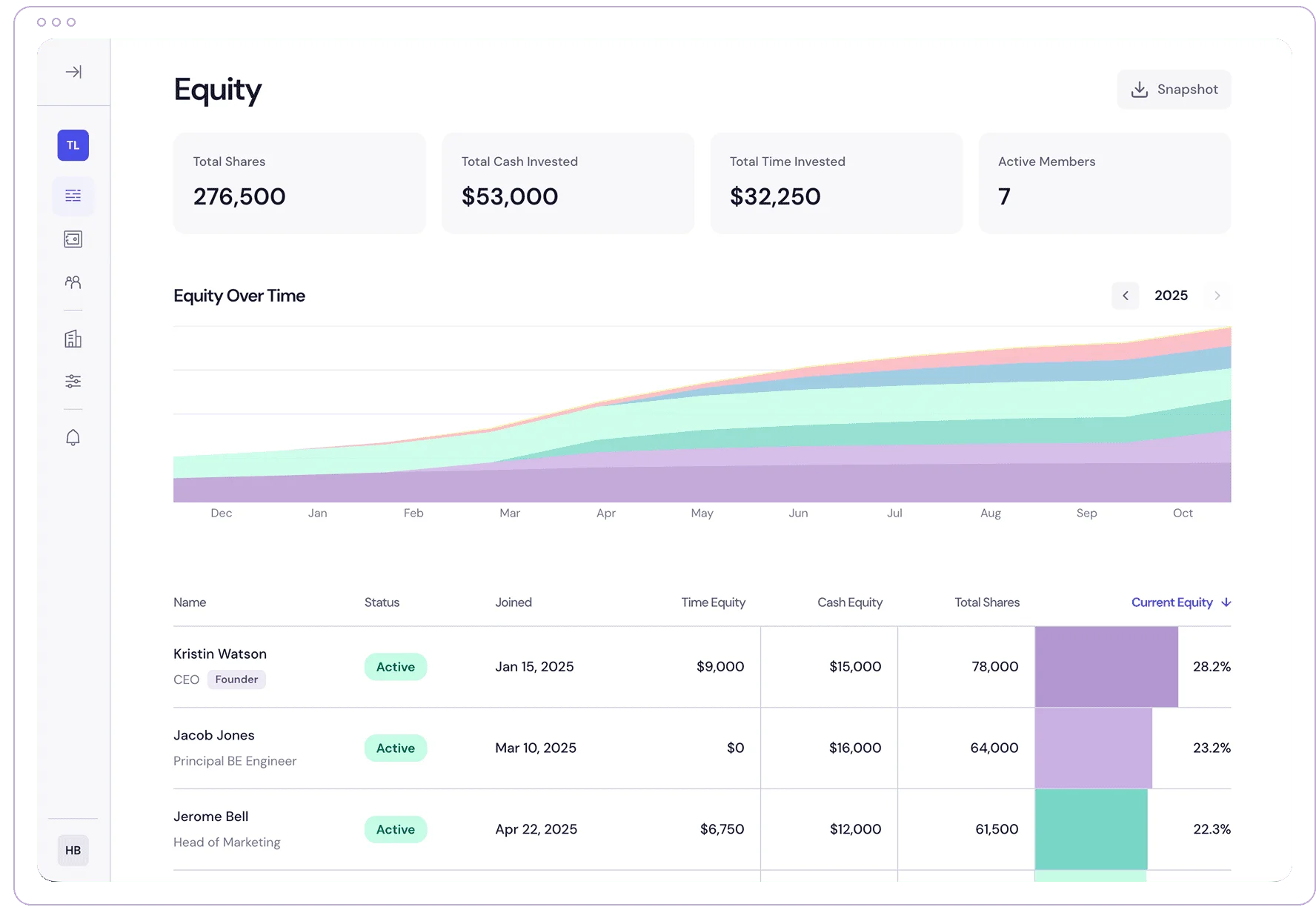
Dynamic equity: Instead of guessing about future contributions, track them. Dynamic equity adjusts ownership based on what each person actually puts in. When you’re ready, freeze into a fixed split. No negotiation required because the data decides.
Dynamic equity is especially useful for technical/non-technical partnerships because it removes the argument about whose work is worth more. You set hourly rates, track contributions, and the math handles it.
The scripts
Opening the conversation
Don’t say: “We need to talk about equity.”
This sounds like “we need to talk” in a relationship. It immediately puts the other person on guard.
Instead, try:
“Hey, I’ve been thinking about how we should structure this so we’re both protected and motivated long-term. Can we set aside 30 minutes this week to talk through equity and make sure we’re on the same page?”
This frames it as mutual protection, not a negotiation. You’re both trying to get to the right answer.
If you’ve been avoiding it and it’s overdue:
“I want to be honest — I’ve been putting off the equity conversation because I wasn’t sure how to bring it up. But I think the longer we wait, the harder it gets. I’d rather figure this out now while we’re still aligned than after there’s real money involved.”
Acknowledging the awkwardness disarms it.
Establishing the principle
Before anyone says a number, agree on the framework.
“Before we get into specific percentages, can we agree on something? I think our equity should reflect what we’re each actually contributing. Not just the idea, not just the code — everything. Time, money, risk, skills. Does that seem fair to you?”
If they agree, you’ve established contribution-based equity as the principle. Now you’re not arguing about who deserves more. You’re collaborating on how to measure it.
If they push back:
“I hear you. What would you base the split on instead? I want to understand your thinking.”
Let them talk. You’ll learn a lot about how they see the partnership.
Addressing the “I’m building the product” dynamic
This is the moment most non-technical founders dread. The technical co-founder says something like: “Without the product, there’s no company.”
Don’t get defensive. Acknowledge it, then expand the frame:
“You’re right. The product is critical. But a product without customers is a side project. A product without funding runs out of runway. A product without a business model doesn’t survive. We need both sides. That’s why I think we should look at everything each of us is putting in, not just one dimension.”
If they still push for a larger share:
“I respect that. What if instead of arguing about percentages, we track our contributions and let the data determine the split? That way neither of us has to convince the other — the math does it. If you’re contributing more, you’ll own more. Same for me.”
This is where dynamic equity is powerful. It takes the emotion out of the negotiation because there is no negotiation. There’s just tracking.
Talking about time commitment differences
One of the most common sources of tension is when one person is full-time and the other is part-time.
“I think we need to be real about time commitment. Right now I’m [full-time / putting in X hours a week], and you’re [full-time / part-time / evenings and weekends]. That might change, and that’s fine. But I think our equity should reflect what we’re actually putting in at any given time, not what we hope it’ll look like in a year.”
If you’re the one who’s part-time:
“I know I’m not full-time yet, and I don’t think I should get the same equity as someone who is. I’m fine with my ownership reflecting my actual contribution. When I go full-time, my equity should grow accordingly.”
This kind of honesty builds trust fast.
The money conversation
If one founder is investing cash and the other isn’t, it needs to be acknowledged.
“I’m putting in [$X] of my own money to fund this. That’s money I could invest somewhere else with less risk. I think cash contributions should carry a multiplier — maybe 2x or 4x the equivalent time contribution — because money carries more risk. What do you think?”
The multiplier concept is standard in dynamic equity frameworks. Cash is valued higher than time because cash is after-tax, already-earned money with real opportunity cost.
Bringing up vesting
This is non-negotiable, but it can feel awkward to suggest.
“Whatever we agree on, I think we should both have vesting. Not because I don’t trust you — because it protects both of us. If either of us has to step away for any reason, the other person isn’t stuck with dead equity on the cap table.”
If they resist vesting:
“Here’s how I think about it: if we’re both committed to being here for four years, vesting costs us nothing. It only matters if someone leaves early. And if someone does leave early, don’t we want to make sure the equity is fair?”
A co-founder who resists vesting is telling you something important about their commitment level.
Closing the conversation
“I’m glad we talked about this. Here’s what I’m hearing: [summarize what you agreed on]. Should we write this up and make it official? Even a simple agreement protects both of us.”
Then document it. A co-founder agreement isn’t optional. Put the split, the vesting, the roles, and the decision-making structure in writing.
What if you can’t agree?
If the conversation stalls or you’re far apart on numbers, there are a few options:
Use a calculator. Run the numbers through an equity calculator with both of you in the room. Input each person’s contributions honestly. See what the math says. It’s easier to accept a number from a formula than from the other person’s mouth.
Try dynamic equity for 3-6 months. If you can’t agree on a fixed split, agree not to agree yet. Track contributions with dynamic equity for a few months and see where the numbers land. You’ll have real data instead of guesses.
Bring in a third party. An advisor, a mentor, or even a startup attorney can help mediate the conversation. Sometimes having a neutral voice in the room makes it easier to be honest.
Walk away. If your potential co-founder refuses to discuss equity, refuses vesting, or demands a split that doesn’t reflect contributions, that’s a signal. The wrong co-founder is worse than no co-founder.
The conversation nobody regrets having
Every founder who has been through a messy equity dispute says the same thing: “I wish we’d had this conversation earlier.”
Nobody ever says “I wish we’d avoided the topic longer.”
The conversation is uncomfortable. It might take more than one sitting. You might disagree on some things. That’s fine. Disagreeing now, when the stakes are low and both of you are still excited about the company, is infinitely better than disagreeing later when there’s money, employees, and investors involved.
Your equity split is the foundation of your partnership. Build it on honest conversation and real data, not on avoidance.
Use the equity calculator to run your numbers, or start tracking contributions today so the math can guide the conversation for you.
Frequently asked questions
How much equity should a technical co-founder get?
It depends entirely on the stage and the relative contributions. At the idea stage with both founders full-time, near-equal splits are common. If you’ve been building for months and bringing on a technical co-founder, 25-40% is typical. If you already have revenue, 15-25% with a salary component makes more sense. The key is that the split should reflect actual contributions, not just who writes the code. Use a calculator to model different scenarios.
What if my technical co-founder thinks they deserve more because they’re building the product?
Acknowledge that the product is critical, but widen the frame. A product without customers, without funding, without a business model is a side project. Both technical and business contributions are necessary for a company to succeed. If you can’t agree, suggest tracking contributions with dynamic equity for a few months and letting the data determine the split.
Should the equity conversation happen before we start working together?
Yes. Research shows that 73% of founding teams set their equity split within the first month, often before they have real data. While you don’t need exact numbers on day one, you should at minimum agree on the principles (contribution-based, with vesting) and start tracking contributions from the very first week.
What if I already have a 50/50 split and it’s not working?
You’re not stuck. Have the conversation now — it’s harder than it would have been at the start, but easier than it will be in six months. Consider transitioning to dynamic equity so that going forward, ownership reflects actual contributions. You can’t change the past, but you can make the future fair. Read our post on the hidden cost of 50/50 splits for context on why this matters.
Ready to split equity fairly?
Equity Matrix tracks contributions and calculates ownership automatically.
Get Started FreeThis article is for informational purposes only and does not constitute legal, tax, or financial advice. Equity Matrix is not a law firm, accounting firm, or financial advisor. Consult a qualified professional for guidance specific to your situation.

Co-founder, Equity Matrix
Sebastian writes about startup equity, founder dynamics, and building fair partnerships.
Keep reading
Co-founders in different countries: how to set a fair rate
When one co-founder is in the US and another is in Lithuania, do you value their time at local rates or the same rate for the same work? How to set GHRR fairly across borders.
Read more →How to track co-founder contributions (before it costs you)
A practical system for tracking co-founder contributions: what to log, how often, the fields that matter, and where spreadsheets start to strain.
Read more →