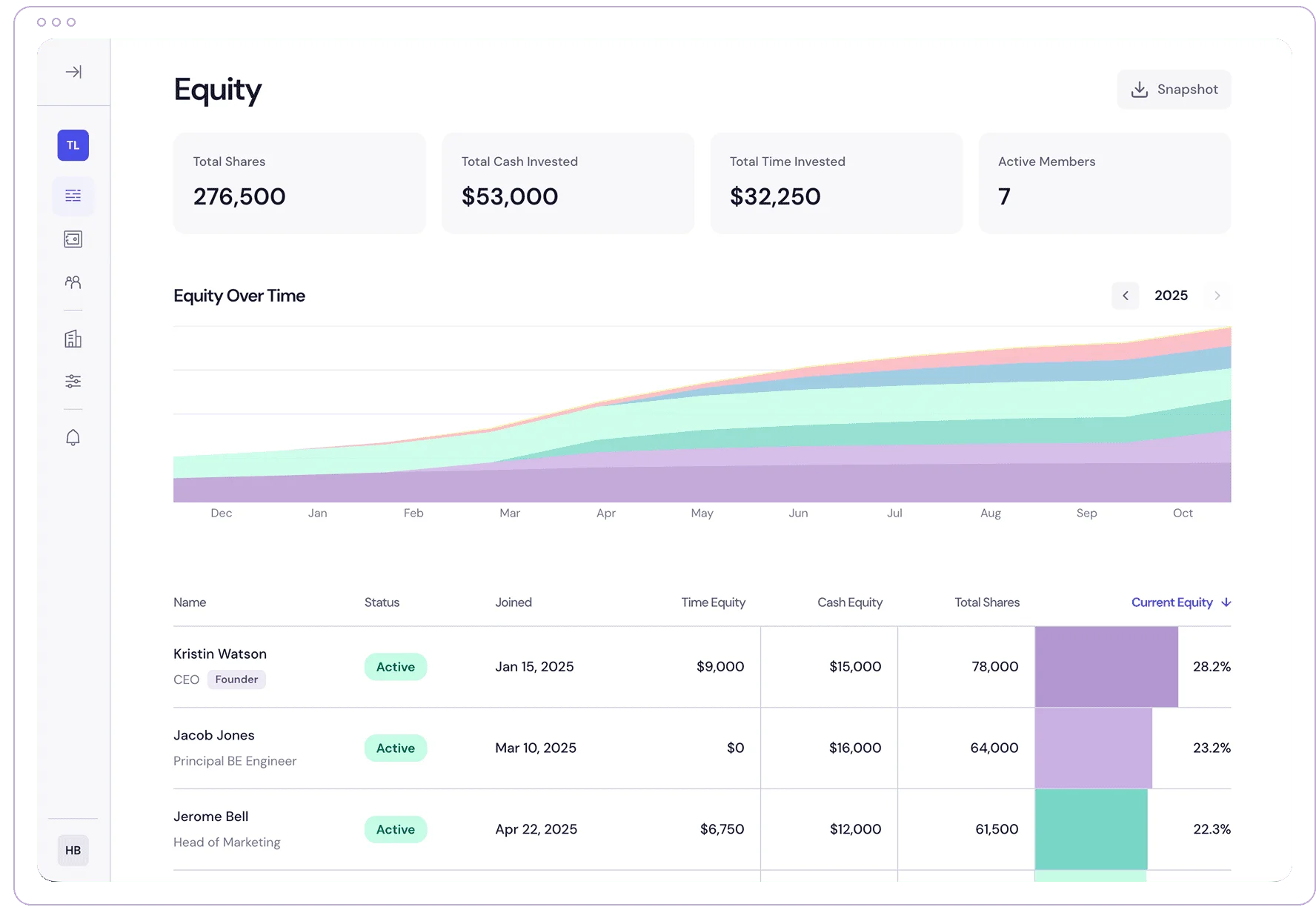
Dan Martell’s “Buy Back Your Time” framework teaches founders to delegate low-value tasks so they can focus on what matters most. But in early-stage startups, the people doing that work can’t always be paid in cash. They need to be paid in equity. Dynamic equity makes sure they’re paid fairly.
The Buy Back Your Time Problem
Dan Martell’s core idea is elegant. Stop doing work below your “buyback rate.” If your time is worth $500/hour on high-leverage activities like closing deals, building partnerships, or shaping product strategy, you should not be spending it on $50/hour tasks like scheduling social posts or troubleshooting CSS.
His book, Buy Back Your Time, has helped thousands of founders internalize this. Delegate. Build a team. Focus on what only you can do. It’s genuinely great advice, and it works.
But there’s a gap that his framework doesn’t fully address. Once you decide to delegate, you need people to delegate to. And in early-stage startups, you usually can’t afford to pay them.
You have no revenue. No funding. Maybe a little savings. You know you need a developer to build the product, a marketer to get the word out, an operator to keep things running. You know you need to buy back your time. But you don’t have the cash to do it.
So what do most founders default to? “I’ll give them some equity.”
Great instinct. But how much equity? Based on what? And what happens when the contributions aren’t equal six months in?
Equity Is the Currency of Early-Stage Delegation
When you can’t pay market rate salaries, equity is how you attract co-founders, early employees, and contractors willing to bet on your vision. This is true for nearly every bootstrapped startup and most pre-seed companies. Equity is the currency.
The problem is that most founders handle equity with a handshake deal or a vague promise. “We’ll figure it out later.” Or they lock in a fixed split on day one, 50/50 with a co-founder, 10% for the first developer, and hope it all works out.
It rarely does.
Fixed splits don’t account for what actually happens after the agreement. One person works 60 hours a week. Another scales back to 15. Someone invests cash. Someone else brings in a key client. The original split stops reflecting reality, and resentment builds quietly until it explodes.
If you’re in Dan Martell’s world, you know this pain. You’re bringing on operators, developers, and marketers to buy back your time. But you don’t have a system for making the equity fair. You just have a number you picked because it felt reasonable at the time.
Dynamic Equity Solves the Delegation Equity Gap
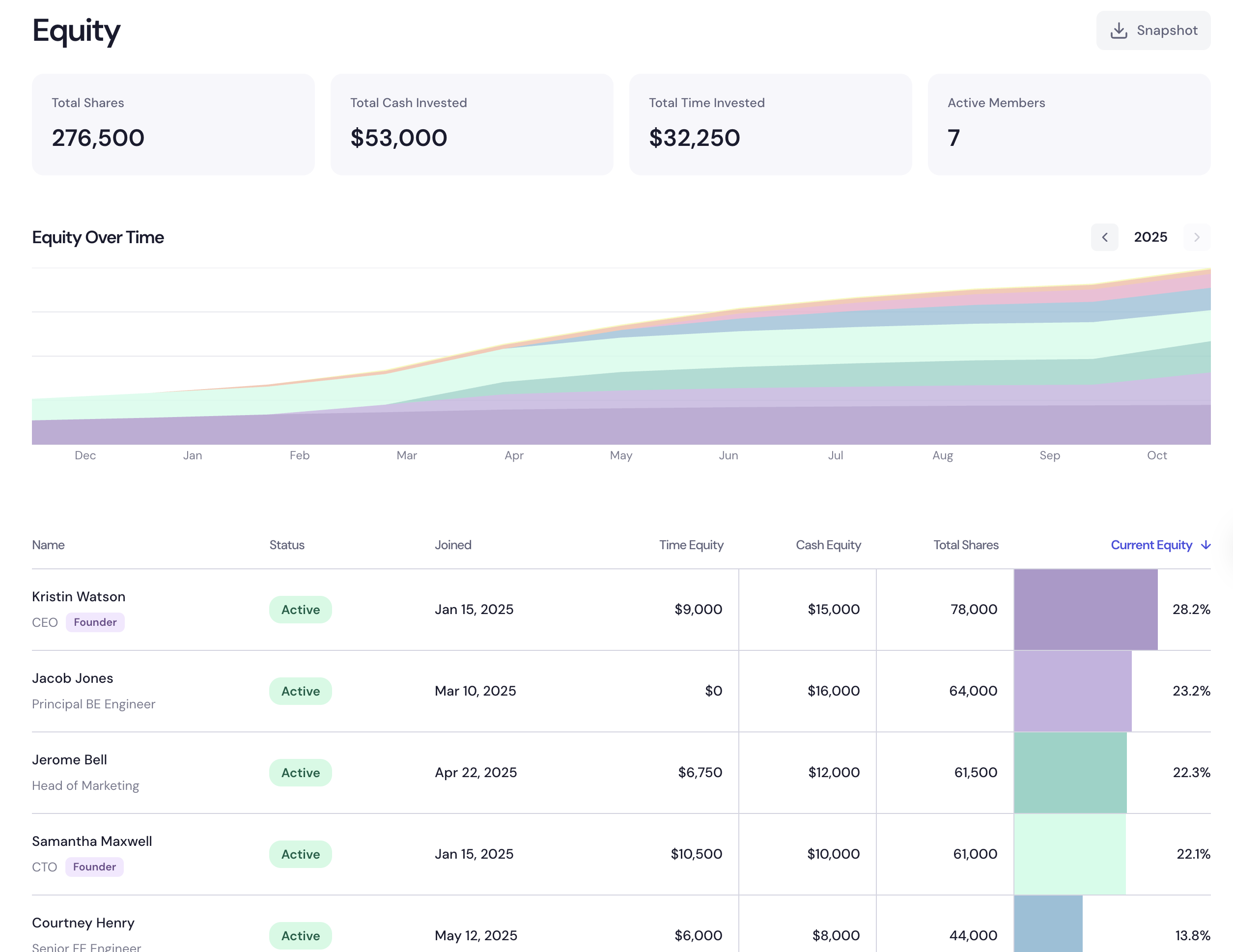
Dynamic equity is the system you’re missing. Instead of guessing at a fixed split, dynamic equity tracks what each person actually contributes. Time at their market rate, cash invested, equipment provided, intellectual property brought in. Every contribution gets recorded. Every person’s ownership percentage reflects their real share of the total value created.
When you bring someone on to handle marketing, buying back your time on that front, their hours get tracked at their agreed-upon market rate. When you bring on a developer to build the product, same thing. When you invest $10,000 of your own money, that gets added to your contribution total.
The result is an equity split that adjusts automatically as people contribute. No guessing. No negotiation. No promises that get awkward later.
This is exactly what founders in the “buy back your time” mindset need. You’re already thinking about delegation as a system. Dynamic equity gives you the system for the compensation side of that equation.
If you’re new to the concept, start with our guide on how to split equity in a startup.
How It Works in Practice
Let’s walk through a scenario that should feel familiar if you’ve read Dan’s book.
You’re a SaaS founder doing everything. Product, sales, support, marketing. You’re stretched thin, making slow progress on all fronts and fast progress on none. You read Buy Back Your Time and decide to take action. You’re going to delegate and focus on what you do best.
Month 1: You bring on a technical co-founder. They start building the product, buying back your development time entirely. Their hours get tracked at a $150/hr market rate, which is what they could earn as a senior developer elsewhere. Your hours get tracked at $120/hr for business development and sales. After the first month, you’ve both put in about the same number of hours, so equity is roughly 50/50. But the exact split is based on the dollar value of contributions, not a handshake.
Month 3: You bring on a part-time marketer. They work 15 hours a week at a $100/hr market rate. Their contributions start accumulating alongside yours and your co-founder’s. No one had to renegotiate the existing split. The new person’s work simply gets added to the total.
Month 6: You invest $20,000 in cash to cover hosting, tools, and a small ad budget. That cash gets weighted and added to your contribution total. Your equity percentage ticks up to reflect the additional value you’ve put in.
The result after six months: Your technical co-founder, who has been working full-time building the product, has the largest equity share. They put in the most value. You have a strong position because of your consistent time investment plus the cash injection. The marketer has a smaller but completely fair slice based on their part-time contributions.
Nobody had to negotiate. Nobody felt shortchanged. And when you eventually hire your first salaried employee, you have a clean, documented equity structure to build on. Not a napkin agreement. Not a vague memory of what was promised.
Why This Matters for Scaling
Dan Martell talks a lot about building systems and processes. That’s how you scale. You don’t just delegate tasks. You build systems so that delegation is repeatable and reliable.
Dynamic equity IS the system for ownership. It turns one of the most contentious parts of startup building into a straightforward, trackable process.
Here’s why that matters as you grow.
Adding new people gets simple. When you hire your next person, you don’t have to renegotiate everyone’s equity. The new person’s contributions just get added to the running total. The percentages adjust naturally. This scales whether you have three people or thirteen.
Departures don’t create dead equity. When someone leaves, and it happens, their equity reflects what they actually contributed up to that point. They don’t walk away with 25% of the company for three months of work that was supposed to be a long-term commitment. No dead equity. No resentment from the people who stayed and kept building.
Fundraising becomes cleaner. When you’re ready to raise, you have a defensible cap table based on actual contributions. Investors can see exactly how the equity was determined. There’s no “we just picked 50/50 because it seemed fair.” There’s a clear, documented rationale. Investors love this because it signals that the founding team is thoughtful and organized.
Conversations stay professional. One of the worst things about fixed equity splits is the conversation that happens when they stop feeling fair. Someone has to bring up the uncomfortable topic of renegotiating ownership. With dynamic equity, there’s nothing to renegotiate. The numbers speak for themselves.
The Bottom Line
Buying back your time is one of the smartest things a founder can do. Dan Martell is right about that. But it only works if the people doing the work are compensated fairly. If your delegation strategy creates resentment, confusion, or legal problems down the road, you haven’t actually bought yourself anything.
Equity is the compensation tool for pre-revenue startups. It’s how you attract talented people when you can’t write paychecks. But equity only works as a tool if the people earning it trust the system.
Dynamic equity makes it fair, transparent, and automatic. Contributions get tracked. Percentages reflect reality. And everyone can see exactly where they stand at any point.
If you want to see how this would look for your startup, try the Slicing Pie Calculator to model a split. Or start tracking contributions properly with Equity Matrix.
You already know you need to buy back your time. Now build the system that makes it fair for the people giving you theirs.
FAQ
What if the person I’m delegating to is a contractor, not a co-founder?
Dynamic equity works for anyone contributing to the business. Contractors, advisors, part-time contributors. Everyone’s time gets tracked at their agreed-upon market rate. You can include or exclude people as makes sense for your situation. The key is that anyone earning equity through their work has their contributions tracked the same way, regardless of their title or formal role.
How do I set the right market rate for each person?
Use what they could realistically earn for similar work elsewhere. A developer who could earn $150K per year has a market rate of about $75/hr. A marketer at $100K per year is about $50/hr. Be honest with these numbers. The whole system depends on fair rates. If you inflate someone’s rate to be generous, you’re distorting everyone else’s equity in the process. For a deeper look at how to value non-cash contributions, read our guide on sweat equity valuation.
What if someone contributes a lot early but then scales back?
That’s exactly what dynamic equity handles well. Their early contributions are recorded permanently. They get full credit for the work they did. But as they scale back and others contribute more, the percentages naturally adjust to reflect the new reality. No awkward conversation needed. No renegotiation. The math just works. If you’re worried about this scenario, read dynamic equity is easier than you think for more on how adjustments happen naturally over time.
Ready to split equity fairly?
Equity Matrix tracks contributions and calculates ownership automatically.
Get Started FreeThis article is for informational purposes only and does not constitute legal, tax, or financial advice. Equity Matrix is not a law firm, accounting firm, or financial advisor. Consult a qualified professional for guidance specific to your situation.

Co-founder, Equity Matrix
Sebastian writes about startup equity, founder dynamics, and building fair partnerships.
Keep reading
Co-founders in different countries: how to set a fair rate
When one co-founder is in the US and another is in Lithuania, do you value their time at local rates or the same rate for the same work? How to set GHRR fairly across borders.
Read more →How to track co-founder contributions (before it costs you)
A practical system for tracking co-founder contributions: what to log, how often, the fields that matter, and where spreadsheets start to strain.
Read more →