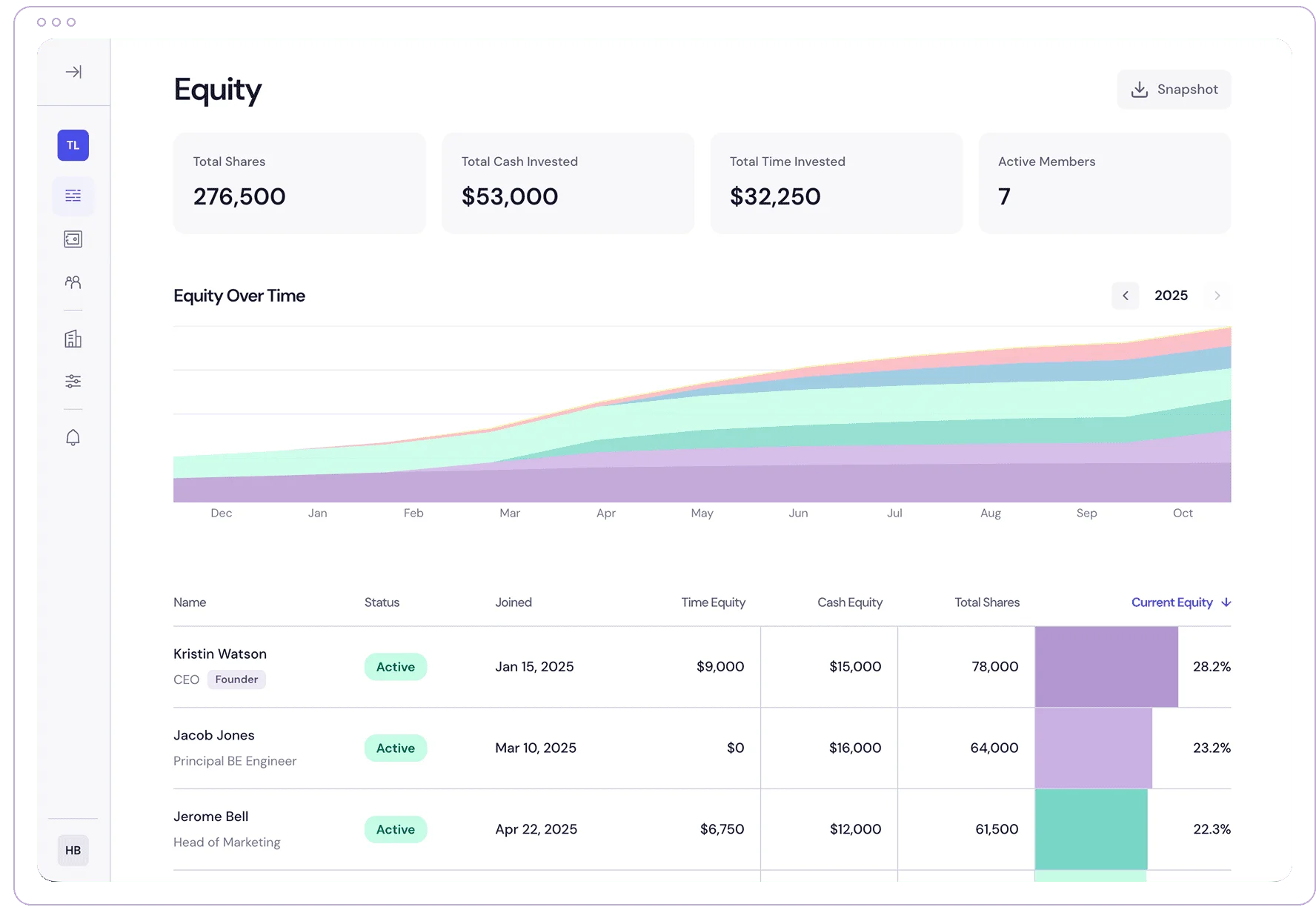
The TOC framework is a method for splitting startup equity based on three inputs: Time (hours each founder works), Opportunity Cost (what each person’s time is worth on the open market), and Cash (money invested into the business). It was outlined by Rob Walling, founder of MicroConf and TinySeed, in his video on distributing startup equity fairly.
If you’ve ever googled “how to split equity fairly,” you’ve probably seen advice that boils down to “just split it 50/50 and move on.” Rob Walling offers a better answer. His TOC framework gives you a structured way to calculate ownership based on what each person actually contributes. And the best part: it aligns closely with other contribution-based models like Slicing Pie, so you’re not locked into one system.
Who is Rob Walling and why this matters
Rob Walling is one of the most trusted voices in the bootstrapped SaaS world. He founded MicroConf, the largest community for bootstrapped and mostly-bootstrapped SaaS founders. He runs TinySeed, an accelerator that has invested in over 200 startups. He hosts the long-running podcast “Startups for the Rest of Us” and has over 117K subscribers on YouTube.
His audience is bootstrapped and indie SaaS founders. These are exactly the people who benefit most from contribution-based equity splits. When you’re not raising millions in venture capital, the question of “who gets what” becomes deeply personal. It’s your savings, your nights, your weekends.
Rob addresses this head-on in his video How To Distribute Startup Equity Fairly for Founders. He walks through the TOC framework as a practical way to calculate fair ownership. And at the end of the video, he points viewers to the Slicing Pie handbook for a more formalized version of the same general approach.
That endorsement matters. When someone with Rob’s experience says “track contributions and let the math decide,” it carries weight.
The TOC framework explained
TOC stands for Time, Opportunity Cost, and Cash. Each component captures a different dimension of what founders bring to the table.
T: Time
How many hours is each founder putting in?
This is the most straightforward input. A founder working 60 hours per week is contributing more than one doing 10 hours per week. That difference should show up in the equity split.
The key here is to actually track it. Weekly. Don’t guess, don’t estimate at the end of the quarter, don’t rely on “we both work about the same amount.” Use a spreadsheet, a time tracker, or a tool built for this purpose. The data keeps everyone honest and removes the emotional component from the conversation.
O: Opportunity Cost
What could each person earn if they weren’t working on this startup?
A senior developer giving up a $200K salary has a different opportunity cost than a recent graduate. A founder leaving a VP role at a public company is making a bigger financial sacrifice than someone between jobs.
This is essentially the “market rate” concept from Slicing Pie. It’s what makes the framework fair across different skill sets and experience levels. Your time is valued at what the market would pay for it, not at some arbitrary number you and your co-founder agree on over coffee.
If you’re trying to figure out what your own contributions are worth, our guide on sweat equity valuation walks through how to set a fair market rate.
C: Cash
Here’s where TOC gets interesting, and where it differs from Slicing Pie in a meaningful way.
In Rob’s framework, cash contributions are valued based on a company valuation. You decide what the company is worth, and the cash buys a percentage of that value.
For example: if you value the company at $200K and someone invests $50K, they’re buying roughly 25% of the existing value (before accounting for future contributions). If the company later grows to a $2M valuation, that same $50K would only buy about 2.5%.
This means early cash is worth MORE than later cash, because the company valuation is lower at the start. The framework naturally rewards the risk of investing early, when the company has nothing but an idea and some ambition.
How TOC compares to Slicing Pie
These two frameworks share more DNA than you might expect. Here’s an honest side-by-side comparison.
| TOC (Rob Walling) | Slicing Pie (Mike Moyer) | Equity Matrix | |
|---|---|---|---|
| Time tracking | Hours x opportunity cost | Hours x market rate (same concept) | Hours x market rate with configurable rates per member |
| Cash weighting | Based on company valuation at time of investment | Fixed multiplier (typically 2x-4x) | Configurable multiplier (adjustable over time) |
| Risk adjustment for cash | Built in: early cash buys more because valuation is lower | Flat: same multiplier regardless of when cash is invested | Adjustable: you can change the multiplier as the company matures |
| Requires company valuation? | Yes, for cash contributions | No | No (but can incorporate one in the future) |
| Loyalty protections | None | None | Built-in cliffs, thresholds, and equity decay |
| Legal agreements | None | None (refers you to lawyers) | Auto-generated operating agreements |
| Ongoing tracking | Manual / spreadsheets | Manual / basic app | Automated with Slack integration |
| Simplicity | Conceptual (need to agree on valuation) | Book with detailed rules | App handles the math for you |
The time-tracking side is nearly identical across all three. They all say: figure out what each person’s time is worth, multiply by the hours they work, and use that as the basis for their equity share.
The differences are in how they handle cash, what protections they offer, and how much of the work is automated. TOC is a conceptual framework. Slicing Pie is a formalized model with a book. Equity Matrix is the platform that implements these concepts with software, adds protections that neither framework includes, and generates the legal documents you need.
The real question when comparing TOC and Slicing Pie specifically is how they handle cash.
The valuation question
This is the core tradeoff between the two approaches. Neither is wrong. They just solve the problem differently.
The case for TOC’s valuation-based approach
It’s more accurate. Early cash IS riskier and should buy more equity. As the company grows and generates revenue, the valuation goes up, and each new dollar of cash buys less. This reflects reality.
There’s also an intuitive clarity to it. Founders understand “your $50K bought 25% of the company when it was worth $200K.” That sentence makes immediate sense. You don’t need to explain multiplier theory or slice calculations.
If you’re curious about how startup valuations work in the context of equity, our post on how to value a startup for equity covers the basics.
The case for Slicing Pie’s multiplier approach
It’s simpler. You don’t need to agree on what the company is worth, which is nearly impossible pre-revenue. What is a two-person startup with no customers worth? $50K? $500K? $5M? Good luck getting two co-founders to agree on that number.
The multiplier still rewards cash over time (a 2x to 4x premium), just not dynamically based on stage. And critically, it avoids arguments about valuation. This matters more than you might think. Valuation disagreements can be just as toxic as equity disagreements. Replacing one source of conflict with another isn’t progress.
The honest answer
Both have tradeoffs. The valuation-based approach is more precise but harder to implement. The multiplier approach is simpler but less nuanced.
For most early-stage teams, the simplicity of the multiplier wins because the valuation question is genuinely hard to answer when you have no revenue. Once you do have revenue, you have real data to base a valuation on, and you can adjust accordingly.
An ideal system would combine both: start with a multiplier, then adjust it based on actual company value as you grow. This is something Equity Matrix is exploring for future versions.
If you’re still weighing dynamic vs. fixed equity splits, understanding both of these approaches will help you make a more informed decision. And if you’re skeptical about whether dynamic equity is practical at all, our post on why dynamic equity is easier than you think addresses the most common objections.
How to use this framework today
Whether you prefer TOC or Slicing Pie, the core idea is the same: track contributions and let the math determine fair ownership. Don’t guess. Don’t shake hands on a number over dinner. Build a system that updates as the work actually happens.
Here’s how to get started:
-
Try the calculator. Use our Slicing Pie Calculator to model a split based on time and cash contributions. It implements the same core mechanics that both frameworks share.
-
Watch the full video. Rob’s take is worth 15 minutes of your time: How To Distribute Startup Equity Fairly for Founders.
-
Read the detailed guide. Our Slicing Pie guide covers the formalized version with rules for edge cases, departures, and ongoing adjustments.
-
Set up ongoing tracking. For continuous tracking with built-in protections like cliffs, decay, and loyalty thresholds, Equity Matrix handles the math so you can focus on building.
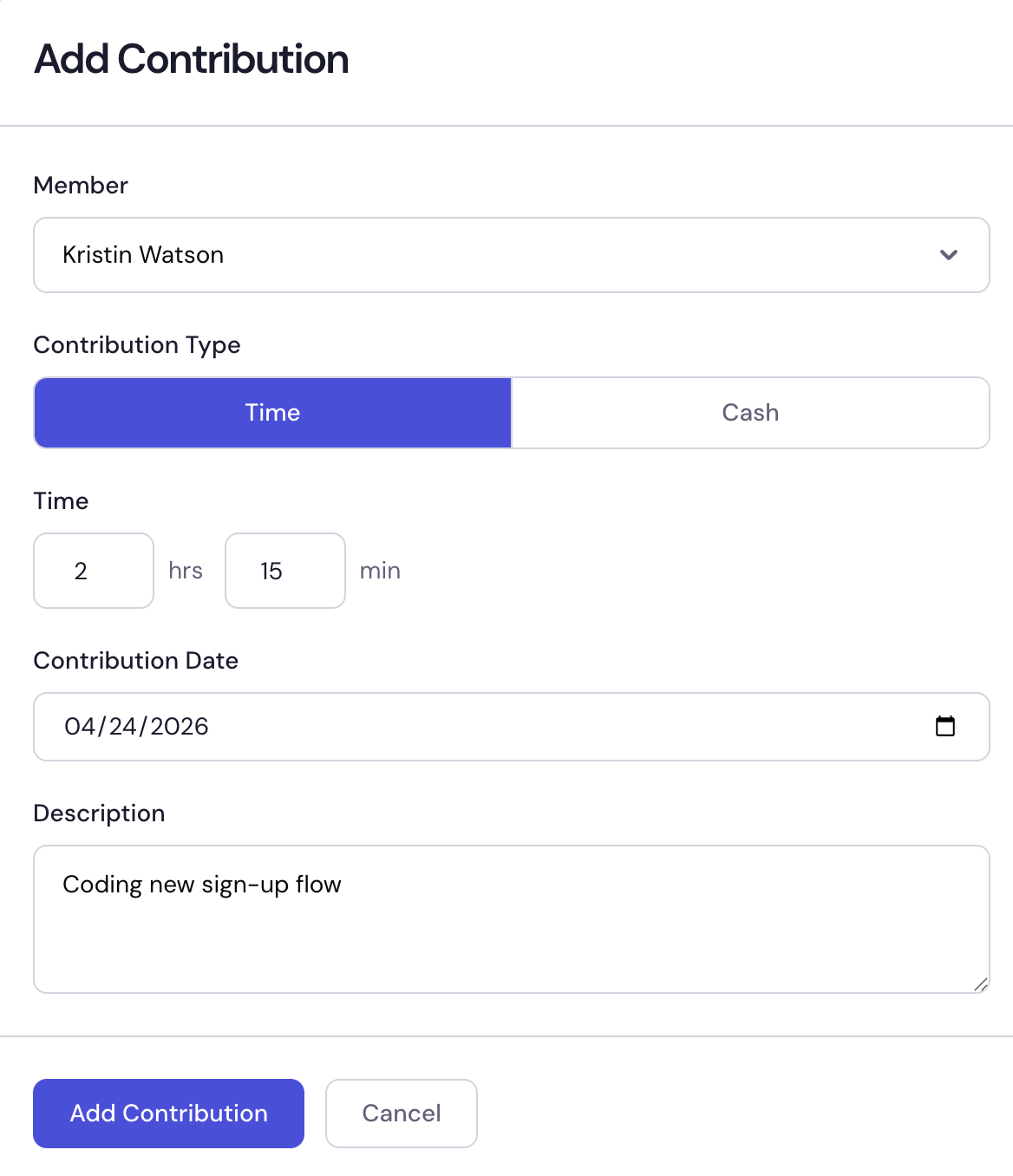
Logging a contribution takes about 30 seconds.
- Talk to your co-founder. No framework works if you don’t actually have the conversation. Pick an approach, agree on the inputs, and start tracking. You can always refine later. The worst thing you can do is nothing.
FAQ
Did Rob Walling invent the TOC framework?
He outlines it in his video on distributing startup equity fairly. The underlying concepts, valuing time at market rate, accounting for opportunity cost, weighting cash contributions, are shared across several contribution-based equity models, including Slicing Pie. Rob points viewers to the Slicing Pie handbook at the end of his video for a more detailed implementation. The value of his video is in packaging these ideas into a clear, accessible format for bootstrapped founders.
Which should I use, TOC or Slicing Pie?
They’re more similar than different. Both track time at a fair market rate and account for cash contributions. The main difference is how cash is weighted. If you can agree on a company valuation, TOC’s approach rewards early cash investment more accurately. If you want simplicity and want to avoid the valuation question entirely, Slicing Pie’s multiplier approach is easier to implement. For a deeper look at the options, read our guide on how to split equity in a startup.
Can I use Equity Matrix with the TOC framework?
Yes. Equity Matrix tracks time contributions at each person’s market rate and cash contributions with a configurable multiplier. The core mechanics are the same. You can adjust your multiplier over time to approximate the valuation-based approach if you want. The tool is framework-agnostic. It cares about inputs and math, not which book or video you got the idea from.
Ready to split equity fairly?
Equity Matrix tracks contributions and calculates ownership automatically.
Get Started FreeThis article is for informational purposes only and does not constitute legal, tax, or financial advice. Equity Matrix is not a law firm, accounting firm, or financial advisor. Consult a qualified professional for guidance specific to your situation.

Co-founder, Equity Matrix
Sebastian writes about startup equity, founder dynamics, and building fair partnerships.
Keep reading
Slicing Pie: complete guide to dynamic equity
How the Slicing Pie model works: formulas, GHRR calculations, multipliers, and real examples. Plus the problems Mike Moyer's book doesn't cover and how to solve them.
Read more →Co-founders in different countries: how to set a fair rate
When one co-founder is in the US and another is in Lithuania, do you value their time at local rates or the same rate for the same work? How to set GHRR fairly across borders.
Read more →