You’ve been building alone. Now you’re wondering if you need a partner.
Maybe you’re burned out. Maybe you’ve hit a wall on the technical side or the business side. Maybe investors keep asking “where’s your co-founder?”
The solo founder path is harder—at least conventionally. Research is actually mixed. One study found solo founders survive longer and generate more revenue, while other data suggests teams raise more capital. Y Combinator funds plenty of solo founders, but for certain businesses—especially those requiring diverse expertise—investors expect a team.
But adding a co-founder isn’t automatic. Get it wrong and you’ve created a new problem instead of solving one.
Here’s how to think through the transition.
Quick Framework: Should You Add a Co-Founder?
| Signal | Stay Solo | Add a Co-Founder |
|---|---|---|
| Skill gap | Learnable or hireable | Critical and complementary |
| Emotional state | Sustainable | Burning out |
| Stage | Side project | Ready to scale |
| Candidate | No one fits | Strong match available |
| Terms | Can’t agree | Fair deal possible |
The Emotional Reality
Let’s start with the part nobody talks about.
Giving up the solo founder title is hard. You’ve been making all the decisions. You’ve been the one pushing through. Adding a co-founder means sharing control, sharing credit, and sharing equity.
Some founders resist this for too long. They don’t want to dilute. They don’t want to compromise. They keep struggling alone because sharing feels like losing.
Others rush into co-founder relationships out of loneliness or desperation. They’re so tired of carrying everything that they give away too much to the first person who shows interest.
Both extremes are dangerous. Many famous co-founder disputes started with poorly thought-out partnerships.
The right question isn’t “do I want a co-founder?” It’s “does my company need a co-founder, and if so, what kind?”
When Adding a Co-Founder Makes Sense
You Have a Critical Skill Gap
Maybe you’re a technical founder who can’t sell. Or a business person who can’t build. Some gaps can be filled with hires or contractors. Others are so fundamental that you need someone at the ownership level.
Ask yourself: can I learn this skill? Can I hire for it? Or is it so core to the business that I need a true partner?
You’re Hitting Founder Burnout
Solo founding is exhausting. There’s no one to share the load. No one to talk through decisions. No one who cares as much as you do.
If you’re burning out and the company still has legs, a co-founder can be the difference between quitting and breaking through.
Investors Keep Passing
Some investors won’t back solo founders. They’ve seen too many burn out or hit walls. If you’re getting consistent feedback that your team is too thin, a co-founder might unlock funding.
YC data suggests solo founders can absolutely succeed. But for certain businesses—especially those requiring diverse expertise—a team is expected.
You’ve Found an Exceptional Candidate
Sometimes the right person appears before you’ve decided you need them. If someone with truly complementary skills wants to join at the co-founder level, don’t dismiss it just because you started alone.
The availability of the right partner is itself a signal.
The Hidden Cost of 50/50 Equity Splits
When to Stay Solo
The Skill Gap Is Fillable
Not every gap requires a co-founder. A fractional CMO might be better than a marketing co-founder. A CTO-for-hire might work while you find product-market fit. Ask whether you need ownership-level commitment or just execution.
You’ve Already Raised
Adding a co-founder after raising money is complicated. You’re diluting existing investors. You’re potentially renegotiating control. The bar for a new co-founder goes up significantly once there’s a cap table with outside money.
You Haven’t Found the Right Person
A mediocre co-founder is worse than no co-founder. 65% of high-potential startups fail due to people problems, including co-founder conflict. The wrong partner creates problems you didn’t have before.
Wait for the right match. Don’t settle out of desperation.
The Business Doesn’t Require It
Some businesses are designed for solo founders. Lifestyle businesses. Small-scale products. One-person agencies. Not every venture needs a co-founder.
Finding the Right Person
Once you’ve decided to look, here’s how to evaluate candidates.
Skills First, Relationship Second
The natural instinct is to partner with friends. But research suggests that teams chosen for skill complementarity often outperform teams chosen for personal relationships. A Kauffman Fellows study found 68% of co-founders with complementary skills were doing well, versus only 38% without.
This doesn’t mean you should partner with strangers. But skills should be the primary filter, not friendship.
Look for Genuine Complementarity
The best co-founder relationships have minimal overlap. If you’re both business people, you’re fighting over the same territory. If one of you is business and one is technical, you each have clear domains.
| Your Strength | Look For |
|---|---|
| Technical / product | Sales, marketing, fundraising |
| Business / sales | Technical leadership, product |
| Operations | Vision, customer-facing roles |
| Domain expertise | Generalist execution |
Work Together Before Committing
This is critical. Don’t go from stranger to co-founder in one step.
Many experienced founders recommend working with potential partners for at least a month before formalizing anything. The Founder Institute’s FAST Agreement suggests at least 8 hours together with potential advisors—the same principle applies to co-founders. Some suggest 3-6 months of working together on a real project.
During this trial period, you’ll learn:
- How they handle stress
- Whether they deliver on commitments
- How you make decisions together
- Whether you actually like working with them
Most co-founder relationships that fail show warning signs in the first few months. Pay attention.
Check References
Talk to people who’ve worked with them. Not just colleagues—former co-founders, employees, investors. Ask specifically about how they handled conflict and difficult situations.
Structuring the Equity Split
This is where solo-to-co-founder transitions get tricky.
You’ve already done work. Maybe significant work. You’ve taken risk. Built something. The company isn’t a blank slate.
But you also need to offer enough equity to attract a true partner. Nobody will take co-founder-level commitment for a token stake.
Credit Your Head Start (But Don’t Overvalue It)
You deserve equity credit for what you’ve built. Your past work is sweat equity and has real value. But be careful not to overvalue it. Six months of solo work on an unvalidated idea isn’t worth 50% of the company forever.
A framework: calculate your prior contributions as if you’d been an early investor or contractor. Time at market rate. Cash at cost. Then compare that to expected future contributions. See our guide on how to bring on a co-founder after starting for detailed examples.
Typical Ranges for Late Co-Founders
| Stage When Joining | Typical Equity Range |
|---|---|
| Idea only, no product | 40-49% |
| Working prototype | 25-40% |
| Launched, no revenue | 15-30% |
| Early revenue | 10-25% |
| Product-market fit | 5-15% |
These are starting points, not rules. The right number depends on what they’re bringing and what you need.
Use Dynamic Equity to Remove Guesswork
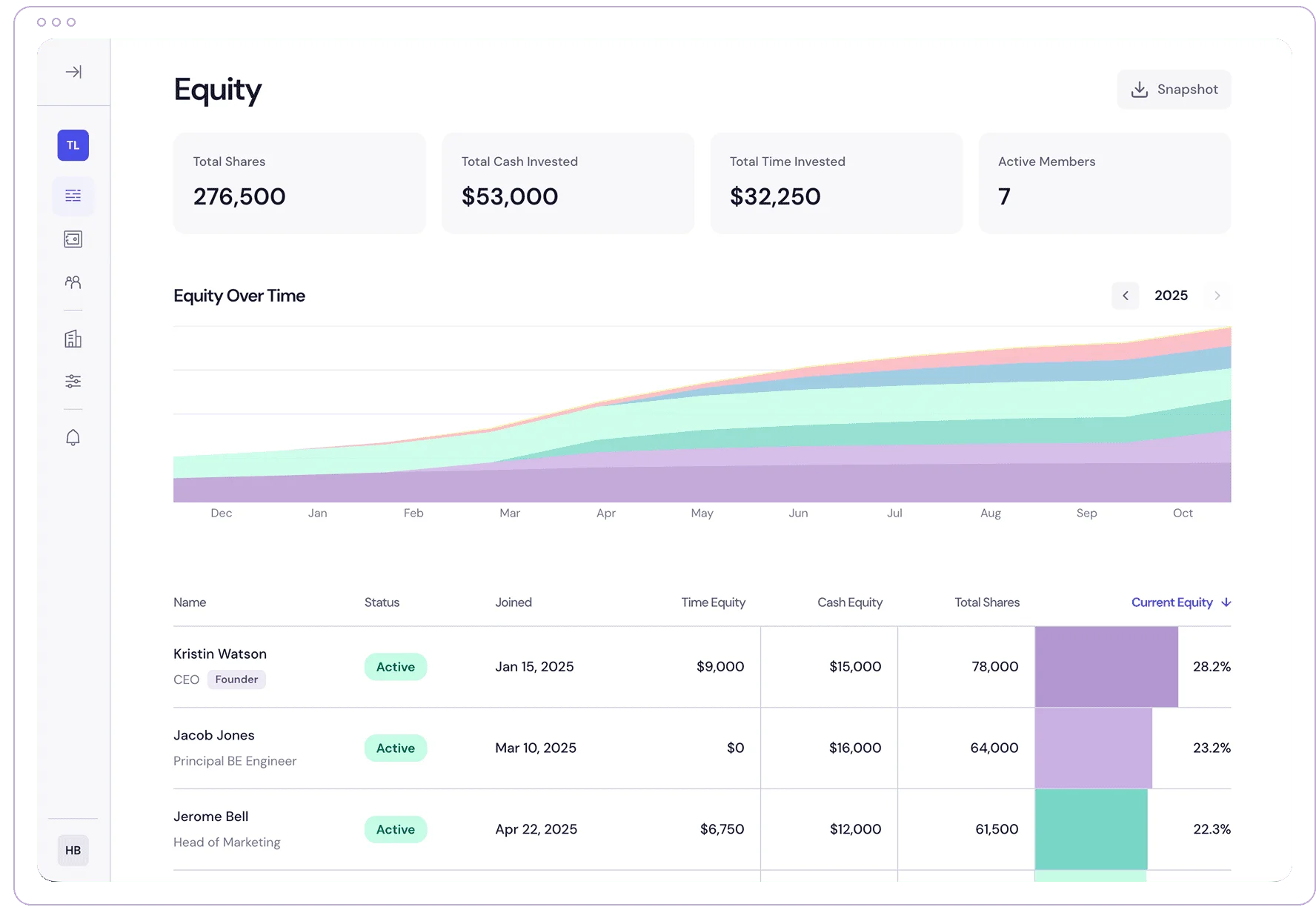
If you’re uncertain about relative contributions going forward, consider dynamic equity. Track contributions as they happen. Let ownership reflect reality rather than day-one predictions.
When you’re ready to raise or when contributions have stabilized, you can freeze the split based on actual data.
Always Use Vesting
Whatever split you agree on, the new co-founder’s equity should vest. Standard is four years with a one-year cliff.
Your existing equity might also get reset to vesting if you’re approaching investors. Many VCs require all founders—even those who’ve been working solo for a year—to be on vesting schedules.
The Co-Founder Agreement
Put everything in writing. This isn’t about distrust. It’s about clarity.
Your agreement should cover:
Equity and vesting: What’s the split? What’s the vesting schedule? What happens to unvested equity if someone leaves?
Roles and decisions: Who handles what? Who has final say on product? On hiring? On strategy?
Commitment level: Is everyone full-time? If not, when does that change?
Exit scenarios: What if someone wants to leave? What if you both want to shut down? What if there’s a disagreement you can’t resolve?
IP assignment: Does the company own everything you both build? What about work done before the partnership started?
Get a lawyer to draft or review this. Templates exist, but your situation has specifics worth addressing.
Common Mistakes
Moving too fast. You’re lonely and burned out. Someone shows interest. You offer co-founder equity after two conversations. Slow down. Work together first.
Giving away too much. In your eagerness to bring someone on, you offer 50% to someone joining a year into your work. Be generous but reasonable.
Not giving away enough. You’re so protective of equity that you offer a token amount. Real co-founders won’t accept 5%.
Skipping the hard conversations. You avoid discussing what happens if things don’t work out. Then things don’t work out, and you have no agreement. Avoiding 50/50 splits that you haven’t thought through is critical.
Assuming alignment. You think you agree on vision, pace, and priorities. But you’ve never actually tested those assumptions under pressure.
Vesting Explained: Everything Founders Need to Know
Red Flags in Potential Co-Founders
Walk away if you see these signals:
They want the title but not the work. Co-founder is a status symbol to some people. Make sure they’re in it for the grind, not the LinkedIn update.
They can’t commit. Keeping a day job forever, hedging bets, unwilling to take real risk. A co-founder needs skin in the game.
Values mismatch. You want to build something sustainable. They want a quick flip. These conflicts get worse, not better.
Can’t handle conflict. The first sign of disagreement and they get defensive or disappear. You need someone who can fight constructively.
Financial desperation. If they need income you can’t provide, they’ll leave when money gets tight. Financial runway matters.
The First 90 Days
Once you’ve agreed on terms and formalized the partnership, the first three months set the pattern.
Over-communicate. You’re used to making decisions alone. Force yourself to loop in your co-founder on everything, even things that seem obvious.
Define lanes clearly. Who owns what? Get specific. Ambiguity creates conflict.
Have the awkward meetings. Weekly check-ins on what’s working and what isn’t. Surface issues early before they become resentments.
Watch for warning signs. If the first 90 days feel wrong, trust that instinct. Better to unwind early than wait until you’re deep in.
Frequently Asked Questions
How much equity should I give a co-founder who joins after I’ve started?
It depends on your stage and their contribution. A co-founder joining an idea-stage startup might get 40-49%. One joining after you have revenue might get 10-25%. Use your prior contributions and their expected future contributions to find a fair number. See our detailed framework.
Should I add a co-founder just because investors want me to?
Not just because investors say so. Add a co-founder if you genuinely need the skills or support. A bad partnership is worse than staying solo. That said, if multiple investors cite your team as a concern, it’s worth taking seriously.
How do I know if someone is co-founder material vs. just a good early hire?
Co-founders should fill critical skill gaps, take real risk (quitting jobs, investing time without salary), and care about the business as much as you do. If someone wants a salary and defined hours, they’re an employee. If they want equity and ownership, they might be a co-founder.
What if the co-founder relationship doesn’t work out?
This is why vesting matters. With a one-year cliff, someone who doesn’t work out in the first year walks away with nothing. After the cliff, they keep their vested equity but forfeit the rest. Your co-founder agreement should also specify buyback rights and dispute resolution.
Ready to bring on a co-founder and structure equity fairly? Our equity calculator helps you model splits based on contributions and stage.
Ready to split equity fairly?
Equity Matrix tracks contributions and calculates ownership automatically.
Get Started FreeThis article is for informational purposes only and does not constitute legal, tax, or financial advice. Equity Matrix is not a law firm, accounting firm, or financial advisor. Consult a qualified professional for guidance specific to your situation.

Co-founder, Equity Matrix
Sebastian writes about startup equity, founder dynamics, and building fair partnerships.
Keep reading
Co-founders in different countries: how to set a fair rate
When one co-founder is in the US and another is in Lithuania, do you value their time at local rates or the same rate for the same work? How to set GHRR fairly across borders.
Read more →How to track co-founder contributions (before it costs you)
A practical system for tracking co-founder contributions: what to log, how often, the fields that matter, and where spreadsheets start to strain.
Read more →