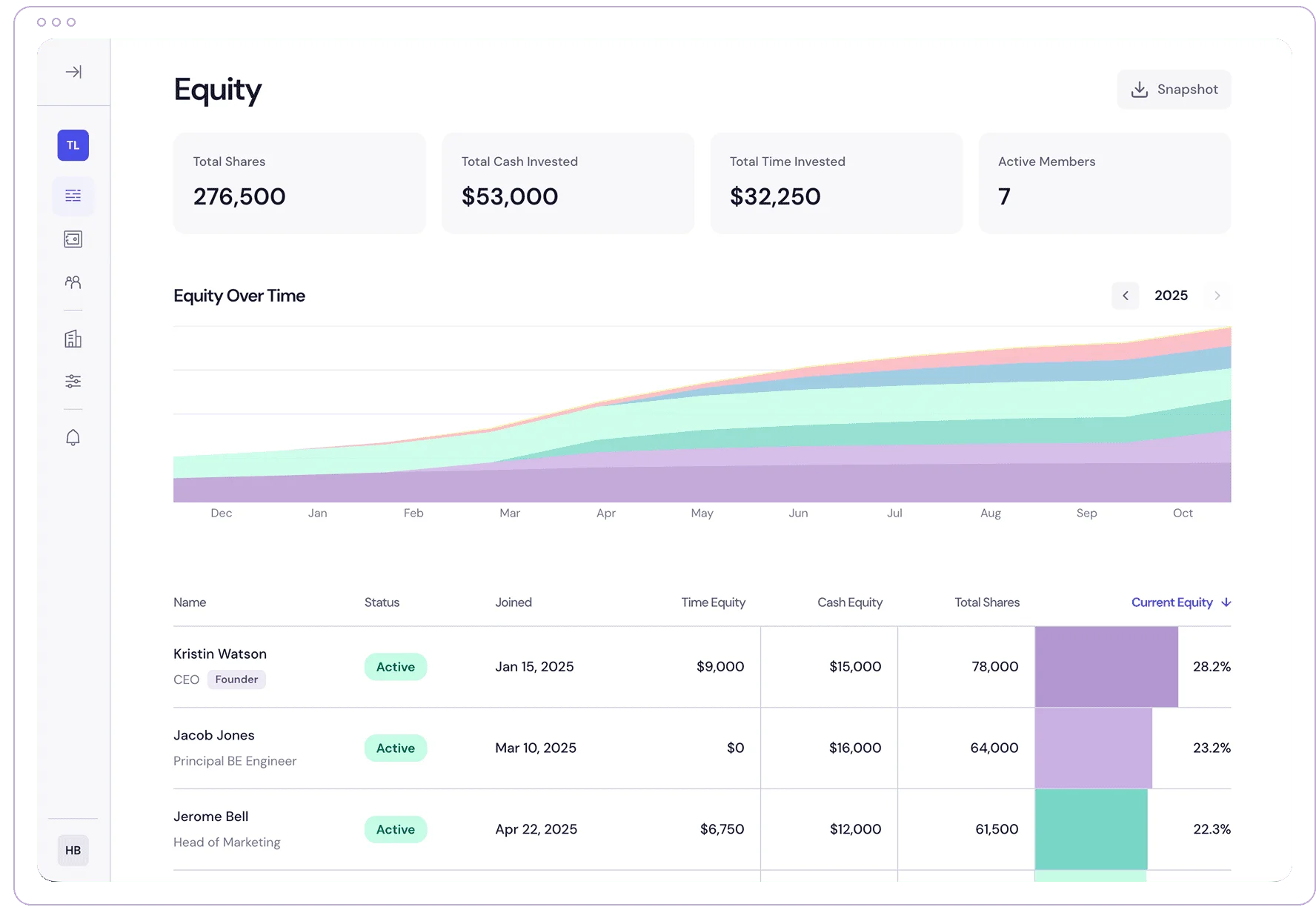
One of our co-founders shares the experiences that led us to build Equity Matrix.
I didn’t set out to build equity software.
I set out to build a startup with a co-founder. We made every mistake in the book. And by the time we figured out what we should have done, we’d already lived through the pain of doing it wrong.
This is that story.
The 50/50 Trap
Like most first-time founders, we started with a handshake and a 50/50 split.
It felt fair. We were equals. We were in this together. Why wouldn’t we split it down the middle?
Then reality showed up.
We needed to invest money in the business. Only one of us could put cash in. The first time it happened, we just… left the split alone. It felt awkward to bring it up. We were still equal partners, right?
The second time, we couldn’t ignore it anymore.
“Well, that’s not fair. Let’s adjust the equity.”
So we negotiated. On the fly. Some arbitrary percentage that felt reasonable in the moment. We moved on.
Then it happened again. More cash needed. More negotiation. But this time, something else surfaced.
“If we keep doing this, I’m going to end up with nothing. I’ll lose motivation.”
He was right. The dynamic had shifted. We weren’t two equals building together anymore. We were two people with increasingly complicated feelings about who owned what.
That’s when we went looking for a solution.
The Hidden Cost of 50/50 Equity Splits
Finding Slicing Pie
We discovered Slicing Pie, Mike Moyer’s framework for contribution-based equity.
The core idea is simple: instead of guessing how much each person will contribute and locking in ownership upfront, you track contributions over time and let the math determine fair splits.
It was exactly what we needed.
No more awkward negotiations. No more guessing. Every hour logged, every dollar invested, every resource contributed would count toward your slice. The pie would grow, and your percentage would reflect what you actually put in.
We implemented it. And for a while, things got better.
But then the problems started.
The Dead Equity Problem
Co-founders came and went.
Some joined with enthusiasm, attended a few meetings, never actually built anything, and then disappeared. Under Slicing Pie, they’d earned some slices. Small amounts, but still ownership.
There was no cliff. No threshold. Work one hour, get shares.
When someone expensive showed up for a few weeks and then left, their contribution stayed in the pie forever. It diluted everyone else. The pool got bigger, but not because we were building value. It got bigger because someone’s brief stint was now baked into the ownership structure permanently.
Then came the marketing co-founder.
He joined to handle growth. It ended up not being a good fit. We parted ways professionally, but his equity stayed behind.
By the time we’d been through a few of these, we had significant dead equity sitting on the cap table. Former contributors who would share in any future success, even though they hadn’t stuck around to build it.
This is the gap in Slicing Pie that nobody talks about. The model assumes people either stay or get bought out. In reality, early-stage companies are messy. People come and go. And if you don’t have protections in place, you end up with a cap table that doesn’t reflect who actually built the company.
The Legal Mess
By this point, we knew we needed professional guidance.
We found Mike Moyer’s website and paid for a consultation. He was helpful in explaining the philosophy, but couldn’t give us legal advice. Fair enough.
He referred us to lawyers on his site who supposedly specialized in dynamic equity.
The first lawyer we talked to had no idea what dynamic equity actually was.
He told us we were idiots for setting up a Delaware C-Corp with only 1,500 shares. Standard for startups was 10 million shares, he said. We’d done everything wrong.
He was right that we’d made mistakes. We’d used an online incorporation service and made all the selections ourselves with no guidance. We’d chosen a Delaware C-Corp because that’s what you’re supposed to do if you want to raise VC, even though we weren’t sure we wanted to raise.
But his advice wasn’t helpful. It was expensive. And we walked away having paid for legal fees on top of having an incorrectly structured business.
We’d spent money on lawyers and still didn’t have answers.
The System Is Broken
This is where the frustration really set in.
The whole point of building a startup is to focus on the product, the customers, the business. Equity mechanics should be solved problems. Overhead. Infrastructure that exists so founders can focus on what matters.
In the last fifteen years, we’ve seen technology make so many parts of starting a company easier. Incorporation. Payroll. Banking. Fundraising. Cap table management.
But all of those tools assume you’ve already figured out your ownership structure. They’re designed for companies that have raised money, that have standard 10-million-share setups, that are on the VC track.
What about everyone else?
What about founders who don’t know yet if they’re raising? Who might be building a lifestyle business or a bootstrapped company? Who want to share equity fairly but don’t have $5,000 to spend on lawyers to figure out how?
What about small businesses? The bakery owner going into business with a friend. The dry cleaner whose partner stops showing up. The consultant who brings on a co-founder and realizes six months later that it isn’t working.
These people have no tools. No guidance. No infrastructure.
My Dad’s Story
This isn’t just about startups.
My dad went into business with a partner. 50/50 split. Straightforward.
Except it was supposed to be four people contributing. Two couples. His partner’s wife was part of the deal. She never did anything. Never showed up. Never contributed. But she still wanted her share.
If they’d used dynamic equity, it would have solved itself. She didn’t contribute, so she wouldn’t have earned ownership. Simple.
Instead, the partnership fractured. They couldn’t work together anymore. My dad had to buy his partner out, which put enormous financial burden on the business early on when they should have been reinvesting in growth.
Broken equity destroys relationships. I’ve seen it in my own family. I’ve heard it from dozens of founders through the network we’ve built with Equity Matrix partners. Lost friendships. Fractured businesses. People who stopped talking to each other.
It doesn’t have to be this way.
Famous Co-Founder Disputes: What Went Wrong
Why Slicing Pie Stopped Evolving
Mike Moyer deserves credit for creating the foundation.
Slicing Pie gave us the language to think about contribution-based equity. The core insight, that ownership should reflect what people actually put in, was correct. And it’s helped thousands of founders avoid the 50/50 trap.
But the implementation stopped evolving.
The software looks like an app for college kids starting a side project. It’s fine if you’re just tracking hours in a dorm room. But if you’re building a serious business, it doesn’t feel like a tool you’d show to investors or partners.
More importantly, the model is designed to freeze. Dynamic equity is supposed to get you to the point where you raise money, start taking salaries, and then convert to a fixed cap table. That’s your ownership in the business. Done.
But what if you don’t raise?
What if you bootstrap? What if you want to continue sharing equity after you have revenue? What if you bring on employees and want them to participate in ownership the way your co-founders did?
The existing tools don’t support that. They’re not built for ongoing equity distribution. They’re not built for companies that stay dynamic.
The Vision for Equity Matrix
That’s what we’re building.
Not just a better Slicing Pie implementation. A complete infrastructure for fair ownership.
Loyalty protection built in. Cliffs and thresholds so that people who leave early don’t drag down everyone else forever.
Professional-grade interface. Software that looks like something you’d show to investors. Not a toy.
Support for SMBs and bootstrapped companies. Not everyone is building a VC-track startup. Fair equity matters for bakeries and consulting firms too.
Continuous equity sharing. Tools for distributing ownership to employees, contractors, and partners after the business has revenue. Dynamic equity doesn’t have to freeze.
Educational resources. So founders understand what they’re doing, not just mechanically entering numbers into a form.
The Bigger Picture
Here’s what keeps us up at night.
Over the past decade, startups have given employees 35% less equity. Option pools are shrinking. The wealth that gets created goes to fewer and fewer people.
And nobody’s really talking about it.
We’re just moving forward with the status quo. Standard cap tables. Standard 10-million-share structures. Standard vesting schedules designed for companies that raised a Series A.
If we don’t make fair equity easy, nothing changes. The wealth gap keeps growing. In a hundred years, we’re back to kings and peasants, wealth concentrated in the hands of whoever happened to be there first.
That’s not what America was supposed to be about. But we’ve allowed ourselves to slide toward it, slowly, through poor equity model design.
Someone has to make it easy to change.
That’s why we’re building Equity Matrix.
What Comes Next
We’re still early. We’re building the foundation.
But the vision is to support any equity distribution model that facilitates fair, broad ownership. Not just dynamic equity for pre-revenue startups. Ongoing ownership for established businesses. Tools that make sharing wealth the default instead of the exception.
If you’ve lived through any of what I described—if you’ve made the 50/50 mistake, dealt with dead equity, paid for legal advice that didn’t help—we’d love to hear from you.
And if you’re starting something new and want to avoid making our mistakes, try the calculator or sign up for free.
The system is broken. Let’s fix it together.
Frequently Asked Questions
Why didn’t you just use traditional vesting instead of dynamic equity?
Traditional vesting assumes you know the ownership split upfront. You’re locking in percentages before you know who will actually contribute what. Dynamic equity defers that decision until you have real data. For early-stage companies where contributions are unpredictable, that’s a much better model.
Is Slicing Pie still useful?
Yes. The core framework, tracking contributions and calculating ownership based on what people actually put in, is solid. We just think the implementation needs to evolve. Better protections for when people leave. Better tools for ongoing equity sharing. A more professional interface. That’s what Equity Matrix adds to the foundation Slicing Pie created.
What’s wrong with a 50/50 split?
Nothing, if both founders contribute equally forever. But that almost never happens. One person invests more cash. One person works more hours. Circumstances change. A 50/50 split locks you into a structure that may not reflect reality six months or two years later.
How do you handle co-founders who leave?
With loyalty protection. Cliffs ensure people don’t earn ownership until they’ve been contributing for a minimum period. Thresholds set minimums for what counts as meaningful contribution. And our exit protection features help recover equity from people who leave early, so it doesn’t sit as dead weight on your cap table forever.
Ready to split equity fairly?
Equity Matrix tracks contributions and calculates ownership automatically.
Get Started FreeThis article is for informational purposes only and does not constitute legal, tax, or financial advice. Equity Matrix is not a law firm, accounting firm, or financial advisor. Consult a qualified professional for guidance specific to your situation.

Co-founder, Equity Matrix
Sebastian writes about startup equity, founder dynamics, and building fair partnerships.
Keep reading
Co-founders in different countries: how to set a fair rate
When one co-founder is in the US and another is in Lithuania, do you value their time at local rates or the same rate for the same work? How to set GHRR fairly across borders.
Read more →How to track co-founder contributions (before it costs you)
A practical system for tracking co-founder contributions: what to log, how often, the fields that matter, and where spreadsheets start to strain.
Read more →