Cap table management is the process of tracking, updating, and maintaining your company’s ownership records. Get it wrong and you’ll face deal delays, investor skepticism, and legal headaches that cost far more than any software subscription.
If you’re an early-stage founder, the phrase “cap table management” might feel premature. You haven’t raised money. You might not even be incorporated. Why worry about managing something you barely have?
Because the decisions you make now about how to track ownership become the foundation of your cap table later. And founders who treat this casually in year one spend tens of thousands cleaning it up in year two.
This guide covers when you need cap table management, what tools to use at each stage, the mistakes that trip founders up, and how contribution tracking fits into the picture before you formalize.
What cap table management actually involves
A cap table is a record of who owns what in your company. Cap table management is the ongoing work of keeping that record accurate as things change.
That includes:
- Recording equity issuances — every time you grant shares, options, or warrants
- Tracking vesting schedules — who has vested what and when
- Modeling dilution — what happens to everyone’s ownership when you raise a round or expand the option pool
- Documenting conversions — when SAFEs or convertible notes convert to equity
- Maintaining the stock ledger — the legal record of all issued shares and their holders
- Running scenario analysis — what if you raise at this valuation? What if you add 10% to the option pool?
At the earliest stage, most of this is simple. Two founders, a split, maybe some vesting. But complexity grows fast. One funding round, a few employee grants, and an advisor allocation later, and a spreadsheet that made sense six months ago is now a liability.
The three stages of cap table management
Not every startup needs the same tools on day one. What matters is using the right tool for the stage you’re at.
Cap table management by stage
| Stage | What you need | Best tool | When to upgrade |
|---|---|---|---|
| Pre-revenue / pre-incorporation | Track contributions, determine fair equity split | Dynamic equity (contribution tracking) | When you incorporate or raise |
| Incorporated, pre-funding | Stock ledger, vesting tracking, basic cap table | Spreadsheet or free tier software | When you issue options or take SAFEs |
| Post-funding / 10+ stakeholders | Full cap table software, scenario modeling, compliance | Carta, Pulley, or similar | When complexity outgrows your current tool |
Stage 1: before you incorporate
This is where most cap table management content fails founders. The advice assumes you already have a corporation, shares issued, and a stock ledger. But what if you’re still figuring out who owns what?
If you’re pre-revenue and pre-incorporation, you don’t need a cap table yet. You need contribution tracking.
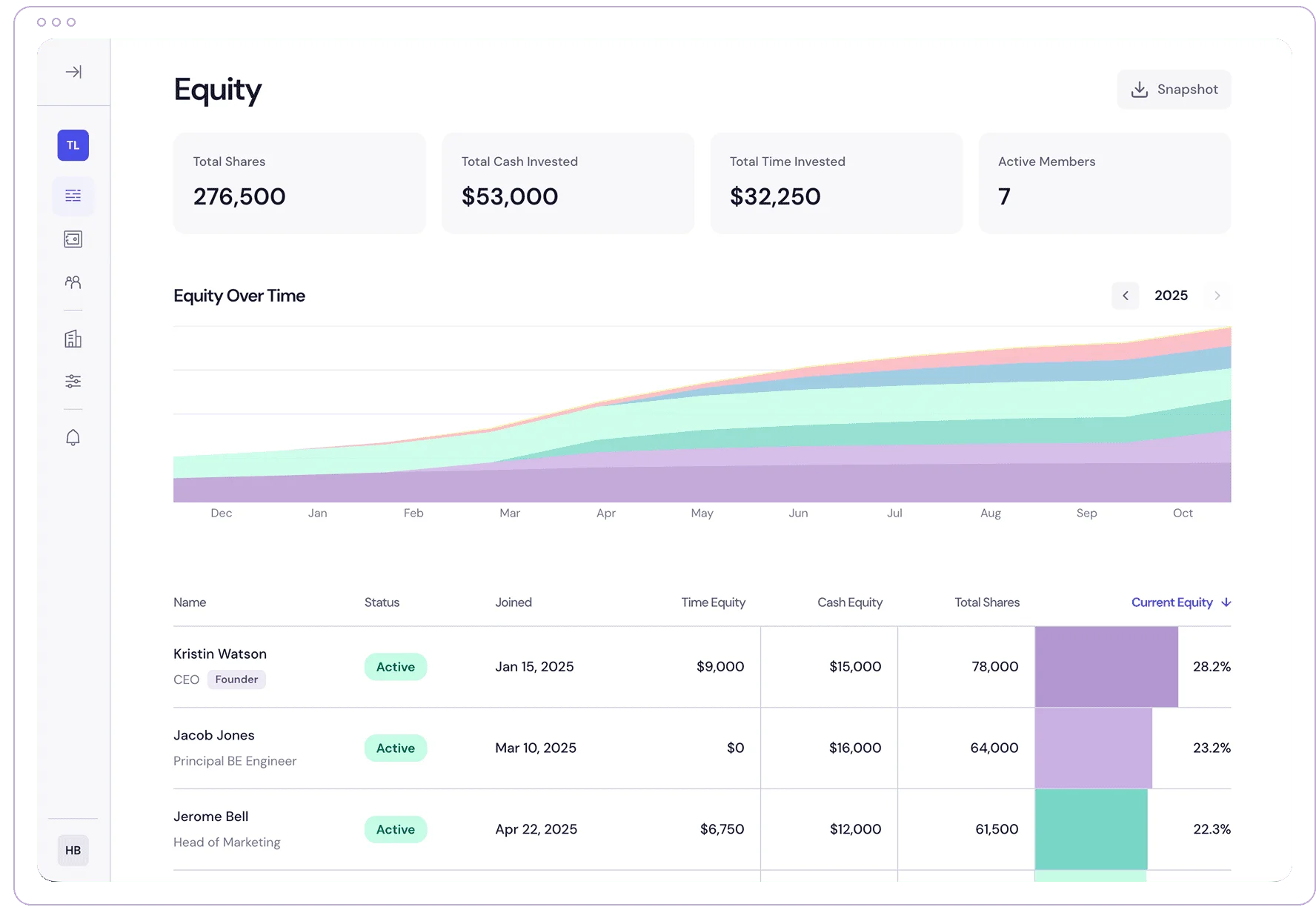
Dynamic equity lets you track what each person is putting in — time, money, expertise — and calculates a fair ownership split based on actual contributions. When you’re ready to incorporate, you freeze that split into a formal cap table with real shares.
This matters because 73% of founding teams set their equity split within the first month, before they have real data about contributions. Tracking contributions from day one means your cap table starts with accurate numbers instead of guesses.
Stage 2: incorporated, pre-funding
Once you’ve incorporated, you have a real cap table: authorized shares, issued shares, and a stock ledger. At this point you need:
- A record of who holds what (the cap table itself)
- Vesting schedules for all founders and early hires
- Basic scenario modeling (what happens if we raise at X valuation?)
A spreadsheet can work here, but only if someone keeps it meticulously updated. The moment you have more than a handful of stakeholders, spreadsheets start breaking.
Free tools like Pulley’s free tier or Carta Launch can handle this stage without cost. The key is getting your data into a system that’s auditable before you need it to be.
Stage 3: post-funding or 10+ stakeholders
Once you’ve raised money, issued employee options, or accumulated more than 10 stakeholders, you need real cap table software. This isn’t optional — it’s what investors and lawyers expect during due diligence.
At this stage, you need:
- Automated vesting tracking
- 409A valuation integration
- Scenario modeling for future rounds
- Waterfall analysis for exit scenarios
- Compliance reporting
- Stakeholder portal so investors can see their holdings
Cap table management tools compared
The cap table software market is dominated by a few players. Here’s how they compare for founders at different stages.
Cap table software comparison
| Tool | Best for | Starting price | Key strength |
|---|---|---|---|
| Spreadsheet | Pre-seed, 2-3 founders | Free | Simple, flexible |
| Equity Matrix | Pre-revenue, pre-incorporation | Free trial | Contribution tracking → fair cap table |
| Pulley | Seed to Series A | Free tier available | Cost-effective, clean UI |
| Carta | Series A and beyond | ~$280/year | Market leader, full ecosystem |
| AngelList Stack | Raising from AngelList investors | Free | Integrated with AngelList fundraising |
| Cake Equity | International startups | Free tier available | Good for non-US companies |
The gap nobody talks about: Carta, Pulley, and AngelList all assume you’ve already decided your equity split. They manage what you’ve decided, but they don’t help you decide it. If you’re still figuring out who owns what, you need a contribution tracking layer first.
That’s what Equity Matrix does. Track contributions before you incorporate. Freeze into a cap table when you’re ready. Then move to Carta or Pulley for ongoing management post-funding.
The best time to start managing your cap table is before you have one. The decisions you make about equity in the first months become permanent once you incorporate.
The 7 most common cap table management mistakes
1. No vesting on founder shares
The most expensive mistake a founding team can make. Without vesting, a co-founder who leaves after three months keeps their full equity stake. That’s dead equity that dilutes everyone else and scares off investors.
The fix: Four-year vesting with a one-year cliff for all founders. No exceptions.
2. Managing equity in a spreadsheet too long
Spreadsheets work for two founders and a simple split. They break when you add SAFEs with different valuation caps, employee option grants with different vesting start dates, and advisor allocations with different cliff periods.
Cap table discrepancies are one of the most common causes of deal delays during due diligence. Investors and their lawyers will reconcile your cap table against your stock ledger and underlying agreements. If the numbers don’t match, the deal slows down or dies.
The fix: Move to dedicated software before your first priced round, or earlier if you have more than 10 stakeholders.
3. Not updating after equity events
Every time you issue shares, grant options, or someone exercises stock, your cap table needs to reflect it immediately. Founders who batch updates quarterly or “when they get around to it” create discrepancies that surface during due diligence.
The fix: Update within 24 hours of any equity event. Set a reminder if you have to.
4. Ignoring the option pool math
When investors say they want a 10% option pool, that pool comes from the pre-money valuation, which means it dilutes existing shareholders, not the new investors. Many first-time founders don’t realize this until the term sheet math doesn’t add up.
The fix: Model option pool dilution before negotiating. Tools like Pulley and Carta have scenario modeling built in.
5. Missing documentation
A cap table is only as good as the paperwork behind it. Every equity grant needs a signed agreement. Every SAFE needs a filed document. During due diligence, investors will ask for the underlying documents, not just the spreadsheet.
The fix: Maintain a “cap table binder” — a folder (digital or physical) with every signed equity agreement, board resolution, and SAFE filing.
6. Forgetting about 83(b) elections
When founders receive restricted stock subject to vesting, they have exactly 30 days to file an 83(b) election with the IRS. Miss the deadline and every vesting event becomes taxable at fair market value. This can cost tens of thousands of dollars.
The fix: File the 83(b) election within the first week of receiving restricted stock. Don’t wait.
7. Not modeling dilution before raising
Founders who don’t run dilution scenarios before taking investment are often surprised by how much ownership they give up. A seed round plus option pool expansion can take founders from 100% to 60% ownership. A Series A can take them below 50%.
The fix: Use a pro forma cap table to model what your ownership looks like after each round. Run the scenarios before you sign anything.
When to transition from dynamic equity to a cap table
If you’re using dynamic equity to track contributions pre-incorporation, you’ll eventually need to formalize into a real cap table. The common triggers:
- Incorporating as a C-Corp — shareholders need real shares
- Raising a priced round — investors need an auditable cap table
- Issuing stock options — requires authorized shares and a stock ledger
- Bringing on institutional advisors — they’ll want to see formal equity structure
The transition isn’t complicated if your contribution data is clean. Your dynamic equity split becomes your founding share allocation. You authorize shares, issue them according to the tracked split, add vesting, and your cap table is born.
We wrote a detailed guide on this: When to freeze your equity split and convert to a cap table.
Cap table management best practices
Start tracking from day one. Whether you use dynamic equity or a simple spreadsheet, the day you start working with other people is the day ownership tracking should begin.
Maintain a single source of truth. One cap table. One system. Not a spreadsheet on one founder’s laptop and a different version on another’s.
Update immediately after any equity event. Don’t batch updates. Every grant, exercise, conversion, or transfer gets recorded within 24 hours.
Run scenario analysis before major decisions. Before every funding round, option pool expansion, or new hire equity grant, model the impact on existing shareholders.
Prepare for due diligence continuously. Don’t wait until investors ask. Keep your stock ledger current, your agreements organized, and your cap table auditable at all times.
Get a 409A valuation before issuing options. This isn’t optional for C-Corps. The IRS requires a fair market value assessment (409A valuation) before you can set exercise prices for employee stock options.
Frequently asked questions
When do I need cap table management software?
Before your first priced equity round or when you reach 10-15 stakeholders, whichever comes first. Before that point, a spreadsheet or contribution tracking tool like Equity Matrix works fine. The key is having clean, auditable data when investors and lawyers start asking for it. Don’t wait until due diligence to realize your records are a mess.
What’s the difference between a cap table and a stock ledger?
A cap table is a summary of who owns what and at what percentages. A stock ledger is the legal record of all share issuances, transfers, and cancellations. You need both. The cap table gives you the big picture; the stock ledger provides the legal proof. Most cap table software maintains both automatically.
Can I use Equity Matrix instead of Carta or Pulley?
They serve different stages. Equity Matrix is for pre-revenue, pre-incorporation teams who are still figuring out their equity split based on contributions. Carta and Pulley are for companies that have already incorporated and need to manage issued shares, vesting, option grants, and compliance. The typical path is: Equity Matrix first (to determine a fair split), then freeze into a cap table and move to Carta or Pulley for ongoing management.
How much does cap table management software cost?
Pulley offers a free tier for early-stage companies and paid plans starting around $50/month. Carta Launch is free for companies with under 25 stakeholders and less than $1M raised; paid plans start at about $280/year and scale significantly with company size. AngelList Stack is free if you’re raising through their platform. For pre-incorporation contribution tracking, Equity Matrix offers a 14-day free trial.
What’s the biggest cap table mistake founders make?
Not implementing vesting on founder shares. Without vesting, a co-founder who leaves early keeps their full equity stake. That dead equity dilutes everyone remaining and is one of the top reasons investors pass on deals. The standard is four-year vesting with a one-year cliff for all founders, and most institutional investors require it.
Getting cap table management right doesn’t start with software. It starts with tracking who’s contributing what from day one. Whether you use dynamic equity, a spreadsheet, or dedicated software, the goal is the same: clean, accurate ownership records that reflect reality.
Try the equity calculator to see what a contribution-based split looks like for your team, or sign up to start tracking.
Ready to split equity fairly?
Equity Matrix tracks contributions and calculates ownership automatically.
Get Started FreeThis article is for informational purposes only and does not constitute legal, tax, or financial advice. Equity Matrix is not a law firm, accounting firm, or financial advisor. Consult a qualified professional for guidance specific to your situation.

Co-founder, Equity Matrix
Sebastian writes about startup equity, founder dynamics, and building fair partnerships.
Keep reading
Pro forma cap table: how to model your equity before you raise
A pro forma cap table shows who owns what after your next round closes. How to build one, with a worked example of SAFE conversion and the option pool shuffle.
Read more →Pausing equity isn't the same as ending it
Freezing your dynamic equity split doesn't have to be permanent. Here's when to pause accrual temporarily, why a fundraise or a full salary is a good trigger, and how it differs from converting to a fixed cap table.
Read more →