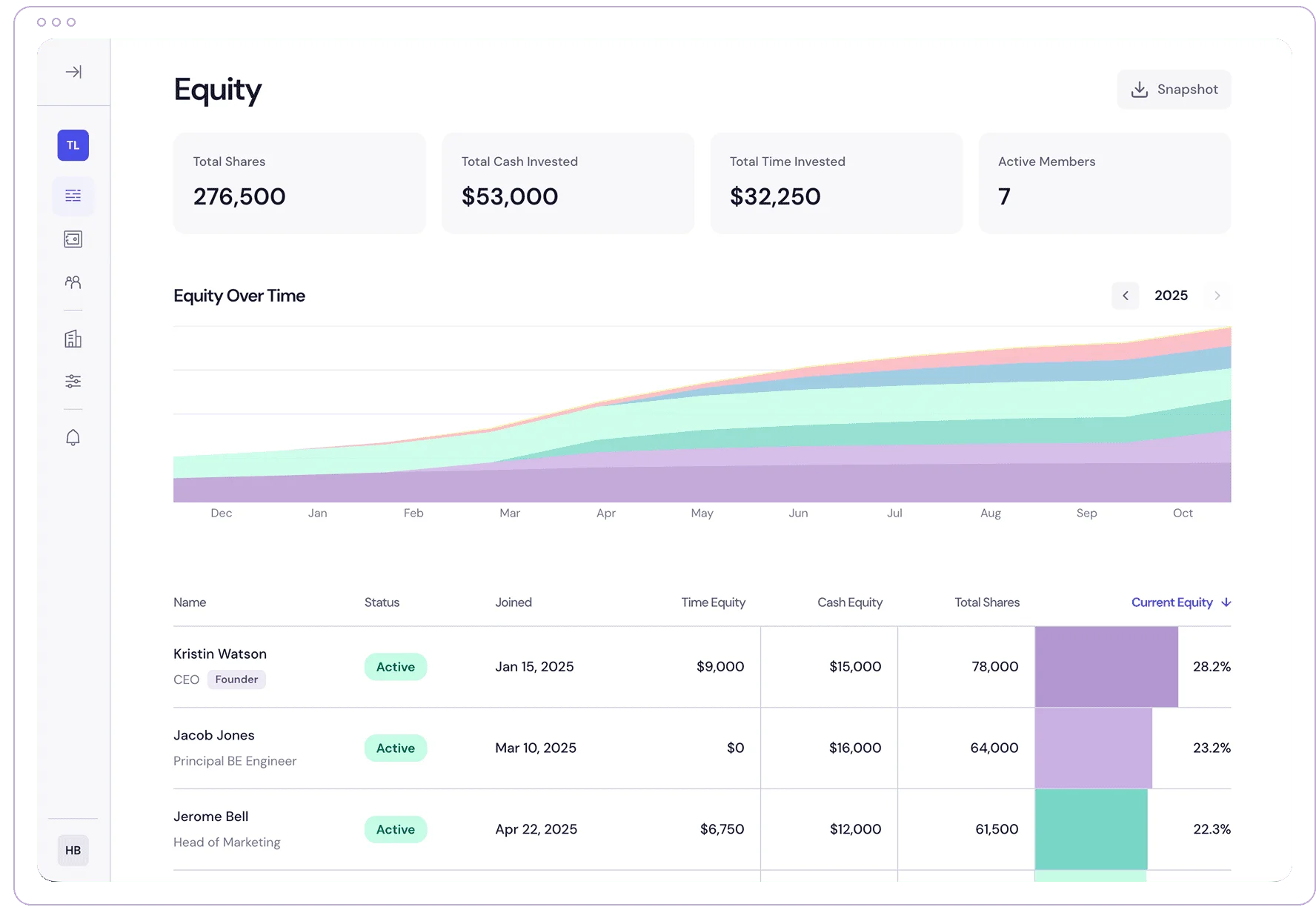
A cap table (short for capitalization table) is a record of everyone who owns equity in your company, what type they hold, and what percentage of the company it represents. It’s the single source of truth for ownership.
If you’re starting a company with other people, raising money, or hiring early employees with equity, you need a cap table. Not eventually. Now.
The cap table is the document that answers the most important question in any startup: who owns what? The equity calculator is a good place to start modeling those ownership percentages before you formalize anything. Every equity decision you make, from splitting equity with co-founders to granting stock options to your first hire, flows through it.
What a Cap Table Actually Looks Like
At its simplest, a cap table is a list of names, share types, and percentages. Here’s what one looks like for a three-founder startup that just incorporated:
Pre-funding Cap Table
| Shareholder | Share Type | Shares | Ownership % |
|---|---|---|---|
| Alice (CEO) | Common Stock | 4,500,000 | 45.0% |
| Bob (CTO) | Common Stock | 3,500,000 | 35.0% |
| Carol (COO) | Common Stock | 2,000,000 | 20.0% |
| Total | 10,000,000 | 100.0% |
Clean. Simple. Everyone knows where they stand.
Now here’s what that same cap table looks like after a $1.5M seed round at a $6M pre-money valuation, followed by sizing an unallocated option pool to 10% of the post-pool fully diluted total. Before the pool, the $7.5M post-money valuation gives the investor 20%: $1.5M / $7.5M.
Post-Seed Cap Table
| Shareholder | Share Type | Shares | Ownership % |
|---|---|---|---|
| Alice (CEO) | Common Stock | 4,500,000 | 32.40% |
| Bob (CTO) | Common Stock | 3,500,000 | 25.20% |
| Carol (COO) | Common Stock | 2,000,000 | 14.40% |
| Seed Investor Fund | Series Seed Preferred | 2,500,000 | 18.00% |
| Option Pool (unallocated) | Reserved | 1,388,889 | 10.00% |
| Total (Fully Diluted) | 13,888,889 | 100.0% |
The round price is $6,000,000 / 10,000,000 = $0.60 per share, so the investor receives $1,500,000 / $0.60 = 2,500,000 shares. To make the pool exactly 10% after the round, solve pool / (12,500,000 + pool) = 10%, which gives approximately 1,388,889 pool shares. This example sizes the pool after pricing for clarity; real term sheets often require a pre-money pool increase, which shifts more dilution to existing holders.
What’s on a Cap Table
A cap table tracks every form of equity your company has issued or promised. Here are the main categories.
Common Stock
This is what founders and early employees typically hold. It’s the most basic form of ownership. Common stockholders are last in line during a liquidation event, but they benefit the most when things go well. If you split equity among co-founders, you’re splitting common stock.
Preferred Stock
Investors get preferred stock. Each fundraising round creates a new class: Series Seed Preferred, Series A Preferred, and so on. Preferred stock comes with extra rights like liquidation preferences, anti-dilution protection, and sometimes board seats. These rights are negotiated during each round and documented in your term sheet.
Stock Options and the Option Pool
Stock options give employees the right to buy shares at a set price (the “strike price”) in the future. Companies create an option pool, typically 10-20% of shares, to fund these grants. The pool is usually created before a funding round, which means the dilution comes from existing shareholders, not the new investors.
For benchmarks on how much equity to grant employees at different stages, see Employee Equity Benchmarks.
SAFEs and Convertible Notes
SAFEs and convertible notes are fundraising instruments that are tracked as obligations rather than outstanding shares before conversion. Cap-table presentations vary: they may be shown separately or modeled on an as-converted, fully diluted basis. Their eventual share counts depend on the future financing and instrument terms.
This is where founders get burned most often. You might think you own 45% of the company, but if you have $500K in outstanding SAFEs with a low valuation cap, the real number is much lower. A good cap table models these conversions so there are no surprises.
Other Instruments
Restricted stock is common stock that’s subject to vesting or other conditions. If you receive restricted stock, you should understand 83(b) elections and their tax implications.
Warrants give the holder the right to purchase shares at a set price. They’re less common in early-stage startups but sometimes appear in debt deals or strategic partnerships.
Why Your Cap Table Matters
Your cap table isn’t just a record. It’s the foundation for nearly every financial and strategic decision your startup makes.
Fundraising
Investors ask for your cap table before almost anything else. A clean, accurate cap table signals that you know what you’re doing. A messy one signals risk.
Studies suggest that roughly 30-40% of seed-stage startups have cap table errors when they enter due diligence. Missing option grants, unrecorded SAFEs, or incorrect vesting schedules can delay or kill a deal. For a deeper dive into what investors scrutinize, read What Investors Look for in Cap Tables.
Employee Equity
You can’t make a meaningful equity offer to an employee without knowing the fully diluted share count. “We’ll give you 10,000 shares” means nothing until you know the denominator. Your cap table provides that denominator.
Exit Scenarios
When your company gets acquired or goes public, the cap table determines who gets paid, how much, and in what order. Liquidation preferences on preferred stock mean investors often get paid first. The remaining proceeds flow to common stockholders. Without a clear cap table, you can’t model what an exit actually means for each stakeholder.
Decision-Making
Every equity decision requires your cap table: bringing on a co-founder, compensating an advisor, creating an option pool, raising a round. If you don’t know the current state of ownership, you’re making these decisions blind.
Common Cap Table Mistakes
Most cap table problems are avoidable. Here are the ones that cause the most pain.
No vesting on founder shares. If a co-founder leaves after six months with 30% of the company fully vested, you have a dead equity problem that’s nearly impossible to fix without legal action. Vesting protects everyone.
Giving away too much equity too early. Advisors, early contractors, and “idea people” who get 5-10% each can leave founders with too little ownership to attract investors or stay motivated.
Handshake deals without documentation. Verbal promises about equity are both legally ambiguous and practically unenforceable. If it’s not written down and signed, it doesn’t exist.
Not modeling SAFE/note conversion dilution. Founders often forget that outstanding SAFEs will convert into real shares. If you’re not modeling the post-conversion cap table, you don’t actually know what you own.
Dead equity from departed contributors. When someone who holds significant equity stops contributing but keeps their shares, it drags down the entire team. This is one of the most common and most damaging cap table problems. Read more about why dead equity kills startups.
Using round numbers without thinking. A 50/50 split feels fair on day one, but rarely reflects the actual contribution balance over time. Think carefully about how to split equity before locking in numbers.
When to Formalize Your Cap Table
You need a cap table from day one. Even a simple spreadsheet counts. The goal is to have a single document that everyone agrees on.
That said, there are clear triggers that signal when you need to upgrade from a basic spreadsheet to something more robust:
- First outside investment. Once someone else’s money is involved, accuracy becomes non-negotiable.
- First employee option grant. You need to track strike prices, vesting schedules, and exercise windows.
- 409A valuation. If you’re issuing options, you’ll need a formal valuation, and the valuator will need your cap table.
- Multiple instrument types. Once you have common stock, SAFEs, options, and maybe a convertible note, a spreadsheet starts to break.
You don’t need Carta on day one. You need accuracy. The tool matters less than the discipline of keeping the information current and correct.
How Dynamic Equity Fits In
Traditional cap tables assume ownership is fixed from the start. But in the earliest stages of a startup, contributions are still in flux. One co-founder might be full-time while another is part-time. Someone contributes capital, someone else contributes code. The split shouldn’t be locked in until you know what everyone is actually contributing.
This is where dynamic equity comes in. A dynamic equity model tracks contributions in real time and adjusts ownership based on what each person actually puts in. It solves the “who owns what” problem when the answer is still changing week to week. For a deeper look at the tools and processes for keeping your cap table clean at every stage — from pre-incorporation through a funded round — the cap table management guide walks through the full lifecycle.
When you raise outside funding or need to formalize the company, the dynamic split freezes into a fixed cap table. This transition is one of the most important moments in a startup’s life. If you’re approaching that point, read Converting a Dynamic Split to a Fixed Cap Table for a step-by-step guide.
Equity Matrix bridges both stages. It tracks dynamic contributions during the pre-funding phase, then models how fundraising, option pools, and investor terms affect everyone’s ownership as you move into a formalized cap table.
Key Terms: Quick Glossary
| Term | Definition |
|---|---|
| Fully Diluted Shares | A modeled total that includes issued shares and specified options, warrants, and other rights. Treatment of unconverted SAFEs and notes varies; they are often shown separately or on an as-converted basis because their share counts depend on a future round. |
| Authorized vs. Issued Shares | Authorized shares are the maximum your company can issue (set in your charter). Issued shares are the ones actually distributed to shareholders. |
| Option Pool | A block of shares reserved for future employee equity grants. Typically 10-20% of fully diluted shares, created before a funding round. |
| Dilution | The reduction in ownership percentage that occurs when new shares are created. Your share count stays the same, but your percentage of the whole decreases. |
| Liquidation Preference | The right of preferred stockholders to get paid before common stockholders in a sale or liquidation. A 1x preference means they get their investment back first. |
| 409A Valuation | An independent appraisal of your company’s common stock fair market value. Required by the IRS before issuing stock options. Typically updated annually or after significant events. |
FAQ
Do I need cap table software?
Not immediately. A well-maintained spreadsheet works fine for a two or three person founding team with no outside investors. Once you raise a priced round, issue options, or have more than a handful of stakeholders, dedicated software becomes worth it. The risk with spreadsheets is human error: one wrong formula can misrepresent ownership for months.
How often should I update my cap table?
Every time ownership changes. That means after every funding event, option grant, share transfer, or conversion. At a minimum, review it quarterly to make sure nothing has been missed. Before any fundraise or major equity decision, verify that every number is current.
What’s the difference between issued shares and fully diluted shares?
Issued shares are shares actually distributed to shareholders. A fully diluted presentation adds specified options, warrants, and the unallocated pool. Unconverted SAFEs and notes may be shown separately or modeled as converted because their exact share counts depend on future financing terms. Always define the denominator used in an ownership percentage.
Can I use dynamic equity instead of a traditional cap table?
Dynamic equity is a complement to a cap table, not a replacement. In the earliest stages, a dynamic equity model tracks contributions and adjusts ownership in real time. But once you incorporate, raise money, or bring on employees, you need a formal cap table that reflects fixed ownership and legal agreements. The dynamic model informs the cap table. It doesn’t replace it.
What Investors Look for in Cap Tables
Converting a Dynamic Split to a Fixed Cap Table
Your cap table is too important to guess at. Equity Matrix helps you track dynamic contributions, model fundraising scenarios, and keep your ownership data accurate from day one through your first raise and beyond.
Ready to split equity fairly?
Equity Matrix tracks contributions and calculates ownership automatically.
Get Started FreeThis article is for informational purposes only and does not constitute legal, tax, or financial advice. Equity Matrix is not a law firm, accounting firm, or financial advisor. Consult a qualified professional for guidance specific to your situation.

Co-founder, Equity Matrix
Sebastian writes about startup equity, founder dynamics, and building fair partnerships.
Keep reading
Startup cap table: how to build, manage, and not mess it up
A step-by-step guide to building your startup's cap table from scratch, managing it through funding rounds, and avoiding the mistakes that cost founders equity.
Read more →Pre-money valuation: how early-stage startups set a price
How to value a pre-revenue startup: Berkus method, scorecard method, cost-to-duplicate, and comparable transactions. Which method works at which stage, with examples.
Read more →