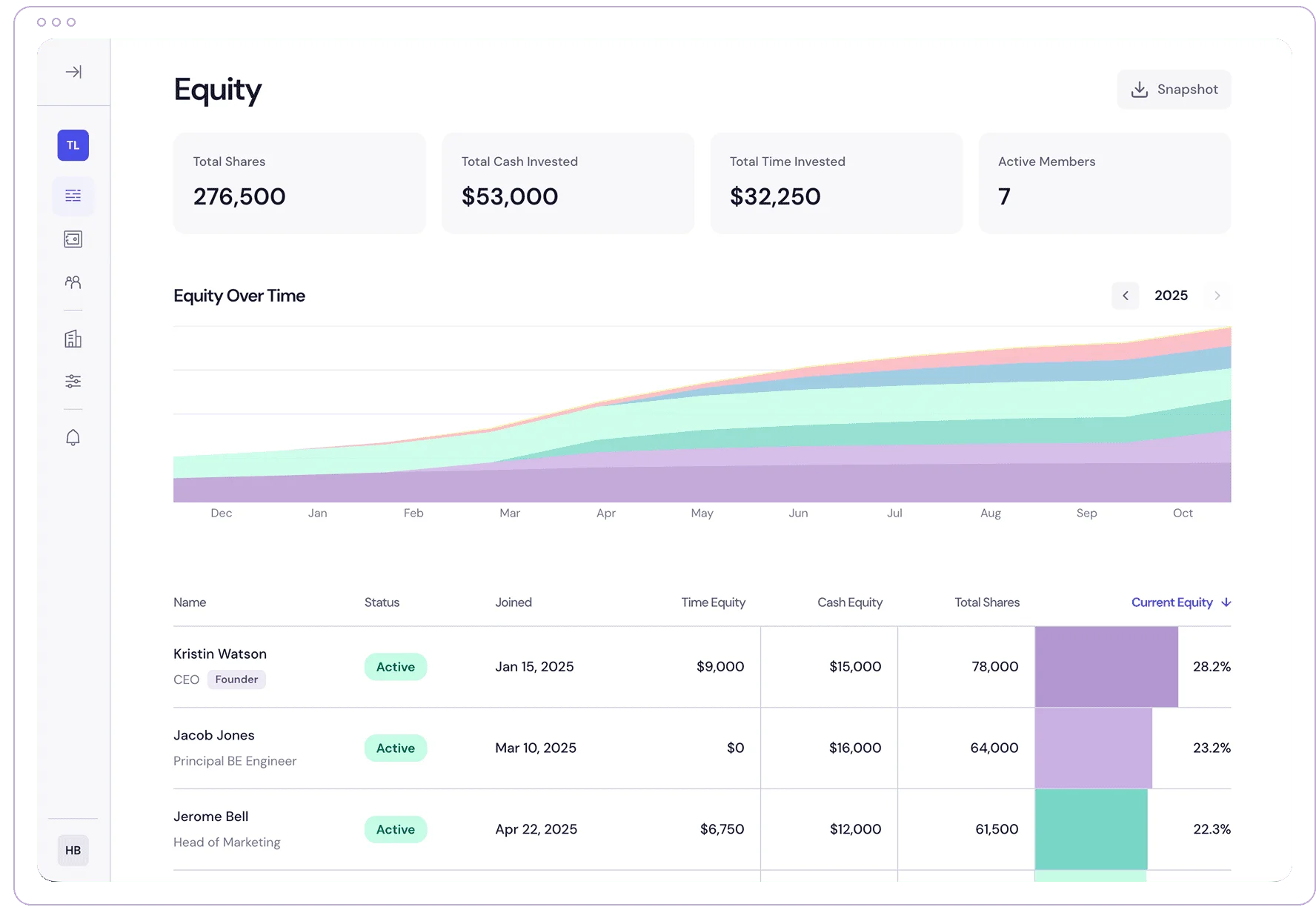
Dynamic equity sounds complicated. It’s not. You track two things: time and cash. The math does the rest. And it’s a lot less painful than the alternative, which is a co-founder blowup over an unfair split that was locked in before anyone knew what they were getting into.
Most founders hear “dynamic equity” and immediately picture spreadsheets, formulas, legal complexity, and hours of overhead they don’t have time for. They think it’s some academic framework that only works on paper.
So they default to a fixed split. 50/50, or maybe 60/40 if one person is feeling generous. It takes five minutes to agree on. And then it takes months or years to regret.
The irony is that the “simple” approach is actually the hard one. Dynamic equity is the easy path. You just haven’t seen it yet.
The “It’s Too Complicated” Myth
The term “dynamic equity” does sound technical. It conjures images of financial modeling, weighted formulas, and attorney fees. And to be fair, when you read about Slicing Pie, there are multipliers and theoretical market rates and recovery frameworks. It can feel like a lot.
Even Rob Walling, who advocates for contribution-based equity, opens his talks by acknowledging it sounds complicated. That framing sticks. If the people recommending this approach lead with “I know this seems hard,” no wonder founders are skeptical.
Reddit is full of founders saying “just do 50/50 and move on.” The reasoning is always the same: don’t overthink it, don’t create friction, just split it and start building.
That advice is understandable. Nobody wants to slow down when they’re excited about an idea. Nobody wants to introduce tension into a brand-new partnership.
But here’s the thing. A 50/50 split takes five minutes to agree on and can take years to unwind. The hidden costs of equal splits don’t show up on day one. They show up on month six, when one person is doing most of the work and both people own the same amount.
That’s when the real complexity starts.
What You Actually Have to Do
Here’s the entire process for running dynamic equity:
Step 1: Each person tracks their hours. Once a week. It takes about two minutes. You can do it in the app, via Slack, or in a shared spreadsheet if you want to keep it simple. This is the same system described in the buy back your time framework for founders — delegate low-value work, track what each person contributes, and let the math determine fair ownership.
Step 2: Set a market rate for each person’s time. This is what they could reasonably earn elsewhere. If your co-founder is a senior engineer, their rate might be $150/hour. If you’re handling business development, yours might be $100/hour. You set these once and adjust them rarely.
Step 3: Track any cash invested. If someone puts $5,000 into the business, that gets logged alongside their time contributions.
That’s it.
The system multiplies hours by rate, adds cash contributions, and calculates each person’s ownership percentage. The person contributing more owns more. The person contributing less owns less. It updates automatically.
No spreadsheet formulas. No weekly negotiations. No awkward conversations about who deserves what.
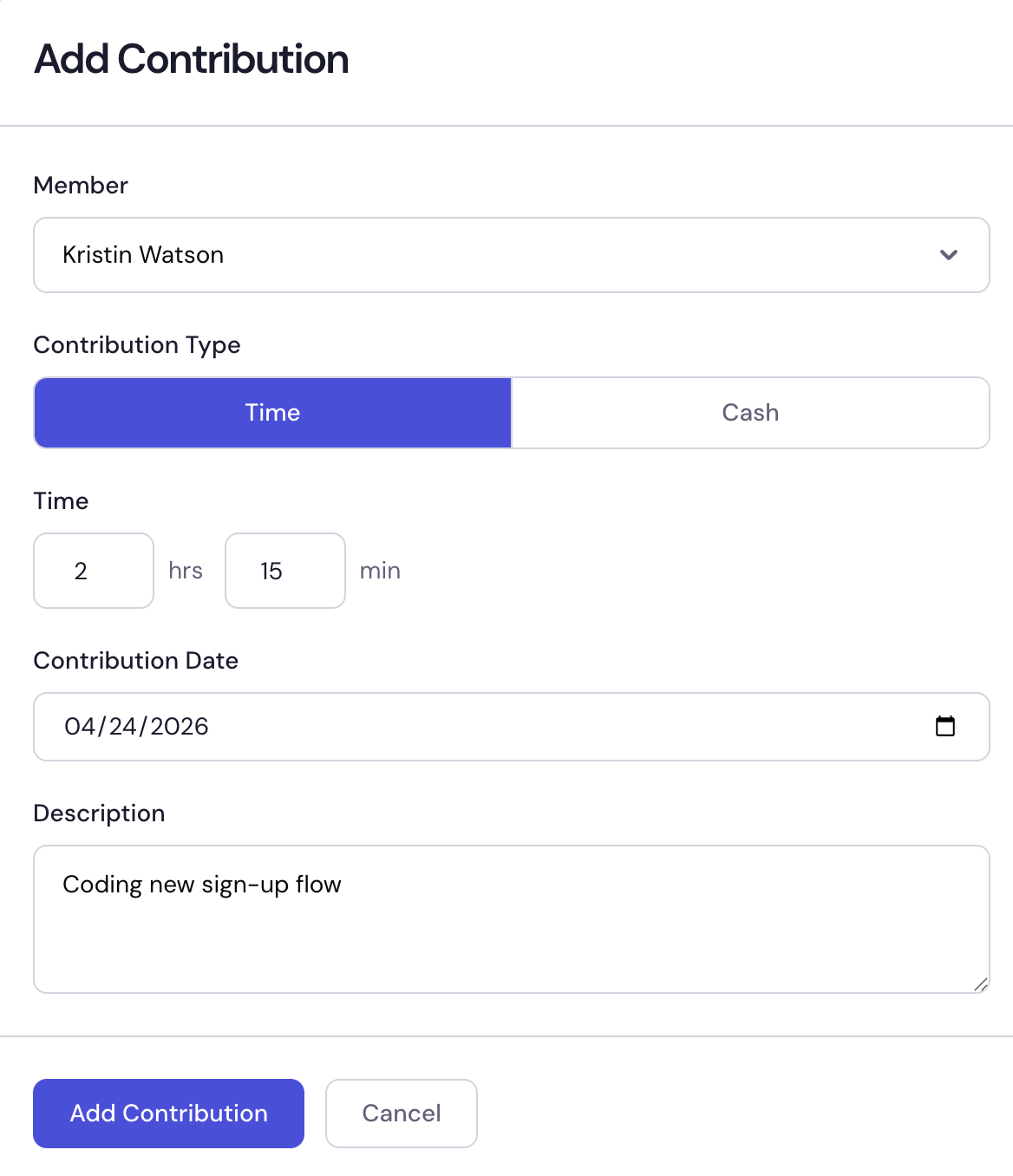
Adding a contribution takes about 30 seconds.
You can run the numbers yourself with our Slicing Pie calculator or the equity split calculator to see how it works before committing to anything.
Compare That to the Alternative
The “simple” approach, a fixed equity split, actually requires you to do all of the following:
Predict the future. You have to guess, on day one, who will contribute more over the life of the company. You have no data. You’re guessing based on intentions, not actions. And if you’re a bootstrapped indie hacker — where equity, profit sharing, and even hybrid models all come into play — the indie hacker’s guide to equity splits walks through scenarios the standard advice ignores entirely.
Have an uncomfortable negotiation. Someone has to propose a number. If it’s not 50/50, someone has to explain why they think they deserve more. This is the conversation most founders skip entirely, which is why equal splits are so common.
Revisit it when things change. And they always change. Someone gets a full-time job. Someone has a kid. Someone loses interest. Someone discovers they’re doing all the sales while their co-founder “focuses on product vision.” Now what?
Deal with dead equity. When someone leaves, their shares stay on the cap table. You’re building something valuable and a person who contributed three months of work owns a permanent piece of it. This is one of the most common reasons startups fail.
Have “the talk.” At some point, one founder realizes the split is unfair. They either bring it up, which starts a conflict, or they don’t bring it up, which starts resentment. Both paths lead to the same place. Read what happens when a co-founder stops contributing and you’ll see the pattern.
Now ask yourself: which of these sounds harder? Logging your hours once a week, or having a confrontation about equity with your co-founder six months in?
”But What About the Legal Stuff?”
This is a valid question. Yes, you need an operating agreement. You need something in writing that says how ownership is determined.
But you need that with a fixed split too. Every LLC and corporation needs an operating agreement or bylaws that specify ownership. This isn’t unique to dynamic equity.
The difference is what that agreement says. With a fixed split, it says “Alice gets 60%, Bob gets 40%.” With dynamic equity, it says “ownership is based on the relative value of each member’s contributions, tracked and calculated according to the following method.”
One of those reflects reality. The other reflects a guess you made before the business existed.
When you’re ready to formalize things, maybe for fundraising, hiring, or because the team agrees the split is settled, you freeze the dynamic split and convert it to a traditional cap table. The percentages become fixed at that point, based on actual contributions rather than day-one assumptions.
Equity Matrix generates the operating agreement for you. You don’t need a lawyer to get started. You’ll want one eventually, but the initial setup is something you can do in a single sitting.
What Equity Matrix Adds That Slicing Pie Doesn’t
The Slicing Pie book is great at explaining the philosophy of contribution-based equity. But it leaves a lot of gaps when it comes to actually running your business.
Legal structure. Slicing Pie doesn’t tell you what entity to form, how to set it up, or how taxes work. We wrote the Dynamic Equity Playbook specifically to cover entity structure, tax strategy, and the full path from formation to exit.
Agreements. With Slicing Pie, you’re on your own for legal documents. Equity Matrix dynamically generates your operating agreement based on your settings. Change your multiplier, update a member’s role, adjust loyalty protections, and the agreement updates to reflect it.
Loyalty protections. People assume dynamic equity has no way to handle early departures or dead equity. That’s not true. Equity Matrix includes cliffs, thresholds, and decay. If someone leaves before the cliff, they forfeit their equity. If they stay, they’re protected. Slicing Pie has no built-in mechanism for this. We do.
Market rate is simpler than you think. The biggest objection people have is “how do I figure out everyone’s market rate?” You don’t need a formula. Use what you made on your last tax return. If you earned $120K last year, your market rate is roughly $60/hour. If your co-founder earned $180K, theirs is $90/hour. Done. It doesn’t have to be perfect. It has to be honest and agreed upon.
What It Looks Like in Practice
Let’s walk through a year of dynamic equity for a two-person startup.
Month 1: You and your co-founder both work 40 hours a week. Your market rates are similar. The split is roughly 50/50. Identical to what a fixed split would look like.
Month 3: Your co-founder gets a full-time job offer they can’t turn down. They drop to 15 hours a week. You’re still at 40. The split adjusts to reflect reality. Maybe it’s 65/35 now. No awkward conversation needed. No confrontation. The math just updated.
Month 6: Your co-founder invests $10,000 in the business to cover hosting and marketing costs. That cash contribution is weighted and their percentage goes back up. Maybe it’s 55/45 now. Fair. They contributed real capital. The system recognized it.
Month 12: A third person joins as a technical co-founder. Their contributions start getting tracked from day one. Everyone’s percentage adjusts naturally as work gets done. There’s no negotiation about what the new person “deserves.” They earn their share by contributing.
At no point did anyone have to negotiate, argue, or guess. The math reflected reality the entire time. When contributions were equal, the split was equal. When they diverged, the split diverged. When cash came in, it was counted.
That’s it. That’s the whole system.
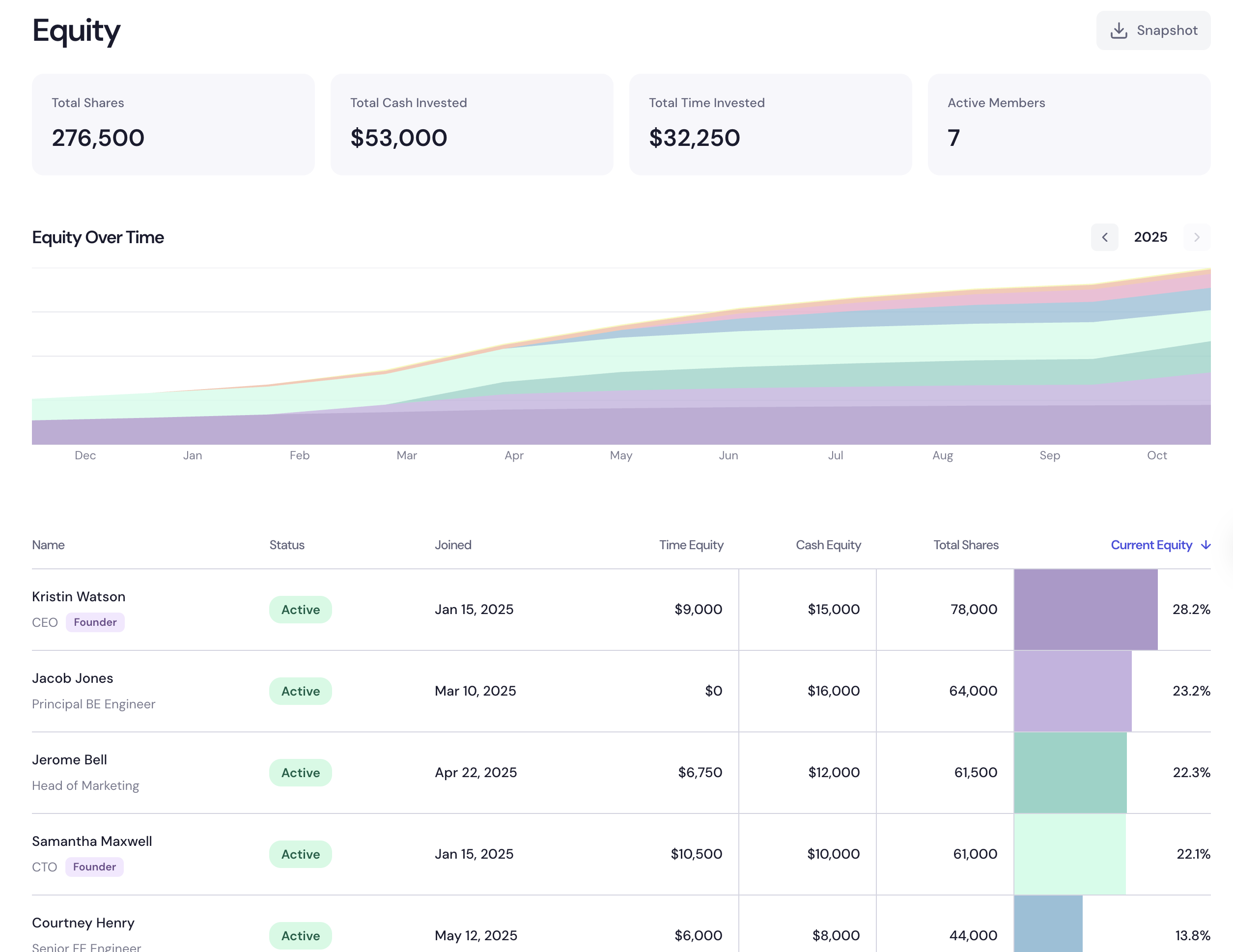
The Equity Matrix dashboard updates ownership in real time as contributions are logged.
The Real Question
The question isn’t “is dynamic equity too complicated?” It’s “is it more complicated than the problem it solves?”
About 65% of high-potential startup failures trace to people problems, according to Wasserman’s research. Co-founder conflict is the largest category of those people problems.
Tracking your hours once a week is not complicated. Having a falling out with your co-founder is.
Filing your contributions in an app is not complicated. Watching someone who stopped working six months ago own half your company is.
Setting a market rate for your time is not complicated. Trying to renegotiate a fixed split after resentment has been building for a year is.
Dynamic equity isn’t the complex option. It’s the one that prevents complexity from showing up later.
Try It in 10 Minutes
You don’t have to commit to anything right now. Start with the equity split calculator to see how the math works. Plug in your situation. See what the split would look like based on actual contributions.
If it makes sense, sign up for Equity Matrix. You can set up your team, define market rates, and start tracking contributions in a single session. The operating agreement generates automatically.
The hardest part of dynamic equity is deciding to try it. Everything after that is easier than you think.
FAQ
How often do I need to log contributions?
Weekly is ideal. It takes about two minutes. Open the app, enter your hours for the week, and you’re done. You can also log contributions via Slack if that’s easier. The key is consistency. As long as everyone logs regularly, the math stays accurate.
What if my co-founder doesn’t want to use dynamic equity?
Show them the calculator. Run a scenario together. Plug in your hours, your rates, and see what the split looks like. When people see the math in action, the resistance usually goes away. Nobody objects to fairness. They object to complexity, and the calculator proves it’s not complex.
When do we stop using dynamic equity?
When you raise money, hire employees who need stock options, or when everyone agrees the split is settled and reflects reality. At that point, you freeze the dynamic split into a fixed cap table and move forward with traditional equity structures. We’ve written a full guide on converting a dynamic split to a fixed cap table if you want the details.
Ready to split equity fairly?
Equity Matrix tracks contributions and calculates ownership automatically.
Get Started FreeThis article is for informational purposes only and does not constitute legal, tax, or financial advice. Equity Matrix is not a law firm, accounting firm, or financial advisor. Consult a qualified professional for guidance specific to your situation.

Co-founder, Equity Matrix
Sebastian writes about startup equity, founder dynamics, and building fair partnerships.
Keep reading
Co-founders in different countries: how to set a fair rate
When one co-founder is in the US and another is in Lithuania, do you value their time at local rates or the same rate for the same work? How to set GHRR fairly across borders.
Read more →How to track co-founder contributions (before it costs you)
A practical system for tracking co-founder contributions: what to log, how often, the fields that matter, and where spreadsheets start to strain.
Read more →