Most small businesses don’t start with an equity agreement. They start with a handshake, a shared bank account, and the assumption that good intentions will be enough.
Then someone’s contributions change. Or someone wants out. Or someone wants to bring in a new partner. And suddenly you discover that your state legislature already wrote your equity agreement for you, and you’re not going to like what it says.
There are 36.2 million small businesses in the US. Most partnerships among them operate without a written equity agreement. Not because the founders decided against one, but because the conversation felt premature, or awkward, or unnecessary when everyone was getting along.
It’s never unnecessary. Here’s why.
What happens when you don’t have an agreement
Every state has a default set of rules for business partnerships. If you haven’t written your own, the state’s version applies automatically.
In every state, some version of the Uniform Partnership Act applies — about 40 states use the revised version (RUPA), a handful still use the original, and Louisiana has its own civil law equivalent. The details vary by state, but they all agree on one thing: profits split equally, regardless of contribution.
One partner invested $200,000 in capital. The other invested $0. Equal split.
One partner works 60 hours a week. The other shows up on Fridays. Equal split.
One partner brought the client list, the industry expertise, and the brand reputation. The other brought enthusiasm. Equal split.
The UPA doesn’t care who did what. It cares that you didn’t bother to write down something different. And since you didn’t, 50/50 it is.
Beyond the profit split, operating without an agreement means:
- No buyout mechanism. If a partner wants to leave, there’s no agreed-upon way to value their share or structure the exit. You’re negotiating from scratch, usually when emotions are already running high.
- No decision-making framework. Every business decision requires consensus. One partner can block a major hire, a lease, or a sale. With equal ownership, there’s no tiebreaker.
- No protection against departure. A partner can walk away and still own their share. You keep running the business. They keep collecting profits. This is dead equity in its purest form.
- No IP clarity. Who owns the work product? The brand? The customer relationships? Without an agreement, the answer depends on your state’s default rules and whatever a judge decides.
The “we’ll figure it out later” plan is really a plan to let your state legislature figure it out for you. And they wrote those rules for generic situations, not yours.
When equity problems actually surface
Nobody fights about equity on day one. The problems show up later, usually around year two or three, after the initial excitement fades and the reality of who’s actually doing what becomes impossible to ignore.
Contribution drift. One partner gradually takes on more responsibility while the other drifts into a smaller role. It happens slowly enough that neither person addresses it directly. By the time it’s obvious, the working partner has months of accumulated resentment and the other partner has gotten comfortable with the arrangement. We wrote about this dynamic in detail in our post on whether investors dislike 50/50 splits. Short answer: yes, because 50/50 often signals that the partners avoided a hard conversation.
Family business dynamics. Mom and Dad started the company. One sibling runs it. The other siblings own equal shares because they’re family. The sibling doing the work feels taken advantage of. The siblings not doing the work feel entitled. The often-repeated claim that 70% of family businesses fail during succession is methodologically contested: the underlying research measured how many remained family-controlled into the next generation, not whether succession caused them to fail. Clear ownership and succession terms still matter, but the statistic does not establish causation.
Life changes. A partner has a kid and goes part-time. A partner gets sick. A partner gets a job offer they can’t refuse. A partner moves to another city. None of these are betrayals. They’re just life. But the ownership stake stays frozen at whatever was agreed to on day one, and suddenly 50% ownership doesn’t match 20% contribution.
Bringing in outside money. You decide to take on an investor or a loan. The investor asks to see your operating agreement. You don’t have one. That’s either a dealbreaker or the start of an expensive process to create one retroactively — while simultaneously negotiating the investment.
The pattern is always the same: the equity structure was fine when contributions were roughly equal, and it became a problem the moment they weren’t.
What an equity agreement actually covers
An equity agreement isn’t a 50-page legal document (though it can be, if you want). At its core, it answers a handful of questions that every partnership will eventually face.
Ownership percentages and capital contributions. Who owns what, and what did they put in to get it? This includes cash, property, equipment, and sweat equity. If one partner contributed $100,000 and the other contributed expertise, the agreement should reflect that difference.
Profit and loss allocation. For LLCs, profit distributions can be split differently from ownership percentages. A partner who owns 40% of the company can receive 60% of the profits if the operating agreement says so. This flexibility is powerful, but only if it’s written down.
Decision-making authority. Who can sign contracts? Who can hire and fire? What decisions require unanimous consent vs. a simple majority? Without this, every disagreement becomes a potential deadlock. With a 50/50 split and no tiebreaker mechanism, a single disagreement can paralyze the business.
What happens when someone leaves. This is the section most people skip, and it’s the one that matters most. Buyout terms, vesting schedules, right of first refusal, valuation methodology, payment timelines. If a partner leaves after two years, do they keep their full ownership? Do they get bought out? At what price? Over what period? These questions are easy to answer when nobody’s leaving. They become nearly impossible when someone is.
Non-compete and IP ownership. Can a departing partner start a competing business? Who owns the intellectual property created during the partnership? The code, the designs, the processes, the customer relationships?
Dispute resolution. Mediation, arbitration, or litigation? Where? Under what rules? Setting this up in advance saves enormous legal fees when conflicts arise.
The problem with static agreements
Here’s the thing most legal guides won’t tell you: even a well-written equity agreement has a shelf life.
A static agreement captures a moment in time. Partner A owns 60%, Partner B owns 40%, based on what they each contributed on the day the agreement was signed. That’s fine for day one.
But partnerships are dynamic. Contributions change. Roles evolve. One person’s involvement might double while the other’s shrinks. A static agreement doesn’t account for any of that. It treats the ownership split as permanent, even when the underlying contributions shift dramatically.
An estimated 6 million US small businesses will face ownership transitions by 2035, and many of those will struggle precisely because their equity structures can’t adapt.
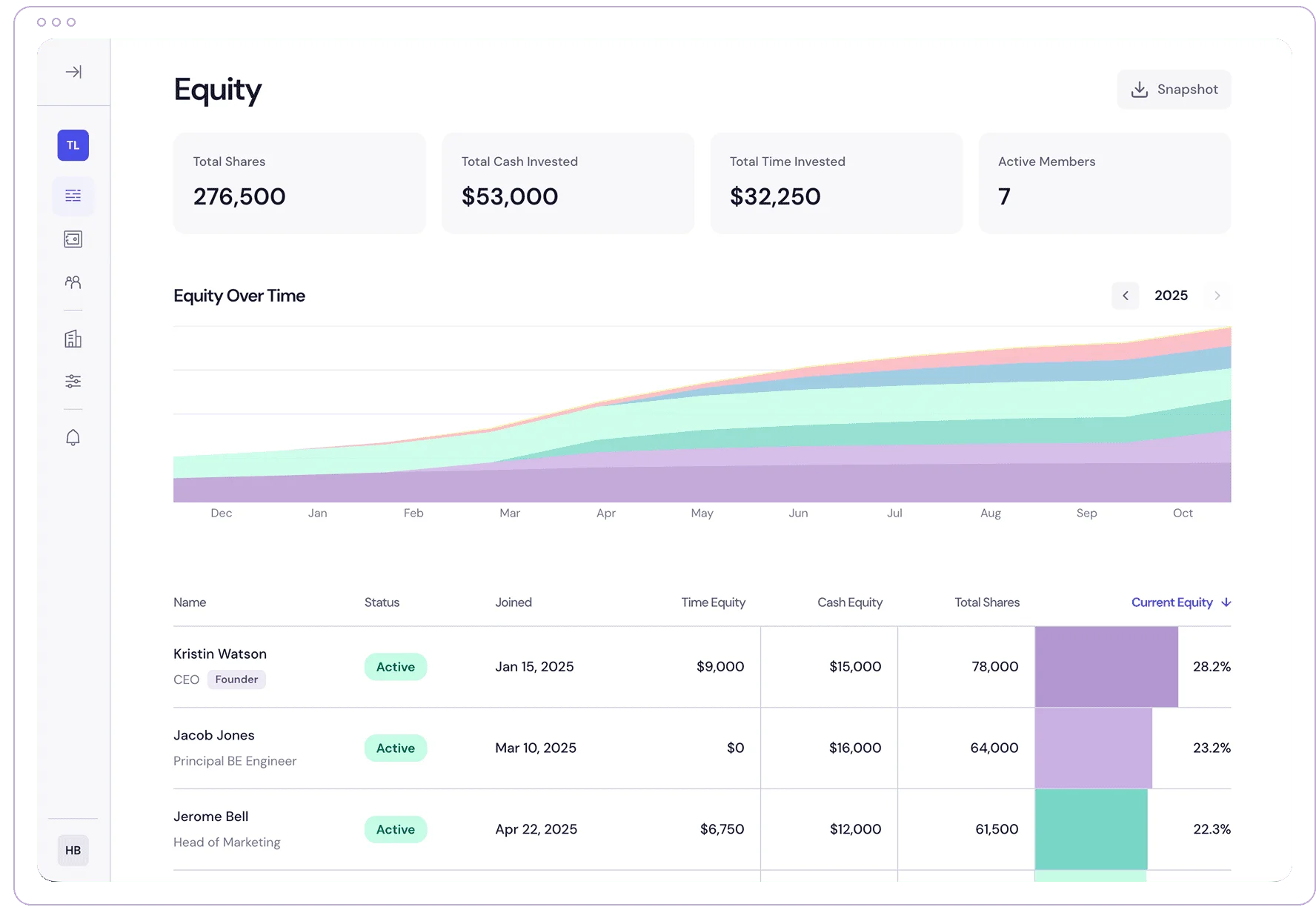
The alternative is contribution-based equity, sometimes called dynamic equity. Instead of locking in percentages on day one, you track what each partner actually puts in over time. Cash, time, expertise, connections, equipment. The ownership percentages adjust as contributions accumulate.
This isn’t theoretical. The Slicing Pie model by Mike Moyer formalized this approach, and thousands of partnerships use some version of it. It works because it ties ownership to reality, not to a handshake made before anyone knew what the business would become.
Dynamic equity isn’t right for every business. Once you take outside investment or reach a certain scale, you typically freeze the equity and move to a traditional cap table. But for early-stage partnerships where contributions are uneven and evolving, it solves the exact problem that static agreements create.
You can model the cost of dead equity in your partnership using our dead equity calculator.
Signs you need one right now
If any of these apply to your business, you need an equity agreement today, not next quarter:
- You don’t have a written operating agreement. If it’s not in writing, your state’s default rules apply — and as we covered above, those defaults almost certainly don’t reflect your arrangement.
- You’re adding a new partner. Bringing someone into the business without restructuring ownership is one of the most common and expensive mistakes small business owners make. We covered how to do this correctly in a separate post.
- You’re taking investment. Any investor will want to see your governance documents. Not having them signals amateurism at best and risk at worst.
- A partner is going part-time. Their ownership stake should reflect their reduced role. Without an agreement that accounts for this, you’re stuck with the original split.
- Family members are involved. The family relationship makes it harder to have the conversation, which makes the agreement more important, not less.
- Anyone is contributing sweat equity. If someone is earning their ownership through work rather than cash, there needs to be a framework for how that’s tracked and valued. Use our equity calculator to model different scenarios.
If any of those apply, every month you wait is a month where the default rules govern your partnership, whether you know it or not.
Frequently asked questions
Do I need an equity agreement if I’m the sole owner?
If you’re the only owner, no. But the moment you bring on a partner, a co-founder, or even a key employee with an equity stake, you need one. Don’t wait until the relationship is complicated.
Can I write my own equity agreement or do I need a lawyer?
You can draft the core terms yourself. Many partnerships start with a simple written agreement covering ownership, profit distribution, decision-making, and exit terms. But I’d strongly recommend having a business attorney review it before signing. A lawyer will review an operating agreement for $500-$2,000. A partnership dispute costs $50,000+ in legal fees. The math is obvious.
What’s the difference between an operating agreement and an equity agreement?
An operating agreement is the broader document that governs how an LLC operates. It includes equity terms but also covers management structure, voting rights, meeting requirements, and administrative procedures. An equity agreement can be a standalone document or a section within the operating agreement. For most small businesses, putting everything into a single operating agreement is cleaner.
How often should I update my equity agreement?
Review it annually, and update it whenever there’s a material change: a partner joins or leaves, contributions shift significantly, the business takes investment, or the company’s structure changes. The agreement should reflect the current state of the partnership, not a snapshot from three years ago.
You either set the terms of your partnership yourself, or your state legislature sets them for you. The state’s version doesn’t know your business, your partners, or your goals. It just applies the same default rules to everyone who didn’t bother to write their own.
Take 30 minutes. Draft the agreement. Have the conversation now, while everyone’s still getting along. Equity Matrix tracks contributions and models fair splits, so your agreement stays grounded in what’s actually happening — not what you assumed six months ago.
Ready to split equity fairly?
Equity Matrix tracks contributions and calculates ownership automatically.
Get Started FreeThis article is for informational purposes only and does not constitute legal, tax, or financial advice. Equity Matrix is not a law firm, accounting firm, or financial advisor. Consult a qualified professional for guidance specific to your situation.

Co-founder, Equity Matrix
Sebastian writes about startup equity, founder dynamics, and building fair partnerships.
Keep reading
How to split profits in a partnership with unequal contributions
One partner put in more money, the other more time. Here's how to split profits fairly when contributions are unequal, and the default rule that bites if you don't.
Read more →Equity for small businesses: partnerships and LLCs
Equity isn't just a startup problem. Here's how partnerships, LLCs, and S-corps handle ownership — and which structure protects you when contributions aren't equal.
Read more →