Most small business owners pick their business structure based on what their accountant recommends for taxes. That’s fine for year one. But when contributions start to diverge, when one partner is working nights and the other is coasting, when you want to bring on a key employee with a piece of the upside, the structure you chose on day one determines whether you can fix things or whether you’re stuck.
There are 36.2 million small businesses in the US, and millions of them have more than one owner. Yet most multi-owner businesses spend more time choosing a logo than choosing the right ownership structure. The logo doesn’t matter when your partner wants out and there’s no buyout clause.
The structure matters. Not because of taxes, but because of what it lets you do with equity when things get complicated.
General partnerships: the default you didn’t choose
If you’re running a business with someone and never filed anything with the state, you’re probably a general partnership. You didn’t choose it. It chose you.
Under the Uniform Partnership Act (UPA), the default rules are simple and brutal: profits split equally, control splits equally, and every partner has unlimited personal liability. It doesn’t matter if you put in $200,000 and your partner put in a good attitude. Equal.
Every partner can bind the business to contracts. Every partner is personally liable for every other partner’s decisions. There’s no buyout mechanism unless you write one. There’s no way to adjust equity unless everyone agrees.
This is where most handshake deals live. Two people start doing something together, money changes hands, and suddenly they’re legally partners whether they intended to be or not.
The danger isn’t that general partnerships are inherently bad. It’s that the defaults are terrible for unequal contributions. If you and your partner are genuinely contributing the same amount of time, money, and effort, and you’re both comfortable with unlimited personal liability, a general partnership works. But we’ve seen very few real-world partnerships where contributions stay equal for more than a year. Most start 50/50 because it feels fair and then diverge.
If you’re currently in a general partnership and haven’t written a partnership agreement, stop reading this and write one. Or better yet, form an LLC. You can do both at the same time.
LLCs: the flexibility most owners don’t use
LLCs are the most popular structure for small businesses, and for good reason. They offer liability protection, tax flexibility, and one feature that most owners don’t even know about: you can allocate profits differently from ownership percentages.
This is the single most important structural advantage for businesses with unequal contributions.
Here’s what that means in practice. Say you and your partner each own 50% of the LLC. But you’re running the day-to-day operations while your partner is a silent investor. Your operating agreement can specify that you take 70% of the profits and your partner takes 30%, even though you both own 50%. The IRS allows this as long as the allocations have “substantial economic effect,” which basically means they reflect the economic reality of who’s contributing what.
You can’t do this with an S-corp. More on that in a minute.
Member-managed vs. manager-managed
Member-managed means all owners run the business together. Manager-managed means you designate one or more people (who may or may not be owners) to make decisions. For partnerships where one person is active and the other is passive, manager-managed is usually the right call. It prevents the silent partner from making operational decisions they’re not qualified to make.
The operating agreement IS the equity agreement
For an LLC, the operating agreement is where your equity terms live. Ownership percentages, profit allocation, vesting schedules, buyout terms, what happens if someone dies or wants out. If your LLC doesn’t have an operating agreement, your state’s default LLC rules apply — and those vary. About 20 states default to equal per-capita splits regardless of investment, while others split proportional to capital contributions. Either way, they’re unlikely to match your actual arrangement.
An LLC’s liability shield is statutory and generally attaches when the entity is properly formed; it does not depend on filing or having an operating agreement. A few states require an LLC to have an operating agreement as a governance matter, although none requires filing it. A well-drafted agreement still defines the owners’ deal and strengthens the separation that helps defend against veil-piercing. Members remain liable for their own torts.
Tax treatment options
By default, a multi-member LLC is taxed as a partnership. But you can elect S-corp taxation if it makes sense. The flexibility to choose is an advantage, but the choice matters, because S-corp election removes the ability to allocate profits differently from ownership. More on that below.
S-corps: great for taxes, limiting for equity
S-corps get attention because distributions above an owner-employee’s reasonable W-2 compensation may avoid employment tax. There is no universal profit threshold or “$40,000 breakeven.” The result depends on reasonable compensation, payroll and administrative costs, state taxes, and the Section 199A/QBI consequences. A CPA should model the specific business before an election.
That tax savings is real, and it’s why a lot of accountants push their clients toward S-corp election. But the equity constraints are significant, and most accountants don’t mention them.
S-corps can only have one class of stock. That means profits and distributions must follow ownership percentages exactly. If you own 40% of the company, you get 40% of the profits. Period. You can’t do the 50/50 ownership with 70/30 profit split that an LLC allows.
Other constraints:
- 100-shareholder limit. Not usually a problem for small businesses, but it matters if you’re planning to give equity to employees over time.
- Shareholder eligibility rules. Nonresident aliens cannot be shareholders, but resident aliens can; other statutory restrictions also apply.
- No flexibility on profit allocation. This is the big one. If contributions change over time, the only way to adjust compensation is to change actual ownership percentages, which is a more involved legal and tax process than updating an operating agreement.
When S-corp makes sense
S-corp election works well when the ownership structure is simple and unlikely to change. Two partners who are both active, contributing roughly equally, and plan to stay that way. The tax savings are worth it, and the equity constraints don’t matter because you don’t need the flexibility.
It works poorly when contributions are unequal, when you’re thinking about bringing on new partners, or when you want to use profit-sharing as a tool for rewarding different levels of effort.
| Feature | LLC (partnership taxation) | LLC (S-corp election) | S-corp |
|---|---|---|---|
| Profit allocation flexibility | Can differ from ownership | Must match ownership | Must match ownership |
| Liability protection | Yes | Yes | Yes |
| Self-employment tax savings | No | Yes | Yes |
| Shareholder restrictions | Entity-specific | 100 max; no nonresident aliens | 100 max; no nonresident aliens |
| Complexity to change ownership | Update operating agreement | Update agreement + stock records | Amend articles + stock records |
Profit-sharing vs. equity: when to give one instead of the other
This distinction trips up more small business owners than almost anything else. Equity is an ownership stake. Profit-sharing is an income allocation without ownership. They feel similar to the person receiving them, but they’re fundamentally different in terms of control, liability, and how hard they are to undo.
When profit-sharing is the right tool
Key employees you want to reward but not make owners. Your general manager runs the restaurant. They deserve a piece of the upside. But do you want them voting on whether to sell the business or take on debt? Probably not. Profit-sharing gives them the financial upside without governance rights.
Short-term partnerships or trial runs. You’re working with someone on a project. You think they might be a good long-term partner. Give them a profit-sharing arrangement for 6-12 months before committing ownership. If it works out, convert to equity. If it doesn’t, the profit-sharing agreement ends cleanly.
Performance-based compensation. A salesperson who brings in new clients gets 10% of the profit from those clients. That’s profit-sharing, not equity. It aligns incentives without diluting ownership.
Why this distinction matters so much
Giving equity when you meant to give profit-sharing is very hard to undo. Once someone is an owner, getting that ownership back requires a buyout, a legal process, and often a lot of money. Profit-sharing agreements can have end dates, performance conditions, and termination clauses. Equity is permanent until someone writes a check.
We’ve seen business owners give 20% equity to an employee they wanted to motivate, only to realize six months later that the employee now has a say in every major business decision and can’t be removed without buying them out. If they’d structured it as profit-sharing, they could have achieved the same motivational effect with none of the governance headaches.
Tax implications
Tax treatment depends on the arrangement. Employee bonus or contractual profit-sharing compensation may be deductible, but a partnership allocation of profit to a partner is not a deductible expense. Guaranteed payments and compensatory capital or profits interests follow different rules. Have a CPA classify the arrangement rather than relying on its label; equity distributions generally are not deductible compensation.
Sweat equity and contribution-based models
Most small businesses have partners contributing fundamentally different things. One puts in cash. Another puts in time. Another brings the client relationships. The question is always: how do you compare a dollar invested to an hour worked to a client relationship that generates revenue?
There’s no perfect answer, but there are frameworks that work better than guessing.
Cash vs. time: the multiplier approach
Cash contributions typically carry a multiplier of 2-4x relative to time contributions. The logic is risk. The cash partner can lose their investment entirely. The time partner can walk away and get a job elsewhere. That asymmetry in risk justifies valuing cash more highly per dollar than time per dollar.
A common approach: cash contributions are valued at 2x their face value. Time contributions are valued at 1-2x a reasonable market salary. So a partner who invests $50,000 gets credit for $100,000 in the equity calculation, while a partner who works full-time at a $75,000 market rate gets credit for $75,000-$150,000 per year.
The exact multipliers depend on your situation. If the cash is genuinely at risk (early-stage, no revenue), 3-4x is reasonable. If the business is already generating revenue and the cash is more like working capital, 1.5-2x might be more appropriate.
Dynamic equity for small businesses
The Slicing Pie model was designed for startups, but it works for any business where contributions are ongoing and potentially unequal. The idea is simple: track every contribution (time, money, resources, relationships) and assign equity based on relative contribution over time.
This solves the core problem with fixed equity splits: they assume you can predict the future. A dynamic equity model lets ownership reflect reality as it unfolds.
If your partner is putting in sweat equity while you’re putting in capital, a dynamic model gives you a fair, trackable way to determine who owns what, updated in real time rather than locked in on day one.
Protecting against dead equity
Dead equity is ownership held by someone who is no longer contributing to the business. It’s one of the most common and most destructive problems in small business partnerships, and by some estimates, 6 million US SMBs will face ownership transitions by 2035.
A partner who reduces their involvement but keeps their full ownership stake creates a drag on the business. The remaining partners do more work for the same share of profits. Resentment builds. Growth stalls. The cost of dead equity compounds over time.
Vesting schedules aren’t just for startups
Vesting is the simplest protection against dead equity. Instead of granting ownership all at once, ownership accrues over time. If a partner leaves before they’re fully vested, they only keep what they’ve earned.
A typical small business vesting schedule:
- 4-year vesting period with a 1-year cliff. No ownership for the first year. After that, ownership accrues monthly or quarterly.
- The cliff matters. It protects against someone who joins, contributes for three months, and then disappears with a meaningful ownership stake.
If you’re thinking “vesting feels too corporate for my business,” consider the alternative. Without vesting, a partner who leaves after six months could walk away with 50% of a company they barely helped build. That’s a problem whether you’re a tech startup or a landscaping company.
Buy-sell agreements
A buy-sell agreement specifies what happens when an owner wants to leave, dies, becomes disabled, or gets divorced. It establishes how the ownership will be valued and who has the right to purchase it.
Without a buy-sell agreement, you’re stuck. The departing partner’s ownership doesn’t disappear. It sits there, collecting value they’re not earning, or worse, it transfers to their spouse, their estate, or someone you never intended to be in business with.
Key elements of a buy-sell agreement:
- Valuation method. How is the business valued? Formula-based (multiple of revenue or earnings) or independent appraisal?
- Right of first refusal. Can the remaining partners buy the departing partner’s share before it’s offered to outsiders?
- Triggering events. Death, disability, retirement, voluntary departure, involuntary removal.
- Funding mechanism. How do the remaining partners pay for the buyout? Life insurance is common for death triggers.
Choosing the right structure
There’s no universal answer, but here’s how I think about it.
If you need maximum equity flexibility — different profit allocations, the ability to adjust terms as contributions change, room to bring on new partners with custom arrangements — form an LLC with a detailed operating agreement. This covers the most scenarios and gives you the most room to adapt. Most businesses with partners who contribute unequally should start here.
If tax savings are your priority and the equity structure is simple — two or three partners, roughly equal contributions, not planning major ownership changes — ask a CPA to model an S-corp election. Savings are possible only after reasonable W-2 compensation and must be weighed against payroll, administrative, state-tax, and QBI effects. Just understand that you’re trading equity flexibility for potential tax efficiency.
If you’re testing a partnership before committing — start with a profit-sharing agreement. Run it for 6-12 months. If the partnership works, convert to equity. If it doesn’t, the profit-sharing agreement ends without a buyout negotiation.
Regardless of structure, track contributions from day one. Use a contribution tracker or at minimum a shared spreadsheet. When disputes happen — and they usually do — data resolves them faster than memory. The businesses that handle equity well aren’t the ones that chose the perfect structure. They’re the ones that documented everything and negotiated terms before they needed to.
Proper formation creates the LLC’s statutory liability shield, but clear written terms remain essential for governance, economics, and veil-piercing defense.
Frequently asked questions
Can an LLC split profits differently from ownership?
Yes, and this is one of the key advantages of an LLC taxed as a partnership. Your operating agreement can specify any profit-sharing arrangement, as long as the allocations have “substantial economic effect” under IRS rules. This means you can own 50% of the company but take 30% of profits (or 70%) if that reflects the economic arrangement between partners. S-corps cannot do this — profits and distributions must follow stock ownership percentages.
What’s the difference between equity and profit-sharing?
Equity is an ownership stake in the business. It gives you a share of the company’s value (including if it’s sold), voting rights on major decisions, and a claim on assets. Profit-sharing is an income arrangement — you receive a percentage of profits but don’t own any part of the business. Profit-sharing is easier to set up, easier to end, and doesn’t give the recipient any governance rights. If you want to reward someone without making them a co-owner, profit-sharing is usually the better tool.
Do small businesses need vesting schedules?
Any business with more than one owner benefits from vesting. Without it, a partner who leaves early keeps their full ownership stake, which creates dead equity — ownership held by someone no longer contributing. A simple 4-year vesting schedule with a 1-year cliff protects all partners. It’s not just a startup concept; it’s a governance concept that applies to any business.
Should I choose an LLC or S-corp for a partnership?
Start with what you need from the equity structure, not the tax treatment. If contributions between partners are unequal or likely to change, an LLC gives you flexibility, subject to partnership-tax rules and the operating agreement. If contributions are roughly equal and stable, an S-corp election may save employment taxes after reasonable compensation. There is no universal breakeven: payroll and administrative costs, state tax, and QBI effects all matter. Many businesses start as LLCs taxed as partnerships and ask a CPA to model an S-corp election later when the equity structure is settled.
A restaurant owner I talked to gave his chef 25% equity on a handshake. The chef left after eight months. The owner spent over $40,000 in legal fees buying back the stake. An operating agreement with a vesting clause would have cost him $1,500.
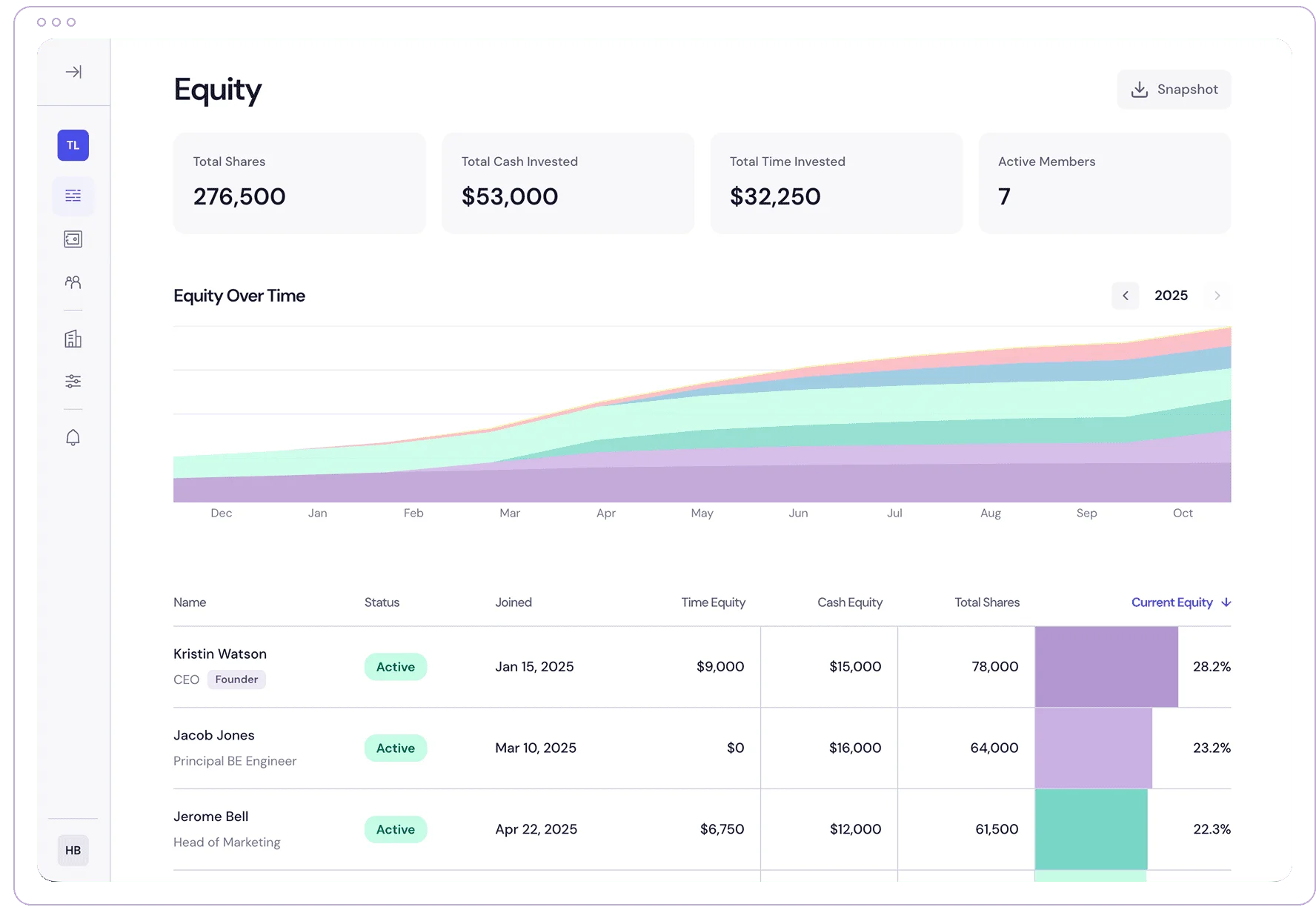
Whatever structure you choose, the math always works out the same: getting it in writing costs almost nothing compared to sorting it out later. Equity Matrix tracks contributions and models fair splits, so the agreement stays grounded in what’s actually happening.
Ready to split equity fairly?
Equity Matrix tracks contributions and calculates ownership automatically.
Get Started FreeThis article is for informational purposes only and does not constitute legal, tax, or financial advice. Equity Matrix is not a law firm, accounting firm, or financial advisor. Consult a qualified professional for guidance specific to your situation.

Co-founder, Equity Matrix
Sebastian writes about startup equity, founder dynamics, and building fair partnerships.
Keep reading
How to split profits in a partnership with unequal contributions
One partner put in more money, the other more time. Here's how to split profits fairly when contributions are unequal, and the default rule that bites if you don't.
Read more →Does your small business need an equity agreement?
Most small businesses start with a handshake and figure out equity later. By the time they realize they need an agreement, the damage is already done. Here's why you need one now.
Read more →