Even with its shortcomings, Slicing Pie is better than any fixed equity split. That’s not a controversial take. It’s math.
A fixed split is a guess about the future. Slicing Pie tracks what actually happens. Even if you never use a single tool and just run the model on a napkin, you’ll end up with a fairer outcome than two founders shaking hands on 50/50 and hoping for the best. Our 2026 research found that only 3% of founding teams use contribution-based models, and the other 97% are overwhelmingly the ones posting about disputes online.
So why look for alternatives? Not because the core idea is wrong. (If you’re still new to the model, our complete guide to Slicing Pie covers how it works before you weigh the tools.) Because the book was written as a framework, not a product. It doesn’t have cliff protection. Advisor equity is awkward. Converting to a fixed cap table for fundraising is a manual process. And the language assumes you’re a VC-backed startup, not a small business partnership where two people split an LLC.
If you believe ownership should reflect contribution (and you should), the question is which tool makes that principle work in practice. Here are the ones that actually do dynamic equity, followed by a note on cap table platforms for when you’ve moved past the contribution-tracking phase.
Quick answer
The best Slicing Pie alternative depends on why you are leaving the model. If you want the same contribution-based equity logic with more flexible rules, cliff protection, scenario modeling, and small-business support, Equity Matrix is the closest modern alternative. If you want to run Slicing Pie exactly as written, SliceFair is the cleaner fit. If you need cap table administration after the split is fixed, use a cap table platform like Cake, Vestd, Carta, Pulley, or WE.VESTR alongside your contribution-tracking history.
1. Equity Matrix
Best for: Teams that want Slicing Pie’s philosophy with more flexibility, better UX, and real-world adaptability
We built Equity Matrix because we believe Slicing Pie got the big idea right: ownership should reflect what people actually put in. But when we tried to use it ourselves, we kept hitting walls. The fixed 2x/4x multipliers didn’t fit our situation. There was no cliff protection. The recovery formula created tension nobody wanted. And the available tools felt like homework apps, not something you’d trust with the most important financial agreement in your company.
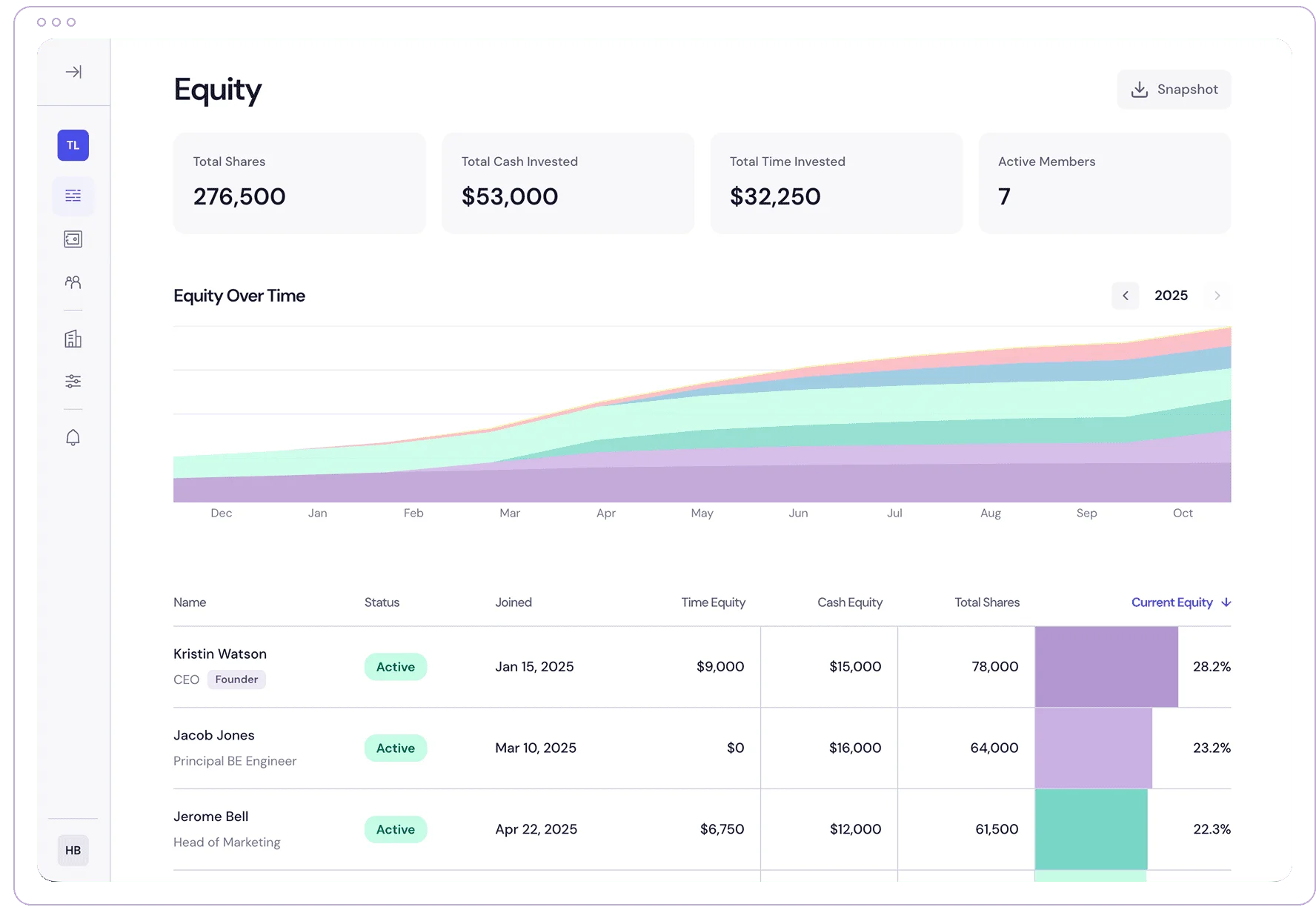
So we took dynamic equity as a concept and started giving it more legs. Customizable contribution categories. Flexible multiplier rules. Cliff and vesting protection built in. Scenario modeling so you can see what happens before you commit. And a UX that treats equity management like a real product, not a side project.
What it does:
- Tracks contributions across time, cash, equipment, relationships, and custom categories
- Lets you define your own valuation rules instead of being locked into Slicing Pie’s fixed multipliers
- Built-in cliff and vesting protection (the biggest gap in Slicing Pie)
- Scenario modeling: what happens to the split if a new partner joins, someone reduces their hours, or you bring on an advisor?
- Works for startups and SMB partnerships (LLC profit sharing, operating agreements, not just startup cap tables)
- Generates reports for investor conversations and cap table conversion
How it’s different from Slicing Pie:
Slicing Pie says “here are the rules, follow them.” Equity Matrix says “here’s how contribution-based equity works, now set it up for your situation.” You can implement Slicing Pie’s exact formula if you want. Or you can adjust the multipliers, add contribution types the book doesn’t cover, and build in protections it doesn’t offer. The equity calculator lets you model both approaches side by side.
Pricing: Free tier available. Paid plans for teams.
Best for teams that: Believe in contribution-based equity but need a tool that adapts to their specific situation, whether that’s a VC-track startup, a bootstrapped SaaS, or a two-person LLC where one partner brings cash and the other brings labor.
2. SliceFair
Best for: Teams that want to implement Slicing Pie exactly as the book describes
SliceFair is the most literal implementation of Slicing Pie as software. If you’ve read the book and want a tool that mirrors the model precisely, this is it.
What it does:
- Logs time contributions with personalized hourly rates
- Tracks cash investments and expenses
- Calculates equity splits in real time using Slicing Pie’s formula
- Handles team member departures with Slicing Pie’s recovery framework
- Supports multiple projects with unlimited participants
Strengths:
SliceFair removes the spreadsheet overhead from running Slicing Pie. Everyone logs their contributions, the math happens automatically, and you can see the current ownership split at any time. For teams that are committed to the Slicing Pie model and just want it to work without maintaining a complex spreadsheet, this is a clean solution.
Limitations:
SliceFair implements Slicing Pie and only Slicing Pie. If you want to deviate from the model’s rules (different multipliers, custom vesting, a hybrid approach), the tool doesn’t support that. It also doesn’t handle cap table management or the transition from dynamic equity to a fixed structure for fundraising.
Pricing: Free tier (1 project, 1 member). $99 one-time per project for full team access.
3. WE.VESTR
Best for: European startups that want Slicing Pie plus cap table management in one platform
WE.VESTR is a European equity management platform that has Slicing Pie built directly into the product alongside traditional cap table features. It’s one of the few tools that bridges the gap between the dynamic contribution-tracking phase and the fixed cap table phase.
What it does:
- Built-in Slicing Pie module for tracking pre-investment contributions
- Custom multipliers for each growth phase
- Cap table management, ESOP administration, and shareholder management
- Financial reporting integration (import P&L, cash flow, revenue data)
- Converts dynamic equity tracking into formal shareholding when you’re ready
Strengths:
WE.VESTR’s biggest advantage is that you don’t need to switch tools when you move from dynamic equity to a fixed cap table. You start with the Slicing Pie module to track contributions, and when the team is ready to freeze the split, the data flows directly into cap table management. That transition is where a lot of teams stumble, and having it built into one platform removes friction.
The self-determined multipliers for each growth phase are also a nice touch. Instead of Slicing Pie’s fixed 2x/4x, you can adjust the multipliers as the company matures and the risk profile changes.
Limitations:
WE.VESTR is Europe-focused. If you’re a US-based startup, the cap table features may not align with US legal structures and investor expectations as well as US-native tools. The platform is also less well-known than competitors, so investor familiarity is lower.
Pricing: Free tier (up to 25 stakeholders). Paid plans from EUR 150/month.
4. Cake Equity
Best for: Startups that want a modern, founder-friendly equity management platform with dynamic cap table features
Cake Equity is a US-based equity platform that takes a more dynamic approach to cap table management than traditional tools. It’s not a pure Slicing Pie implementation, but its philosophy is closer to contribution-based equity than the static cap table platforms.
What it does:
- Dynamic cap table management that adjusts as new grants, investments, and changes happen
- Stock option and ESOP administration with automated vesting schedules
- Lawyer-approved equity agreement templates
- Capital raise planning and scenario modeling
- Employee equity portals with value visualization
Strengths:
Cake’s focus on making equity feel tangible to team members sets it apart. The employee portal doesn’t just show vesting status; it helps people understand what their equity could be worth and why it matters. For founders who are using equity to motivate their team (not just compensate them), Cake’s approach resonates.
Limitations:
Cake is closer to a modern cap table tool than a true dynamic equity tracker. It doesn’t implement Slicing Pie’s contribution-tracking model or let you define custom multipliers for different contribution types. It’s more dynamic than Carta in how it handles equity workflows, but the ownership percentages themselves are still set by the founders, not calculated from tracked contributions.
Pricing: Free onboarding for early-stage startups. Paid plans for growing teams.
5. Vestd
Best for: UK companies that need FCA-regulated share scheme management
Vestd is the leading equity management platform for UK businesses, with a focus on share schemes and Companies House compliance.
What it does:
- Share scheme setup and management (EMI, CSOP, growth shares)
- Digital share issuance and option grants
- Real-time cap table with Companies House integration
- Shareholder dashboards and communication tools
- Built-in valuation support for tax reporting
- FCA-regulated, ISO 27001 certified
Strengths:
Vestd solves a UK-specific problem: setting up tax-efficient share schemes (particularly EMI schemes, which are extremely valuable for UK startups) without paying a lawyer thousands of pounds. The Companies House auto-filing alone saves significant admin time. If you’re a UK company, Vestd is likely the right choice for equity administration.
Limitations:
Primarily UK-focused. No dynamic equity tracking or contribution-based ownership calculation. Vestd assumes you’ve already decided who owns what and helps you manage the shares from there. It’s not a Slicing Pie alternative in the dynamic equity sense, but it’s relevant for UK teams that need to formalize their equity structure after the contribution-tracking phase.
Pricing: Published on their website. Plans vary by company size and scheme type.
6. Spreadsheets (Google Sheets / Excel)
Best for: Very early teams who want maximum control and zero cost
The original Slicing Pie implementation tool. Mike Moyer himself provides spreadsheet templates on the Slicing Pie website.
What it does:
- Whatever you build it to do
- Full control over formulas, multipliers, and tracking categories
- Everyone can see and verify the math
- Free
Strengths:
Spreadsheets work when there are 2-3 people, everyone trusts each other, and someone is disciplined enough to maintain it. For the first few months of a partnership, a shared Google Sheet with columns for date, contributor, contribution type, hours, and calculated equity is genuinely fine.
Limitations:
Spreadsheets break. Not immediately, but predictably.
- No access controls. Anyone can edit anyone else’s contributions. One accidental formula change and the equity calculations are wrong, and nobody notices for weeks.
- No audit trail. When there’s a dispute about who contributed what, “the spreadsheet says” isn’t compelling if anyone could have edited it.
- Manual calculation errors. As the team grows and contribution types multiply, the formulas get complex. One broken reference and the ownership percentages are silently wrong.
- No scenario modeling. “What if we bring on a new partner?” means manually building a parallel sheet and hoping the formulas carry over correctly.
- Social friction. Nobody wants to be the person nagging teammates to log their hours every week. Software with reminders and dashboards makes this less personal.
A spreadsheet is a fine starting point. But if you’re still using one after six months or after the team grows past three people, you’re creating risk that a purpose-built tool would eliminate.
What about Carta, Pulley, and other cap table platforms?
If you search for “Slicing Pie alternatives,” you’ll find listicles that include Carta, Pulley, Qapita, and other cap table management tools. These are good products, but they’re not really Slicing Pie alternatives. They solve a different problem.
Slicing Pie answers the question: “How do we figure out who should own what?” Cap table tools answer: “We already know who owns what. How do we manage it?”
It’s like searching for pickup trucks and getting recommended SUVs. Both are vehicles. Both get you somewhere. But if you need a truck bed, an SUV isn’t going to work.
That said, if you’re past the contribution-tracking phase, here’s a quick orientation:
- Carta — Industry standard for US startups. Cap table management, 409A valuations, stock option administration. Investors expect it. Paid plans typically start in the low thousands per year.
- Pulley — Lighter, cheaper alternative to Carta. Cleaner UX, startup-friendly pricing. Good pro forma modeling for fundraising scenarios. Also offers 409A valuations.
Both are tools you graduate to when you convert from dynamic equity to a fixed cap table. They complement the tools above rather than replace them.
Comparison table
| Tool | Dynamic equity | Contribution tracking | Cap table | Best for |
|---|---|---|---|---|
| Equity Matrix | Yes (flexible) | Yes | Yes | Startups and SMB partnerships |
| SliceFair | Yes (Slicing Pie only) | Yes | No | Pure Slicing Pie teams |
| WE.VESTR | Yes (Slicing Pie built-in) | Yes | Yes | European startups |
| Cake Equity | Partial (dynamic cap table) | No | Yes | US startups, team equity |
| Vestd | No | No | Yes (UK) | UK share schemes |
| Spreadsheets | Manual | Manual | No | 2-3 person teams, first few months |
How to choose
If you’re pre-revenue and the split is still forming: You need dynamic equity tracking. That’s Equity Matrix, SliceFair, or WE.VESTR. Choose SliceFair if you want to follow the Slicing Pie model exactly. Choose WE.VESTR if you’re in Europe and want Slicing Pie plus cap table in one tool (check your country’s default partnership rules first). Choose Equity Matrix if you want flexibility to customize the rules or need a tool that works for an SMB partnership, not just a startup.
If you need a modern cap table tool with a founder-friendly UX: Cake Equity is worth a look. It’s not a contribution tracker, but it handles equity administration with less friction than Carta.
If you’re in the UK: Vestd is the clear choice for share scheme management. Use a dynamic equity tool alongside it if you’re still in the contribution-tracking phase.
If you’re just starting and have 2-3 people: A spreadsheet is fine for now. Set a calendar reminder to revisit in three months.
If you’ve already locked in your split and need to formalize it: Skip the dynamic equity tools and go straight to a cap table platform (Carta or Pulley for US, WE.VESTR for Europe, Cake for global, Vestd for UK).
Whichever tool you land on, it helps to see the underlying model in action first. Run your team’s contributions through the Slicing Pie calculator to see what a contribution-based split looks like today. It’s free, needs no signup, and gives you a baseline to compare any tool against.
Frequently asked questions
What is the best Slicing Pie alternative?
Equity Matrix is the best Slicing Pie alternative if you want contribution-based ownership with more flexible rules than the original model. SliceFair is better if you want to follow Slicing Pie exactly. WE.VESTR is strongest when you need Slicing Pie plus European cap table management, while Cake, Vestd, Carta, and Pulley are better once your split is already fixed.
Is there a free Slicing Pie tool?
Yes. SliceFair offers a free tier, and Equity Matrix has a free plan that includes contribution tracking and equity calculations. Mike Moyer also provides free spreadsheet templates on the Slicing Pie website. For most early-stage teams, the free tiers are sufficient until the team grows past 4-5 contributors.
What’s wrong with Slicing Pie?
Nothing’s wrong with the core principle. Ownership should reflect contributions. The limitations are in the details: the fixed 2x/4x multipliers don’t fit every situation, there’s no built-in cliff protection, advisor equity is awkward, and the recovery formula can create uncomfortable dynamics when someone leaves. These are solvable problems, but they require either adapting the model or choosing a tool that gives you more flexibility.
Can I use Slicing Pie for an LLC or small business partnership?
The framework translates, but the language doesn’t. Slicing Pie was written for startups, and the terminology (co-founders, option pools, fundraising rounds) doesn’t map cleanly to an LLC with two partners splitting profits. The underlying math works fine for any business where contributions are unequal, but you’ll need a tool like Equity Matrix that speaks both startup and small business languages.
Do I need a dynamic equity tool if we’ve already agreed on a split?
No. If the split is fixed and everyone’s happy with it, move straight to a cap table platform. Dynamic equity tools solve the problem of figuring out the split, not managing it after it’s decided.
Slicing Pie got the big idea right: equity should be earned, not guessed. The question is which tool helps you execute that principle in practice. Try the equity calculator to model your team’s contributions and see what a fair split looks like before committing to any tool.
Ready to split equity fairly?
Equity Matrix tracks contributions and calculates ownership automatically.
Get Started FreeThis article is for informational purposes only and does not constitute legal, tax, or financial advice. Equity Matrix is not a law firm, accounting firm, or financial advisor. Consult a qualified professional for guidance specific to your situation.

Co-founder, Equity Matrix
Sebastian writes about startup equity, founder dynamics, and building fair partnerships.
Keep reading
Slicing Pie calculator: what the numbers mean
A step-by-step guide to using the Slicing Pie calculator. Learn how market rates, multipliers, and contribution types affect your equity split, with real examples.
Read more →Rob Walling's TOC framework for splitting equity
Rob Walling's TOC framework splits equity based on Time, Opportunity Cost, and Cash. Here's how it works, how it compares to Slicing Pie, and how to use it with a calculator.
Read more →