European partnership and business formation laws.
Default rules for partnerships, startup entities, equity splits, and marital property across 32 European countries. What applies when you don't have a written agreement.
| Country | Default split | Startup entity | Min. capital | Community property | Formation cost |
|---|---|---|---|---|---|
| United Kingdom | Equal | Private Limited Company (Ltd) | £1 (no practical minimum) | No | £100–£124 |
| Ireland | Equal | Private Company Limited by Shares (LTD) | €1 (no practical minimum) | No | €50 |
| Netherlands | Proportional | Besloten Vennootschap (BV) | €0.01 (effectively no minimum) | Yes | €900–€2,500 (notary required) |
| Germany | Equal | Gesellschaft mit beschränkter Haftung (GmbH) | €25,000 (€12,500 at incorporation; or €1 for UG) | Yes | €600–€2,000 (notary required) |
| Sweden | Equal | Aktiebolag (AB) | SEK 25,000 (~€2,200) | Yes | SEK 2,400–2,700 (~€215–€240) |
| Denmark | Equal | Anpartsselskab (ApS) | DKK 20,000 (~€2,700) | Yes | DKK 670 (~€90) |
| Finland | Equal | Osakeyhtiö (Oy) | €0 (no minimum since 2019) | Yes | €300–€400 |
| Norway | Equal | Aksjeselskap (AS) | NOK 30,000 (~€2,600) | Yes | NOK 6,825–7,912 (~€590–€680) |
| Switzerland | Equal | Gesellschaft mit beschränkter Haftung (GmbH / Sàrl) | CHF 20,000 (~€21,000) | Yes | CHF 2,000–5,000 (notary required in most cantons) |
| Estonia | Proportional | Osaühing (OÜ) | €0.01 per shareholder (personal liability up to €2,500 if capital below that) | Yes | €190–€265 |
| France | Proportional | Société par Actions Simplifiée (SAS) | €1 (no practical minimum) | Yes | €250–€750 |
| Spain | Proportional | Sociedad Limitada (SL) | €1 (since Ley Crea y Crece 2022) | Yes | €500–€1,500 (notary required) |
| Portugal | Proportional | Sociedade por Quotas (Lda) | €1 per quota holder (effectively no minimum) | Yes | €220–€360 (Empresa na Hora) |
| Poland | Equal | Spółka z ograniczoną odpowiedzialnością (sp. z o.o.) | PLN 5,000 (~€1,150) | Yes | PLN 250–600 (~€80–€140) |
| Belgium | Proportional | Besloten Vennootschap (BV) / Société à Responsabilité Limitée (SRL) | €0 (no minimum since 2019, but adequate initial capital required) | Yes | €1,000–€2,000 (notary required) |
| Austria | Proportional | Gesellschaft mit beschränkter Haftung (GmbH) | €10,000 (at least €5,000 paid in cash; FlexKapG also €10,000) | No | €500–€2,000 (notary required) |
| Czech Republic | Equal | Společnost s ručením omezeným (s.r.o.) | CZK 1 (~€0.04, effectively no minimum) | Yes | CZK 6,000–15,000 (~€250–€600) |
| Italy | Proportional | Società a Responsabilità Limitata (S.r.l.) | €1 (S.r.l. and S.r.l.s.; restrictions apply below €10,000) | Yes | €1,500–€3,000 (notary required) |
| Romania | Proportional | Societate cu Răspundere Limitată (SRL) | RON 500 (~€100) | Yes | RON 500–2,000 (~€100–€400) |
| Hungary | Proportional | Korlátolt Felelősségű Társaság (Kft.) | HUF 3,000,000 (~€7,500) | Yes | HUF 100,000–300,000 (~€250–€750) |
| Greece | Equal | Ιδιωτική Κεφαλαιουχική Εταιρεία (IKE) | €0 (no minimum for IKE) | No | €150–€500 |
| Croatia | Hybrid | Društvo s ograničenom odgovornošću (d.o.o.) | €2,500 (€1 for j.d.o.o.) | Yes | €200–€800 |
| Bulgaria | Proportional | Дружество с ограничена отговорност (OOD) | €1 (effectively no minimum) | Yes | €100–€500 |
| Lithuania | Proportional | Uždaroji Akcinė Bendrovė (UAB) | €1,000 | Yes | €200–€500 |
| Latvia | Proportional | Sabiedrība ar ierobežotu atbildību (SIA) | €2,800 | Yes | €150–€400 |
| Slovakia | Equal | Spoločnosť s ručením obmedzeným (s.r.o.) | €5,000 | Yes | €300–€800 |
| Slovenia | Hybrid | Družba z omejeno odgovornostjo (d.o.o.) | €7,500 | Yes | €300–€1,000 |
| Luxembourg | Proportional | Société à Responsabilité Limitée (Sàrl) | €12,000 | Yes | €1,500–€3,000 (notary required) |
| Malta | Proportional | Private Limited Liability Company (Ltd) | €1,164.69 (20% paid up) | Yes | €200–€500 |
| Cyprus | Equal | Private Company Limited by Shares | €0 (no minimum) | No | €400–€1,000 |
| Iceland | Equal | Einkahlutafélag (ehf.) | ISK 500,000 (~€3,400) | Yes | ISK 140,500–200,000 (~€880–€1,350) |
| Liechtenstein | Proportional | Gesellschaft mit beschränkter Haftung (GmbH) | CHF 10,000 (~€10,500) | No | CHF 3,000–7,000 |
United Kingdom
Private Limited Company (Ltd) | Min. capital: £1 (no practical minimum)
Ireland
Private Company Limited by Shares (LTD) | Min. capital: €1 (no practical minimum)
Netherlands
Besloten Vennootschap (BV) | Min. capital: €0.01 (effectively no minimum)
Germany
Gesellschaft mit beschränkter Haftung (GmbH) | Min. capital: €25,000 (€12,500 at incorporation; or €1 for UG)
Sweden
Aktiebolag (AB) | Min. capital: SEK 25,000 (~€2,200)
Denmark
Anpartsselskab (ApS) | Min. capital: DKK 20,000 (~€2,700)
Finland
Osakeyhtiö (Oy) | Min. capital: €0 (no minimum since 2019)
Norway
Aksjeselskap (AS) | Min. capital: NOK 30,000 (~€2,600)
Switzerland
Gesellschaft mit beschränkter Haftung (GmbH / Sàrl) | Min. capital: CHF 20,000 (~€21,000)
Estonia
Osaühing (OÜ) | Min. capital: €0.01 per shareholder (personal liability up to €2,500 if capital below that)
France
Société par Actions Simplifiée (SAS) | Min. capital: €1 (no practical minimum)
Spain
Sociedad Limitada (SL) | Min. capital: €1 (since Ley Crea y Crece 2022)
Portugal
Sociedade por Quotas (Lda) | Min. capital: €1 per quota holder (effectively no minimum)
Poland
Spółka z ograniczoną odpowiedzialnością (sp. z o.o.) | Min. capital: PLN 5,000 (~€1,150)
Belgium
Besloten Vennootschap (BV) / Société à Responsabilité Limitée (SRL) | Min. capital: €0 (no minimum since 2019, but adequate initial capital required)
Austria
Gesellschaft mit beschränkter Haftung (GmbH) | Min. capital: €10,000 (at least €5,000 paid in cash; FlexKapG also €10,000)
Czech Republic
Společnost s ručením omezeným (s.r.o.) | Min. capital: CZK 1 (~€0.04, effectively no minimum)
Italy
Società a Responsabilità Limitata (S.r.l.) | Min. capital: €1 (S.r.l. and S.r.l.s.; restrictions apply below €10,000)
Romania
Societate cu Răspundere Limitată (SRL) | Min. capital: RON 500 (~€100)
Hungary
Korlátolt Felelősségű Társaság (Kft.) | Min. capital: HUF 3,000,000 (~€7,500)
Greece
Ιδιωτική Κεφαλαιουχική Εταιρεία (IKE) | Min. capital: €0 (no minimum for IKE)
Croatia
Društvo s ograničenom odgovornošću (d.o.o.) | Min. capital: €2,500 (€1 for j.d.o.o.)
Bulgaria
Дружество с ограничена отговорност (OOD) | Min. capital: €1 (effectively no minimum)
Lithuania
Uždaroji Akcinė Bendrovė (UAB) | Min. capital: €1,000
Latvia
Sabiedrība ar ierobežotu atbildību (SIA) | Min. capital: €2,800
Slovakia
Spoločnosť s ručením obmedzeným (s.r.o.) | Min. capital: €5,000
Slovenia
Družba z omejeno odgovornostjo (d.o.o.) | Min. capital: €7,500
Luxembourg
Société à Responsabilité Limitée (Sàrl) | Min. capital: €12,000
Malta
Private Limited Liability Company (Ltd) | Min. capital: €1,164.69 (20% paid up)
Cyprus
Private Company Limited by Shares | Min. capital: €0 (no minimum)
Iceland
Einkahlutafélag (ehf.) | Min. capital: ISK 500,000 (~€3,400)
Liechtenstein
Gesellschaft mit beschränkter Haftung (GmbH) | Min. capital: CHF 10,000 (~€10,500)
No countries match your search.
Key differences across Europe
Equal vs proportional: the default split divide
14 countries default to equal profit sharing among partners, regardless of capital contributed. These include the UK, Ireland, Germany, and the Nordic countries. 16 countries default to proportional sharing based on capital contributions, and 2 (Croatia and Slovenia) use statutory hybrid formulas combining capital-based and equal elements.
This matters because a partner who contributed €90,000 in an equal-split country would share profits 50/50 with a partner who contributed €10,000 — unless a written agreement says otherwise.
Formation costs vary dramatically
Incorporating in Ireland costs just €50, while a Swiss GmbH costs CHF 2,000–5,000 and requires CHF 20,000 minimum capital. Countries requiring notarization (Germany, Austria, Switzerland, Belgium, Italy) add €500–€3,000 to the process.
Several countries have recently reduced barriers: Finland eliminated its minimum capital, Czech Republic dropped from CZK 200,000 to CZK 1, and Spain's Startup Act allows €1 formation.
Community property: your marriage affects your business
26 of 32 countries have some form of community or marital property by default. In these countries, business interests acquired during marriage may be divided on divorce.
Notable exceptions with separate property include the UK, Ireland, Greece, Austria, Cyprus, and Liechtenstein. Germany uses a unique hybrid (Zugewinngemeinschaft) where assets are separate during marriage but gains are equalized on divorce.
Tax-efficient reinvestment: the Estonian and Latvian model
Estonia and Latvia tax only distributed profits, meaning retained and reinvested earnings face 0% corporate tax. This is a significant advantage for startups that reinvest revenue rather than pay dividends.
Hungary's 9% flat rate, Bulgaria's 10%, and Ireland's 12.5% are also competitive. Malta's imputation system offers an effective 5% rate for qualifying non-resident shareholders.
Looking for US partnership laws?
Our US state directory covers all 50 states: UPA vs RUPA adoption, LLC default splits, operating agreement requirements, and community property rules.
View US state directoryFrequently asked questions
What is the default profit split for partnerships in Europe?
It varies by country. 14 European countries (including the UK, Ireland, Germany, and the Nordic countries) default to equal profit sharing among partners. 16 countries (including the Netherlands, France, Spain, and Italy) default to proportional sharing based on capital contributions, and 2 (Croatia and Slovenia) use statutory hybrid formulas. In all cases, a written partnership agreement can override the default.
Which European country is cheapest to incorporate in?
Ireland has the cheapest formation in this directory at €50. Poland (~€80–€140), Denmark (~€90), and the UK (£100–£124) are also inexpensive, and Finland, Czech Republic, Romania, and Bulgaria have effectively zero minimum capital with low formation fees. However, formation cost alone should not drive the decision — consider corporate tax rates, legal infrastructure, investor familiarity, and proximity to your market.
Do European countries have community property?
Most do. About 26 of 32 countries in this directory have some form of community property or marital property regime by default. Notable exceptions include the UK, Ireland, Greece, Austria, Cyprus, and Liechtenstein, which use separate property. In community property countries, business interests acquired during marriage are generally considered marital property and may be divided on divorce. A pre-nuptial agreement can typically exclude business assets.
Which European countries have the lowest corporate tax rates?
Hungary has the lowest headline rate at 9%. Bulgaria has a 10% flat rate. Ireland's 12.5% rate is well known for attracting tech companies. Estonia and Latvia's distributed-profit-only taxation model provides an effective 0% rate on retained earnings. Malta's imputation system offers an effective 5% rate for qualifying non-resident shareholders.
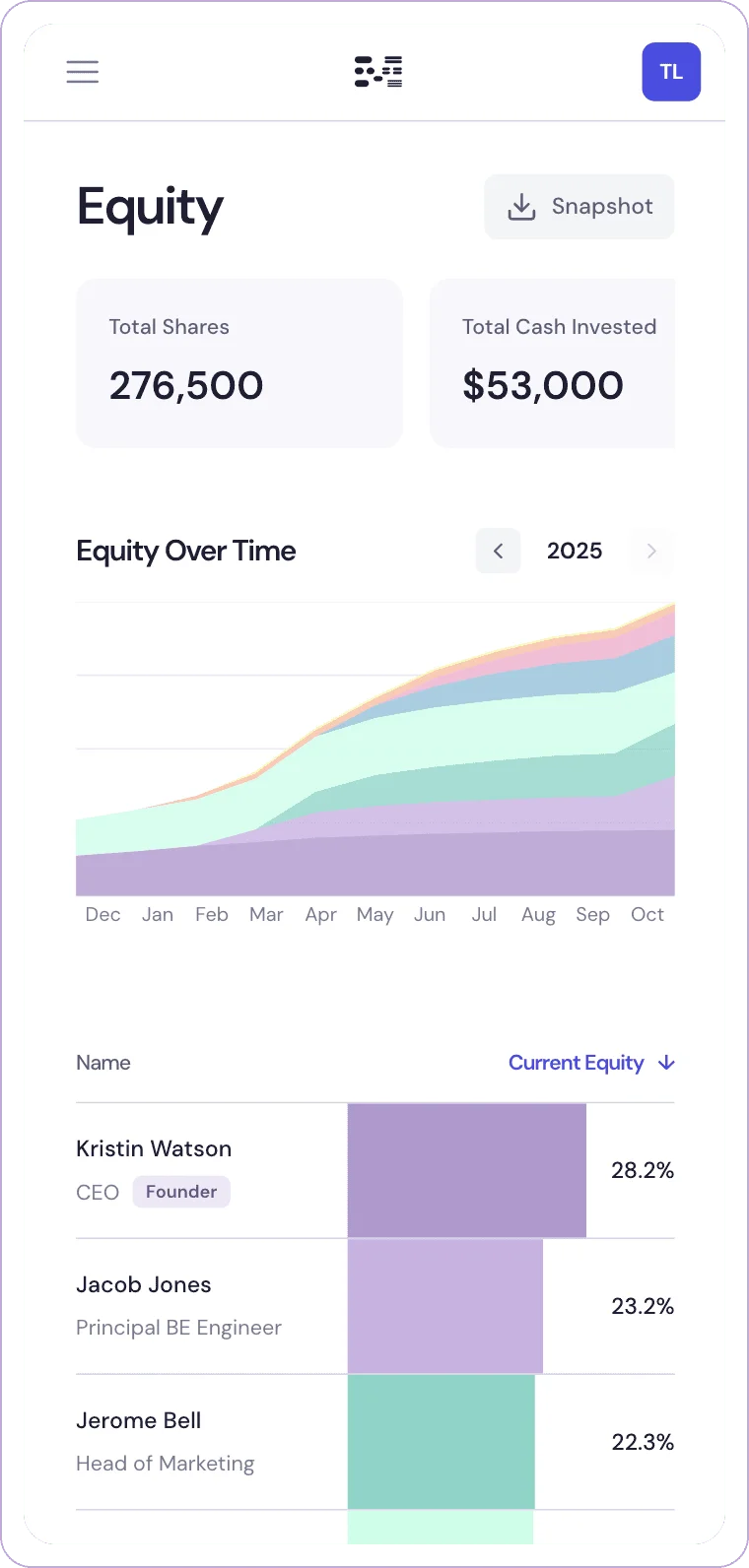
Don't rely on default rules for your equity.
Equity Matrix tracks contributions and calculates ownership automatically, so your agreement reflects what your team actually built together — no matter where you incorporate.