You spent years building this business alone. Now you’re thinking about handing a piece of it to someone else.
That’s a strange feeling. You know you need help. Maybe the business has outgrown what one person can run. Maybe someone approached you with capital, or skills you don’t have, or connections that could unlock the next level of growth. The rational case is clear.
But there’s a part of you that keeps asking: am I giving away what I earned?
Most business owners skip the hard work of structuring this correctly. They bring someone in on a handshake, figure they’ll “work it out,” and six months later they’re posting on Reddit asking how to get rid of a partner who owns half the company but stopped showing up. Our research found that 38% of equity disputes end unresolved. Most of those could have been prevented with 30 minutes of planning upfront.
First question: do you actually need a partner?
Not every growth problem requires giving away ownership. Before you start the partnership conversation, be honest about what you actually need.
Hire an employee if you need someone to execute specific tasks under your direction. A marketing manager, an operations lead, a sales rep. They get a salary, you keep control.
Bring on an advisor if you need expertise and connections but not daily involvement. Advisors typically receive 0.5-2% equity with a vesting schedule, and they don’t get governance rights.
Add a partner if you need someone to share the risk, make strategic decisions alongside you, invest capital or significant time, and commit to the business long-term. Partners get ownership, profit sharing, and a voice in how the business is run.
If what you need is an employee or advisor, giving them partner-level equity is the most expensive hiring mistake you can make. Call it what it is before structuring the deal.
Before you talk numbers: value your business
You can’t give away a fair piece of something if you don’t know what it’s worth. Before any partnership conversation, you need a number.
This doesn’t have to be a formal appraisal. A few methods work well for small businesses:
Revenue multiple. Multiply your annual revenue by a factor typical for your industry. Service businesses usually sell for 1-2x revenue. Retail and e-commerce are 1.5-3x. Businesses with recurring revenue command higher multiples. If your business does $300,000 a year and the typical multiple is 1.5x, you’re looking at a $450,000 valuation.
Seller’s discretionary earnings (SDE). Net profit plus the owner’s salary, benefits, and personal expenses run through the business. Multiply SDE by a factor (typically 2-4x for profitable small businesses, though it varies significantly by industry and growth rate). This gives a better picture than revenue alone because it reflects what the business actually generates for the owner.
Asset value. What the business owns minus what it owes. Equipment, inventory, accounts receivable, intellectual property, minus debts and obligations. This sets a floor: the business is worth at least its net assets.
For a more detailed breakdown of valuation methods and what to expect from a professional appraiser, see the partner buyout guide. The same valuation methods apply whether you’re buying someone out or bringing someone in.
Agree on the valuation method before you run the numbers. If you negotiate the method after seeing the results, the conversation becomes adversarial.
How much ownership to give
This is the question that stalls most partnership conversations. The new partner wants enough equity to feel like an owner. You want to keep enough to reflect what you’ve already built.
The contribution-based approach
Value what each person is contributing and let the numbers do the negotiating for you. This is the fairest method because it turns “I think I deserve X” into “here’s what the math says.”
What you bring to the table: the business itself (its current valuation), customer relationships, brand and reputation, operational systems, and any cash you’ve invested. What they bring: cash investment (if any), their time commitment at market rate, skills you don’t have, and relationships that could grow the business.
Run these through an equity calculator to see what a fair split looks like. If you’ve built a $400,000 business and the new partner is investing $100,000 in cash plus committing to full-time work valued at $80,000/year, the math will tell you what percentage their contributions represent.
The “investor + operator” model
If your new partner is primarily investing cash while you continue to run the business, think of them more like an investor than an equal partner.
Cash investments sometimes command a multiplier (typically 1.5x-2x for established small businesses, higher for early-stage ventures) because money carries real risk. But the operator can equally argue that a proven, cash-flowing business deserves a premium over raw capital. Multipliers can work in both directions. The key is that cash alone doesn’t earn a controlling stake. The person running the business day-to-day is providing ongoing value that accumulates over time.
A common structure: new partner invests $150,000 into a business valued at $500,000. Their cash gets them 23% ownership (150K / 650K total value). If you apply a 2x cash multiplier, it’s 300K / 800K = 37.5%. The operating partner retains the remainder. Whether to use multipliers and how large they should be is a negotiation. The sweat equity guide covers the options.
What the market says
Based on discussions we analyzed in our 2026 equity split research, late-joining partners in existing businesses typically receive 15-40% ownership depending on how established the business is, whether they’re investing cash, whether they’re going full-time, and what unique skills or relationships they bring.
Anything below 15% and you’re hiring an employee, not adding a partner. Go above 49% and you’ve effectively handed control of a business you built to someone who just arrived. Both can work, but call them what they are.
Structure the deal to protect both sides
A handshake is not a partnership agreement. Before the new partner starts contributing, get these things in writing.
Operating agreement
If you’re an LLC (and most small business partnerships should be), the operating agreement is the governing document. It should cover ownership percentages and how they were calculated, roles and responsibilities in specific terms, decision-making authority (who can sign contracts, hire, spend money), profit distribution schedules, capital contribution requirements, buyout provisions for when one partner wants out, and a dispute resolution process that starts with mediation.
If you don’t have an operating agreement, your state’s default LLC rules apply. Many states default to equal management rights in member-managed LLCs, regardless of ownership percentage. That can mean a partner with 20% gets the same decision-making power as the partner with 80%. The rules vary by state, but the defaults rarely favor the person who built the business. Get an attorney to draft one. Expect $1,500-$10,000 depending on complexity and location. Each partner should ideally have their own attorney review the agreement.
Vesting
Don’t give the new partner their full ownership stake on day one. Use vesting so they earn into it over time.
A typical structure: the new partner’s ownership vests over 3-4 years with a 1-year cliff. If they leave after six months, they walk away with nothing. If they stay a year, they’ve earned 25% of their allocated stake. The rest vests monthly.
Vesting exists because people change. Six months in, priorities shift, life happens, and suddenly your partner is a name on the operating agreement and nothing else. Without vesting, you’re stuck. With vesting, the problem resolves itself.
In our research, the absence of vesting was the single most cited regret among business owners who had partnership disputes.
Contribution tracking
If the partnership involves unequal or changing contributions (one partner full-time, the other part-time; one investing cash, the other investing labor), track what each person puts in from day one.
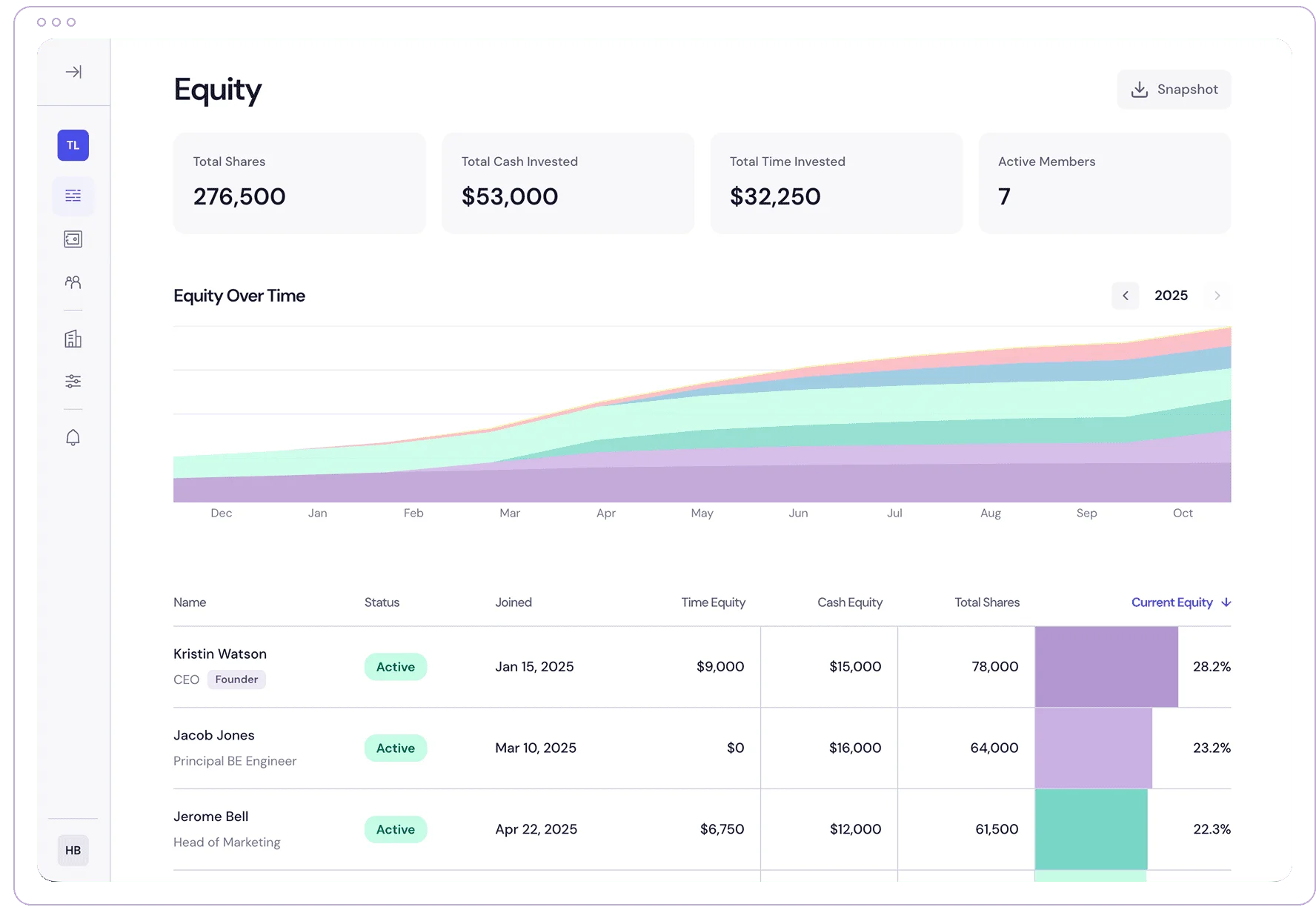
Dynamic equity models adjust ownership based on actual contributions. Instead of guessing what each partner will contribute over the next five years, you track what they actually do and let the split reflect reality. The equity calculator automates this.
Even if you don’t use dynamic equity, keeping a log of hours, cash invested, and responsibilities handled gives you data for the inevitable conversation about whether the partnership is working.
Non-compete and IP assignment
The new partner should sign an IP assignment agreement (anything they create for the business belongs to the business) and, depending on your state, a non-compete or non-solicitation agreement.
Non-compete enforceability varies dramatically by state. California, Minnesota, North Dakota, and Oklahoma ban or severely restrict them. Several other states have enacted significant limitations. Even where they’re technically enforceable, courts frequently narrow overly broad non-competes. Non-solicitation agreements (preventing the departing partner from poaching clients or employees) and confidentiality agreements are often more reliable and enforceable than non-competes. Check your state’s rules and have an attorney draft provisions that will actually hold up.
The trial period: try before you commit
Before formalizing the partnership, consider working together for 3-6 months under a simple contractor or employee arrangement. Think of it as dating before marriage.
This isn’t a vague “let’s see how it goes.” Structure the trial:
Set specific milestones. If they’re coming in for sales, define a revenue target. If operations, define processes they’ll build or improve. Measurable outcomes, not feelings.
Track their contributions. Log hours, revenue generated, projects completed, and cash invested. This data becomes the foundation for the equity conversation when the trial ends. The equity calculator makes this easy to track from week one.
Pay them. A contractor rate or below-market salary. The trial needs to be fair to both sides. You’re not asking them to work for free; you’re asking them to prove the partnership works before you share ownership.
Set a decision date. “In 90 days, we’ll sit down and decide whether to formalize this.” No ambiguity.
If the trial goes well, convert to a formal partnership with real data informing the equity split instead of guesses. If it doesn’t, you’ve avoided the most expensive mistake in small business.
This approach is more common than people realize. In our research, the equity conversation itself killed several potential partnerships. Better to discover incompatibility during a trial than after signing an operating agreement.
The psychological shift: from sole owner to co-owner
Nobody talks about this, but it matters. When you’ve run a business alone, every decision was yours. The speed, the direction, the priorities. Adding a partner means giving up some of that control, and it can feel like a loss even when it’s the right move.
Expect friction on small things first. They’ll want to change the way you handle invoicing. You’ll disagree on a vendor. A decision you would have made in 10 minutes now takes a meeting. This is normal. It’s the cost of having someone who actually cares about the outcome as much as you do.
The structure you put in place (operating agreement, defined roles, decision-making authority) is what keeps this friction productive instead of destructive. Without it, every disagreement becomes a power struggle.
Partnering with a friend makes this harder, not easier. When there’s a friendship at stake, the difficult conversations feel riskier. That’s an argument for more structure, not less.
Tax implications of adding a partner
Adding a partner to your business has tax consequences that many owners don’t anticipate.
LLC membership interest transfer
If you’re transferring a membership interest in an LLC, the tax treatment depends on whether the new partner is receiving a capital interest or a profits interest.
Capital interest (share of existing value): The new partner receives an ownership stake in the business’s current assets. If they pay fair market value for it, there’s no taxable event. If they receive it in exchange for services (sweat equity), it’s taxable as ordinary income based on the value received.
Profits interest (share of future value only): The new partner receives a right to future profits and appreciation, not the existing value. Under IRS Rev. Proc. 93-27 (supplemented by Rev. Proc. 2001-43 for vesting interests), profits interests can often be structured to be tax-free at grant. But the requirements are specific: the interest can’t relate to a substantially certain income stream, the partner can’t dispose of it within two years, and the operating agreement needs a proper liquidation waterfall. Your tax advisor needs to confirm your arrangement qualifies. This is the preferred structure for most sweat equity arrangements, but it’s not automatic.
Important: Once someone receives an LLC membership interest, they’re reclassified as a partner for tax purposes. They get a K-1 instead of a W-2, pay self-employment tax, and need to make quarterly estimated payments. Both partners should understand this before finalizing anything.
Section 83(b) election
If the new partner receives a capital interest that vests over time, filing an 83(b) election within 30 days may let them pay taxes on the current value (which may be low) rather than the vested value later (which may be much higher). For profits interests that qualify under the Rev. Proc. 93-27 safe harbor, the 83(b) election works differently and may not be necessary. The interaction between Section 83 and partnership interests is one of the more complex areas of tax law. Have your tax advisor determine whether an 83(b) election applies to your specific structure. If it does, the 30-day deadline is absolute.
Get professional advice
The difference between a well-structured and poorly-structured partnership can be tens of thousands of dollars in unnecessary taxes. Talk to a CPA and a business attorney before finalizing the deal. This is not the place to save money on professional fees.
Frequently asked questions
How much equity should I give a new partner?
It depends on what they’re contributing, what the business is already worth, and how much you need them. Late-joining partners in existing businesses typically receive 15-40%. Use the equity calculator to model different scenarios based on actual contribution values.
Can I add a partner to my sole proprietorship?
Adding a partner to a sole proprietorship converts it into a general partnership, which exposes both partners to unlimited personal liability. The better path: convert to an LLC first, then add the new partner as a member. The LLC provides liability protection and a cleaner legal framework for partnership governance.
What if the new partner doesn’t work out?
If you used vesting, unvested equity is forfeited and the problem is contained. If you included buyout provisions in the operating agreement, you have a pre-agreed mechanism for one partner to buy the other out. If you have neither, you’re negotiating from scratch under pressure. That’s why the structure matters more than the handshake.
How long should a trial period be?
Three to six months is typical. Long enough to see how someone performs under real conditions (not just their best behavior in the first two weeks), short enough that neither person is investing years before knowing if the partnership works. Set a specific end date and a decision framework before starting.
The structure you set now is the relationship you’ll have in two years. Get it right on paper and you can focus on building together instead of watching your back. Start modeling a fair split with the equity calculator.
Ready to split equity fairly?
Equity Matrix tracks contributions and calculates ownership automatically.
Get Started FreeThis article is for informational purposes only and does not constitute legal, tax, or financial advice. Equity Matrix is not a law firm, accounting firm, or financial advisor. Consult a qualified professional for guidance specific to your situation.

Co-founder, Equity Matrix
Sebastian writes about startup equity, founder dynamics, and building fair partnerships.
Keep reading
Co-founders in different countries: how to set a fair rate
When one co-founder is in the US and another is in Lithuania, do you value their time at local rates or the same rate for the same work? How to set GHRR fairly across borders.
Read more →How to track co-founder contributions (before it costs you)
A practical system for tracking co-founder contributions: what to log, how often, the fields that matter, and where spreadsheets start to strain.
Read more →