Splitting equity in a two-person startup means deciding how to divide ownership between co-founders — a decision that defaults to 50/50 far too often and leads to conflict when contributions inevitably diverge.
Two founders. One company. How do you divide it?
This is the most common equity question in startups, and most founders get it wrong. They either default to 50/50 because it feels fair, or they pick arbitrary numbers based on gut feeling.
Both approaches create problems later.
The right answer depends on what each person is actually contributing. Not what they promise to contribute. Not what they contributed to a different company five years ago. What they’re putting into this specific venture, right now.
Why 50/50 Feels Right (But Usually Isn’t)
Equal splits are the default because they’re easy. No awkward conversations. No one feels slighted. You shake hands and move on.
But here’s what the data shows: equal splits are becoming more common, not less. According to Carta’s 2024 data, 45.9% of two-founder startups now use equal splits, up from 31.5% in 2015.
Despite everything we’ve learned about co-founder conflicts, founders are increasingly choosing the path of least resistance.
This matters because 65% of high-potential startups fail due to people problems. And many of those problems trace back to equity splits that don’t match reality.
The issue isn’t that 50/50 is always wrong. It’s that it’s rarely examined. When two founders contribute equally in time, money, skills, and risk, equal ownership makes sense. But that’s the exception, not the rule. Even Sam Altman’s advice on co-founder equity — which most people misquote as “split it equally” — actually recommends “nearly equal with one extra share to prevent deadlocks,” a structural tiebreaker that pure 50/50 doesn’t provide.
What Actually Determines a Fair Split
Before you divide anything, you need to understand what’s being contributed. Here’s what matters:
Time Commitment
Is one founder working full-time while the other keeps their day job? That’s not a minor difference. The full-time founder is taking on significantly more risk and opportunity cost.
| Scenario | Equity Implication |
|---|---|
| Both full-time from day one | Time contribution is equal |
| One full-time, one part-time | Full-time founder should get more |
| Both part-time but one contributes 30+ hours | Track actual hours, not intentions |
| One joins 6 months later | See how to bring on a co-founder after starting |
Capital Investment
Cash matters, especially in the early days. If one founder puts in $50,000 and the other puts in $0, that needs to be reflected somehow.
The Slicing Pie model typically values cash at 2x the rate of time because cash is harder to recover if the startup fails. A founder who invests money is taking a different kind of risk than one who invests only time.
Skills and Market Value
What would each founder earn if they were working for someone else? A senior engineer giving up a $200,000 salary is making a bigger sacrifice than someone leaving a $60,000 job.
This isn’t about ego or status. It’s about opportunity cost. The engineer could be earning that salary elsewhere. By working on the startup, they’re forgoing that income.
The Idea
Ideas are worth less than most founders think. Execution matters more. But the person who identified the opportunity, validated the problem, and convinced others to join did create something of value.
Don’t overweight the idea. A common mistake is giving the “idea person” 60-70% because they thought of it first. Ideas without execution are worthless. Weight it at 5-10% of total contribution, not more.
How to Value Sweat Equity Contributions
Existing Assets
Did someone bring in:
- A working prototype or MVP?
- Existing customers or revenue?
- Key relationships or partnerships?
- Intellectual property?
These have concrete value that should be accounted for.
The Two Approaches to Splitting Equity
Approach 1: Fixed Split with Vesting
You agree on percentages upfront and lock them in. Both founders vest over time (typically 4 years with a 1-year cliff).
Pros:
- Simple to understand
- Standard for raising investment
- Clear from day one
Cons:
- Based on predictions about future contribution
- Doesn’t adapt if circumstances change
- Often requires awkward negotiation
Best for: Founders who are both going full-time immediately, have worked together before, and have high confidence in their respective roles.
Approach 2: Dynamic Equity
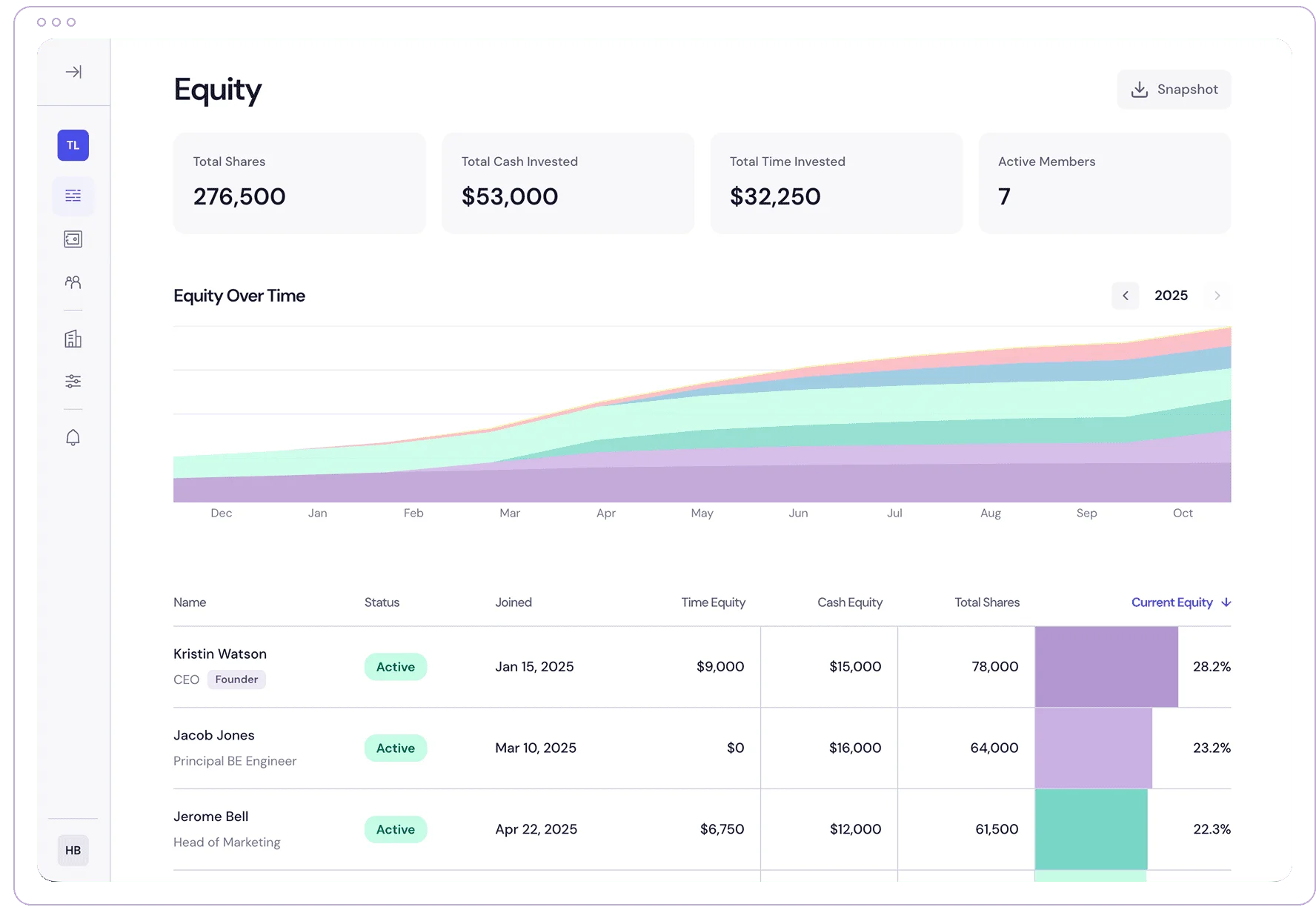
You track contributions over time and let ownership percentages adjust based on what each person actually puts in. When you’re ready (often at first funding), you freeze into a fixed split.
Pros:
- Ownership reflects reality
- Adapts to changing circumstances
- Avoids dead equity if someone leaves
- No awkward upfront negotiation
Cons:
- Requires tracking discipline
- Less familiar to some investors
- Needs clear rules upfront
Best for: Founders with different time commitments, uncertain roles, or any situation where contributions might vary.
Dynamic equity isn’t about avoiding the hard conversation. It’s about having a system that makes the conversation unnecessary.
A Framework for the Conversation
If you’re going the fixed split route, here’s how to approach the discussion. Two-founder teams where one person is technical and one is non-technical face a particular version of this challenge — the leverage imbalance feels real, and it makes the conversation harder. The word-for-word scripts for the technical co-founder equity conversation give you exact language for the moments that feel impossible to navigate.
Step 1: List Everything Being Contributed
Each founder writes down:
- Hours per week they’ll commit
- Cash they’re investing
- Salary they’re giving up
- Skills they’re bringing
- Assets they’re contributing (code, customers, IP)
- Connections or relationships
Be specific. “I’ll work on it” is not useful. “20 hours per week while keeping my job for the first 6 months, then full-time” is useful.
Step 2: Assign Relative Values
You don’t need exact dollar amounts for everything. But you need to agree on relative importance.
Is a year of full-time work worth more or less than $50,000 in cash? Is the CTO’s technical skills more valuable than the CEO’s sales relationships? There are no universal answers, but you need shared answers.
Step 3: Do the Math
Add up each founder’s contributions. Convert to percentages.
If Founder A is contributing 60% of total value and Founder B is contributing 40%, that’s your split. Maybe you round to 55/45 for simplicity. But the conversation started with data, not feelings.
Step 4: Add Vesting and Cliff
Whatever split you agree on, add vesting. Both founders should vest over 4 years with a 1-year cliff.
This protects everyone. If someone leaves after 3 months, they don’t walk away with half the company.
Step 5: Document It
Get it in writing. An operating agreement (for an LLC) or founder agreements (for a corporation). Verbal agreements cause lawsuits.
Common Two-Person Scenarios
Scenario 1: Technical + Business Founder
The most common pairing. One builds, one sells.
Default assumption: 50/50, because both roles are essential.
But consider:
- Who’s going full-time first?
- What’s the market salary difference?
- Who had the original insight?
- Is the MVP already built?
If the technical founder has been building for 6 months before the business founder joins, that’s not a 50/50 situation.
Scenario 2: One Full-Time, One Part-Time
This happens a lot in the early days. One founder quits their job, the other keeps working and helps nights and weekends.
This should not be 50/50. The full-time founder is taking dramatically more risk.
Options:
- Split based on hours (e.g., 70/30 if one works 40 hours and one works 15)
- Use dynamic equity until both are full-time
- Agree on a path to equal ownership when the part-time founder goes full-time
Scenario 3: One Founder Has Capital
Founder A has $100,000 to invest. Founder B has skills but no cash.
Cash should count, but not too much. If Founder A gets 80% because of capital alone, Founder B has no incentive to stay when things get hard.
A reasonable approach: Value cash at 2x time (the Slicing Pie default), but cap how much equity it can represent. Or structure the cash as a convertible note separate from founder equity.
Scenario 4: Friends Starting Together
You’ve known each other for years. You trust each other completely. Why even have this conversation?
Have it anyway. Friendships end over equity disputes. The Zipcar founders were friends. The Facebook co-founders were friends. Documentation protects the friendship.
Famous Co-Founder Disputes: What Went Wrong
Red Flags in Equity Conversations
Watch for these warning signs:
“Let’s just figure it out later.” This never ends well. If you can’t agree now, you definitely won’t agree when there’s money on the table.
“I deserve more because it was my idea.” Ideas are a small part of company value. If someone is anchoring on this, they may not understand what startup success actually requires.
“I don’t care about equity, I just want to build.” This person will care about equity later. Address it now.
Unwillingness to discuss the topic at all. Equity conversations are uncomfortable. If your co-founder refuses to engage, that’s a sign of bigger communication problems.
Using a Calculator vs. Using Your Judgment
Equity calculators (like ours) help structure the conversation. They force you to quantify contributions rather than negotiating from feelings.
But calculators are inputs to a decision, not the decision itself. The final split should feel right to both founders. If the math says 65/35 but you both believe 60/40 is fair, go with 60/40.
The goal isn’t mathematical precision. It’s alignment. Both founders need to feel the split reflects reality and gives them enough ownership to stay motivated for years.
What If You Can’t Agree?
If you can’t reach agreement on equity, you have three options:
1. Keep talking. Sometimes the first conversation doesn’t work. Sleep on it. Come back with fresh perspectives.
2. Bring in a third party. An advisor, lawyer, or mentor can help mediate. Sometimes an outside perspective breaks the deadlock.
3. Don’t start the company together. If you can’t agree on how to split the pie before it exists, you definitely won’t agree when there’s real money involved. A failed co-founder relationship at this stage is better than a failed co-founder relationship after you’ve raised money and hired employees.
The inability to agree on equity is useful information. It tells you something about how you’ll handle future disagreements.
Frequently Asked Questions
What’s a fair equity split for two founders?
A fair split reflects actual contributions: time, capital, skills, existing assets, and risk taken. Equal splits (50/50) work when contributions are genuinely equal, but that’s rare. Most two-founder startups should base the split on a realistic assessment of what each person is putting in, then add vesting to protect both parties.
Should co-founders always split equity equally?
No. Equal splits make sense when contributions are equal, but they’ve become a default that founders choose to avoid difficult conversations. If one founder is working full-time while the other contributes part-time, or one is investing capital while the other isn’t, equal splits create resentment and dead equity problems later.
How do you value a technical co-founder’s contribution?
Consider their market salary (opportunity cost), time commitment, and what they’re building. A senior engineer giving up a $200K salary to work full-time is making a larger sacrifice than a junior developer. If they’re bringing existing code or a working prototype, that has additional value. Use their market rate to calculate sweat equity contribution.
When should two founders use dynamic equity instead of a fixed split?
Use dynamic equity when: one founder starts part-time, contributions will vary over time, you’re uncertain about long-term roles, or you want to avoid negotiation and let the math decide. Dynamic equity tracks actual contributions and adjusts ownership accordingly, then converts to a fixed cap table when you raise funding or the business stabilizes.
The two-person startup is the most common configuration for a reason. Two people can move fast, make decisions quickly, and hold each other accountable. But that only works if the equity foundation is solid.
Get the split right, document it properly, and add vesting. Then stop thinking about equity and start building.
Our equity calculator can help you model different scenarios before you commit to anything.
Ready to split equity fairly?
Equity Matrix tracks contributions and calculates ownership automatically.
Get Started FreeThis article is for informational purposes only and does not constitute legal, tax, or financial advice. Equity Matrix is not a law firm, accounting firm, or financial advisor. Consult a qualified professional for guidance specific to your situation.

Co-founder, Equity Matrix
Sebastian writes about startup equity, founder dynamics, and building fair partnerships.
Keep reading
Co-founders in different countries: how to set a fair rate
When one co-founder is in the US and another is in Lithuania, do you value their time at local rates or the same rate for the same work? How to set GHRR fairly across borders.
Read more →How to track co-founder contributions (before it costs you)
A practical system for tracking co-founder contributions: what to log, how often, the fields that matter, and where spreadsheets start to strain.
Read more →