Freezing a dynamic equity split doesn’t have to mean the end of it. Sometimes the right move is to pause accrual for a while, or for one person, and then let it keep running.
Most founders treat freezing as a one-way door. You track contributions for a year or two, then a lawyer asks for a cap table, and you lock the whole thing in place forever. That’s the version I wrote about in when to convert dynamic equity to a cap table.
But there’s a quieter version that comes up more often, and almost nobody talks about it.
You don’t always want to end dynamic equity. Sometimes you just want to hold it still for a moment.
The difference between pausing and ending
Converting is permanent. You reconcile the records, calculate final percentages, and dynamic equity is done. From then on, ownership only changes through the normal machinery of a cap table: new shares, option grants, dilution.
Pausing is temporary. Accrual stops, the numbers stay where they are, and when the situation passes, contributions start counting again. Nothing is locked. You’re not converting to a fixed cap table, you’re just pressing hold.
The distinction matters because the two solve different problems. Converting answers “we’re done, what did everyone earn?” Pausing answers “something is happening right now that shouldn’t move ownership, so let’s keep it still until it’s over.”
Here are the situations where I’ve found pausing makes sense.
You’re in the middle of raising
The clearest case is a live fundraise.
An investor is running diligence. Their lawyer is modeling ownership. The moment they see a cap table where percentages shift every time someone logs a few hours, they get nervous, and reasonably so. They’re pricing a stake, and a moving target is hard to price.
You don’t necessarily need to convert yet. The round might not close. Terms might change. But you also don’t want the split drifting underneath the negotiation.
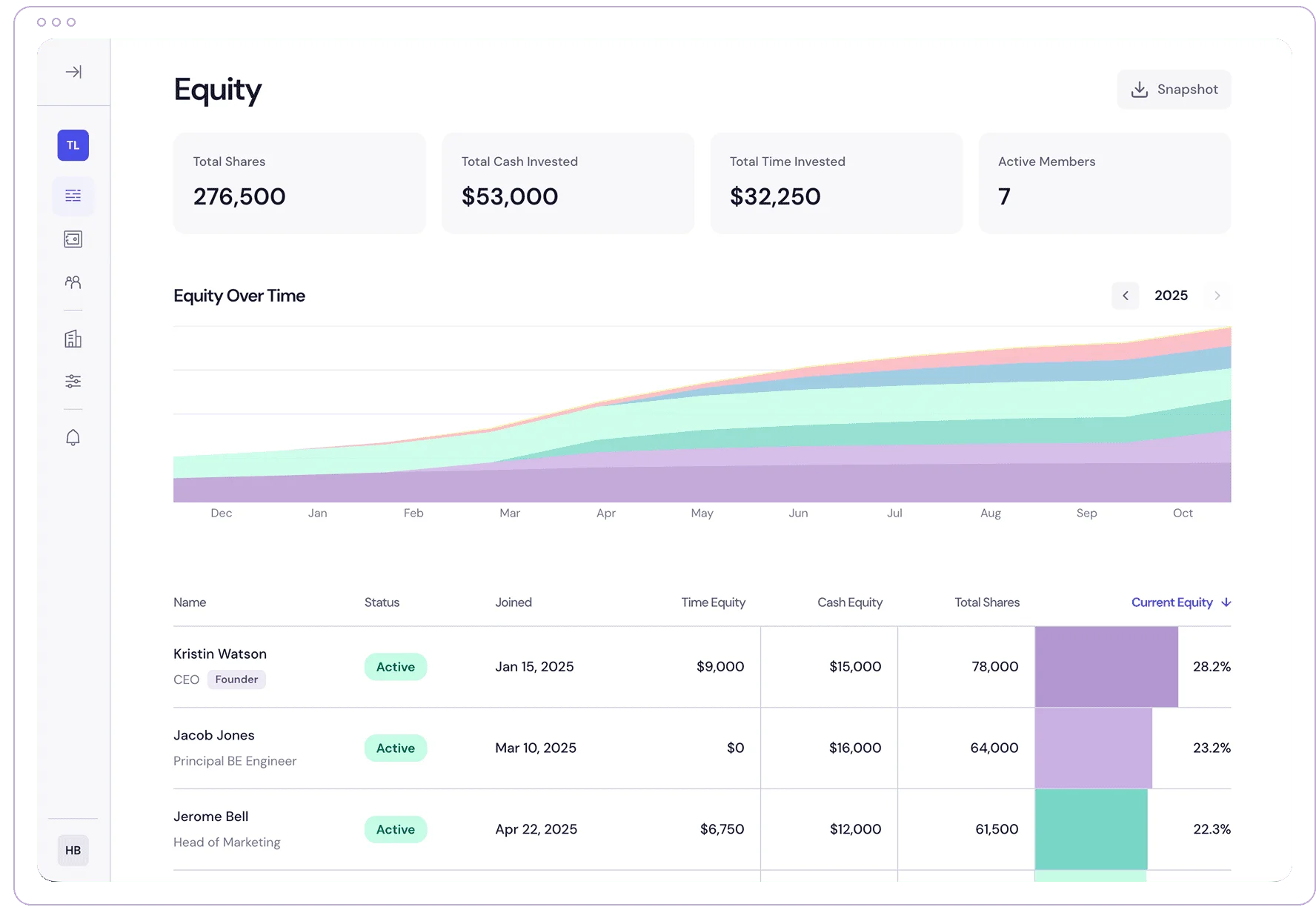
This is where an equity snapshot helps. Instead of committing to a permanent conversion, you capture a moment in time: the split exactly as it stands the day diligence starts. That’s the number the investor’s lawyer models against, and it doesn’t move while the deal is live.
If the round closes, the snapshot becomes your final ownership. That’s your conversion, and it happened at the moment everyone agreed on. If the round falls through, the snapshot was just a picture of one day. You keep tracking contributions in EquityMatrix as if nothing happened, and dynamic equity carries on.
That’s the advantage of a snapshot over a hard freeze. You get the stability an investor needs without betting the whole model on a deal that might not close. Worst case, you took a picture you didn’t end up using.
Someone starts drawing a full salary
This one is subtler, and it applies to a single person rather than the whole team.
Dynamic equity exists to compensate risk. When you work for a struggling company for free, or for less than you’re worth, you’re taking on real financial exposure. Equity is how that risk gets paid back. That’s the whole logic of sweat equity.
But once someone is drawing a full market salary, that logic weakens. They’re being paid for their time in cash, at a fair rate. The risk they were carrying is mostly gone.
“I couldn’t contribute as much this month” stops being a fair reason to earn more ownership when you’re getting paid a market wage to do the job. At that point, continuing to accrue sweat equity means they’re getting compensated twice for the same work.
Pausing that person’s accrual keeps things honest. They keep every share they earned during the risky, underpaid stretch. They just stop adding new ones while the company is paying them properly. If the salary later gets cut during a rough patch, and the risk returns, you can unpause.
This isn’t about punishing anyone. It’s about keeping equity tied to the thing it’s supposed to reward.
An obligation goes unmet
A narrower case: a member commits to something financial and falls behind.
Maybe someone agreed to a buy-in, or to cover a specific cost, and it hasn’t materialized. Letting them keep accruing equity while a commitment sits unpaid can quietly distort the split, and it tends to breed resentment among the people who did follow through.
Pausing accrual until the obligation is met is a cleaner lever than renegotiating the whole agreement. It holds their position steady without taking anything away, and it gives them a clear path back: settle up, and accrual resumes.
I’d use this one carefully. It works best when the obligation was explicit and agreed to in advance, not as a way to relitigate a vague expectation after the fact.
What pausing protects you from
The common thread across all three is that pausing keeps ownership honest during a stretch where letting it move would misrepresent reality.
A fundraise shouldn’t reward whoever happened to log the most hours during diligence. A salaried employee shouldn’t earn risk-based equity on top of a market wage. An unmet commitment shouldn’t quietly accrue ownership. In each case, holding the numbers still, whether through a snapshot or a pause, keeps the line until the situation resolves one way or the other.
It also buys you optionality. A pause is reversible. Converting isn’t. When you’re not sure whether a change is permanent, a temporary freeze lets you wait and see instead of locking in a decision you can’t easily undo. That’s often worth more than it looks, especially early, when a lot is still in flux.
How pausing works in practice
Mechanically, a pause is simple. You agree on a trigger, you stop counting new contributions, and the existing percentages hold.
A few things I’d keep in mind:
- Write down the trigger in advance. “We freeze accrual during any priced round” is a policy. “We froze Dana’s accrual because it felt like time” is a fight waiting to happen. Agreeing on triggers before they occur takes the personal edge off.
- Be clear about scope. Some pauses are company-wide, like a fundraise. Others apply to one person, like a full salary. Make sure everyone knows which one they’re in.
- Decide what unpauses it. A pause with no defined end is really just a slow, undocumented conversion. Name the condition that turns accrual back on: the round closes or dies, the salary gets cut, the obligation gets settled.
- Keep the records clean either way. Whether you pause or convert, the value is in an accurate history of who contributed what. A dynamic equity system is only as trustworthy as the ledger behind it.
When you should actually convert instead
Pausing isn’t always the right answer. Sometimes the situation isn’t temporary, and pretending it is just delays a decision you’ve already made.
If your team has stabilized, everyone’s on salary, and the risk phase is genuinely over, that’s not a pause. That’s the end of dynamic equity, and you’re better off converting cleanly. Same if you’ve closed a round and the cap table is now formal. The conversion process exists for exactly these moments.
The test I use: is this a moment, or a new chapter? Pause the moments. Convert the chapters.
Getting that distinction wrong in either direction causes problems. Convert too early and you kill a system that was still doing useful work. Pause something that should have been a conversion and you leave the split in a permanent state of “we’ll deal with it later,” which is how dead equity and stale cap tables happen.
The bottom line
Freezing your equity split doesn’t have to be a funeral. Most of the time it’s closer to a pause button than an off switch.
When a raise is live, when someone moves onto a full salary, when a commitment goes unmet, holding accrual still keeps ownership tied to reality without forcing an irreversible decision. And when the situation clears, you pick up where you left off.
Dynamic equity is supposed to reflect what’s actually happening. Sometimes what’s actually happening is “wait.” Pausing is how you say that without giving up the flexibility that made the model worth using in the first place.
Ready to split equity fairly?
Equity Matrix tracks contributions and calculates ownership automatically.
Get Started FreeThis article is for informational purposes only and does not constitute legal, tax, or financial advice. Equity Matrix is not a law firm, accounting firm, or financial advisor. Consult a qualified professional for guidance specific to your situation.

Co-founder, Equity Matrix
Sebastian writes about startup equity, founder dynamics, and building fair partnerships.
Keep reading
The state of equity distribution: how ownership actually splits
We mapped how startup equity really splits across investors, founders, and the option pool from seed to Series C, and where employees quietly get diluted out.
Read more →Equity for your first SaaS hire: how much to give
Your first hire is the hardest equity decision after the co-founder split. Here's how to structure it so you attract the right person without giving away too much.
Read more →