Two co-founders, same job, different countries. One’s a senior engineer in San Francisco, the other’s an equally senior engineer in Vilnius. When you track their contributions to figure out equity, do you value an hour of their work the same, or do you pay the local market rate for each? It sounds like a technicality. It’s actually one of the most consequential decisions a distributed founding team makes, because in a contribution-based model, the rate you assign to someone’s time directly determines how much of the company they earn.
Get it wrong and you either quietly underpay a founder into a smaller stake than they deserve, or you overpay in a way the other founder resents. Neither is a good place to start a company.
Here’s how we think about it, and why we land where we do.
Why the rate matters so much here
In a dynamic equity model, ownership tracks contribution. Time is usually the biggest contribution, and time is valued at a person’s fair market rate, their GHRR: roughly their fair-market annual salary divided by 2,000 hours. In the standard model, the uncompensated value someone contributes is then multiplied (commonly 2x for unpaid time) to reflect the risk of working without pay, and that’s what converts into ownership.
The point for our purposes is simpler than the mechanics: the rate you assign is the exchange rate between someone’s hours and their equity. If your Vilnius co-founder’s hour is valued at half your San Francisco co-founder’s hour, then the same hours on the same problems earn roughly half the ownership. Over a couple of years of full-time work, that compounds into a meaningfully smaller stake for the same contribution.
That’s why the geography question deserves real thought instead of defaulting to whatever’s easiest to look up.
The case for local market rates
The argument for paying each person their local rate is a serious one, and it’s worth stating at full strength before disagreeing with it.
Fair market value is usually defined by the labor market actually available to a person. Your Vilnius co-founder’s real alternative to working on your company is a Vilnius salary, not a San Francisco one. So their opportunity cost, what they’re giving up to be here, is the local number. A grunt-fund model is arguably meant to measure exactly that forgone compensation, not the abstract output value of the work. By this logic, valuing their time at a San Francisco rate credits them equity for pay they could never actually have commanded, which overstates what they gave up.
This isn’t a claim that their work is worth less. A local-rate advocate can fully agree the code is equally valuable and still argue that equity should track forgone compensation, and that forgone compensation is genuinely lower for someone in a lower-cost market.
If you were employing people, this logic would carry real weight. Plenty of remote companies pay location-adjusted salaries, and it’s a defensible way to run payroll.
Why we don’t buy it for co-founders
The opportunity-cost logic is coherent, but I think it’s the wrong frame for founders, for a few reasons.
The first is what a founding stake is actually for. An early employee is trading their time for pay, so measuring their forgone salary makes sense. A co-founder is committing to build and own the company. The rate you plug in is a choice about what the model should reward, and for founders I’d rather it reward the building than the local price of the builder. Two people building the same thing, side by side, are putting in comparable work. Anchoring one of them to a lower local salary band means the rate, and so their ownership, starts tracking their old labor market instead of the company they’re now creating together.
There’s also a durability problem. A local reference point bakes in an assumption that ages badly: that your Vilnius co-founder stays in Vilnius, stays cheaper, and so should own less of a company you may run together for a decade. People move. Cities converge. A stake earned over years shouldn’t be pinned to where someone happened to sit in year one.
And there’s the relationship. Even if the opportunity-cost math is defensible, a co-founder who realizes two years in that identical work earned them a smaller stake because of their location will tend to read it as being treated like the cheaper hire, not the equal partner they were told they were. Whether or not that reaction is “correct,” it’s common enough that it’s worth designing around. It’s the kind of quiet mismatch that strains founding teams.
So our stance is straightforward: value the work, not the geography. For co-founders doing comparable work, use a comparable rate. We’d rather the model slightly over-credit the lower-cost founder than slowly convince them they were never really a partner.
What “value the work” actually means in practice
“Same rate for same work” is the principle. Applying it takes a little more nuance than setting every founder to the same number.
Anchor on the role, not the person’s location. Ask what a person doing this role, at this level, is worth to the company. That’s the rate. A senior engineer’s GHRR should reflect what senior engineering is worth to you, whether they’re in California or Kaunas.
Use a market you can defend, and use it for everyone. The cleanest approach is to pick one reference market for each role, usually the market where the company is based or raises money, and apply it consistently. If you’re a US-incorporated startup, US market rates for each role are a reasonable, consistent yardstick. What you want to avoid is a different yardstick per person.
Rate the role level honestly. This is where real differences belong. If one engineer is genuinely more senior or carries more scope, that difference should show up in their rate. That’s a difference in contribution, not geography, and it’s exactly what the rate is supposed to capture. Don’t flatten real seniority differences in the name of fairness, and don’t invent geographic ones.
Write down why. Whatever rate you assign each founder, record the reasoning, because “we valued the role at X” is a much better answer in year three than “I think we picked that?” The Slicing Pie calculator has a market-rate lookup that gives you a defensible starting point per role.
Where local reality still fits
Valuing contribution at a consistent rate doesn’t mean pretending cost of living doesn’t exist. It means handling it through cash rather than through the rate.
If your Vilnius co-founder needs to pay rent while the company is pre-revenue, that’s a cash compensation question. You might agree to pay them a modest salary to live on. In a grunt-fund model, paying someone reduces the uncompensated value they’re contributing: they earn slices on the gap between their fair-market rate and what they’re actually paid, so every dollar of cash they receive shrinks that gap (and, once the time multiplier is applied, reduces their slices by more than a dollar’s worth).
Be honest with your team about what this means, because it’s the subtle part. Taking cash trades away some equity, and that’s true for any founder who draws a salary, not just the one abroad. What you’re avoiding is the other thing: quietly assigning the lower-cost founder a lower rate, so they earn less ownership for the same work even before any cash changes hands. Keep the rate consistent, and treat cash draws as a separate decision the team agrees on. A founder who needs to live on some salary gives up some equity for that, as a deliberate trade, rather than having a smaller stake imposed by their zip code.
Cash can be local. The rate shouldn’t be.
The short version
When co-founders are in different countries and doing comparable work, resist the instinct to plug in local salaries. Value the role consistently, let genuine seniority differences show up in the rate, and handle cost-of-living through cash rather than by shrinking someone’s ownership.
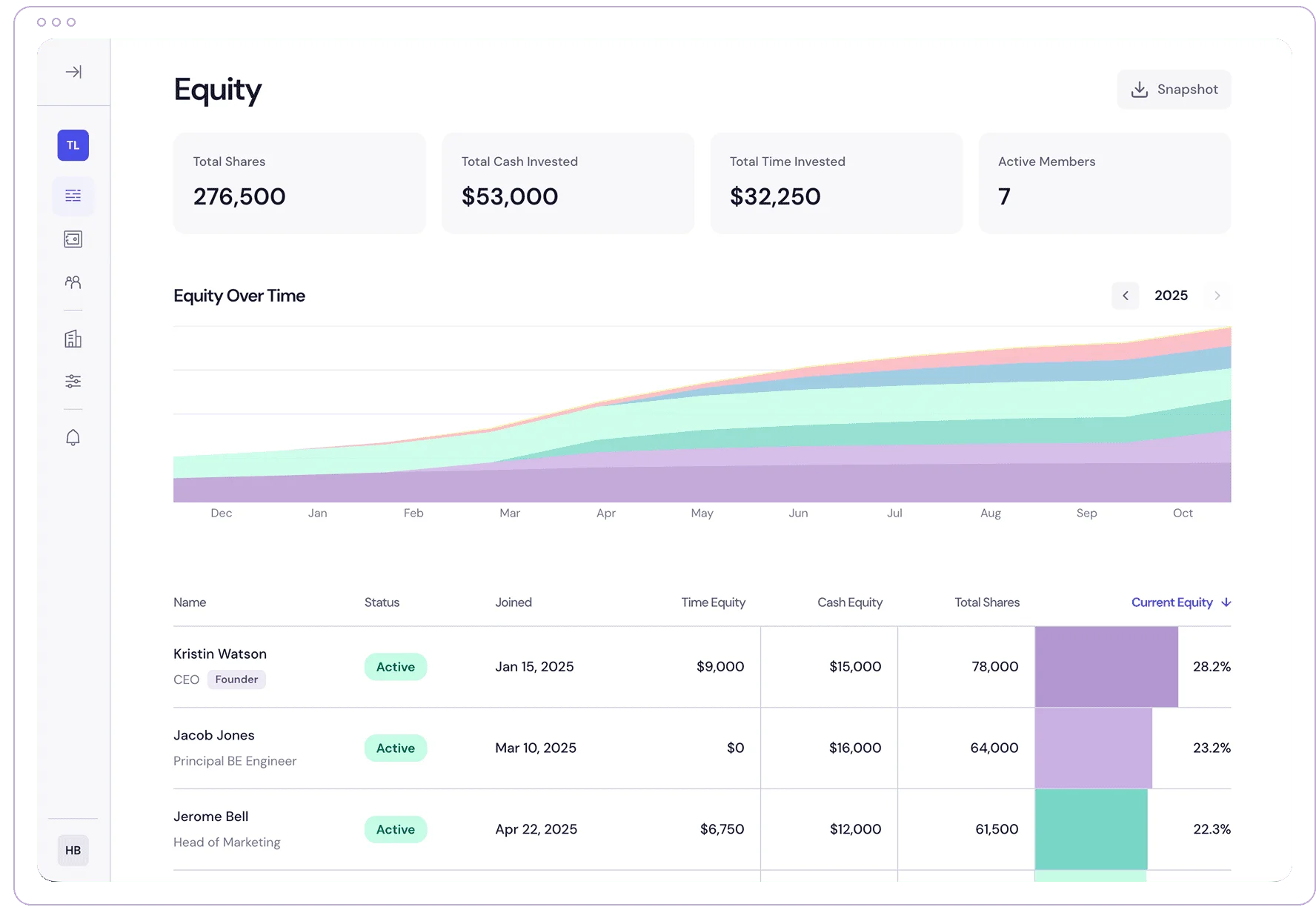
Dynamic equity only works if the rate honestly reflects contribution. A co-founder’s contribution doesn’t get smaller because they crossed a border. If you want to keep every founder’s rate and contributions in one place instead of arguing about it later, that’s what Equity Matrix is built for.
Frequently asked questions
Should co-founders in different countries be valued at the same rate? For comparable work at a comparable level, yes. In a contribution-based model, the rate you assign to someone’s time determines how much equity they earn, so using a lower local rate for equal work means less ownership for the same contribution. Value the role consistently rather than by location.
What about big cost-of-living differences? Handle those through cash, not the rate. Keep each founder’s rate consistent for their role, and if someone needs a salary to cover living costs, pay it. In a grunt-fund model they then earn equity on the gap between their rate and their pay, so drawing cash reduces their equity accrual. That’s a trade any founder taking a salary makes, and it’s a better way to reflect cost of living than quietly assigning a lower rate.
Doesn’t paying a US rate to someone abroad overpay them? For payroll, maybe. For equity, you’re not paying a salary, you’re measuring how much someone contributed to the company’s value. Identical work adds identical value regardless of where it was done, so the contribution rate should match.
How do we set a defensible rate for each role? Pick one reference market (often where the company is based) and apply it consistently across founders, adjusting only for genuine differences in role and seniority. Our Slicing Pie calculator includes a market-rate lookup to give you a starting point per role.
Will investors expect location-based numbers? The rates you assign feed your contribution model; they aren’t line items on a conventional cap table. In our experience what a diligent investor actually probes is whether the resulting split reflects who built the company. A split that tracks real contribution tends to be easier to defend than one that discounted a founder for living somewhere cheaper.
Ready to split equity fairly?
Equity Matrix tracks contributions and calculates ownership automatically.
Get Started FreeThis article is for informational purposes only and does not constitute legal, tax, or financial advice. Equity Matrix is not a law firm, accounting firm, or financial advisor. Consult a qualified professional for guidance specific to your situation.

Co-founder, Equity Matrix
Sebastian writes about startup equity, founder dynamics, and building fair partnerships.
Keep reading
How to track co-founder contributions (before it costs you)
A practical system for tracking co-founder contributions: what to log, how often, the fields that matter, and where spreadsheets start to strain.
Read more →How to add a partner to an existing business
Adding a partner to a business you already own? Here's how to structure the deal, value the business, and protect yourself legally.
Read more →