Plenty of founding teams split the equity on day one, shake hands, and never look at contributions again. When we studied public equity-split discussions, the teams in that dataset posting about disputes were overwhelmingly the ones who never tracked anything. A split you agree to on day one is a guess about the future, and the future usually has other plans.
One person goes full time while the other keeps their job for another eight months. One writes a check to cover payroll. One does all the selling. Six months in, the 50/50 on paper no longer matches the 70/30 that actually happened.
If you want ownership to reflect what people put in, you have a decision to make: track contributions, or accept that the split is a guess. This post is about doing the first thing without it becoming a second job. It’s model-neutral, so it works whether you run Slicing Pie, a lighter contribution model, or your own house rules.
What actually counts as a contribution
Before you track anything, agree on what you’re tracking. Most teams under-count, because the obvious contribution (hours worked) is only one of several.
The four that matter for most early teams:
- Time. Hours worked, valued at each person’s fair market rate. A designer’s rate and a CTO’s rate usually differ, and most contribution models value time at market rate rather than treating every hour as identical. If you’re not sure what rate to use, our Slicing Pie calculator has a market-rate lookup built in.
- Cash. Money put into the business. There’s a wrinkle worth deciding up front: cash you’ll likely never get back (covering payroll, paying for legal) carries more risk than a loan you expect repaid, so most models weight it more heavily.
- Sales and commissions. If someone closes revenue and forgoes the commission a normal rep would take, that forgone commission is a real contribution.
- Assets. Equipment, transferable IP, a domain someone bought two years ago. These count at an agreed value, and only where the asset or rights are genuinely being contributed to the company. A pre-existing customer list is the tricky one, since it depends on who owns it and whether it can legally be transferred.
You don’t have to get the weighting perfect on day one. Agree on the categories, agree on how you’ll value each, and start writing things down. (For why cash and time get weighted differently, dynamic equity is easier than you think walks through the logic.)
The fields worth logging
The most common tracking mistake is logging too little to be useful later. “8 hours” in a cell tells you nothing in six months. Here’s a record structure that holds up:
| Field | Example | Why it matters |
|---|---|---|
| Date | 2026-09-12 | Anchors the entry in time; makes weekly review possible |
| Contributor | Priya | Who earned it |
| Category | Time | Time / cash / sales / asset |
| Amount | 8 hrs | The raw quantity |
| Valuation basis | $60/hr rate | How the amount converts to value |
| Description | Rebuilt onboarding flow | What the equity was actually earned for |
That last column does more work than it looks. A dated, described entry is something you can point to in a disagreement. A bare number is something you argue about.
The habit that makes or breaks it
The tracking mistake that sinks teams isn’t a bad formula. It’s trying to reconstruct three months of work from memory.
Memory is uneven. You’ll remember the big pushes and forget the ten quiet Saturdays. The person who talks more tends to remember more of their own effort. And once the numbers start to feel made-up, the system loses the trust it needed to be worth anything.
So the skill isn’t the spreadsheet. It’s the cadence.
Log weekly, not monthly. A week is short enough that you still remember it and long enough that it isn’t annoying. Pick a day. Friday afternoon tends to work, since you’re already reviewing the week.
Do it together. Ten minutes, both of you, once a week. It keeps everyone honest and surfaces the “wait, you spent how long on that?” conversations while they’re small. This is a social practice, not a formal dispute-resolution process, but for a two- or three-person team it catches most of what would otherwise fester.
Capture the description, not just the hours. See the table above. Future-you will want to know what an entry was for.
Get the cadence right and the tool almost doesn’t matter for a while. Get it wrong and no tool will save you.
Where the spreadsheet starts to strain
Most teams start in Google Sheets, and early on it’s genuinely fine. I’ve started there myself. It tends to get tested when the stakes rise, and the strain shows up in a familiar order.
Shared editing is a liability. Sheets does keep version history, so it’s not that edits vanish. The problem is that anyone with edit access can change last month’s numbers, permissions are usually broader than you’d want for your most important financial record, and reconstructing “who changed what and why” from version history is a chore nobody does until there’s already a fight.
The math gets fragile. Weighting cash against time, applying multipliers, keeping percentages that always sum to 100, updating it weekly for three people. That’s a lot of formulas, and formulas break quietly. One dragged cell and the ownership numbers are wrong for a month before anyone notices.
The hard cases are all manual. Someone joins six months in. A co-founder steps back but doesn’t fully leave. You want a cliff so nobody walks with meaningful ownership after three weeks. A spreadsheet can model these, but each one is a hand-built rebuild. And a model is not a legal instrument: a cliff in your sheet records how you intend to treat someone’s stake, but making it enforceable takes the right agreements, not a formula. (Pausing equity is worth reading before you hit that one.)
None of this makes spreadsheets wrong. It makes them a good place to start and a risky place to still be when real money is attached.
What tracking looks like in a tool built for it
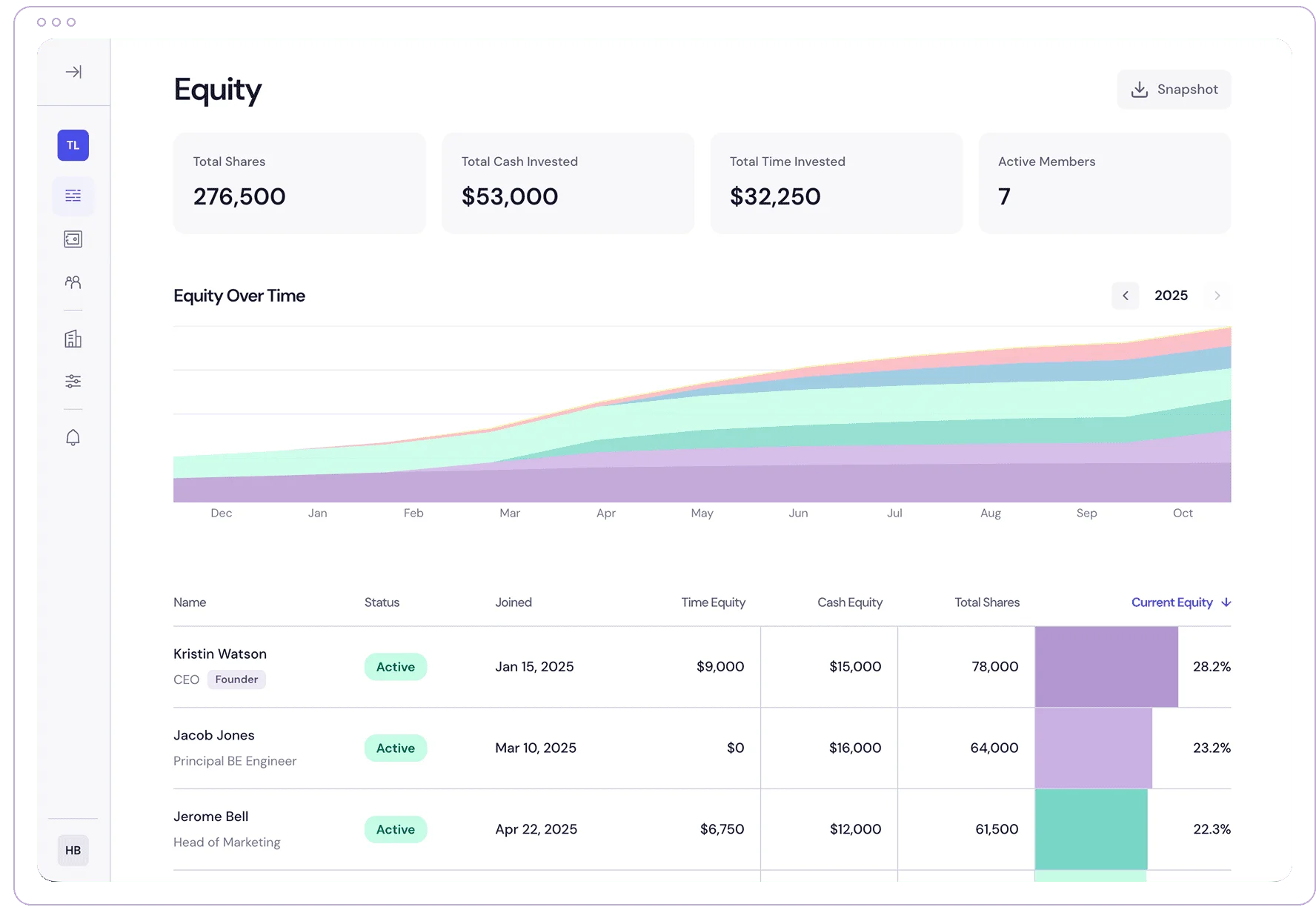
We built Equity Matrix because we kept hitting these walls ourselves. The app is designed around the tracking habit rather than bolted on after.
You set your framework once and invite your team. From then on, each person logs their own contributions as work happens, and an activity feed keeps a shared, timestamped record everyone can see, so it isn’t one person’s private spreadsheet. The split recalculates on its own, so it stays current. And the app generates a plain-language equity framework document you can export and take to your team and your lawyer.
Two honest caveats, because they matter. The generated framework is a starting document, not legal advice; you should have counsel review it before anyone signs. And a shared feed is more trustworthy than a spreadsheet only up to a point. The app isn’t magic. The habit is still the hard part. A tool just makes logging fast enough that you actually keep it up.
Start small, but start
You don’t have to solve all of this today. Three things this week will do:
- Agree on what counts as a contribution and how you’ll value each category.
- Pick a day and log the last week, together, using the fields above.
- Do it again next week.
A team that tracks imperfectly is in far better shape than one that tracks nothing and discovers the split was wrong two years too late.
Frequently asked questions
How often should we log contributions? Weekly tends to be the sweet spot. It’s recent enough to remember accurately and infrequent enough that it stays a ten-minute habit rather than a chore. Monthly usually turns into guesswork.
Should we estimate hours or track them precisely? Honest estimates logged weekly beat precise numbers logged from memory three months later. Don’t let the pursuit of perfect timekeeping stop you from logging at all.
What if we disagree about an entry? Handle it in the weekly review while it’s small. Because entries are dated and described, you’re debating a specific record rather than two people’s memories, which is a much easier conversation.
Is a spreadsheet ever enough? For a two-person team in month one, yes. The question is whether you’ll still trust a shared, editable sheet once there’s real money and a third person involved. That’s usually when teams move to something purpose-built.
Ready to split equity fairly?
Equity Matrix tracks contributions and calculates ownership automatically.
Get Started FreeThis article is for informational purposes only and does not constitute legal, tax, or financial advice. Equity Matrix is not a law firm, accounting firm, or financial advisor. Consult a qualified professional for guidance specific to your situation.

Co-founder, Equity Matrix
Sebastian writes about startup equity, founder dynamics, and building fair partnerships.
Keep reading
Co-founders in different countries: how to set a fair rate
When one co-founder is in the US and another is in Lithuania, do you value their time at local rates or the same rate for the same work? How to set GHRR fairly across borders.
Read more →How to add a partner to an existing business
Adding a partner to a business you already own? Here's how to structure the deal, value the business, and protect yourself legally.
Read more →