When you pay a contractor in equity instead of cash, the honest exchange rate isn’t one-for-one. Work worth $10,000 should convert to something more like $20,000 of equity, because equity carries risk that cash doesn’t.
You need a developer, a designer, or a fractional operator, and you can’t cover their full rate in cash. So you offer equity to make up the gap. The question everyone asks first is “how much?” — and the honest answer starts with a different question: what is their work actually worth, and how much should you gross it up to account for the fact that you’re paying them in something that might be worth nothing?
Start with the cash value, then apply a risk multiplier
The clean way to size a contractor’s grant is not to pull a percentage out of the air. It’s to take the cash value of the work they’re doing and convert it into equity using a multiplier.
The logic is straightforward. Cash is certain. Equity is a bet on a company that might fail. So a dollar of at-risk equity is worth less to the person receiving it than a dollar of cash, which means you have to offer more of it to make the trade fair. In the Slicing Pie model, the standard is that time and non-recoverable work convert at roughly 2x, and cash someone puts in (the most at-risk contribution of all) converts at up to 4x. A contractor forgoing their fee is effectively contributing at-risk value, so you gross up their normal rate before turning it into equity.
That’s the counterintuitive part founders trip on: yes, you’re “giving away more” than the cash you saved, and that’s by design. They’re taking on your risk. If the company works, they earned it. If it doesn’t, they worked for shares worth nothing.
Want to model this against real numbers instead of guessing? The Slicing Pie calculator lets you plug in hours, rate, and multiplier and see the resulting split.
What the percentages usually look like
Once you’ve converted the cash value to equity, the resulting percentage depends heavily on what the contractor is doing and how early you are. As rough rules of thumb — not benchmarks — the ranges people cite tend to land around:
- Building the actual product (a functional prototype, core engineering): up to ~5%.
- Marketing, sales, or services work: roughly 0.1%–1%.
- A fractional executive (like an outside CFO): around 0.5%–2%.
The earlier and more pre-revenue you are, the higher these drift, because your equity is worth less and your need is greater. A common founder shorthand is 1–2% if you’re already profitable and 5–10% if you’re pre-revenue and genuinely can’t function without the help. Treat all of these as starting points to sanity-check the number your multiplier math produced, not as targets to hit.
A contractor is not an advisor, and not an employee
It’s worth being precise here, because the frameworks don’t transfer.
Advisors get equity through structures like the FAST agreement, typically 0.15%–1% for ongoing strategic guidance, vesting over about two years. That framework is explicitly designed for advice, not for work-for-hire. A contractor building your app is doing defined, deliverable work, which is a different thing.
Employees typically get more than a comparable contractor would, because you’re also buying retention and alignment. See our employee equity benchmarks for those ranges. A contractor is transactional by design: they deliver a scope and move on.
So don’t reach for an advisor grant or an employee grant and apply it to a freelancer. Size it from the work.
Vest it to the delivery
A one-time equity grant to someone doing multi-week work is a mistake. If they vanish after two weeks with a full grant, you’ve created dead equity: a stake owned by someone who did almost nothing, cluttering your cap table forever. We wrote a whole piece on why dead equity quietly kills startups.
Instead, tie the equity to delivery:
- Time-based, if it’s an ongoing engagement — monthly or weekly vesting over the length of the project.
- Milestone-based, if the work ships in chunks — a slice of equity per deliverable, sized to that milestone’s importance.
- Hybrid, for a mix of both.
The point is that the equity should arrive as the value does, not before.
The legal traps that catch founders
This is where equity-for-services gets genuinely dangerous, and where cash would have been simpler. Three things to know before you sign anything.
You often legally cannot pay a contractor’s company in equity. The federal exemption most startups rely on to issue compensatory equity (Rule 701) only covers natural persons. If your freelancer bills through an LLC, an S-corp, or an agency, you generally can’t grant the equity to that entity under the safe harbor. The grant has to go to the human, personally. Getting this wrong is one of the most common compliance failures, and it can create rescission rights and derail a future financing.
The tax timing depends on the instrument. Under IRC Section 83, transferred restricted stock for services is generally ordinary income as it vests unless a valid 83(b) election accelerates tax to the transfer date. Nonqualified stock options are generally taxed at exercise, and RSUs at settlement. You cannot make an 83(b) election for a bare option or an unfunded RSU; an election may apply to restricted stock acquired through an early exercise. Your contractor needs instrument-specific tax advice before accepting the award.
A 409A appraisal is not universal. Section 409A matters when an award creates nonqualified deferred compensation—for example, an option priced below fair market value. An independent 409A appraisal is a common safe harbor for option pricing, not a requirement for every equity grant. Have counsel and a tax advisor determine the instrument, its fair-market-value support, and whether Section 409A applies.
When you should just pay cash
Sometimes the answer is that equity is the wrong tool. If the engagement is a defined, one-time job with a clear end, most advisors will tell you to pay cash and keep your cap table clean. Every point you hand out today is a point you don’t own at your next raise, at an acquisition, or when profits get distributed. A freelancer who did a two-week project shouldn’t own a piece of the company a decade later.
Equity makes sense when you genuinely can’t afford the cash and the person’s contribution is significant enough to be worth the ongoing complexity. If it’s a small, well-scoped job, the cleaner move is to find the cash.
The bottom line
Size a contractor’s equity from the cash value of their work, grossed up by a risk multiplier, then vest it to the delivery. Keep it small enough to protect your cap table, and get the Rule 701, 83(b), and 409A details right before you grant anything.
Frequently asked questions
How much equity should I give a freelance developer?
Start from the cash value of their work and apply a risk multiplier (around 2x for time-based work), then convert that to a percentage of your company. For core product work at an early, pre-revenue startup, the resulting grant often lands somewhere up to a few percent. But the right number comes from the math, not a fixed rule.
Is contractor equity taxable?
Generally, compensatory equity produces taxable income, but timing is instrument-dependent: restricted stock is generally taxed at vesting unless a timely 83(b) election accelerates tax to transfer, NSOs at exercise, and RSUs at settlement. A bare option or unfunded RSU is not eligible for an 83(b) election.
Can I give equity to my contractor’s LLC?
Usually not under the Rule 701 exemption, which only covers natural persons. The grant generally has to go to the individual personally. Getting this wrong can create serious problems in a future financing, so confirm the structure with a lawyer.
Should I pay a contractor in equity or cash?
Cash is cleaner and keeps your cap table tidy. Equity makes sense when you genuinely can’t afford the cash and the contribution is large enough to justify the added legal and tax complexity. For small, one-off jobs, pay cash.
Ready to split equity fairly?
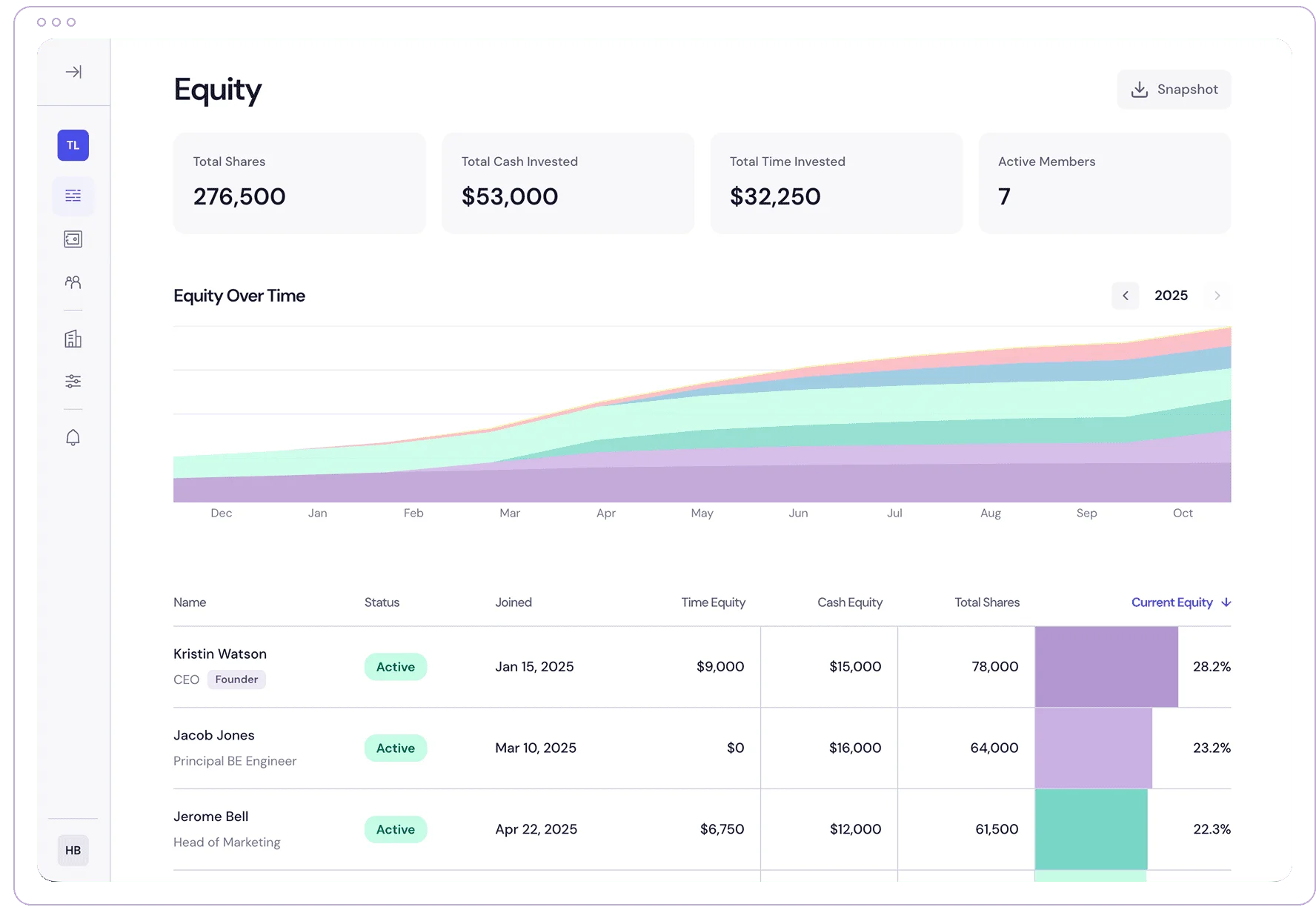
Equity Matrix tracks contributions and calculates ownership automatically.
Get Started FreeThis article is for informational purposes only and does not constitute legal, tax, or financial advice. Equity Matrix is not a law firm, accounting firm, or financial advisor. Consult a qualified professional for guidance specific to your situation.

Co-founder, Equity Matrix
Sebastian writes about startup equity, founder dynamics, and building fair partnerships.
Keep reading
Sweat equity in small businesses: how to value time
When one business partner invests time and the other invests money, how do you split ownership fairly? A practical guide for LLCs and partnerships.
Read more →Buy back your time with dynamic equity
Dan Martell teaches founders to buy back their time by delegating. But how do you compensate the people who take that work off your plate when you can't afford salaries? Dynamic equity.
Read more →