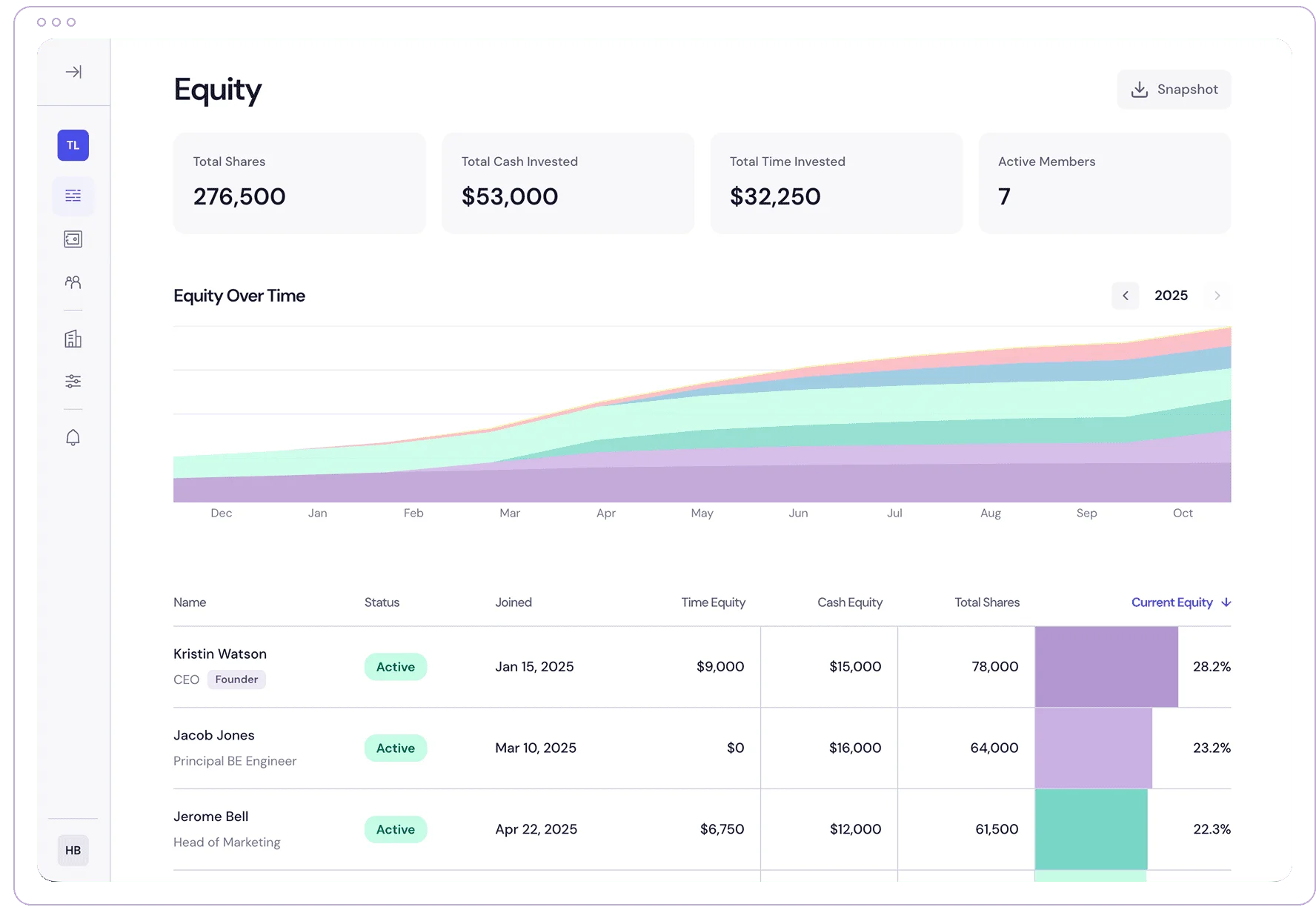
When one business partner puts in the money and the other puts in the work, figuring out who owns what is one of the hardest conversations in small business. The cash partner thinks their investment should count for more. The working partner thinks 60-hour weeks should count for more. Both are right. Neither knows how to put a number on it.
This isn’t a startup problem. This is an LLC problem. A restaurant problem. A real estate problem. A “my buddy and I started a business” problem.
And unlike the startup world, where there’s a whole ecosystem of lawyers, investors, and accelerators pushing founders toward structured equity agreements, most small business partners are figuring this out on their own. Often after the resentment has already started building.
If one partner isn’t pulling their weight and nothing was ever written down about how time translates to ownership, you’re in a harder spot than if you’d spent an afternoon on this before you signed the lease.
Here’s how to value sweat equity in a small business so the split actually reflects who’s doing what.
What sweat equity means in a small business
In a small business, sweat equity is the ownership a partner earns by contributing labor instead of cash. One partner puts up the money. The other partner runs the business. The sweat equity is what the working partner’s effort is worth in ownership terms.
This shows up constantly in partnerships where one person has capital and the other has skills:
- A contractor and an investor start a renovation business. One funds the projects, the other manages them.
- Two friends open a restaurant. One puts in $100,000. The other quits their job to run it.
- A marketing consultant and a developer build an agency. One brings the clients, the other does the work.
In each case, both partners are contributing something real. The question is how much ownership each contribution is worth. For the formal definition and how sweat equity works in a startup context, there’s a separate guide. This post is about the messier, less documented world of small business partnerships.
Put a number on sweat equity.
Enter cash and time contributions to see what a fair ownership split looks like.
Try the calculator →Why the 50/50 default doesn’t work here
Most partnerships start at 50/50 because it feels equal. And when both partners are putting in roughly the same time and money, it is.
But sweat equity situations are inherently unequal by design. That’s the whole point. One person contributes capital. The other contributes labor. These contributions carry different risk profiles:
The cash partner’s risk: They can lose their investment. If the business fails, that money is gone. But that risk is capped at the amount invested, and the cash partner can walk away without the business collapsing.
The working partner’s risk: They’re investing time that could be spent earning a salary elsewhere. If the business fails, they’ve lost months or years of income. Their risk is ongoing — they can’t “invest” the time and walk away. They have to keep showing up.
A 50/50 split ignores these differences. It assumes that $100,000 in cash and a year of full-time work are worth exactly the same amount. Maybe they are. Maybe they aren’t. The point is that you should calculate it, not assume it.
A fair partnership doesn’t mean everyone gets the same slice. It means everyone gets a slice that matches what they put in.
How to put a dollar value on time
The core question: what is a partner’s time worth in ownership terms?
Method 1: Opportunity cost
What would the working partner earn if they took a regular job instead? That’s their opportunity cost, and it’s the most defensible number.
If the working partner could earn $90,000 a year managing someone else’s restaurant, then their year of sweat equity is worth at least $90,000 in contribution value. You don’t need to debate whether their time is “worth it.” The market already answered that question.
| Working partner’s market salary | Monthly contribution value | Annual contribution value |
|---|---|---|
| $60,000 | $5,000 | $60,000 |
| $90,000 | $7,500 | $90,000 |
| $120,000 | $10,000 | $120,000 |
| $150,000 | $12,500 | $150,000 |
Where to find market rates: Bureau of Labor Statistics (bls.gov) for standard roles, or look at job postings for comparable positions in your area. Use the total compensation number (salary plus benefits), not just base pay.
Method 2: Replacement cost
What would it cost to hire someone to do the working partner’s job? This is similar to opportunity cost but approaches it from the business’s perspective.
If the business would need to pay a general manager $75,000 plus benefits to do what the working partner does, that’s the replacement cost.
For highly skilled partners, replacement cost is usually lower than opportunity cost. A corporate lawyer running a small business is worth more on the open market than what a small business would pay a manager. For partners with niche, hard-to-replace skills, replacement cost can actually be higher.
Method 3: The multiplier approach
Some partnerships apply a multiplier to the working partner’s time to account for risk. The logic: working for equity is riskier than working for a paycheck. There’s no guaranteed return.
Common multipliers range from 1.5x to 2x. If the working partner’s market rate is $80,000/year, a 2x multiplier values their annual contribution at $160,000.
Whether to use a multiplier is a negotiation. The cash partner will argue against it (their cash doesn’t get a multiplier, why should time?). The working partner will argue for it (cash can be redirected or recovered if the business is sold; time, once spent, is gone forever).
One reasonable middle ground: apply a multiplier to time and a smaller one to cash (say 1x-1.5x), reflecting the opportunity cost of tying up capital in a small business rather than investing it elsewhere.
Calculating the actual split
Once you’ve agreed on how to value each partner’s contributions, the math is straightforward.
Ownership percentage = Partner’s total contributions / All partners’ total contributions
Example: Restaurant partnership
- Partner A invests $150,000 cash
- Partner B works full-time for the first year, valued at $90,000 (opportunity cost method)
- No multipliers applied
After year one:
- Partner A’s contributions: $150,000
- Partner B’s contributions: $90,000
- Total: $240,000
- Partner A owns: 62.5%
- Partner B owns: 37.5%
After year two (Partner B works another full year, Partner A invests no additional cash):
- Partner A’s contributions: $150,000
- Partner B’s contributions: $180,000
- Total: $330,000
- Partner A owns: 45.5%
- Partner B owns: 54.5%
Notice what happened: the working partner’s ownership overtook the cash partner’s. The cash was a one-time contribution. The labor is ongoing. Over time, ongoing contributions accumulate.
One limitation of this simple model: it doesn’t account for the time value of money or returns generated by the cash investment. Partner A’s $150,000 may have funded the revenue that made year two possible. Some partnerships address this by crediting an annual return rate (say 5-8%) to cash contributions, so the cash partner’s contribution total grows modestly each year.
This is exactly how dynamic equity works. Instead of guessing at the right split upfront, you track contributions and let the math determine ownership. The equity calculator automates this — log contributions weekly, and the ownership percentages update automatically.
A note on multipliers and the math
If you apply the same multiplier to both cash and time, the ownership percentages stay identical. Multipliers only shift the split when applied unevenly. The Slicing Pie model, for example, defaults to 4x on cash and 2x on time, which tilts ownership toward the cash partner.
What counts as a contribution (and what doesn’t)
Those calculations only work if both partners agree on what counts as a contribution in the first place. Not everything a partner does is worth tracking. Set clear rules upfront.
Should count
- Hours worked on the business. Running operations, serving customers, managing employees, doing the books. Actual work that the business needs done.
- Cash invested. Money put into the business for expenses, inventory, equipment, or operating costs.
- Equipment or assets. A partner’s truck used for the business, a commercial kitchen they own, office space they provide. Value at fair market price, not what they paid for it.
- Specific, documented business development. Landing a contract, closing a deal, securing a critical vendor relationship — with a pre-agreed value.
Should not count
- “The idea.” Ideas are worth almost nothing compared to execution. If someone contributed the concept, give it a small fixed value and move on.
- Thinking about the business. Brainstorming in the shower doesn’t count. Only trackable, verifiable work counts.
- Vague “networking” or “being available.” Unless it results in a specific, measurable outcome.
- Work that wasn’t agreed upon. If one partner repaints the office without discussing it, that’s not automatically a tracked contribution.
Write these rules into your partnership agreement. If it’s not in the agreement, it doesn’t count.
The salary question: should the working partner get paid too?
This is where most sweat equity disputes start. The working partner is putting in 40-60 hours a week. The cash partner shows up for monthly meetings. The working partner thinks they should get a salary and equity for their time. The cash partner thinks the equity is the salary.
Both positions are reasonable. Here’s how to navigate it.
Option A: Pure sweat equity, no salary
All of the working partner’s time is compensated through ownership. No cash changes hands. This works when:
- The business has no revenue yet
- Cash is needed entirely for operations
- Both partners agree that the ownership percentage is the compensation
The risk for the working partner: if the business fails, they earned nothing. The upside: if it succeeds, their ownership stake is larger because none of their compensation went to salary.
Option B: Below-market salary plus sweat equity
The working partner receives a partial salary (enough to cover basic living expenses) and earns sweat equity on the difference between that salary and their market rate.
Example: Working partner’s market rate is $90,000. They receive $40,000 in salary. The remaining $50,000 per year is tracked as sweat equity.
This is the most common arrangement in small businesses that have some revenue. It keeps the working partner from going broke while still building meaningful ownership.
Option C: Market salary, no sweat equity
The working partner receives a full market salary and ownership stays fixed based on initial contributions (usually cash). This works when:
- The business is generating enough revenue to pay market rates
- The cash partner’s investment was significantly larger than the working partner’s time value
- Both partners prefer a clean split between compensation and ownership
The key rule: Whatever you choose, put it in writing and review it at least annually. Circumstances change. The arrangement that made sense when you were pre-revenue might not make sense when you’re doing $500K a year.
Protecting both partners
Sweat equity without legal protection is a handshake deal. And handshake deals fall apart when money gets involved.
For the working partner
Get it in writing. Without a signed operating agreement that specifies how time is valued and how ownership is calculated, you’re relying on your state’s default rules. Those defaults usually split profits equally regardless of contributions, which might not reflect the deal you thought you had.
Track relentlessly. Log your hours weekly. Keep records of everything you do for the business. If there’s ever a dispute, the partner with documentation wins.
Insist on vesting or contribution tracking. If the partnership uses fixed ownership, make sure your stake vests over time so you can’t be pushed out before you’ve earned your share. If it uses dynamic equity, make sure the tracking system is transparent and both partners can see the numbers.
For the cash partner
Cap the total sweat equity. If the working partner’s time is tracked indefinitely, their ownership will eventually dilute the cash partner to a minority stake. Decide upfront whether there’s a cap (e.g., “the working partner can earn up to 60% through sweat equity”) or a timeline after which ownership freezes.
Require accountability, not just hours. Hours worked is a crude measure. Ten hours of productive work is worth more than forty hours of busywork. Consider tying sweat equity to outcomes like revenue targets or customer milestones, not just hours logged.
Include a buy-sell agreement. If the partnership doesn’t work out, you need a pre-agreed mechanism for one partner to buy the other out. Without it, you’re stuck negotiating under pressure.
For both partners
Review quarterly. Sit down every three months and look at the numbers. Are contributions tracking as expected? Is the ownership split still fair? Are either partner’s circumstances changing? The equity review framework can structure these conversations.
Agree on a freeze date. At some point, the split should stop adjusting. This usually happens when the business stabilizes, when both partners are drawing market salaries, or when you want to bring on outside investors or new partners. Know what triggers the freeze before you start.
Tax implications of sweat equity
Sweat equity has real tax consequences that catch many small business owners off guard.
The IRS position
The IRS treats equity received in exchange for services as taxable compensation. For LLCs (which most small business partnerships are), the tax treatment depends on whether you receive a capital interest or a profits interest. Getting this wrong can mean an unexpected five-figure tax bill with no cash to pay it.
Capital interest means you receive a share of the company’s existing value. A capital interest received for services generally creates ordinary compensation income under Sections 61 and 83, even if you receive no cash. Whether and how self-employment tax applies is fact-specific; do not assume one categorical result.
Profits interest means you receive a share of future profits and appreciation only, not existing value. Under IRS Rev. Proc. 93-27, profits interests can be received tax-free at grant if structured correctly. This is the preferred structure for most sweat equity arrangements.
But profits interests aren’t automatically tax-free. Rev. Proc. 93-27 excludes interests tied to a substantially certain and predictable income stream, interests disposed of within two years, and certain limited partnership interests in publicly traded partnerships. The predictable-income exception is narrow—examples include high-quality debt securities and net leases. An ordinary operating restaurant or service business does not enter that exception merely because its revenue is stable.
Structuring a proper profits interest requires a specific liquidation waterfall in the operating agreement that gives the profits interest holder zero value on a hypothetical liquidation at the date of grant. This involves a “book-up” of capital accounts and proper Section 704(b) allocations. This is not DIY territory. Get a tax advisor and an attorney involved before finalizing any sweat equity arrangement.
Important: Once you receive a profits interest (or any LLC membership interest), you become a partner for tax purposes. You’ll receive a K-1 instead of a W-2, must pay self-employment tax on guaranteed payments, and need to make quarterly estimated tax payments. Both partners should understand this shift before signing anything.
The 83(b) election
The 83(b) election applies primarily to capital interests that vest over time (or restricted stock in corporations). Filing within 30 days of the grant lets you pay taxes on the value at the time of grant rather than at vesting. For early-stage businesses where the equity is worth very little, this can save significant money down the road.
For profits interests, the 83(b) election works differently. Under IRS Rev. Proc. 2001-43, properly structured unvested profits interests are already treated as held by the partner from the grant date, so the 83(b) election is less critical. Many tax advisors still recommend filing one as a protective measure, but the mechanism that makes profits interests tax-free at grant is the Rev. Proc. safe harbor, not Section 83.
The 30-day deadline is absolute. Miss it by a day and you lose the option. File it the same week you receive the equity.
When sweat equity stops making sense
Once the tax structure is handled, there’s a bigger question: how long should dynamic tracking last? Sweat equity works best in the early stages of a partnership. It’s not a permanent compensation model. Here’s when to transition away from it.
When both partners are drawing market salaries. If the business is generating enough revenue to pay both partners what they’d earn elsewhere, there’s no more “sweat” to compensate. Ownership should be frozen at the current split.
When you’re bringing on employees. Employees complicate sweat equity. They need W-2 wages, benefits, and clear job descriptions. The informal tracking that works between two partners doesn’t scale.
When contributions are roughly equal. If both partners are working full-time and contributing similarly, the dynamic adjustment becomes noise. Lock in the split and focus on running the business.
When you want to sell or restructure. A buyer or new partner needs a clean ownership structure. Convert the sweat equity tracking to a fixed operating agreement before starting any transaction.
Frequently asked questions
How do I value sweat equity if my partner and I can’t agree on a rate?
Use a third-party benchmark. Look up the Bureau of Labor Statistics wage data for comparable roles in your area, or get two quotes from staffing agencies for what it would cost to hire someone to do the working partner’s job. External data takes the personal element out of the negotiation. If you still can’t agree, a business mediator can help — it’s cheaper than a lawyer and faster than arguing for six months.
Can sweat equity be taken away?
It depends on your agreement. With a vesting schedule, unvested sweat equity is forfeited if a partner leaves early. Vested equity typically can’t be taken away without a buyout. Without any vesting provisions, the answer depends on your state’s default partnership or LLC rules, which vary significantly. Write the rules before you need them.
What’s a fair split between a cash partner and a working partner?
There’s no universal answer — it depends on how much cash was invested, what the working partner’s time is worth, and how long the working partner will be contributing before the business is self-sustaining. Run the numbers using the methods in this post. As a rough benchmark: if the cash partner’s investment equals about 1.5-2 years of the working partner’s market salary, a starting split of 55-65% cash partner / 35-45% working partner is common, with the working partner’s share growing over time as they continue contributing. If the cash investment is closer to one year of salary, the starting split is closer to 50/50.
Do I need a lawyer for a sweat equity agreement?
Yes. An operating agreement that defines sweat equity terms, valuation methods, vesting, and buyout provisions should be drafted or reviewed by a business attorney. This is especially important for the tax structuring (profits interests vs. capital interests). A few thousand dollars in legal fees now prevents tens of thousands in disputes later.
Stop guessing who deserves what. Use the equity calculator to model your partnership’s contributions and see what a fair ownership split looks like based on real numbers, not assumptions.
Ready to split equity fairly?
Equity Matrix tracks contributions and calculates ownership automatically.
Get Started FreeThis article is for informational purposes only and does not constitute legal, tax, or financial advice. Equity Matrix is not a law firm, accounting firm, or financial advisor. Consult a qualified professional for guidance specific to your situation.

Co-founder, Equity Matrix
Sebastian writes about startup equity, founder dynamics, and building fair partnerships.
Keep reading
How much equity to give a contractor instead of cash
You can't pay full cash, so you're offering equity. Here's how to size a contractor or freelancer's grant, the risk multiplier to use, and the legal traps to avoid.
Read more →Buy back your time with dynamic equity
Dan Martell teaches founders to buy back their time by delegating. But how do you compensate the people who take that work off your plate when you can't afford salaries? Dynamic equity.
Read more →