Almost every serious conversation about fixing the world eventually runs into the same wall: an enormous amount of wealth pools at the top, and not enough of it reaches the people and problems that need it.
There are, broadly, three answers to that problem. Each has a large and passionate following. And each, we think, is missing the same thing.
Answer one: make the state redistribute it
The first answer is to tax the concentration back out. Raise corporate taxes, close loopholes, fund a safety net, maybe send everyone a check through something like universal basic income. Let the government do what governments are for: turn private gains into public goods.
There’s a lot to like here. The state is the only actor big enough to handle the problems no market will touch, and taxes are the most reliable transfer mechanism ever built. But redistribution runs on political will, which comes and goes, and it treats the symptom rather than the cause. It waits for the wealth to concentrate, then tries to claw some of it back, perpetually a step behind, fighting the last fight.
Answer two: hope the billionaires give it away
The second answer is philanthropy. Let the fortunes form, then count on the people who hold them to give most of it back. This is the model Andrew Carnegie built and Bill Gates modernized, and it’s the model a new generation of AI wealth is about to test at unprecedented scale. We’ve written admiringly about it, and it’s real, serious good.
The greatest philanthropists in history
But it rests on a gamble. It depends on a small number of people choosing to be generous, and staying generous when it becomes controversial, inconvenient, or costly. Signatures on the Giving Pledge have slowed. Some of the loudest tech voices have turned openly skeptical of large-scale giving; Peter Thiel has reportedly urged fellow signers to walk it back. When your entire theory of a fairer world hinges on the sustained goodwill of a few thousand people, you’ve built the future on a coin flip.
There’s a quieter problem too. Philanthropy is, structurally, a repair mechanism for concentration. We need billionaires to give away 80% of their wealth precisely because the wealth became billionaire-sized in the first place. The pledge is, in a sense, an apology for the cap table.
This isn’t a new worry. In 1765, John Adams wrote that “Property monopolized or in the Possession of a few is a Curse to Mankind,” and then drew the line exactly where we’d draw it today: “We should preserve not an Absolute Equality — this is unnecessary — but preserve all from extreme Poverty, and all others from extravagant Riches.” Not forced sameness. Just no destitution at one end and no runaway concentration at the other.
Yvon Chouinard, the founder of Patagonia, put the modern version more bluntly. He reportedly drives a truck with a bumper sticker reading “every billionaire is a policy failure,” and in 2022 he backed it up, handing the entire company, worth around $3 billion, to a trust and a nonprofit so its profits would fight climate change, and asking to be removed from the billionaire lists.
We think the diagnosis is right and the cure is incomplete. Because the “policy” that fails when a founder becomes a billionaire isn’t the tax code. It’s the cap table. Chouinard’s answer was the two-ledger move in its purest form: build the fortune, hold every share, then give the whole thing away at the very end. It’s admirable. But it means the people who actually built Patagonia over fifty years never owned a piece of it. The cleaner version isn’t a government that prevents fortunes, or a founder who renounces his at the finish line. It’s a founder generous enough to share the ownership on the way up, so the fortune never has to be broken up at all.
Answer three: build companies that don’t chase profit
The third answer is the most interesting, and it’s the one Craig Shapiro of Collaborative Fund recently sketched: what if the best social institutions of the next fifty years aren’t foundations at all, but companies whose mission is inseparable from their business? A health company that only grows when people get well. A climate company that makes money as emissions fall.
We think he’s right. But we’d push on one word. The framing sometimes drifts toward companies that care less about profit in order to care more about the mission, and that version, historically, doesn’t scale. It depends on a founder’s willingness to leave money on the table, which is just philanthropy wearing a corporate logo.
The realistic version is the opposite. The most durable way to clean the ocean isn’t a company that sacrifices profit to do it. It’s a company that makes a profit because it does it — pulling plastic out of the water and selling it as material, so that every dollar earned is also a pound removed. Profit isn’t the enemy of the mission. When the incentives are built right, profit is the mission, running at full commercial speed. The problem was never that companies want to make money. It’s what happens to the money after they do.
The fourth answer: share the ownership, not just the profit
Which brings us to the thing all three answers are dancing around.
Look at what’s already happened to income. The gig economy gave millions of people a kind of freedom their parents never had: the ability to earn on their own terms, independent of a single employer. Creators monetize an audience directly. Platforms let anyone turn a skill into a revenue stream. It’s a genuine shift, and a good one.
But it’s only half the shift. All of it is income. None of it is ownership.
We’ve told the story of the Starbucks barista who joined in 1992, got company stock through the Bean Stock program, and rode it to a 22,500% return: student loans paid, house bought, wedding funded. She didn’t get rich from her hourly wage. She got rich because she owned a piece of what she helped build. Now picture the 60 million gig workers powering the modern economy who will never see anything like that, because the system was designed to hand them income and withhold ownership.
That’s the gap. Jobs create income. Equity creates wealth. A wage is a thank-you for work already done. Ownership is a claim on everything the work becomes. And the great trick of the last century is that we extended income to more and more people while keeping ownership locked in a smaller and smaller circle.
So here’s the fourth answer, and it’s the one we’re building toward: what if, just as the gig economy let people share in the revenue of their work independently, the next shift lets them share in the equity? Not a bonus. Not profit-sharing that ends when you leave. A real, tracked, portable stake in the value you help create — earned the way you earn anything else, by contributing.
What that does to the donation question
Here’s a question worth sitting with. If wealth were distributed this way, broadly, through ownership, as it’s created, would people donate more, or less? Would we need more philanthropy, or less?
Both, in different directions. And that’s exactly the point.
You’d need far fewer of the giant, concentration-repairing gifts. A huge share of what philanthropy funds (economic security, opportunity, a foothold for people the economy left out) is the thing broad ownership does directly. The barista with Bean Stock didn’t need a foundation to notice her. She needed a share. You don’t have to donate your way out of a wealth gap that never opened.
But total generosity wouldn’t fall, and might climb. The research here is quietly encouraging: when you account for the whole population rather than just tax itemizers, Americans give a strikingly consistent share of their income to charity, somewhere in the range of 1.4% to 2% whether they earn little or a lot. Generosity, it turns out, is roughly a flat rate. Which means giving scales with the number of people who have something to spare, not the size of the biggest fortunes. Ten thousand people with ten million dollars each, each giving their ordinary share, give more in total than one person with a hundred billion — and they give differently, too: to more places, closer to the ground, answering to more kinds of judgment than a single boardroom. It quietly solves the problem so many people raised when they looked at this coming wave of AI philanthropy: who decides? Spread the ownership and you spread the deciding.
And the truly irreducible work (basic research, the deeply destitute, the public goods no market and no individual is likely to fund) still needs gifts, and still needs the state. Distributed ownership doesn’t abolish philanthropy. It does the part philanthropy was never good at, the structural and ongoing and non-discretionary part, and frees philanthropy to do the part only it can.
The net effect isn’t “no more giving.” It’s a world that leans far less on the hope that a handful of the richest people will be generous enough to save it — because the wealth was shared on the way up, not begged back down.
The hundred-year version
Play this forward a few decades.
Imagine most working people own a meaningful piece of the companies they help build — not a token grant, but a stake that grows with their contribution and travels with them from job to job, gig to gig, platform to platform. Wealth stops being something you either inherit or chase, and becomes something you accumulate the ordinary way: by doing the work.
Fewer hundred-billion-dollar fortunes form, not because anyone tore them down, but because the gains got shared before they ever pooled that high. The wealth gap narrows structurally instead of politically. And the question that dominates every philanthropy debate today — how do we get the money from the few who have it to the many who need it? — starts to fade, because the money was with the many all along.
That’s the world we think is worth building toward. We’re not naive about it. It’s ambitious, it’s slow, and it doesn’t happen because it’s a nice idea. It happens because someone builds the pathways that make shared ownership as easy and ordinary as a paycheck — the tracking, the tooling, the plumbing that turns “you helped build this” into “you own part of this.”
That plumbing is unglamorous. It’s most of what we do. And it’s why we think the fourth answer isn’t a substitute for the other three so much as the foundation underneath them: a world where wealth is better distributed at the source needs less clawed back by the state, less begged back by philanthropy, and less sacrificed by companies trying to do good against their own incentives.
The fortunes are coming. The only question that’s ever really up for grabs is who owns them on the way up.
Ready to split equity fairly?
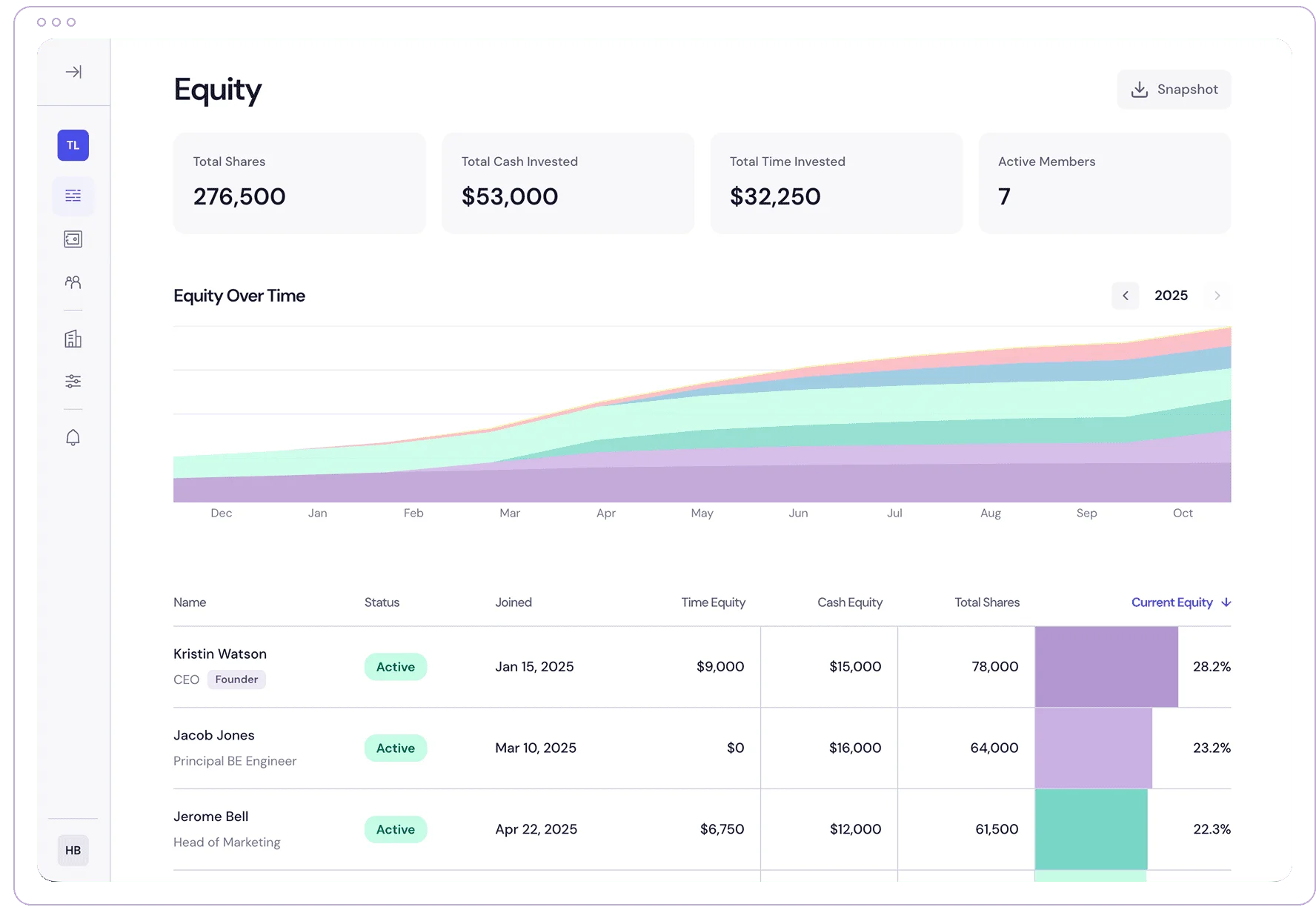
Equity Matrix tracks contributions and calculates ownership automatically.
Get Started FreeThis article is for informational purposes only and does not constitute legal, tax, or financial advice. Equity Matrix is not a law firm, accounting firm, or financial advisor. Consult a qualified professional for guidance specific to your situation.
Co-founder, Equity Matrix
Sebastian writes about startup equity, founder dynamics, and building fair partnerships.
Keep reading
The Third Ledger: what the next wave of philanthropy misses about ownership
The debate over AI-era philanthropy is a fight about what to do with wealth after it's made. There's an older question hiding underneath: who owns it while it's being built.
Read more →Share it on the way up: why we think about business differently
Chouinard reinvented what a company could be to protect Patagonia's mission. Most of us keep the old equity playbook because it's the only one we've seen.
Read more →