For most of modern history, doing good with money followed a simple sequence: build the company, make the fortune, then decide what the fortune should repair.
Carnegie built U.S. Steel, then built libraries. Rockefeller built Standard Oil, then funded medical research. Gates built Microsoft, then went to work on malaria. The pattern is so familiar it feels like the only shape philanthropy comes in. Make the money first. Give it later. The two halves live on separate ledgers, and they only meet at the end.
We’re admirers of that tradition. We’ve written about the greatest philanthropists in history, and almost every one of them built their fortune the same way: through ownership, held over decades, then given away.
But two recent essays got us thinking about the part of that sequence nobody questions — the order itself.
Two essays, one gap
Nan Ransohoff, who runs public goods work at Stripe, published a widely shared piece arguing that AI is about to make hundreds of billions in new philanthropic capital liquid, and that the systems built to turn money into lasting good haven’t caught up. Her point, roughly: an enormous new pool of capital is forming, but we’re short the vehicles, the talent, and the institutions to deploy it well.
Craig Shapiro of Collaborative Fund responded with an adjacent thought that stuck with us. What if some of the most important institutions of the next fifty years aren’t foundations at all, but companies that never separated the wealth from the good in the first place?
His framing is what he calls the two-ledger system. Industry on one ledger, impact on the other, meeting only at the end. And his argument is that the strongest mission-driven companies collapse the two: a health company should grow when people get well, a climate company should make money as emissions fall. As Craig puts it, in those cases “the social good is the unit economics.”
We think both of them are right. And we’d add one thing, from the narrow patch of ground we actually work on.
We only know one small thing
We’re not philanthropy experts. We’re not going to tell anyone how to deploy fifty billion dollars, or which foundation model is correct, or whether this money will even show up the way the napkin math says it will. Smarter people are already arguing about all of that.
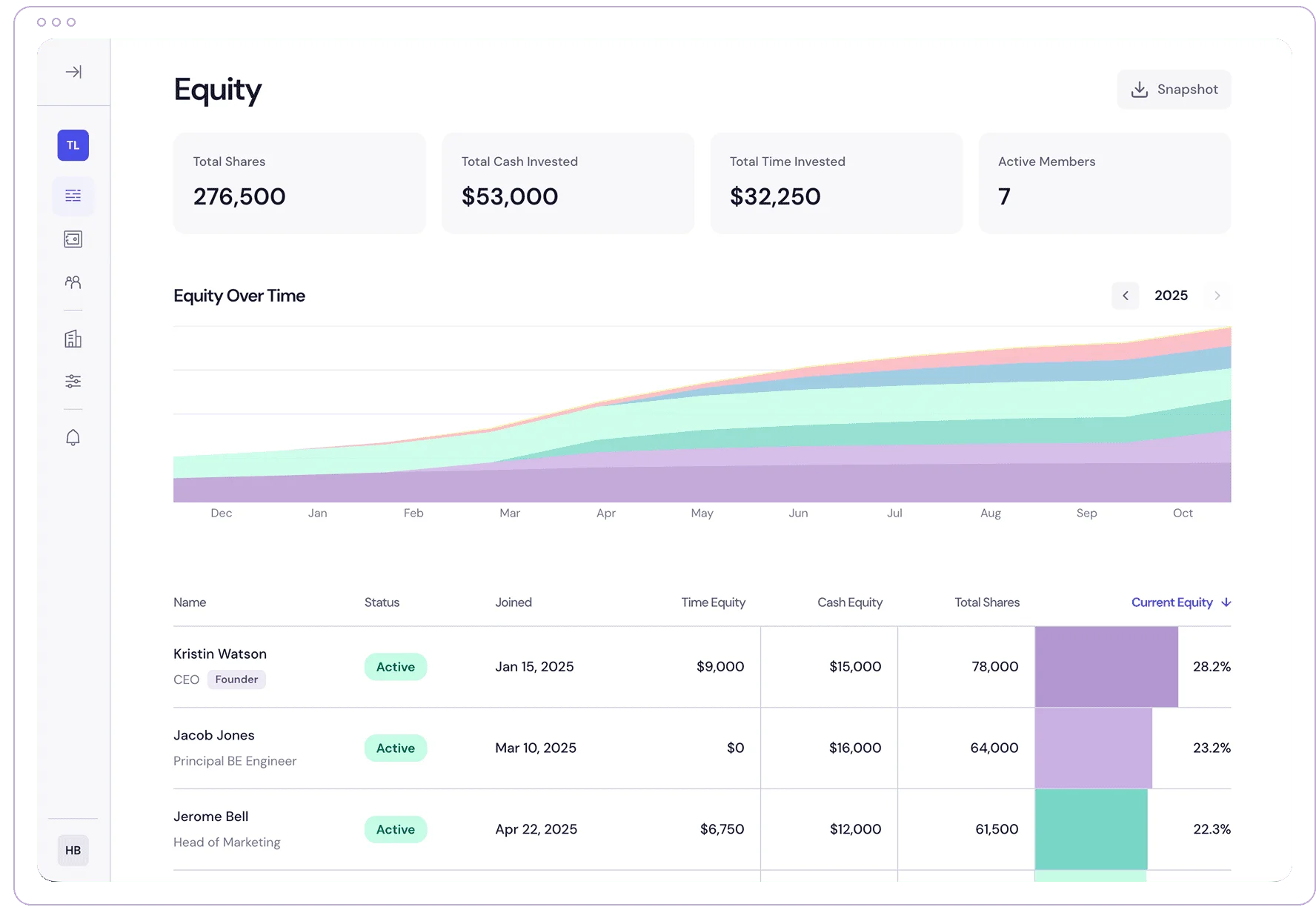
We work on one small, unglamorous problem: seeing who actually did the work. Inside a company, that means tracking the cash, the hours, and the contributions each person makes, so ownership reflects what people put in rather than what they negotiated on day one. That’s it. That’s the whole job.
But once you spend enough time on that one problem, you start to notice it everywhere. And the philanthropy debate, read a certain way, is that exact problem at planetary scale.
The argument underneath the argument
The comment section on Nan’s piece is worth reading more than the piece itself, because it’s where the real tension lives.
The sharpest response came from someone pointing out that the field isn’t empty and waiting to be built on. There are more than a million small nonprofits in this country, staffed by people who are, in his words, “over-credentialed in the only currency that matters here: having actually done the thing.” His fear was that the new money would arrive, go looking for talent, and “walk straight past the people already doing the job.”
Set aside whether he’s right about tech or foundations or any of the culture-war framings that piled up beneath it. Strip it down and his worry is about a mismatch between who creates value and who gets recognized for it. The people doing the work are hard to see, so recognition lands somewhere else.
That’s not a philanthropy problem. That’s a measurement problem. And it’s the same one that quietly wrecks cap tables.
We’ve watched it happen at the scale of a single company hundreds of times. The person who did the most gets diluted by the person who was loudest in the founding meeting. The early contributor who kept the thing alive gets a handshake instead of a stake. Dead equity piles up on one side while the people still building get nothing on the other. Every one of those stories traces back to the same root: nobody was keeping an honest ledger of who contributed what, so the ownership drifted toward whoever was best positioned to claim it — not whoever earned it.
Whether you’re splitting a startup or a fortune, the failure mode is identical. If you can’t see the contribution, you can’t reward it. And if you can’t reward it, the value flows to whoever the system was built to notice.
The third ledger
Here’s the thing about the two-ledger model. It assumes the sequence is fixed: create the wealth, then figure out how to share it. Every fight in that comment section (who allocates it, whether they have taste, whether they’ll see the people who deserve it) is a fight about what happens after the money is already concentrated in a few hands.
But there’s a third ledger, and it comes first. It’s the one that decides who owns the upside while it’s being created.
This is what we mean when we say jobs create income, but equity creates wealth. A salary is a thank-you for work already done. Ownership is a claim on everything the work becomes. The difference between the two is the difference between a good decade and a different life. And the moment you decide who holds ownership isn’t at the exit, or the foundation, or the grant committee. It’s at the beginning, in the cap table, in who earns a stake as they build the thing.
If a company’s growth is supposed to make the world better, the most durable way to guarantee it isn’t a pledge to give later. It’s making sure the people who build the good actually own a piece of it. Then you don’t have to hope the wealth finds its way back to the right people. It was never routed away from them.
We saw a small version of this argument in the philanthropists we admire most. Jamsetji Tata, the largest philanthropist in history adjusted for inflation, didn’t wait until he was done building to start giving. He treated it as part of the mission, not a chapter that came after. He was, quietly, running the third ledger a century before anyone named it.
None of this replaces the check. Some of the most important work in the world will always depend on gifts, public funding, and the people staffing those million small organizations who never had ownership of anything and gave anyway. That work matters, and this isn’t a clever argument for doing less of it.
It’s just a reminder that the check is not the only vehicle — and that it isn’t even the first one. Before you decide what to repair with a fortune, someone decided who would own it. That decision is a moral act too. We just don’t usually treat it like one.
Where this leaves us
We started as a company obsessed with a boring question: how do you make an equity split reflect what people actually contribute, instead of what they guessed at over coffee before anyone had done anything?
The more we sit with the philanthropy debate, the more it looks like the same question wearing a much larger coat. The next wave of givers can build new foundations, new vehicles, new institutions — and they should. But the most interesting move might be the one that happens before any of that: refusing to separate the wealth from the good in the first place, and keeping an honest ledger of who built it, so ownership lands where the work did.
That’s not a philanthropy strategy. It’s just what real economic equity looks like — the kind that includes ownership, not just income. And it’s available to any company, at any scale, starting on day one.
The fortunes will get made. The only question that’s ever really up for grabs is who owns them on the way up.
Ready to split equity fairly?
Equity Matrix tracks contributions and calculates ownership automatically.
Get Started FreeThis article is for informational purposes only and does not constitute legal, tax, or financial advice. Equity Matrix is not a law firm, accounting firm, or financial advisor. Consult a qualified professional for guidance specific to your situation.
Co-founder, Equity Matrix
Sebastian writes about startup equity, founder dynamics, and building fair partnerships.
Keep reading
A better model for wealth distribution: share it on the way up
Taxes claw wealth back. Philanthropy begs it back. Our thesis on inequality — share ownership before the fortunes ever pool.
Read more →Share it on the way up: why we think about business differently
Chouinard reinvented what a company could be to protect Patagonia's mission. Most of us keep the old equity playbook because it's the only one we've seen.
Read more →