A CTO who joins as a co-founder before there’s a product usually gets 20% to 50%. A CTO hired after the company has traction, revenue, or funding usually gets 1% to 5%. The single biggest factor is when they showed up and how much risk they took to be there.
Someone technical is about to join your company, and they’re going to run engineering. Maybe they’re the person who can finally build the thing you’ve been describing in Figma for six months. Maybe they’re a seasoned VP you’re recruiting away from a comfortable job.
The word “CTO” covers both of those people. That’s why the equity question is so slippery.
A co-founding CTO and a hired-gun CTO are doing the same job title with completely different risk profiles. Treating them the same is how founders end up either giving away half the company for a salaried role, or lowballing the one person who could have built it with them.
Here’s how I think about landing on the right number.
First, figure out which CTO you’re actually talking about
The title tells you almost nothing. The timing tells you almost everything.
| Type | When they join | Typical equity | What they’re really being paid for |
|---|---|---|---|
| Co-founding CTO | Pre-product, pre-revenue | 20-50% | Betting their time when the company might be worth zero |
| Founding engineer | Early, but you exist | 1-5% | Building the first real version, still early risk |
| Hired CTO / VP Eng | Post-traction or post-funding | 0.5-2% | Running and scaling a team that already exists |
The gap between the top row and the bottom row is enormous, and it isn’t about skill. A brilliant engineer who joins after your Series A gets a fraction of what a mediocre one might have gotten as a day-one co-founder.
That feels unfair until you remember what equity actually pays for. It compensates people for the risk of working on something that might be worth nothing. The earlier and riskier the moment, the more equity that moment is worth.
Equity is the price you pay for someone believing in the company before the evidence does.
The co-founding CTO: usually not 50/50, and usually not tiny
If your technical partner is a true co-founder, joining before there’s a working product, they’re in the range where equity gets measured in tens of percent, not fractions of one.
I’ve seen the whole spectrum here, and where a co-founding CTO lands depends on what each of you brings.
A few things that tend to push a co-founding CTO’s number up:
- They joined first, or at the same time as you, when the company was just an idea.
- They’re building the product themselves, not hiring someone else to.
- You can’t do their job, and they could plausibly find another founder to do yours.
- They’re taking little or no salary during the risky early stretch.
And a few that push it down:
- You had the idea, the early customers, or the capital already in motion.
- They’re joining a company that already has revenue or a signed term sheet.
- They want a market salary from day one, offloading the financial risk onto the business.
The instinct for a lot of founders is to reach for 50/50. It feels fair, it avoids an awkward conversation, and it signals trust. I understand the appeal, and sometimes it’s genuinely right.
But 50/50 based on “it felt fair to split it down the middle” is different from 50/50 based on “we both looked hard at what each of us is contributing and landed there.” One is a decision. The other is an avoided one. I’ve written before about why investors get nervous about 50/50 splits, and it’s less about the number and more about what it reveals.
The deeper issue: any fixed number you agree on today is a bet on the future. You’re guessing what each person will contribute over the next several years, and then locking that guess into the cap table. People guess wrong all the time.
The founding engineer: 1% to 5%, and it drops fast
If you already have a company, some traction, and maybe a little funding, the person running your engineering is closer to a founding engineer than a co-founder, even if their business card says CTO.
Rough benchmarks here, drawing on Carta’s employee equity data and Y Combinator’s guidance:
| Stage when they join | Typical CTO / lead engineer grant |
|---|---|
| Pre-seed, pre-revenue | 5-15% (shading into co-founder territory) |
| Seed, some traction | 1-5% |
| Series A | 0.5-2% |
| Series B and beyond | 0.25-1% |
The number falls off a cliff as the company de-risks, and that’s the whole point. Every month you survive, every dollar of revenue, every round you raise makes the equity worth more and the risk lower. The person joining later takes less risk, so they get less of the upside.
This is also where vesting stops being optional. A standard four-year schedule with a one-year cliff protects everyone: the company doesn’t hand out ownership to someone who leaves in month three, and the engineer earns their stake steadily for showing up and building. If this person walks away early without vesting, you’re left holding dead equity that does nothing but clutter your cap table.
What equity should your first SaaS hire get?
The hired CTO: you’re buying a manager, not a bet
Sometimes “CTO” means an experienced executive you’re recruiting to run an engineering org that already exists. They want a real salary. They’re not risking much financially. They’re a senior hire with a fancy title.
For this person, equity looks like a strong executive package: often 0.5% to 2%, vesting over four years, sometimes with a portion tied to hitting real milestones. They’re valuable, but they’re being paid mostly in cash, and their equity reflects that they joined once the hard, uncertain part was already behind you.
The mistake I see is founders anchoring on the co-founder number for this hire. Someone great is willing to run your 30-person engineering team, and because the word “CTO” is involved, the founder starts thinking in the 10-20% range. That’s confusing a job with a bet. A hired executive is doing a job. A co-founder made a bet.
A worked example
Say you’re a non-technical founder. You’ve spent nine months validating an idea, you have a waitlist of 400 people, and you’ve put $30,000 of your own money into design and early marketing. Now you find an engineer who can build it.
They’re strong. They’re excited. They want to be a co-founder.
Here’s the read:
- You took real risk first. Nine months, $30k, a validated idea. That’s not nothing.
- But you have no product, and you can’t build one. Without them, the waitlist is just a spreadsheet.
- They’re joining early, before revenue, and they’ll build the whole thing.
A 50/50 split undervalues the risk and work you’ve already put in. A 90/10 split insults the person who’s about to build your entire company and take the leap with you. Somewhere in the 30-45% range for the CTO is probably closer to fair, depending on whether they take a salary and how much of the vision is genuinely theirs versus yours.
Whatever number you pick is a guess about the future
That 30-45% is a bet. You’re predicting, on day one, how much this person will contribute over the next four years, then carving the guess into a fixed percentage and hoping it holds.
It usually doesn’t. The co-founder who was going to build everything gets pulled into fundraising and stops writing code. The engineer you gave 1% turns out to be the reason the product works at all. Contributions drift, but the fixed split doesn’t move.
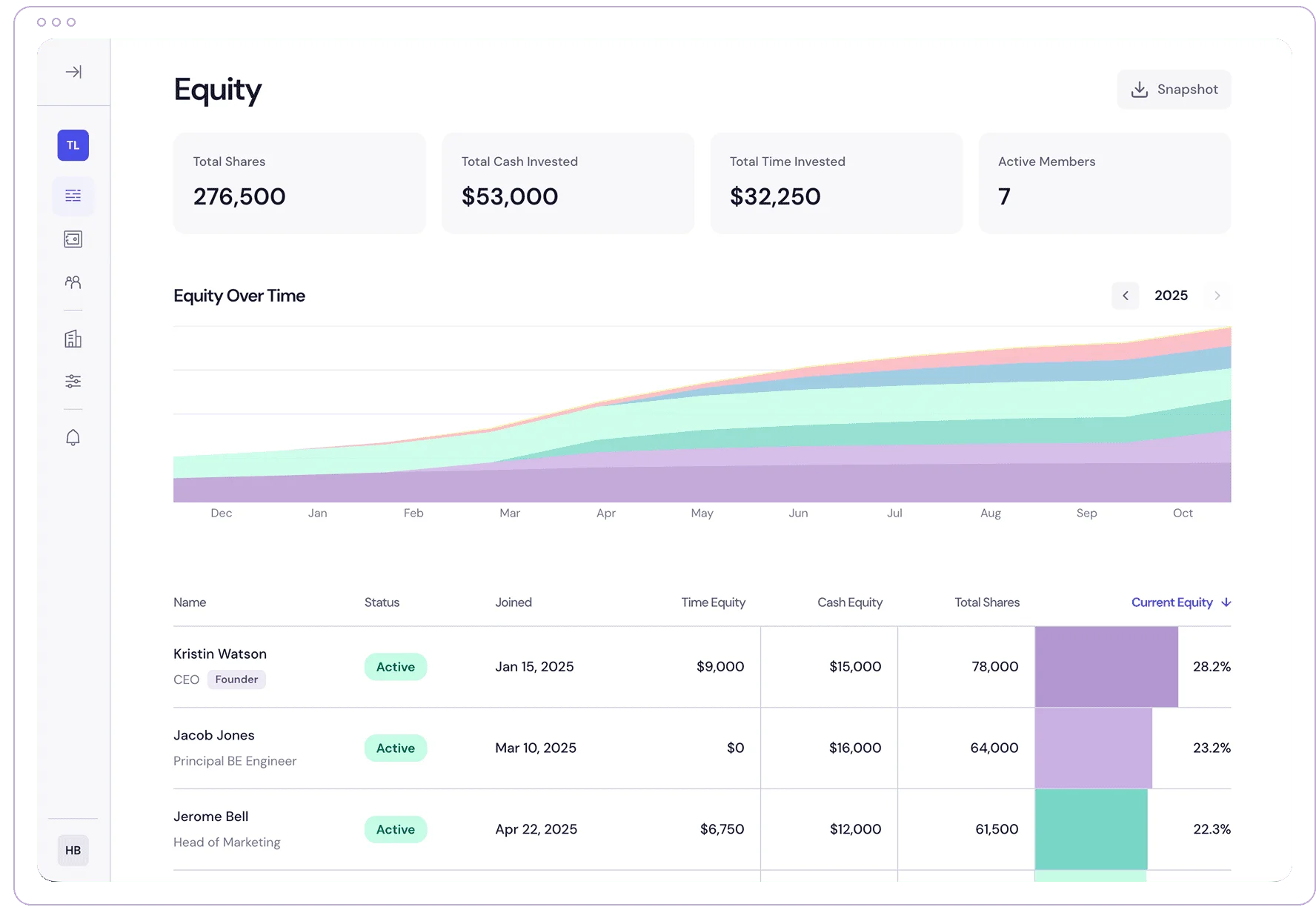
This is why I keep coming back to dynamic equity. Instead of guessing the split up front, you track what each person actually contributes over time, and ownership follows the work. The CTO who builds the whole product earns a stake that reflects that. The one who drifts away earns the stake they actually earned, and no more.
You still need a number to talk about. But dynamic equity turns that number into something reality can correct, instead of a guess you’re stuck with for four years.
Model your co-founder split before you commit.
See how a CTO's stake changes based on timing, salary, and contribution, instead of guessing.
Try the equity calculator →Frequently asked questions
Should a co-founding CTO get 50%?
Sometimes, but not by default. 50/50 makes sense when two people join at the same time, take similar risk, and contribute comparably. If one person had the idea, the early traction, or the capital already moving, a straight 50/50 undervalues that. The better question isn’t “should it be 50/50” but “does the split reflect what each of us is actually bringing.” For more on this, see why investors dislike 50/50 splits.
How much equity does a CTO get at a funded startup?
Usually far less than a co-founding CTO. At seed stage, a CTO joining after some traction typically lands around 1-5%. By Series A, it’s often 0.5-2%. The equity drops as the company de-risks, because the person is taking on less risk by joining later.
What’s the difference between a co-founder CTO and a hired CTO?
Timing and risk. A co-founder CTO joins before there’s a product and bets their time on a company that might be worth nothing. A hired CTO joins an existing company, usually takes a market salary, and runs an engineering team that already exists. One is making a bet; the other is doing a job. Their equity should reflect that difference.
Should CTO equity vest?
Yes, always. A standard four-year schedule with a one-year cliff protects both sides. It makes sure ownership is earned over time rather than handed out on day one, and it prevents dead equity if the person leaves early. This matters just as much for a co-founding CTO as for a later hire.
What if I’m not sure how much my technical co-founder will contribute?
That uncertainty is exactly why fixed splits are risky. If you can’t confidently predict four years of contribution, don’t lock a guess into your cap table. Dynamic equity lets ownership follow actual work, so the split corrects itself as reality unfolds instead of staying frozen to a day-one guess.
Trying to land on a fair number for your technical co-founder? Our equity calculator helps you model the split based on timing, salary, and contribution, so you’re making a decision instead of a guess.
Ready to split equity fairly?
Equity Matrix tracks contributions and calculates ownership automatically.
Get Started FreeThis article is for informational purposes only and does not constitute legal, tax, or financial advice. Equity Matrix is not a law firm, accounting firm, or financial advisor. Consult a qualified professional for guidance specific to your situation.

Co-founder, Equity Matrix
Sebastian writes about startup equity, founder dynamics, and building fair partnerships.
Keep reading
Co-founders in different countries: how to set a fair rate
When one co-founder is in the US and another is in Lithuania, do you value their time at local rates or the same rate for the same work? How to set GHRR fairly across borders.
Read more →How to track co-founder contributions (before it costs you)
A practical system for tracking co-founder contributions: what to log, how often, the fields that matter, and where spreadsheets start to strain.
Read more →