Buying out a business partner is one of the most consequential financial decisions you’ll make as a business owner. Get it right, and you gain full control of a business you’ve helped build. Get it wrong, and you overpay for something you already half-own, or worse, end up in court.
Most buyouts happen for predictable reasons. One partner wants out. One partner isn’t contributing anymore. The partners disagree on the direction of the business. Or life just moves on and the partnership has run its course.
Whatever the reason, the process is the same: figure out what the business is worth, agree on a price, structure the deal, and make it legal. Simple in theory. Messy in practice.
Here’s how to do it without destroying the business or the relationship.
Before you start: check your operating agreement
If you have a partnership agreement or operating agreement, read it before you do anything else. Many agreements include buy-sell provisions that dictate exactly how a buyout should work: valuation method, right of first refusal, payment terms, notice requirements.
If your agreement has a buy-sell clause, you may not have much room to negotiate the process. The terms are already set. That’s actually a good thing. Pre-agreed terms remove emotion from the equation.
If you don’t have a written agreement, you’re operating under your state’s default partnership or LLC rules. Those defaults rarely address buyouts in any useful detail. You’ll need to negotiate everything from scratch, which is why this gets expensive.
Step 1: Value the business
This is where most buyouts stall. Both partners think the business is worth a different number, and neither wants to leave money on the table.
There are three standard approaches to business valuation, and a professional appraiser will typically use more than one.
Income approach
Values the business based on its ability to generate future earnings. The two most common methods:
- Capitalization of earnings: Takes the business’s normalized earnings and divides by a capitalization rate (which reflects risk). Best for stable, established businesses.
- Discounted cash flow (DCF): Projects future cash flows and discounts them back to present value. Better for growing businesses where past earnings don’t reflect future potential.
For most small businesses doing under $5M in revenue, the capitalization of earnings method is more practical. DCF requires assumptions about growth rates that are hard to justify for a two-person operation.
Market approach
Compares your business to similar businesses that have recently sold. This uses revenue or EBITDA multiples from comparable transactions.
| Business type | Typical multiple (SDE) |
|---|---|
| Service businesses | 1.0-2.5x |
| Retail / e-commerce | 1.5-3.0x |
| SaaS / recurring revenue | 3.0-6.0x (often valued on ARR multiples instead) |
| Restaurants / food service | 1.0-2.0x |
| Professional practices | 1.5-3.5x |
SDE stands for Seller’s Discretionary Earnings: net profit plus the owner’s salary, benefits, and any personal expenses run through the business. It represents the total financial benefit of owning the business.
Asset-based approach
Adds up the value of everything the business owns (equipment, inventory, real estate, intellectual property, accounts receivable) and subtracts what it owes. This is most relevant for asset-heavy businesses or companies being wound down.
For most operating businesses, the asset-based approach produces the lowest valuation because it ignores earning power. But it sets a useful floor: the business is worth at least its net assets.
The valuation method matters less than both partners agreeing on which method to use before the numbers come in.
Should you hire an appraiser?
Almost always, yes. A certified business appraiser provides an independent, defensible valuation that neither partner can dismiss as biased. Expect to pay $3,000-$10,000 depending on the complexity of the business.
Two approaches work:
- Single appraiser: Both partners agree on one appraiser. Cheaper, faster, but requires trust.
- Dueling appraisals: Each partner hires their own appraiser, then the two of you negotiate between the numbers (or hire a third to break the tie). More expensive, but useful when trust is low.
If your operating agreement specifies a valuation formula, that formula controls. Common formulas include multiples of trailing twelve-month revenue, book value, or a pre-agreed fixed price updated annually.
Step 2: Understand what you’re actually buying
The headline number isn’t the whole picture. Before you agree to a price, understand what’s included and what’s not.
What’s typically included:
- The departing partner’s ownership percentage (membership units, shares, or partnership interest)
- Their share of retained earnings and capital accounts
- Their claim on business assets
What’s often negotiated separately:
- Real estate owned by the partner but leased to the business
- Personal guarantees on business loans (the exiting partner will want to be released)
- Non-compete agreements (you don’t want them opening a competing business next door)
- Client relationships and transition assistance
- Intellectual property created by the departing partner
Discounts that may apply:
A 50% stake in a private business isn’t necessarily worth 50% of the total business value. Two discounts are common in professional valuations:
- Lack of marketability discount (10-25%): A private business interest can’t be sold on the open market like public stock.
- Minority interest discount (15-35%): If the departing partner owns less than 50%, their stake has less control value.
Whether these discounts apply depends on your agreement, the specifics of the transaction, and negotiating leverage. In a friendly buyout between equal partners, discounts are often waived. In a contentious one, they become bargaining chips.
Step 3: Negotiate the deal
Valuation gives you a starting point. Negotiation determines the actual price and terms.
Price vs. terms
Most buyout negotiations obsess over price. But the terms often matter more. A $500,000 buyout paid over five years at 0% interest is a very different deal than $500,000 due at closing. The total price is the same, but the real cost is different.
Key terms to negotiate:
- Payment structure: Lump sum, installments, or a combination
- Timeline: How long before the departing partner is fully paid out
- Interest rate: On any installment payments
- Security: What happens if the remaining partner can’t make payments
- Transition period: How long the departing partner stays involved
- Non-compete: Scope, duration, and geographic limits
- Representations and warranties: What each party guarantees about the business
The seller-financed buyout
Most small business partner buyouts are seller-financed, meaning the departing partner agrees to be paid over time rather than receiving cash at closing. This is often the only realistic option because the remaining partner doesn’t have the cash and can’t get a bank loan large enough.
A typical structure:
- 10-30% down payment at closing
- Remaining balance paid monthly over 3-7 years
- Interest rate of 4-8% (negotiate this)
- The business assets or the acquired membership units serve as collateral for the note
This gives the remaining partner time to use business cash flow to fund the buyout. It also gives the departing partner ongoing income and an incentive to make the transition smooth.
SBA loans for buyouts
The SBA 7(a) loan program can finance partner buyouts. These loans offer lower interest rates and longer repayment terms than conventional business loans. Requirements include a formal business valuation, a detailed buyout agreement, and the ability to demonstrate that the business can service the debt.
Not every buyout qualifies, but it’s worth exploring if you’d prefer to pay the departing partner in full at closing rather than carrying a multi-year note.
Step 4: Handle the tax implications
Partner buyouts have significant tax consequences for both sides. Get a tax advisor involved before you agree on terms, not after.
For the departing partner
The tax treatment depends on whether the buyout is structured as a sale of interest or a liquidating distribution.
Sale of interest: The departing partner sells their stake to the remaining partner. They pay capital gains tax on the difference between the sale price and their tax basis (usually their original investment plus allocated profits minus distributions). Long-term capital gains rates apply if they’ve held the interest for more than a year.
One important wrinkle: if the business has unrealized receivables or inventory (what the IRS calls “hot assets” under Section 751), a portion of the gain is recharacterized as ordinary income, not capital gains. This is common in service businesses where accounts receivable are a significant asset. The departing partner’s tax bill can be meaningfully higher than a simple capital gains calculation would suggest.
Liquidating distribution: The partnership itself redeems the departing partner’s interest. Section 736(b) generally treats payments for the partner’s interest in partnership property as distribution payments, while Section 736(a) covers other qualifying payments. Goodwill is not generically ordinary income: for the special Section 736 rule applicable when capital is not a material income-producing factor and the departing partner was a general partner, an agreement that provides for goodwill supports Section 736(b) treatment; if the agreement is silent, the goodwill payment falls under Section 736(a). Section 751 hot assets, including unrealized receivables, produce ordinary-income treatment.
For the remaining partner
The basis adjustment depends on the deal form. In a direct sale of the interest, a Section 754 election permits a Section 743(b) adjustment for the buyer. In a partnership redemption, the election permits a Section 734(b) adjustment to partnership property for the benefit of the remaining partners. Those benefits should not be attributed to whichever person happened to fund the payment. In certain large built-in-loss or basis-reduction cases the adjustment is mandatory. Have the partnership’s CPA model both structures before terms are fixed.
The entity type matters. Buyouts in an LLC taxed as a partnership follow the rules above. S-corp buyouts have different mechanics (stock purchase vs. asset purchase, with different tax consequences for each). C-corp buyouts face the risk of double taxation and are generally the most tax-inefficient structure for small businesses.
This is general information, not legal or tax advice. Never finalize a partner buyout without independent transaction counsel and a CPA or tax attorney. Deal form, goodwill language, hot assets, and basis elections can materially change each party’s result.
Step 5: Make it legal
Once the price, terms, and tax structure are settled, it’s time to paper the deal. This is not the place to cut corners.
Documents you’ll need
- Buyout agreement (or membership interest purchase agreement): The core document. Covers price, payment terms, representations, warranties, indemnification, and closing conditions.
- Amended operating agreement: Reflects the new ownership structure after the buyout is complete.
- Promissory note: If the buyout is seller-financed, this documents the loan terms.
- Security agreement: Gives the departing partner a security interest in the business assets or membership units until they’re fully paid.
- Restrictive-covenant and protection documents: Depending on state law, these may include enforceable confidentiality, trade-secret, non-solicitation, transition, or narrowly tailored non-compete provisions.
- Release of claims: Both partners release each other from future claims related to the business.
- Personal guarantee releases: If the departing partner personally guaranteed any business debts, those guarantees need to be addressed (lenders don’t automatically release guarantors).
Lawyer costs
Expect to spend $5,000-$15,000 on legal fees for a straightforward buyout. If the deal is contentious, contested, or involves complex assets, costs can reach $25,000-$50,000. Both partners should have independent legal counsel. One attorney cannot represent both sides.
Step 6: Execute the transition
The paperwork is signed. Now you have to actually run the business without your partner.
Client communication
Clients need to know. Keep it simple and professional. “Alex has decided to pursue other opportunities, and I’m continuing to run the business. Nothing changes for you.” Don’t badmouth. Don’t over-explain. Just reassure.
Vendor and contractor updates
Update banking authorizations, signatory rights, and any contracts that reference both partners. Remove the departing partner from business accounts, credit cards, and any platforms they have access to.
Employee communication
If you have employees, tell them directly. Not through rumor. Explain what’s changing (ownership structure) and what isn’t (their jobs, their pay, the business). If the departing partner had relationships with specific employees, expect some uncertainty. Address it head-on.
Financial housekeeping
- Update your business insurance
- File the amended operating agreement with the state (if required)
- Update tax registrations
- Notify your bank and update loan documents
- Update any licenses or permits that reference both partners
How to protect yourself before you ever need a buyout
If you’re reading this before the partnership has fractured, here are the structures that make future buyouts clean instead of catastrophic.
Include buy-sell provisions from day one
Your operating agreement should answer: What triggers a buyout? How is the business valued? What are the payment terms? What happens if one partner dies or becomes disabled? Answering these questions when the relationship is good is infinitely easier than answering them when it’s bad.
Track contributions continuously
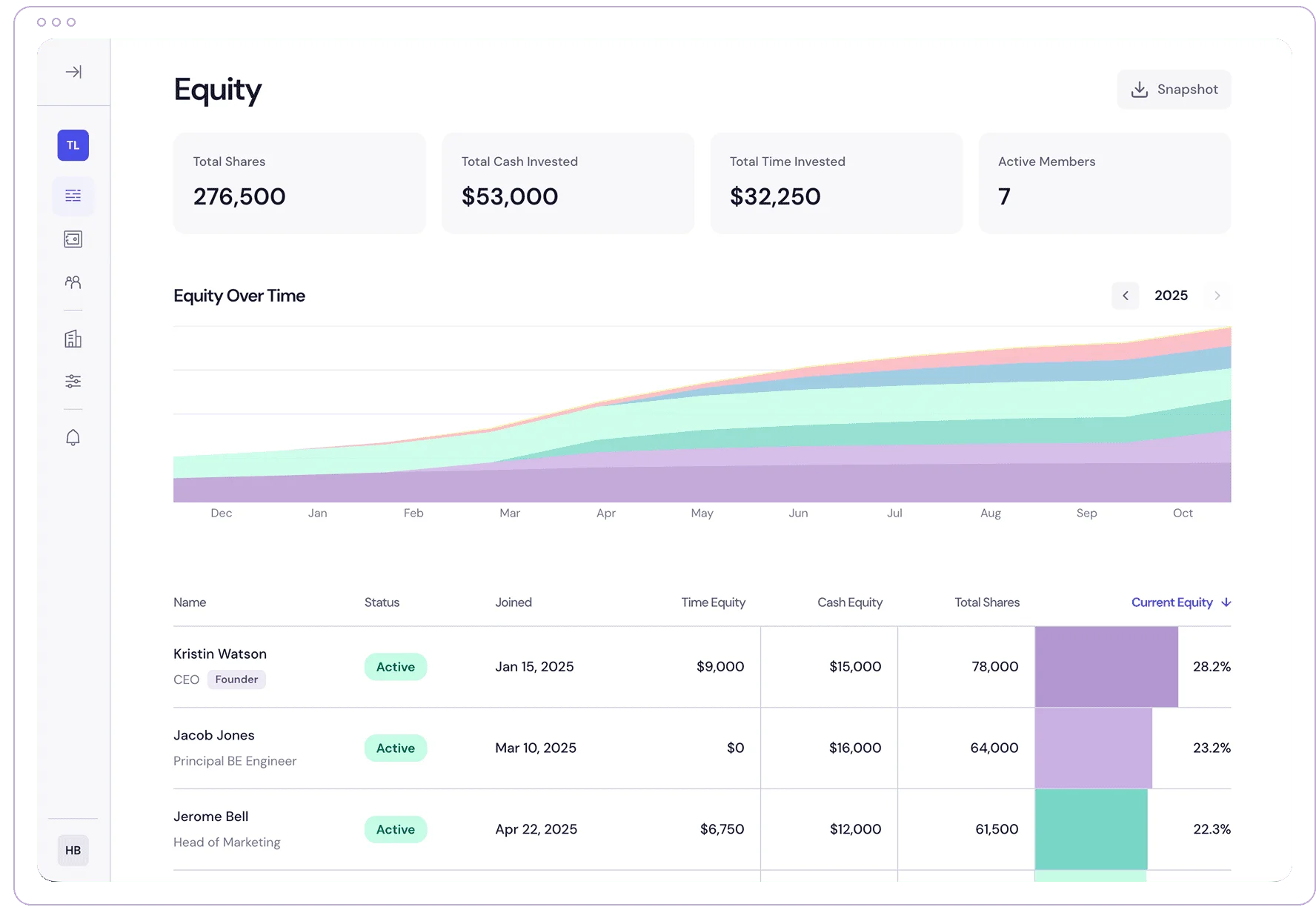
If ownership ever needs to change, having a record of who contributed what makes the conversation factual rather than emotional. Dynamic equity models that track contributions in real time eliminate the guesswork. Tools like Equity Matrix log hours, cash, clients, and skills automatically so ownership always reflects reality.
Use vesting schedules
Vesting isn’t just for startups. Small business partners can vest into ownership over 3-4 years. If someone leaves early, they don’t walk away with the same stake as someone who stayed.
Do annual valuations
Update the business valuation (or at least the agreed-upon formula) annually. This prevents sticker shock when a buyout becomes necessary. If both partners sign off on a $500,000 valuation in January and a buyout happens in March, the negotiation starts from a shared number, not a fight.
The real cost of a bad buyout
A clean buyout typically costs $10,000-$30,000 in legal and valuation fees and takes 60-90 days. A contested one can cost $50,000-$150,000 in legal fees alone, take a year or more, and damage the business in the process. Clients leave, employees get nervous, and revenue drops while the partners are fighting instead of working.
The cheapest buyout is the one you planned for. Buy-sell agreements, clear valuation methods, and contribution tracking don’t just prevent disputes. They make buyouts faster, cheaper, and less painful when they do happen.
Frequently asked questions
How long does a business partner buyout take?
A straightforward buyout where both partners agree on terms typically takes 60-90 days from initial discussion to closing. That includes time for valuation, negotiation, legal documentation, and any lender requirements. Contested buyouts can take 6-18 months, especially if the valuation is disputed or litigation is involved.
Can I force my business partner to sell their share?
Generally, no. You can’t force a partner to sell unless the governing agreement or applicable law provides a remedy. Depending on the entity, agreement, facts, and state law, possible paths can include negotiation, mediation or arbitration, contractual buy-sell enforcement, claims for breach of duty or other relief, judicial expulsion, receivership, or dissolution. Non-competes are heavily restricted or prohibited in many states, so do not assume one will solve the problem; have local counsel assess enforceable confidentiality, trade-secret, non-solicitation, and transition protections.
What happens if we can’t agree on a valuation?
If direct negotiation fails, options include hiring independent appraisers (each partner hires their own, then negotiate between the two numbers), using a “baseball arbitration” approach (each partner submits a sealed number and the arbitrator picks one), or mediation. If all else fails, either partner can petition the court for a judicial dissolution, at which point the court determines the value. This is the most expensive path.
Do I need a lawyer for a partner buyout?
Yes. Both partners should have independent legal representation. The buying partner’s attorney drafts the buyout documents. The selling partner’s attorney reviews them. A single attorney cannot ethically represent both sides because their interests are opposed. Trying to save money by sharing counsel or using templates often creates more expensive problems down the road.
A buyout doesn’t have to end badly. With the right preparation, fair valuation, and clear terms, it can be the beginning of the next chapter for both partners. Start by understanding what your business is actually worth, then use the equity calculator to model how ownership should be structured going forward.
Ready to split equity fairly?
Equity Matrix tracks contributions and calculates ownership automatically.
Get Started FreeThis article is for informational purposes only and does not constitute legal, tax, or financial advice. Equity Matrix is not a law firm, accounting firm, or financial advisor. Consult a qualified professional for guidance specific to your situation.

Co-founder, Equity Matrix
Sebastian writes about startup equity, founder dynamics, and building fair partnerships.
Keep reading
How to fire a co-founder (and what happens to their equity)
Firing a co-founder is legally and emotionally brutal, and the equity is the part that haunts you. Here's how to do it right, what vesting and cliffs actually protect, and how to avoid leaving a dead stake on your cap table.
Read more →My business partner isn't pulling their weight
When one partner does all the work while the other collects half the profits, resentment builds fast. Here's how to address it before the partnership implodes.
Read more →